Great traders have these 10 similarities:
1. They love the game
2. They did their homework
3. Risk management
4. Discipline
5. Always learning
6. Specialization
7. Faith in their edge
8. Faith in their self to follow it
9. Consistency
10. Perseverance
Recently, I read Charlie Munger’s autobiography, known as “Damn Right”. For those of you who don’t know Charlie Munger, just think of him as the guy who changed Warren Buffett's investment philosophy from looking at cigar buts to quality businesses (He is the current ViceChairman
“The chains of habit are too light to be felt until they’re too heavy to be broken.”
“At my age I can’t change any of my habits, I’m stuck. So you look at the habits you admire in others and make those your own habits.”
“Ben Franklin used to it few hundred years ago and it still works today.”
- Warren Buffett. 1998
I was always looking for stocks hovering near the highs
In April - when indices were breathing from the lows - strong stocks stayed near the highs and as soon as they broke out - I bought a few
Examples of strength were - Qpower, Atlanta Electricals, KSH International, MTAR, StlTech and more
They clearly signaled power is a theme and it performed beautifully post that
EVERGREEN ADVICE:
Trade with a plan always. If you don’t have rules or structure around your trading then you will always stay confused which will lead to wrong decisions, and ultimately loss of money.
Never ask others what to do. Study in depth, create a process which includes everything from stock selection to exit.
Always lay emphasis on situational awareness. Understanding what is happening in the broader market can help you make better decisions regarding what you should be doing. Study how many stocks are continuously going up in this market, and for the exceptions which are moving alright, find how much they go up on average before squatting all the way back.
My study says that things are not working according to my strategy. Odds are not favourable as breakouts are not working well. Hence I am not trading.
Traders have different mindsets, risk appetite, styles etc. So there is no specific answer to your question. Multiple approaches can be right but won’t necessarily produce the outcome you expect/want. I don’t know what will suit you.
Everybody is capable of finding answers on their own, no need to be dependent on others. Do the study, trust no one but yourself.
Sharing all my Custom Scans below.
Bookmark this tweet for future reference. 📌
These scans cover some of my favourite filtration frameworks
• Businesses Turning Around
https://t.co/B4Ph7LQXxm
• Margin Expansion Stories
https://t.co/m9mlKS2hA0
• Relative Strength (R.S.) leaders
https://t.co/LO0tS6QeYH
• Consistent NPM expansion
https://t.co/l4dU7q62Ig
• Earnings breakout candidates
https://t.co/O8AsPNGCGH
• Businesses Making ATH
https://t.co/p6X9xZ2meo
• Pat Consistency last 4 Qtrs
https://t.co/BOMZQLQGQG
If you know how to read them properly, these scans can literally change the way you discover stocks during result season.
Disc: Not a Buy/Sell Recomm.
We rallied for 6-7 days.
Just noted down which ones rallied 2X more than the market in the same period. Basically, the ones that led the rally. Stayed focused only on those names in the last 3 months.
A few months back at , we studied a unique auto ancillaries that has been consistently able to outperform the auto growth.
A business whose business model who thrives on the concept that, "Its much easier and cheaper for the OEMs to make the cars look innovative that them to be actually innovative"
SJS Enterprises is a quiet beneficiary of this shift sitting at the intersection of Good Products, Deep Pocket Penetration, and Rising Aesthetics.
If cars are turning into lifestyle statements, SJS is the ideal proxy to this :
> from decals, overlays & chrome plating → to 3D lux parts & hydrographics
> from low-ASP commoditised trims → to high-margin premium surfaces
This is a sustainable long term trend and just an one-off fad led by premiumisation - global & domestic.
Consumers want aspirational interiors & Deep pocket penetration - once inside an OEM platform, SJS expands wallet share model-by-model and by increasing ticket size and launching more products with similar synergies
This is not just a story but a reality which the company has been able to show even into the numbers by outperforming the Industry for 23 consecutive quarters.
Disclaimer - not a recommendation to buy/sell
https://t.co/TMWg0BpPnC
Stalwart Advisors came out with an amazing memo discussing~
- Scuttlebutt by focusing on data Vs anecdotal evidence unless👇
- Small impact of exports on India(domestic~ 80%)
- Vadilal Industries (promoter's dispute settlement+possible rerating post listing of HUL's ice-cream biz
Soon you will realize that 20% of stocks generate 80% of your profits.
Once that clicks, you stop chasing every breakout, stop forcing trades & wait only for A+ setups.
My stats (YTD):
-Total Trades: 50
-Winners: 33
-Losers: 17
-Win Rate: 66%
-Profit Factor: 3.1
-Longest Winning Streak: 12
-Longest Losing Streak: 3
The surprising part:
>Just 10 winning trades (30% of my winners) generated 68.3% of my gross profits.
>Just 4 stocks generated roughly 74% of my total net P&L:
-SATIN
-BLISSGVS
-HINDCOPPER
-CUPID
What's even more interesting is that BLISSGVS and CUPID were repeat winners. I traded both multiple times and made money each time.
The lesson?
You don't need to find hundreds of winning stocks.
Find a handful of true market leaders, trade them exceptionally well & have the patience to wait for them to set up again.
Good traders are innovators. They find better ways to do things. They are creative. They view the same setup or market situation differently and design strategies to extract profit.
Creativity is required to reduce drawdowns or to judiciously use margin to enhance returns. Creativity is also involved in designing entry or exit strategies. If you study successful traders, they have innovated in these areas. They do not follow the most commonly discussed techniques, indicators, or setups the way the vast majority do mindlessly.
There is too much talk in trading communities about discipline and psychology, but not enough focus on creativity.
If you are not creative and innovative as a trader, it is unlikely you will last much longer, even if you focus a lot on discipline or psychology.
Good traders look for good ideas. They are constantly innovating on setups, entry, exit, risk, and other parameters. They always have new and fresh ideas. They hunt for new ideas and try to incorporate them in their trading.
If you want to improve your trading, start generating and collecting new ideas. Fresh ideas will give you a fresh perspective and fresh ways to make money.
This is why every day I start my day with these tools
YTD WIn Rate 24.8%, (Lowest in my 15 years)
YTD Performance: +49% realized (+54.5% unrealized)
Over a month ago, I posted a poll asking whether, with a win rate below 40%, it would be more effective and lead to greater improvement to focus on adjusting your winning trades or your losing trades. The results leaned toward losing trades, and I agree—if you've accepted that your strategy has a win rate under 40%, the priority should be addressing your losing trades. I have one of my lowest annual (YTD) win rate % in my 15 years but I definitely felt I have improved so much more significantly. You can't control the outcome, but you can control your sizing, your risk, your loss.
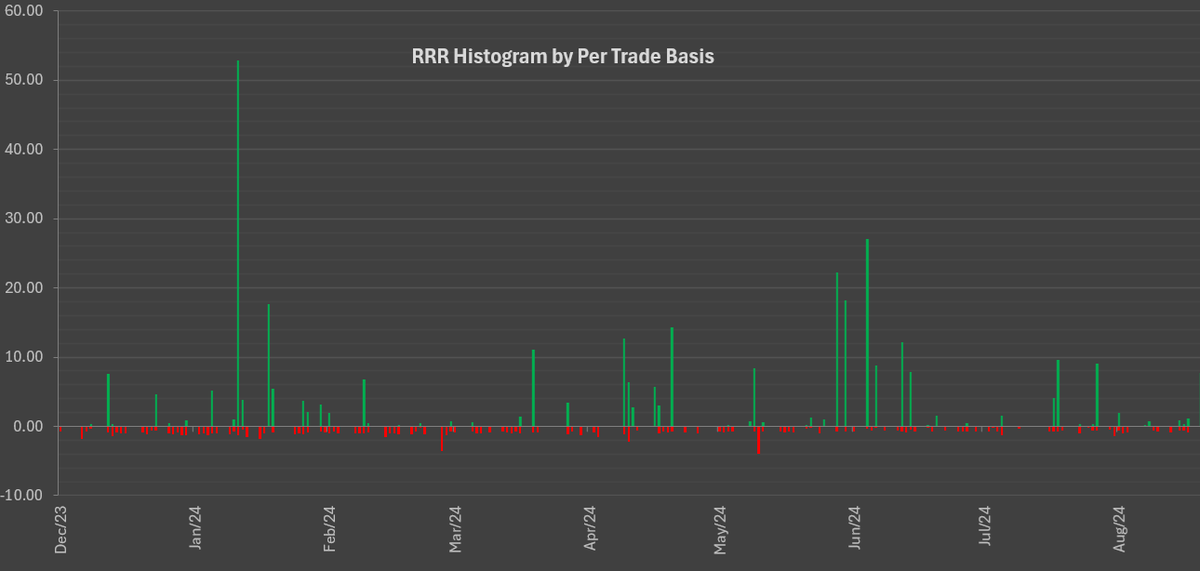
If you're struggling to gain traction in your trading, I recommend building an RRR (Risk-Reward Ratio) histogram graph on per trade basis. This will help you analyze how well your losses are controlled from a broader perspective, rather than focusing on the disappointment of your equity curve which does not present you any perspective to improve.
Total Trades: 371 (Max Month: 64, Min Month: 29)
Trade Type: 64% ETF (Leveraged, Non-leveraged & Inverse), 36% Equities (Mostly long including inverse mega $GGLS and $TSLQ, less than 4 parabolic short)
Win Rate: 24.8% (Max Month: 31.6%, Min Month: 14.5%)
Avg R Gain: 3.7 (Max Month: 6.4, Min Month: 1.4)
Avg R Loss: 0.78 (Max Month: 0.89, Min Month: 0.69)
Avg R Gain/Loss: 4.7 (Max Month: 7.26, Min Month: 1.61)
Consecutive Winning Months: 4 (May to August)
Consecutive Losing Months: 2 (Mar to Apr)
Biggest Winning Month: February (+18.8%, Win Rate: 25%)
Biggest Losing Month: (-7.6%, Win Rate: 14.5%)
Biggest Winner: 7th February $GBTC 53R. (I attempted 26/1 and 7/2 on full losses)
Biggest Loser: $GLD -3.92R (executed 6/6, gap down open 7/6)
Avg Holding Days (Winners): 15 Days (Max Month: 22.4, Min Month: 9.6)
Avg Holding Days (Losers): 2 Days (Max Month: 4.3, Min Month: 1.2)
Longest Consecutive Losing Trades: 17 8th March to 15th March (Min Month: 5)
Longest Consecutive Winning Trades: 4
A few key takeaways I hope you can learn from.
1. Trading is not easy because you are on drawdown and facing consecutive losing streaks most of the time. You face bad days more than good days, this is a fact and you need to accept it. My longest consecutive losing streak of 17 in 6 trading days is not easy to stomach for someone without risk management and emotional control.
2. Don’t fixate on the performance of your last 10 trades, the performance this week or this month —focus on the performance of your last 500 trades. Embrace the big picture, the law of large numbers, and a long-term perspective in trading.
3. Be highly selective to reduce subpar trade frequency and improve the quality of both trade selection and execution. At times I favor high ADR% stock not because they move fast, but because they may give you the tightest entry based on LoD to ATR and it could just explode to 5-6R winner in a single day when it trades to its mean ADR%, its implied volatility. It's about quality of entry opportunity much more than selection quality alot of times.
4. I won’t be a profitable trader without RVOL-based entries. This year there's alot of false breakout, false gap up movers. I have big winners in $KOSS and $MGOL because they open as much as +1000% Rvol and trades to +4500% in under 15mins. Volume are strong clues for trading breakouts in equities and intraday follow through.
5. High-quality entries is way more important than stock selection imho. I can bet you not many swing traders can profit from high quality IPO names trading at ATH $CAVA $BTSG $NU until you can get a quality entry eg. $CAVA 9th August high rvol below 60% LoD.
5. Learn to size down losses before your trade hit the eventual stops. I spoke alot about selling partial in sequential manner of 33% size out from 33% below entry, and further 33% size out from 33% to stop loss. I can control my average losses within 0.8R because of this even with slippages and spread. This is a metrics anyone can improve and I largely focus to improve on.
6. Learn to hold trades if it is working. I am still holding $XLU and $SCHH with 70 days calendar days holding period. Non-leveraged ETFs may be slow on ADR% perspective, but they present the best trend to 10/20-MA without overshoots as much as equities. This 2 are +25R trades.
7. Don't kick yourself for missing major trade of the year that are being hyped up on social media eg. $SMCI or $ASTS. I did not even capture that.
Trading becomes challenging if you let daily price action affect you emotionally. However, it becomes more manageable and straightforward when you focus on the bigger picture, address your weaknesses and learn to improve them on MoM basis. You need to give yourself time and avoid the mentality that you can rush towards success.