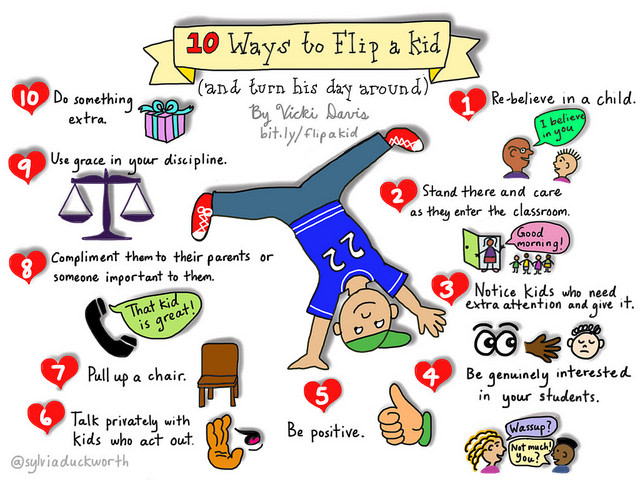
When a student misbehaves, take recess away.
When a student doesn't understand fractions, take the manipulatives away.
When a student struggles to read, take the books away.
Makes sense, right?
Wrong. We add support rather than take something away.
Intervention!
This article synthesis information on Social Learning Theory and social media explaining how social media can enhance student engagement and allow for connections between students while also stimulating attention, retention, and motivation. #6711SM6
https://t.co/SO3iQpKTvF
Social Learning Theory can be applied to the music classroom by providing students with prerecorded lessons to watch prior to completing an activity. This flipped model allows students to observe the activity before working independently. #6711SM6 https://t.co/zN4Zq4DrA6
People learn from watching others. Social Learning Theory, developed by Albert Bandura, can be applied to understand the root causes of behavior and the importance of role models. This animated video explains the theory clearly and concisely. #6711SM6 https://t.co/5mV8oGVJpn
What does constructivism look like in the prek-12 music room? In many music classrooms, the teacher is at the center of learning as they are the conductor. This article encourages teachers to learn alongside their students instead of leading them. #6711SM5
https://t.co/OwVBBXMwfv
Many K-12 schools are currency operating virtually or in a hybrid model. This blog post offers a variety of techniques to incorporate the constructivist learning theory in the online classroom. #6711SM5
https://t.co/vptnPJQf6L
This popular source provides a great explanation of constructivism and how to incorporate it into the classroom. When properly implemented, constructivism engages and motivates students by making them take a more active role in their learning. #6711SM5
https://t.co/XFPlfiKv8p
While this blog is directed at corporate leaders, it is also a great resource for educators. The post describes Cognitive Learning Theory and makes connections to both Piaget and Bloom’s taxonomy. #6711SM4
https://t.co/A4xUhGU0xB
Cognitive learning strategies improve a student’s ability to process, store, transfer, and apply learning. This article explains five strategies for educators to use in their classrooms.
#6711SM4
https://t.co/uFGT3VEG9S
Field trips are an excellent way to extend student learning and create episodic memories for students. Can we finally agree to make field trips an equitable reality? This list of virtual field trips is a great place to start! #6711SM4.
https://t.co/kMwM1m9wb4
Behaviorism in the 21st century at work! Check out this blog post on how to implement a Behavior Management Economic System in the elementary grades. #6711SM3
https://t.co/I3Dwdfahvt
This is a quick and excellent resource for understanding behaviorism and the role it plays in the classroom. Teacher Tony decides upon the behaviors he wishes students to exhibit and then chooses appropriate reinforcers and consequences. #6711SM3 https://t.co/yZFplbvePp
Positive Behavioral Interventions and Supports (PBIS) is an evidence-based, school-wide, three-tiered program designed to support all students by addressing student behavior. It is a great example of behaviorism in the 21st Century at work. #6711SM3 https://t.co/3G2EWUhUHF
I still have a lot of work to do (adding rubrics and project examples) but it is a start! Please take a look at my wiki lesson for 6th-grade music and share your ideas on how I can make it a more meaningful learning experience for my students. #6710App5
https://t.co/BIghtO3oqD
Wearing a mask is about respect.
We launched a national campaign to encourage every American to wear a mask. Stop the Spread. Save Lives.
#MaskUpAmerica