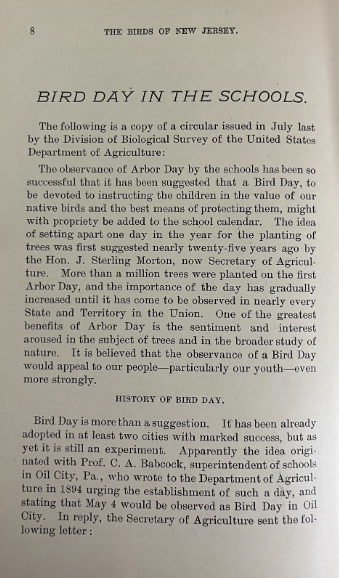
Recently, our staff found a collection of books in The Gibbon House, one being The Birds of New Jersey, compiled by Charles A. Shriner in 1896. The book was printed solely for the Fish and Game Commission of the State of New Jersey.
Sources:
“Local News,” The Daily Journal (Vineland, NJ), June 8, 1876
“Talking With the Dead???” Bridgeton Evening News, April 30, 1920
“Our Beloved Dead, What Are They Doing Now?” Bridgeton Evening News, Oct. 5, 1946
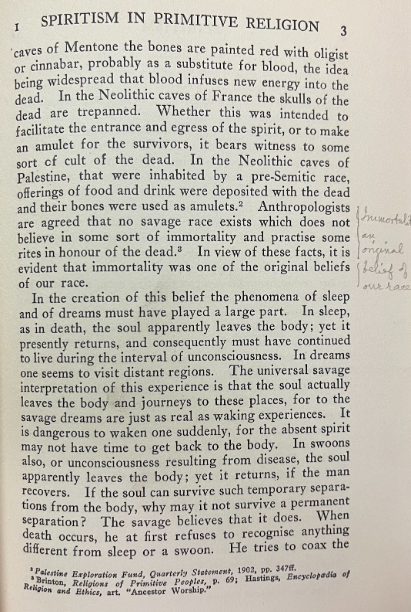
Everett T. Tomlinson (1859-1931), a prolific author in Cumberland County, read and annotated the book Spiritism and the Cult of the Dead in Antiquity by Lewis B. Paton (1921). His annotation in the photo reads “Immortality an original belief of our race,” in reference to humans
they go where they choose?” He continued with the point that “war tragedies bring desire to commune with [the] dead,” giving more reason to why Spiritism was a popular topic following major crises (both world wars, 1918 pandemic, etc.).
Sources:
“A Useful Window Box,” Bridgeton Evening News, Apr. 10, 1906
Sidney Snow, “Enjoy a Herb Garden: Can Be Included in Your Present Garden Plot,” Bridgeton Evening News, Aug. 8, 1935
“Radio Garden Club Program,” Bridgeton Evening News, July 14, 1938
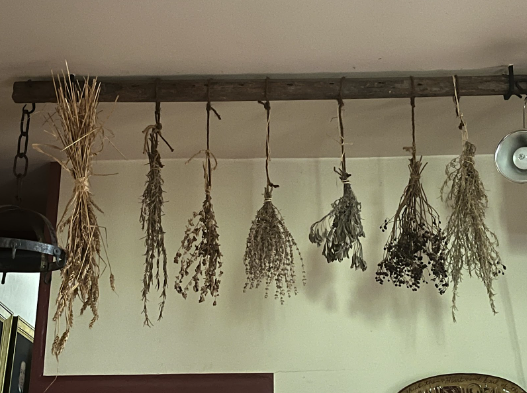
What herbs do you use in your cooking? Newspaper articles throughout the early twentieth century raved about the utility of herb gardens in culinary arts. Interest spiked during the Great Depression, as “the modicum of care required to keep the little herb garden thrifty and
green repa[id] one in savory dishes and the changes that can be rung upon one variety of food by its use.” Using little space and necessities, people experiencing financial hardship could (literally) spice up their dishes at little to no extra cost.
Have you ever heard of Bird Day? This introductory passage in The Birds of New Jersey (1896) includes an earlier message from the Division of Biological Survey of the United States Department of Agriculture, wherein the Department, inspired by the success of Arbor Day,
populations. In the late 1890s, the Seven Oaks Club petitioned the Bridgeton Board of Education “to set apart a day … in which to teach the value of the feathered songsters and to inculcate lessons against their wanton destruction.”📷
These pieces on display at the Gibbon House appear simple, as they are likely white linen with basic embroidered elements. This garment is called a “stomacher.” Throughout the eighteenth and nineteenth centuries, stomachers developed from modest undergarments and accessories into
“The Women of Servia [sic],” Advertiser and Review (Bridgeton, NJ), August 30, 1876.
”Imported Dresses,” Bridgeton Evening News, September 20, 1892.
”Fashion’s Favorites: From Rococo to Romantic,” Philadelphia Museum of Art, April 2005-June 2006, https://t.co/oEkRXqLqDv...
Sources:
Bill Lockhart, et al., “The Cohansey Companies,” Society for Historical Archaeology, https://t.co/WWIGm7Vvam
Penelope S. Watson, “Bridgeton,” Encyclopedia of Greater Philadelphia.
When visiting the Gibbon House, you’ll see an assortment of glass pieces. Together, they create a mosaic of South Jersey’s bountiful glass-making history. In Bridgeton specifically, the industry began in 1836 with Stratton, Buck & Co. From there, upwards of twenty factories
sprung up in the city, including Cohansey Glass Manufacturing Co. Although the headquarters for Cohansey Glass was in Philadelphia, the Bridgeton plant famously “made bottles, fruit jars, and window glass.” Do you have any Bridgeton bottles in your personal collection?