A scientist telling true stories about the strange, funny and beautiful patterns hidden inside ordinary life. Science is the lens. Curiosity is the subject.
The leafy sea dragon is one of the ocean’s most extraordinary creatures. Found in the coastal waters of Australia, this unusual fish has leaf like appendages that help it blend in with seaweed and kelp, making it a master of camouflage.
Despite its dragon like appearance, it is related to seahorses and feeds on tiny crustaceans by sucking them up through its long snout. One of its most fascinating features is that the male carries the eggs until they hatch.
Musk oxen are living Ice Age survivors, built to handle Arctic temperatures below −40°F. They’re actually more closely related to sheep and goats than cattle.
Their incredibly warm undercoat, called qiviut, is one of nature’s finest fibers.
When threatened by wolves, they form a circle with their horns facing outward and calves protected inside.
They can run nearly 30 mph despite their huge, shaggy appearance.
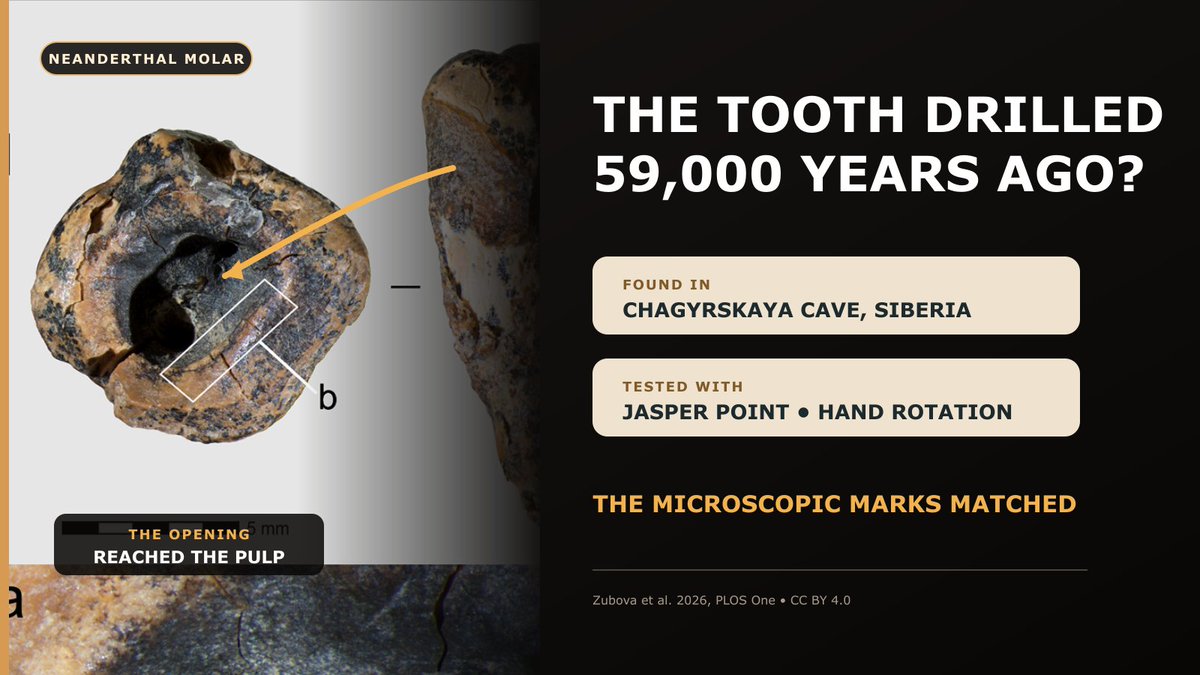
Someone appears to have opened a Neanderthal’s rotten molar with a stone point about 59,000 years ago.
The tooth kept chewing afterward.
Archaeologists found the molar in Chagyrskaya Cave in southwestern Siberia.
A large hollow ran through its chewing surface and reached the pulp chamber, where the nerves and blood vessels had been.
The opening measured about 4.2 mm long, 2.8 mm wide and 2.6 mm deep.
That could have been damage.
It could have formed naturally as the tooth decayed.
Or someone could have deliberately opened it to relieve the pain.
Researchers examined the molar with microscopes, micro-CT scans and spectroscopy.
They found deep decay around the hollow.
They also found tiny grooves running along its walls, as if a pointed tool had been rotated against the tooth.
Then they tested the idea.
The team fixed 3 extracted modern molars in cork and worked on them with small jasper points.
Scraping was slow and ineffective.
Rotating the point by hand broke through the tooth’s surface within seconds.
One experiment reached the pulp chamber in about 50 minutes.
The procedure produced grooves with the same general shape, orientation and microscopic structure as those on the Neanderthal molar.
The ancient opening also showed smoothing from use during life.
That means the tooth did not simply break after burial.
Its owner continued chewing with it.
The researchers argue that this is the earliest known invasive treatment of tooth decay.
Other specialists remain cautious. An injury followed by decay, or repeated work with a toothpick-like tool, may not be completely ruled out.
But the marks preserve a striking possibility.
The oldest known dental drill may not have been metal.
It may have been held between 2 Neanderthal fingers.
For more than 30 years, part of Irish prehistory rested on a cow that was not a cow.
In the 1980s and 1990s, archaeologists excavating Ferriter’s Cove, a Stone Age camp on Ireland’s Dingle Peninsula, found bone fragments identified as domestic cattle.
That created a problem.
The bones dated to the Late Mesolithic, centuries before farming became established in Ireland.
And Ireland had no native wild cattle.
If the identification was correct, the bones were evidence that Ireland’s last hunter gatherers had already made contact with farming communities across the sea.
The “Kerry Cow” entered the scientific literature.
For decades, it became an important piece of the story of how farming reached Ireland.
Then, in 2026, researchers went back to the original bones with a technique that did not exist when they were excavated.
ZooMS.
Instead of identifying a fragment mainly from its shape, ZooMS reads proteins preserved in the bone’s collagen.
The team tested 8 fragments.
2 did not preserve enough protein for a reliable answer.
The other 6 did.
None was cattle. 😮
2 were bear.
1 was wild boar.
1 was wild pig.
And 2 were human.
The earlier archaeologists had worked from the anatomy visible in small, damaged fragments.
The new team could read molecules inside them.
And just like that, the Kerry Cow disappeared.
The result removed one of the strongest pieces of evidence for contact between Ireland’s Mesolithic hunter gatherers and Neolithic farming communities before 4000 BC.
It did not rewrite everything known about the arrival of farming.
It removed 1 animal that had been carrying far too much of the story.
For more than 30 years, the Kerry Cow lived in scientific papers.
It had never lived in the bones.
Someone appears to have opened a Neanderthal’s rotten molar with a stone point about 59,000 years ago.
The tooth kept chewing afterward.
The molar was found in Chagyrskaya Cave in southwestern Siberia.
Across its chewing surface was a large hollow reaching all the way into the pulp chamber, where the nerves and blood vessels had been.
It measured about 4.2 mm long, 2.8 mm wide and 2.6 mm deep.
At first, there were several possibilities.
Decay could have created it.
An injury could have damaged the tooth.
Or someone could have deliberately opened it to relieve pain.
Researchers examined the molar with microscopes, micro CT scans and spectroscopy.
The tooth was badly decayed.
But inside the hollow they also found tiny grooves running along the walls.
They looked like traces left by a pointed tool being rotated against the tooth.
So the researchers tried to reproduce them.
They fixed 3 modern human molars in cork and worked on them with small jasper points similar to tools found at the cave.
Scraping barely worked.
Rotating the stone point like a tiny hand drill broke through the tooth surface within seconds. 😮
In 1 experiment, researchers reached the pulp chamber in about 50 minutes.
When they examined the experimental teeth under a microscope, the drilling had produced marks similar in shape and orientation to those inside the Neanderthal molar.
Then came another clue.
The ancient grooves had been smoothed by wear.
The opening had been made while the individual was alive.
And afterward, the tooth continued being used for chewing.
The researchers argue that this may be the earliest known invasive treatment of tooth decay.
Not everyone is convinced.
Other specialists say an injury followed by decay, or repeated work with a toothpick-like tool, cannot yet be completely ruled out.
That uncertainty is worth keeping.
We do not have the Neanderthal.
We do not have the moment the tool touched the tooth.
We have 1 damaged molar and microscopic scratches preserved for 59,000 years.
But if the researchers are right, dentistry began long before metal instruments, electric drills or anesthetic.
Someone had a terrible toothache.
Someone else may have picked up a sharp piece of stone.
And the tooth kept chewing.
For more than 30 years, part of Irish prehistory rested on a cow that was not a cow.
In the 1980s and 1990s, archaeologists excavating Ferriter’s Cove, a Stone Age camp on Ireland’s Dingle Peninsula, found bone fragments identified as domestic cattle.
That created a problem.
The bones dated to the Late Mesolithic, centuries before farming became established in Ireland.
And Ireland had no native wild cattle.
If the identification was correct, the bones were evidence that Ireland’s last hunter gatherers had already made contact with farming communities across the sea.
The “Kerry Cow” entered the scientific literature.
For decades, it became an important piece of the story of how farming reached Ireland.
Then, in 2026, researchers went back to the original bones with a technique that did not exist when they were excavated.
ZooMS.
Instead of identifying a fragment mainly from its shape, ZooMS reads proteins preserved in the bone’s collagen.
The team tested 8 fragments.
2 did not preserve enough protein for a reliable answer.
The other 6 did.
None was cattle. 😮
2 were bear.
1 was wild boar.
1 was wild pig.
And 2 were human.
The earlier archaeologists had worked from the anatomy visible in small, damaged fragments.
The new team could read molecules inside them.
And just like that, the Kerry Cow disappeared.
The result removed one of the strongest pieces of evidence for contact between Ireland’s Mesolithic hunter gatherers and Neolithic farming communities before 4000 BC.
It did not rewrite everything known about the arrival of farming.
It removed 1 animal that had been carrying far too much of the story.
For more than 30 years, the Kerry Cow lived in scientific papers.
It had never lived in the bones.
In 1856, Eunice Newton Foote put 2 glass cylinders in sunlight.
1 contained ordinary air.
The other contained carbon dioxide.
The ordinary air reached 106°F.
The carbon dioxide reached 125°F. 😮
It also stayed hot longer after the cylinders were removed from the sunlight.
Foote had built the experiment with remarkably simple equipment.
2 glass cylinders.
4 thermometers.
An air pump.
From that tabletop experiment, she made a much larger connection.
An atmosphere containing more carbon dioxide, she wrote, would give Earth a higher temperature.
On August 23, 1856, her paper was presented at the American Association for the Advancement of Science in Albany, New York.
But Foote did not read it.
Joseph Henry did.
Her paper was only about 2 pages long.
It appeared 3 years before John Tyndall’s better known experiments on heat trapping gases.
There was an important difference.
Foote measured how gases warmed in sunlight.
She did not directly measure the infrared absorption that scientists now understand as central to the greenhouse effect.
Tyndall later investigated that mechanism with more sophisticated equipment.
And the reason Henry presented Foote’s paper instead of Foote herself remains uncertain.
Women faced enormous barriers in science at the time, but Foote herself presented another scientific paper at the association the following year.
Still, her 1856 work received little lasting recognition.
Her name largely disappeared from the history of climate science while Tyndall’s remained.
The experiment fit on a table.
Giving her back her place in the story took more than 150 years.
In September 2023, Rafael Chacón raised his camera toward a small fox beside a road in Cozumel.
Nobody had ever photographed 1 before. 😮
There had been no confirmed sighting of a Cozumel fox since 2001.
Before that morning, the only physical evidence scientists had came from subfossil bones found at archaeological sites on the island.
Those bones showed that a remarkably small fox had lived on Cozumel for thousands of years.
But the population had never been studied genetically or formally recognized as a distinct species.
Scientists did not know how many remained.
They did not even know with certainty whether any remained.
Early on September 14, reports began spreading through phone calls and social media about a disoriented fox beside Cozumel’s coastal highway.
Chacón and a team from the Fundación de Parques y Museos de Cozumel went looking for it.
At about 6 a.m., they found an adult male near kilometer 29, partly hidden behind vegetation.
Chacón took the photographs.
The rescue team safely recovered the fox and kept it under observation.
After veterinary care and a physical assessment, it was released 3 days later into the Laguna Colombia State Reserve, away from the highway.
The photographs transformed scattered reports and ancient bones into evidence that the fox was still alive.
They also revealed how little anyone knew about it.
In 2026, researchers began the 1st survey designed specifically to find Cozumel foxes.
They placed 84 motion activated cameras across nearly 100 square kilometers of habitat.
Some stations also use scent lures and small hair traps, hoping that a passing fox will leave behind enough DNA to reveal whether this population is genetically distinct.
The team is trying to learn where the foxes live, what threatens them and, most urgently, how many are left.
The photograph proved that at least one fox had survived.
Now scientists are trying to find out whether a population did.
X says it wants to reward original creators.
Yet thousands of incredible artists, scientists, designers and builders here will never get close to the 500K impressions required to qualify.
Their work can be genuinely original and still be practically invisible to the program.
If reach is the gatekeeper, you’re not really measuring originality.
You’re measuring distribution.
Did you know a chameleon's tongue is too fast for muscle to power?
Watching it in slow motion is the only way human eyes will ever see what actually happens.
Millions of people walk across Yellowstone every year without knowing what sits beneath their feet.
This 60-second animation shows what is actually down there. 😮
As a scientist, this is still my favorite thing to explain about a sunflower field.
Young sunflowers do not simply follow the sun.
At night, in complete darkness, with nothing visible to follow, they turn back toward the east.
They are getting ready for a sunrise that has not happened yet.
In 2016, researchers at UC Davis tested what was controlling that movement.
They moved sunflowers indoors.
The light above them stayed fixed.
No sunrise crossed the room.
No sunset disappeared in the west.
And yet, for several days, the plants continued their east to west rhythm anyway. 😮
Then the researchers created an artificial sun by switching lights on and off across the room.
With a day close to 24 hours, the sunflowers could follow it and return east during the night.
But when the researchers stretched the artificial day to 30 hours, the plants lost the rhythm.
Their nighttime movement became confused.
The sun was not simply pulling the flowers across the sky.
The plants were keeping time.
The researchers also found how they moved.
During the day, 1 side of the stem grew faster.
At night, the other side did.
The sunflower was using unequal growth to swing itself west during the day and back east before dawn.
I love that distinction.
A sunflower does not wait for morning and then react.
Somewhere inside its cells, morning is already expected.
The sun rises at dawn.
The sunflower starts preparing before it arrives.
The underlying 2016 study was published in Science and led by researchers including Hagop Atamian and Stacey Harmer at UC Davis. It showed that the circadian clock helps control both solar tracking and the nighttime return toward the east.