🕊️ Pax means peace. But if we look around in 2026 — trade wars, chip embargoes, rare earth weaponisation, drone-contested borders — peace is probably one of the last word that comes to mind.
Every era of geopolitical dominance has been called a Pax. Because every hegemon needs the story of peace, even when what they're really building is power.
More importantly: every Pax has been backed by a coin.
🏛️ Pax Romana → the denarius
🐉 Pax Sinica → silver
🦅 Pax Americana → the petrodollar
Strip away the military history and the diplomatic treaties, and what sits at the centre of every hegemonic order is a monetary truth. The coin is the architecture.
So here's the question that we've been looking at: what is the coin of the AI age?
We argue it's the dollar stablecoin — and that Pax Silica, the US-led AI supply chain initiative launched in December 2025, is less a technology alliance than a monetary strategy dressed in the language of semiconductors. The same elegant machine Henry Kissinger assembled in the oil fields of Arabia, rebuilt for the age of compute.
Three harder questions follow from that:
→ Can you actually bifurcate an intelligence economy the way you bifurcated an industrial one? AI was trained on the global internet. Can export controls undo that?
→ China is betting that controlling the unglamorous middle — rare earths, energy infrastructure, AI Belt and Road deployments — will eventually let it contest the monetary layer. Is that bet wrong?
→ And Europe? Is it writing regulations for a monetary contest it might be losing?
Check out our new article in @CurrenPower with @Nicolas_Colin
https://t.co/Hmz3Tr9K6B
This week in @CurrenPower: "The Yield, the Ban, and the Blueprint"
Dollar stablecoins are expanding global dollar dominance outside the traditional banking system. Existing monetary infrastructure wasn't built for this, and every jurisdiction is now being forced to respond.
When it comes to the US, the direction is clear: stablecoins are a core part of a dollar dominance strategy. After the GENIUS Act, the US are now moving on the Clarity Act, debating whom within the stablecoin food-chain should have the right to give yield. Yield on stablecoins is a customer acquisition cost. The competition for currency is now happening at the individual wallet level, globally.
If I'm sitting in Europe and I can earn 5% on USDC, why would I hold euros?
Responses from across the globe are starting to come. Brazil banned regulated fintechs and FX providers from settling cross-border payments in stablecoins. In Europe, Christine Lagarde's rejected the need for Europe to have euro stablecoins has the only answer and advocated for public infrastructure, which won't be ready until 2028.
Meanwhile the Coinbase + AWS announcement showed USDC being embedded as the default payment layer for AI agents. The US is competing for wallet share and building out the AI agent payment stack while everyone else draws up plans.
Read on the full breakdown in this week's Currency of Power, which @Nicolas_Colin co-author.
https://t.co/3rQ36nJzmw
What an honour it was to interview @HowardJDavies for @CurrenPower with @Nicolas_Colin.
Sir Howard Davies has been at the helm of large financial institutions for the last 50 years - giving him a unique perspective on what happened but also where things might go from here.
We deep-dived into the crisis of 2008 and what could regulators have done better; Brexit and how it interrupted London’s journey to become the onshore financial market for Europe; why Beijing is taking international capital standards seriously and why stablecoins make sense for Europe.
Full episode 👇
https://t.co/poUYDAZ5dl
New podcast on @CurrenPower: we sat down with @neha for an in-depth conversation on CBDCs, Stablecoins, Privacy, Quantum and Geopolitics outlook.
Neha has a unique ability to explain very clearly complex concepts - a must listen!
https://t.co/g8T3ATwJZZ
.@neha Narula trained as a software engineer and now heads the Digital Currency Initiative at MIT. The latest @CurrenPower episode with her and @mariekeflament covers a lot of ground. Four things I wanted to highlight.
1️⃣ Programmability vs control. Programmable money executes automatically. What Neha calls "restricted money" can only be spent on certain things — think SNAP benefits / food stamps for instance.
The fear that killed CBDC research in the US was the idea that government money could become conditional money. That fear is now in the politics of every country still considering a retail CBDC.
(And it applies to stablecoins too. Tether freezing $500M of USDT at the US government's request shows where the control actually sits.)
2️⃣ CBDCs and stablecoins are less different than the debate suggests. A stablecoin backed by a central bank balance sheet is effectively a wholesale CBDC wrapped by the private sector. What matters is the design: what is it backed by, who can redeem, what happens in bankruptcy. The label is secondary.
3️⃣ Quantum. Bitcoin's cryptography will eventually be vulnerable. The technical path to post-quantum resistance exists. The hard problem is coordination — no CEO to mandate a migration, Satoshi's coins may be permanently inaccessible, and parts of the community do not accept the premise.
Neha's view: build the signature scheme, enable migration, defer the rest until a quantum computer is actually close.
4️⃣ Geopolitics. Iran's reported willingness to accept payments in stablecoins and Bitcoin signals that these instruments now matter at the level of nation states working around sanctions. That is a story about the limits of dollar infrastructure and who controls the pipes.
🎙 Full episode and transcript here: https://t.co/UZmQteKFMN
New interview at @CurrenPower with @mariekeflament.
@izakaminska on eurodollars, @tether, and why stablecoins are best understood not as a financial innovation but as a stabilisation operation — a controlled way of unwinding an asymmetry that has been building for thirty years.
Full interview: https://t.co/VOHbhvaglb
After weeks in London, Zurich, NYC, and Cannes for @EthCC, one thing is clear: we are witnessing the end of native digital assets.
I’ve been covering crypto for nearly 10 years and visited financial hubs all over the world - this is the first time I’m seeing a shift this big.
Almost no one is talking about native tokens anymore.
It’s striking how fast the conversation has changed.
For the past decade, blockchain meant native digital assets - Bitcoin, Ether, SOL, and thousands of others.
But that era is ending. Most native tokens have collapsed because, in reality, they don’t do much.
Bitcoin remains because it became digital gold.
Ethereum and Solana remain because their networks have real utility - tokenization and payments. But let’s be clear: their token prices are not protected by fundamentals. Both networks could function perfectly with much lower token prices.
The rest? They’re fading away.
Because the native token model never truly proved its value.
In many cases, it was simply a way to raise money without the constraints of equity.
That model isn’t sustainable. Investors are realizing it.
Some projects - @AcrossProtocol being one example - are already rethinking their token models and exploring equity structures.
This will not be an isolated case. Examples like this will multiply.
We are now entering a new era: The era of non-native digital assets.
The real opportunity is no longer assets created for blockchains - but assets moving onto blockchains.
This wave is already being driven by companies like:
- @circle
- @tether
- @KriptownFR
- @tradeon21x
- @Securitize
- And many others
Stablecoins are the clearest example.
Over $300B of dollars are already on-chain. Soon, this will become trillions.
Next:
- Stocks
- Bonds
- Funds
And this is exactly why TradFi is now entering at scale.
The first decade of crypto was about creating new assets. The next decade is about bringing the world’s assets on-chain.
Two systems are competing to replace the petrodollar.
🇺🇸 Cryptodollars: compute as the new oil, stablecoins as the new recycling loop.
🇨🇳 Electroyuan: own the grid, choose the currency.
The rest of the world just gets to pick a dependency 👇
@CurrenPower
New episode of @CurrenPower with the one and only @psneville -- a fantastic wide ranging 2h conversation, from the early days of @circle and USDC to building an AI-native financial organisation with @catena_labs
https://t.co/Vuc6Is3heO
Our CEO @khem sat down with @mariekeflament and @Nicolas_Colin on the @CurrenPower podcast.
The main takeaway: not every gold token is the same.
Most people assume tokenized gold is just a digital ETF.
It isn't.
When you hold $DGLD, you own the actual physical metal safely secured in a Swiss vault (not a paper claim on another piece of paper claim).
You can even redeem it down to a single gram.
Kurt also shared some fascinating lessons from his time at PayPal, why Diem actually failed (spoiler: it wasn't the tech), and how zero-knowledge proofs will fix digital identity.
It is a great conversation. Enjoy it.
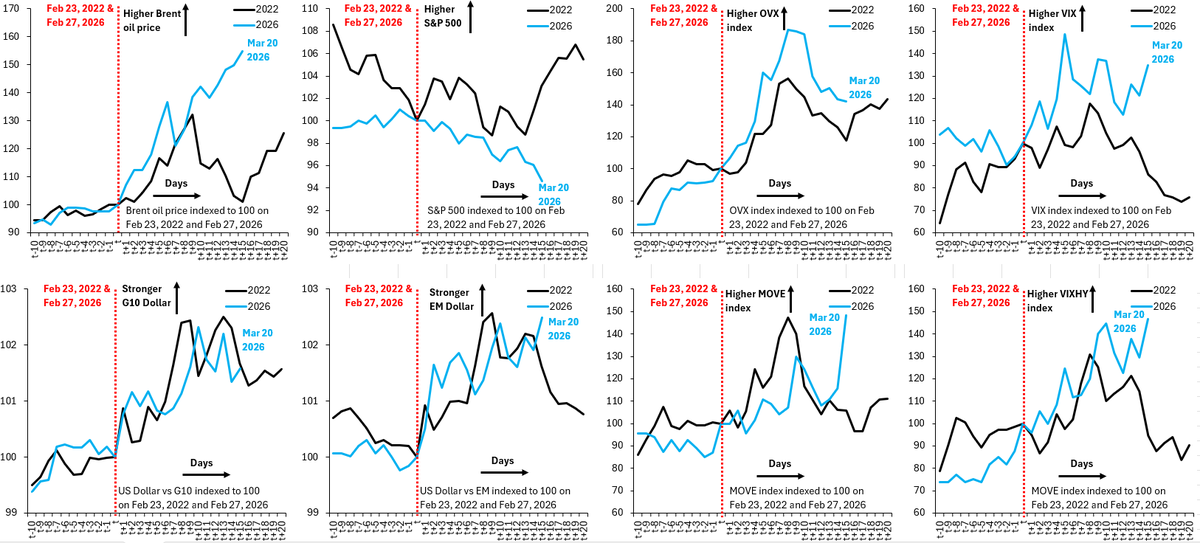
Markets have been the ultimate constraint on Trump. It was like that in April 2025 when China tariffs went to almost 150% and arguably also in January 2026 over Greenland. Markets are now very distressed. Trying to take Kharg Island just isn't realistic.
https://t.co/pzhPwqqSN9
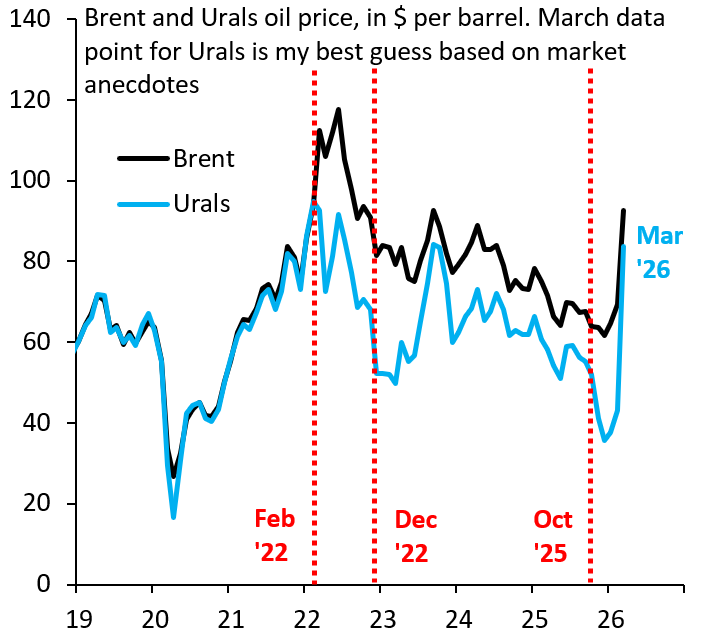
We already know the winner in the war with Iran and that's Russia. The closure of the Straits of Hormuz has swung Russian crude from pariah to prized commodity. Urals oil price is the highest since right after the Ukraine invasion. Putin is loving this...
https://t.co/0Q1tRBlJvs
This week in @CurrenPower — Wide Open, Locked In.
For decades, America and China have been locked in a structural embrace that neither could easily escape. China manufactured; America consumed. China saved; America borrowed.
Exactly this. And on top of the compounding macro problems, the geopolitical backdrop is vastly different. What does coordination (which was essential to stabilizing the global economy in the GFC) look like in the age of the 'Donroe Doctrine'?
Iran’s foreign exchange system is another example of dysfunction in the economy. Subject to decades of sanctions, capital controls, and state intervention, it is
no wonder that it’s fragmented. It never got better because the multi-tiered exchange rate system enabled corruption and split the economy into haves and have-nots, which appeared to be absolutely fine by the regime.
https://t.co/ScGuaLxjd4
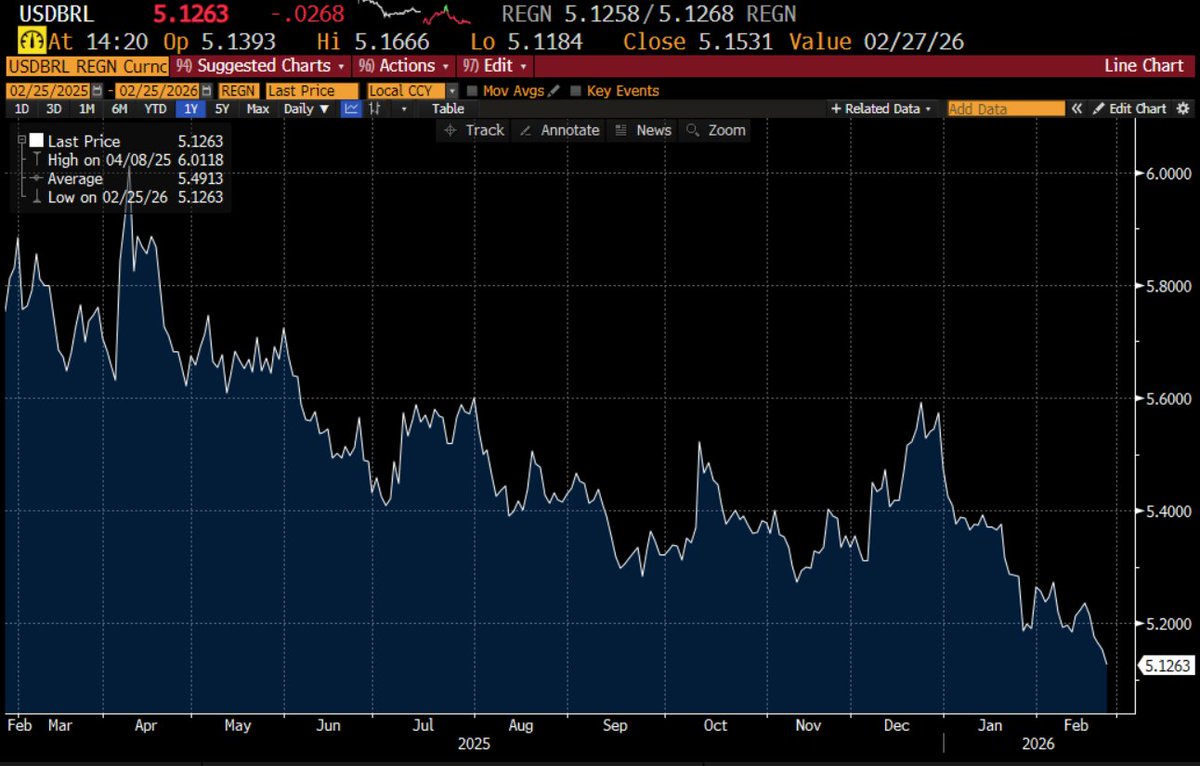
The Dollar is tumbling. Not against the G10, where it's basically stable, but against EM, where it's making new lows almost every day. One of the main beneficiaries of all this is the Brazilian Real, which is the strongest versus USD in almost 2 years...
https://t.co/23k8oAG7Lc
Stripe co-founder @collision predicts there will be a "torrent" of agentic commerce in the future, and that the agents will transact with stablecoins, running on "really high-throughput blockchains":