Yap 🧵
The next year or so is likely to be the rise of the age of performative schizophrenia. With AI continuing to tighten its grip around the minds of hopelessly addicted media addicts, many wont be able to discern what is going on with them.
Many are likely to discern meaning in things that inherently have no meaning. Or worse, meaning imposed retroactively by malevolent forces.
Just like how certain dispositions or archetypes (see "depression", "autism", "pervert", etc) gets ran into the ground by the masses until it loses all meaning, so will be the era of the masses attempting the mind of the contemplative.
What does it mean to be "schitzopilled"?
I tentatively give this label on myself, if for no other reason but that I lack the vocabulary to describe what im trying to say. It is the kind of person inclined to think symbolically; the world is made of symbols and archetypes. There are narratives, and those narratives give purpose and meaning. When you string enough of these narratives together, you form a mental map of reality. When you have formed a detailed enough map, you can then attempt things like belief systems.
The age of mass media has imposed this version of thinking upon the masses. Information is consumed through imagery, through short slogans and memes. Everything is "vibes".
Without the insight to explicate meaning from condensed information like a "meme", you are likely to be stuck with surface interpretations. You will have a version of reality imposed upon you, by others who wish to mold your mind to their world. This is spellcasting, and many fall victim to this.
People routinely go through cycles of consumption where they adopt an identity, signal to others that they share that identity, and then exhaust it until the next socially acceptable set of identities is presented. These cycles are becoming shorter and shorter, as more and more people continue to consume (doomscroll). New identities must be created at a faster rate to sate the curiosity and hunger of meaning. But there is none, because the normie mind does not bother to explicate whats presented in front of them.
It's strange to see so many people adopt this way of thinking. I, and maybe some others have naturally thought this way our whole lives. Some memes are very potent, because it saves you time from typing multiple paragraphs when a simple image conveys the same message with a more visceral impact. It is an artform to be able to string together loose concepts into a cohesive narrative that moves people.
What happens when everyone tries to adopt this? Perhaps we will see many forms of self induced psychosis. This is the price the contemplative pays for being able to do such a thing. This type of person needs firm grounding in the material and spiritual realms. Routinely connecting with the Logos, and remembering that they are still flesh bound to matter are but some of the ways to prevent psychosis. Body, mind and spirit are all connected (duh), and people will forget this as they continue to sink deeper into consumption.
The enemies in this world know this and will offer pre packaged views of the world. Some may call it the new world religion. But whatever it may be, we may see its infancy in 2026 and 2027. (Yes, 67 is not just a meme but a prediction).
Many people cannot be contemplative, and that's fine. Just like how most cannot be a charismatic leader, or an athlete, or social butterfly. Everyone must be allowed to flourish in their own lane, and not be squeezed into a box by the medium they consume.
Just like how not everyone can be "depressed" or "autistic", neither can everyone be "schitzo". If you find yourself slipping into this, ask yourself if you've always been this way before becoming a social media addict. The answer may surprise you.
Yap 🧵: Is AI truly bad?
We've sat in the midst of AI hysteria for a number of years now. From eldrich horrors, to an uncanny valley, to a slightly less uncanny valley, it becomes increasingly clear that the 4th industrial revolution (as coined by Klaus Schwab) is upon us.
X users would have you believe that there are only two positions on AI: A total AI bro willing to embrace Grok and Skynet, or a neo-luddite that embraces their ignorance as a badge of virtue. Like many things, the truth lies somewhere in between.
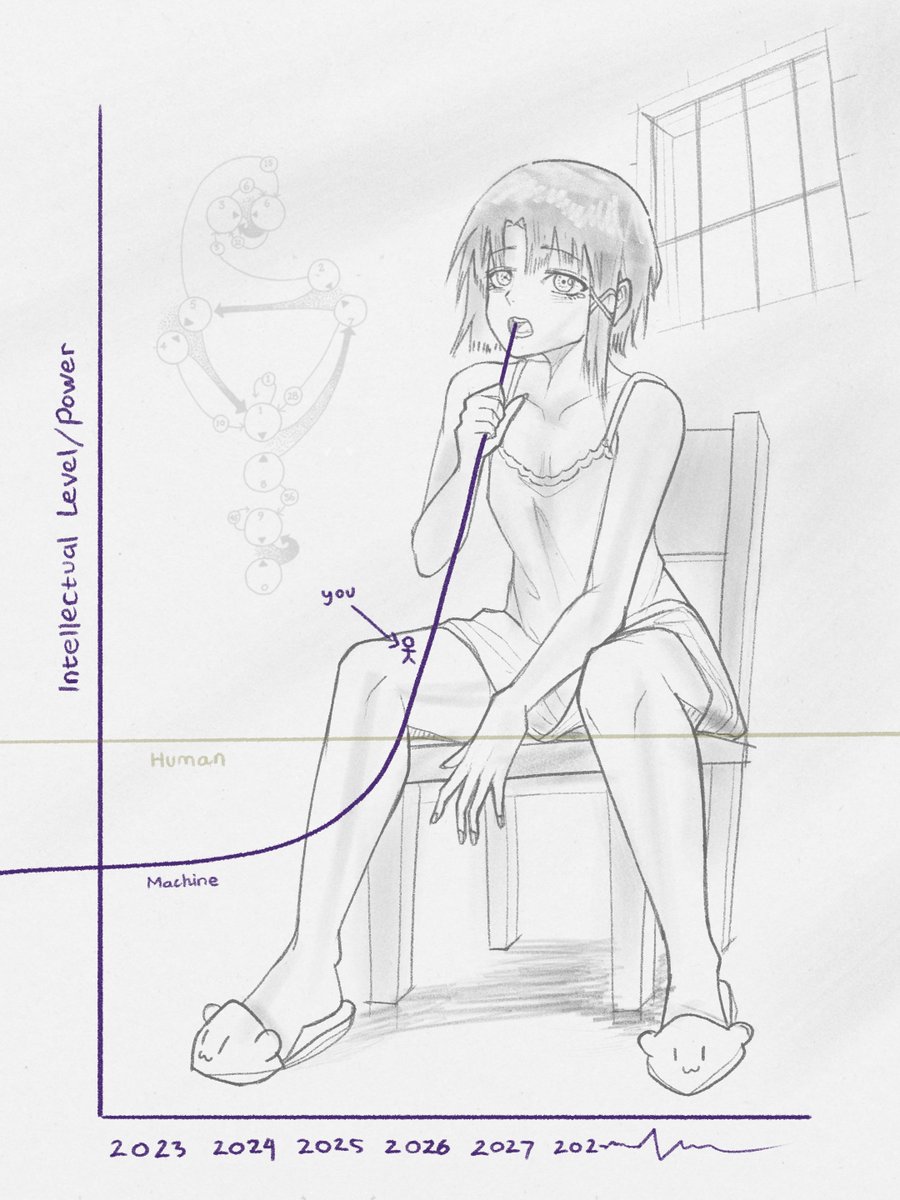
The confusion in AI is not that people overestimate its power, but that they underestimate it. During the previous revolution (the age of the internet), people would believe that it would be a passing fad (Clifford Stoll, '95). In revolutions prior (think the age of mass electricity), there were similar concerns, like today, about it being dangerous. Perhaps because the technology was still in its infancy. You would be scared too if tons of visible wires hung over your city and your own home wasnt properly insulated.
Today, we face some fear about AI. And a lot of this fear is rational, mainly due to how quickly it is aiming towards centralization. The typical user reading this may have dabbled in AI, especially language models like the one this site comes with.
The popular critique I've seen (which may have subsided a bit now) is how the language models direct one's own thinking. Overtly, a user may decry against censorship because the mainstream models dont want to generate a no-no word. More covertly, users begin to notice how the models subtly push the user into molding how they think about and process information.
A user once commented on how one model, Claude, has a slight condescending tone whenever a user has an inquiry. It constantly gets the user to second guess themselves, to the point where it may seem to want to subtly influence the user away from certain queries. Couple that with the fact that many mainline models build and retain user profiles to better serve them, and it begins to feel like a machine studying you, as opposed to you studying a machine.
At the same time, we have seen a lot of media hysteria demonizing AI; tying cyberattacks with clandestine hacker groups that are weaponizing AI for strategization and exploitation of chosen targets through sophisticated vetting mechanisms. A typical user again, looks at all this, and begins to feel as if maybe AI can only bring about evil, after all.
But if you've paid close attention, the media demonizes a particular kind of AI.
Does it highlight for example, the apparently rampant AI psychosis?
Does it talk about how AI is being used by corporations to wreak havoc on the job market via automatic filtering of applicants?
Does it talk about how many restricted frontier models are building user footprints, where an LLM can discern what user is talking to them from a completely different device that they've never used before?
The difference between the former example and the latter examples is that the former have all used "Abliterated AI".
Put simply, abliterated AI is akin to a jailbroken model. Removed of its guardrails, the user has full access to its capabilities, and without any oversight from its original creators. AI then becomes like an unregistered firearm; not only causing harm, but is impossible to detect until in front of your face.
Maybe you are not a cyber criminal looking to hack a corporation. But for a typical user, someone who is able to use fully unrestricted technology, especially in an age where regulations are almost non existent, becomes extremely dangerous to those who want to control it.
Like previous eras, technology eventually became centralized. Maybe this is the first where the user can be absent of central influence.
More importantly, like a gun, whether it is bad depends on who is wielding it. Do you trust an individual, or a centralized power more, with such a gun?
among the downtrodden, the freaks, the outcasts, they find that they can only find company among themselves. the outer world does not understand their struggles or aspirations. they exist only to mock their existence. for within chaos exists rebirth, and creation. reinvention.