Remember the IPO post I dropped earlier?
You now know a company can “go public” and sell shares to everyday people like you and me. But the big question everyone asks after that is: “How much is the whole company actually worth?” That’s valuation.
Today I’m breaking it down in the simplest way possible in plain English.
✨Valuation is simply “the price tag on a company.” Imagine your friend wants to sell their small delivery business. How much would you pay for it? You look at how much money it makes, the assets, the customers, the future potential. That total “worth” is the valuation. Same thing for big companies.
✨There are two main types you’ll hear about: Pre-IPO valuation (what investors think it’s worth BEFORE it goes public)
and Market valuation (what the public market says it’s worth AFTER IPO).
The market one changes every single second the stock exchange is open,just like prices in a busy market.
✨What’s the simplest way the market decides valuation? Market Capitalization (or Market Cap).
Formula: Current share price × Total number of shares.
Example: If one share of a company is trading at $5,000 and there are 1 million shares, the whole company is valued at $5 billion.
✨Why does valuation even matter to you and me? It tells you if the company is “cheap” or “expensive” before you buy shares. If the valuation is too high compared to what the company actually earns, you might be overpaying,like buying a used car for the price of a brand-new one.
✨Valuation also decides how much your own shares are worth. Suppose you bought shares during IPO at $2,000 each. If the company’s valuation later doubles, your shares might now be worth $4,000. But if valuation drops… your money drops with it. That’s the risk part nobody shouts about.
✨Real-life story: I once saw a friend buy into a “hot” tech company right after IPO because “valuation is growing fast.” Three months later the valuation crashed because the company wasn’t making real profit yet.
She lost 40%. Lesson? Valuation is not a promise it’s just the current market opinion.
✨Quick rules I now follow before buying any public company:
•Check if the valuation makes sense compared to how much profit the company makes.
•Compare with similar companies in the same industry.
•Never chase valuation that’s rising only because of hype.
•Remember: A high valuation doesn’t mean the company is better, it just means people are willing to pay more right now.
✨Moral of the story: Valuation is just the market’s way of saying “this is what we think the company is worth today.” It can go up, it can go down. Your job is to understand it, not fall in love with it. Buy based on real value, not headline numbers.
Now you understand IPO and Valuation in the simplest way possible. Bookmark for later.
You are welcome🤗
Remember the IPO post I dropped earlier?
You now know a company can “go public” and sell shares to everyday people like you and me. But the big question everyone asks after that is: “How much is the whole company actually worth?” That’s valuation.
Today I’m breaking it down in the simplest way possible in plain English.
✨Valuation is simply “the price tag on a company.” Imagine your friend wants to sell their small delivery business. How much would you pay for it? You look at how much money it makes, the assets, the customers, the future potential. That total “worth” is the valuation. Same thing for big companies.
✨There are two main types you’ll hear about: Pre-IPO valuation (what investors think it’s worth BEFORE it goes public)
and Market valuation (what the public market says it’s worth AFTER IPO).
The market one changes every single second the stock exchange is open,just like prices in a busy market.
✨What’s the simplest way the market decides valuation? Market Capitalization (or Market Cap).
Formula: Current share price × Total number of shares.
Example: If one share of a company is trading at $5,000 and there are 1 million shares, the whole company is valued at $5 billion.
✨Why does valuation even matter to you and me? It tells you if the company is “cheap” or “expensive” before you buy shares. If the valuation is too high compared to what the company actually earns, you might be overpaying,like buying a used car for the price of a brand-new one.
✨Valuation also decides how much your own shares are worth. Suppose you bought shares during IPO at $2,000 each. If the company’s valuation later doubles, your shares might now be worth $4,000. But if valuation drops… your money drops with it. That’s the risk part nobody shouts about.
✨Real-life story: I once saw a friend buy into a “hot” tech company right after IPO because “valuation is growing fast.” Three months later the valuation crashed because the company wasn’t making real profit yet.
She lost 40%. Lesson? Valuation is not a promise it’s just the current market opinion.
✨Quick rules I now follow before buying any public company:
•Check if the valuation makes sense compared to how much profit the company makes.
•Compare with similar companies in the same industry.
•Never chase valuation that’s rising only because of hype.
•Remember: A high valuation doesn’t mean the company is better, it just means people are willing to pay more right now.
✨Moral of the story: Valuation is just the market’s way of saying “this is what we think the company is worth today.” It can go up, it can go down. Your job is to understand it, not fall in love with it. Buy based on real value, not headline numbers.
Now you understand IPO and Valuation in the simplest way possible. Bookmark for later.
You are welcome🤗
Do you think Discord is just for web3 communities, alpha groups and crypto projects?
If you are in crypto, you practically live on Discord. But did you know you’ll soon be able to buy their actual stock?
Right now, everyone is talking about the upcoming wave of "IPOs."
But what does that actually mean?
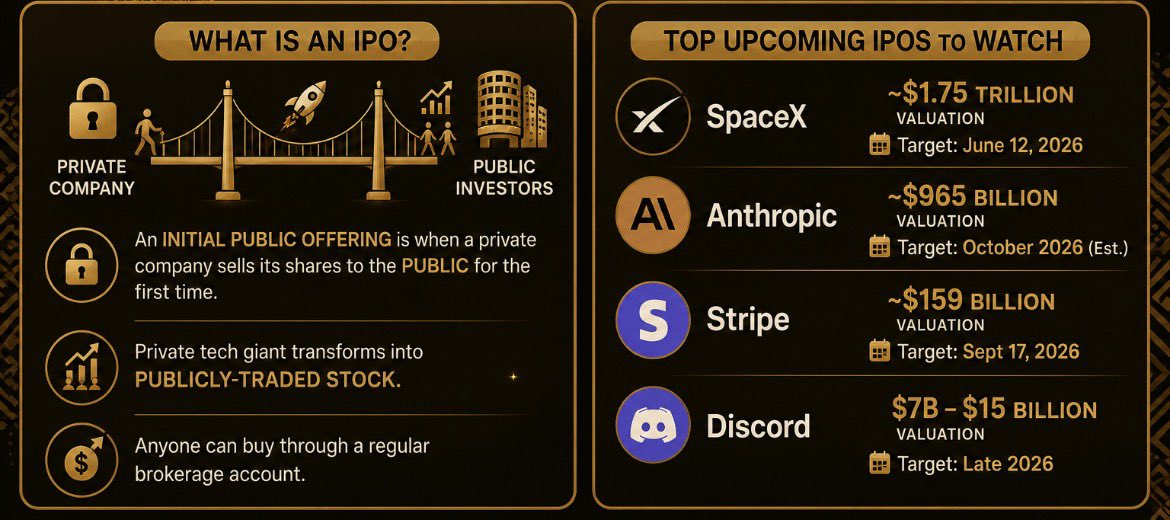
Simply put, an IPO (Initial Public Offering) is when a private company decides to sell its shares to the general public on the stock market for the first time.
It is the exact moment a private tech giant transforms into a publicly traded stock that anyone can buy through a regular brokerage account.
Here are the massive valuations and target windows hitting the market soon:
👾 Discord | $7B - $15 Billion | Target: Late 2026
🚀 SpaceX| ~$1.75 Trillion | Target: June 12, 2026
💳 Stripe | ~$159 Billion | Target: Sept 17, 2026
🧠 Anthropic| ~$965 Billion | Target: October 2026 (Est.)
Bookmark for later
Remember the IPO post I dropped earlier?
You now know a company can “go public” and sell shares to everyday people like you and me. But the big question everyone asks after that is: “How much is the whole company actually worth?” That’s valuation.
Today I’m breaking it down in the simplest way possible in plain English.
✨Valuation is simply “the price tag on a company.” Imagine your friend wants to sell their small delivery business. How much would you pay for it? You look at how much money it makes, the assets, the customers, the future potential. That total “worth” is the valuation. Same thing for big companies.
✨There are two main types you’ll hear about: Pre-IPO valuation (what investors think it’s worth BEFORE it goes public)
and Market valuation (what the public market says it’s worth AFTER IPO).
The market one changes every single second the stock exchange is open,just like prices in a busy market.
✨What’s the simplest way the market decides valuation? Market Capitalization (or Market Cap).
Formula: Current share price × Total number of shares.
Example: If one share of a company is trading at $5,000 and there are 1 million shares, the whole company is valued at $5 billion.
✨Why does valuation even matter to you and me? It tells you if the company is “cheap” or “expensive” before you buy shares. If the valuation is too high compared to what the company actually earns, you might be overpaying,like buying a used car for the price of a brand-new one.
✨Valuation also decides how much your own shares are worth. Suppose you bought shares during IPO at $2,000 each. If the company’s valuation later doubles, your shares might now be worth $4,000. But if valuation drops… your money drops with it. That’s the risk part nobody shouts about.
✨Real-life story: I once saw a friend buy into a “hot” tech company right after IPO because “valuation is growing fast.” Three months later the valuation crashed because the company wasn’t making real profit yet.
She lost 40%. Lesson? Valuation is not a promise it’s just the current market opinion.
✨Quick rules I now follow before buying any public company:
•Check if the valuation makes sense compared to how much profit the company makes.
•Compare with similar companies in the same industry.
•Never chase valuation that’s rising only because of hype.
•Remember: A high valuation doesn’t mean the company is better, it just means people are willing to pay more right now.
✨Moral of the story: Valuation is just the market’s way of saying “this is what we think the company is worth today.” It can go up, it can go down. Your job is to understand it, not fall in love with it. Buy based on real value, not headline numbers.
Now you understand IPO and Valuation in the simplest way possible. Bookmark for later.
You are welcome🤗
@Ichaka_001@WinkLink_Oracle@justinsuntron WINkLink connecting real world data to TRON smart contracts is exactly the bridge that turns static chains into intelligent responsive systems.
@muhitonx@TheARCTERMINAL ARC Drive letting you drop PDFs straight into decentralized storage with ANIMA turning them into living memory in Sovereign Mode is research game changer.