AI can produce answers instantly. This does not mean they are correct.
The risk does not lie with AI. It is unquestioned acceptance.
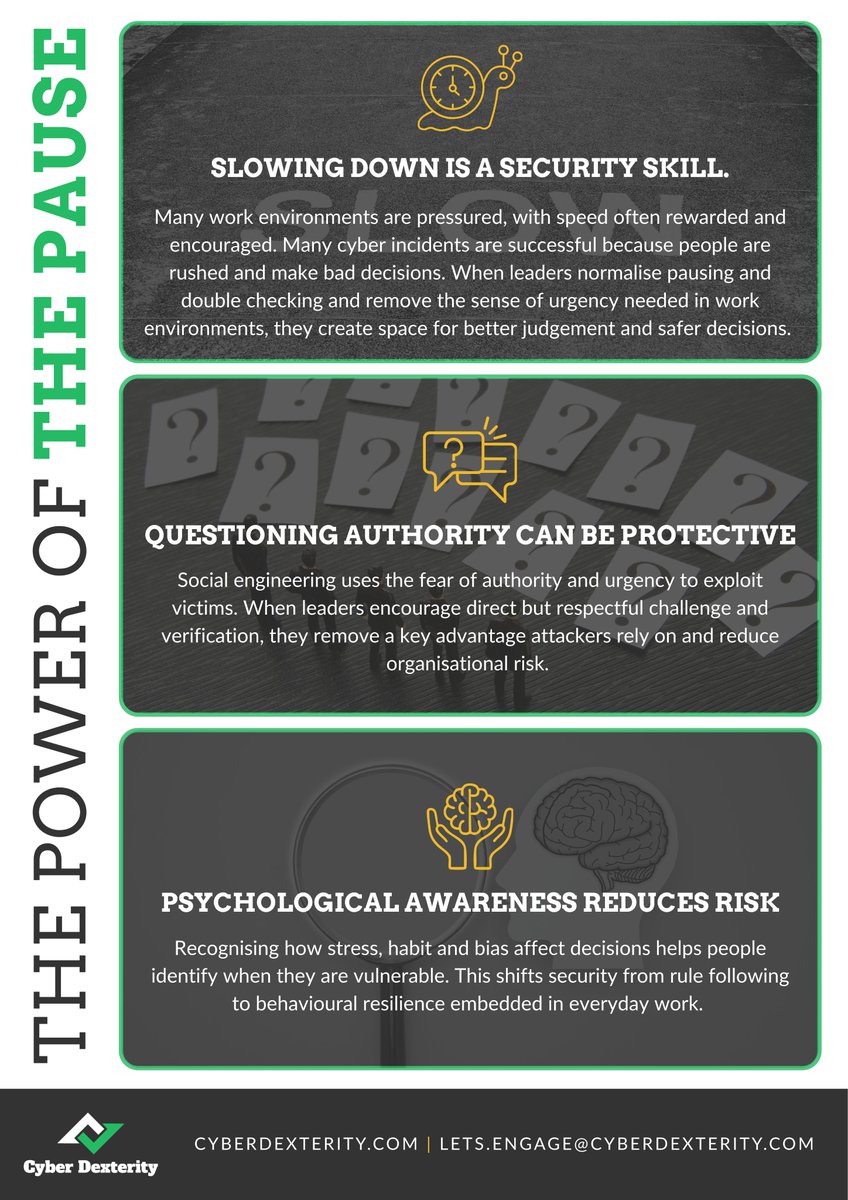
Pause. Reflect. Then decide.
https://t.co/ZRNLFuXa2V
Real-time AI accelerates decision-making. However, when speed replaces scrutiny, judgement declines.
This is a human risk issue worth examining...
https://t.co/ZRNLFuXa2V
#AI#CyberResilience#CyberDexterity
Deepfakes are not a media problem. They are a trust problem. In the recent article for ITWeb, our CEO Antonios Christodoulou asks the real question: not “Can people spot a deepfake?” but “Will they pause, resist pressure and verify when trust is engineered?Read more below.
Cognitive overload does not kill recognition. It kills analysis. Under pressure, working memory shrinks. Judgement drops. That is when cyber deception works.
If a request involves Risk, Money, Access or Identity, pause. Awareness alone fails under stress:https://t.co/qYsacXRi7T
In 2026, we launched a podcast-style learning format that breaks down real cyberattacks through the lens of cyberpsychology. We explore not just what failed, but also why people trusted, clicked or complied.
Check out the teaser here: https://t.co/rtvOaNEf8u
#CyberDexterity
If you can predict human behaviour, you can breach almost any system.
At YPO Cape Town, Tony Christodoulou broke down how modern hackers exploit judgement, context and decision fatigue.
This is cyber risk in the real world.
#YPO#CyberSecurity#HumanFactor#Leadership
Awareness is not the problem. Cognitive overload is.
In her latest article, Taryn-Lee Potgieter explores how multitasking and digital interruption reduce our ability to detect cyber deception, and what organisations can do when overload is unavoidable. https://t.co/qYsacXRi7T
Most cyber scams succeed for one simple reason: People react without thinking. Taking a pause of three to seven seconds can break this pattern.
In this article, we explain why this works and why people still fall for cyber scams: https://t.co/pknudyxpIP
#CyberDexterity
Welcome Myburgh Nel to Cyber Dexterity as Learning Systems Technical Lead! Building smarter learning systems through 3D, automation and technical innovation. #CyberDexterity#NewTeamMember
People fall for cyber scams not because they’re careless, but because attacks exploit how the human brain works.
Urgency, authority and emotion bypass judgement in seconds.
Read why awareness alone fails: https://t.co/pknudyxpIP
#BeyondAwareness#CyberDexterity
Introducing The Framing Effect, our new podcast-style learning experience. We dissect real cyber attacks to expose how criminals exploit context, urgency and authority, and how organisations can reduce human risk in the digital economy. #CyberDexterity#TheFramingEffect
Generative AI is boosting productivity. But at what cost? Our latest article explores how over-reliance on AI can quietly erode critical thinking, increase vulnerability to manipulation, and make convenience feel like insight: https://t.co/As67WKtrel
A massive welcome to Stavros D'Eramo to the team. Appointed as a Junior Content Developer, he will be focusing on research-driven storytelling, video and digital learning, helping us build cyber resilience that actually sticks! #CyberDexterity#Welcome
Proud to share that our founder and CEO, Antonios (Tony) Christodoulou, wrote for ITWeb Client Connect: Beyond awareness: Why cyber security must become a human habit in 2026. Awareness is not behaviour. Ownership is. #CyberDexterity#HumanRisk
Digital arrest scams exploit fear rather than technology. Criminals pose as officials to coerce victims into paying. In this article, our founder Antonios (Tony) Christodoulou breaks down the psychology behind these scams and explains how to resist them: https://t.co/pSEgZpoy4G