This beautiful editorial by @Chris_Surridge of @NaturePlants summarizes the thoughts of the @CSHLplantcourse#FTPS18#Alumni on peer review. "It should be a feedback process to improve science as a whole". https://t.co/VUNXJec3a6, Read here: https://t.co/kqHnAYDU6W
@InibeheEffiong Congratulations Sir! Resilience will always prevail. May the just judge and the monarch of Zion preserve, protect and prolong your strides in your defense of citizens and the law.
@OluwatobiAjayiJ@Iam_akinbusola Building is hardwork, only few muster the courage to finish. Thank you for persevering Sir. Because of you a Nigerian can succeed!
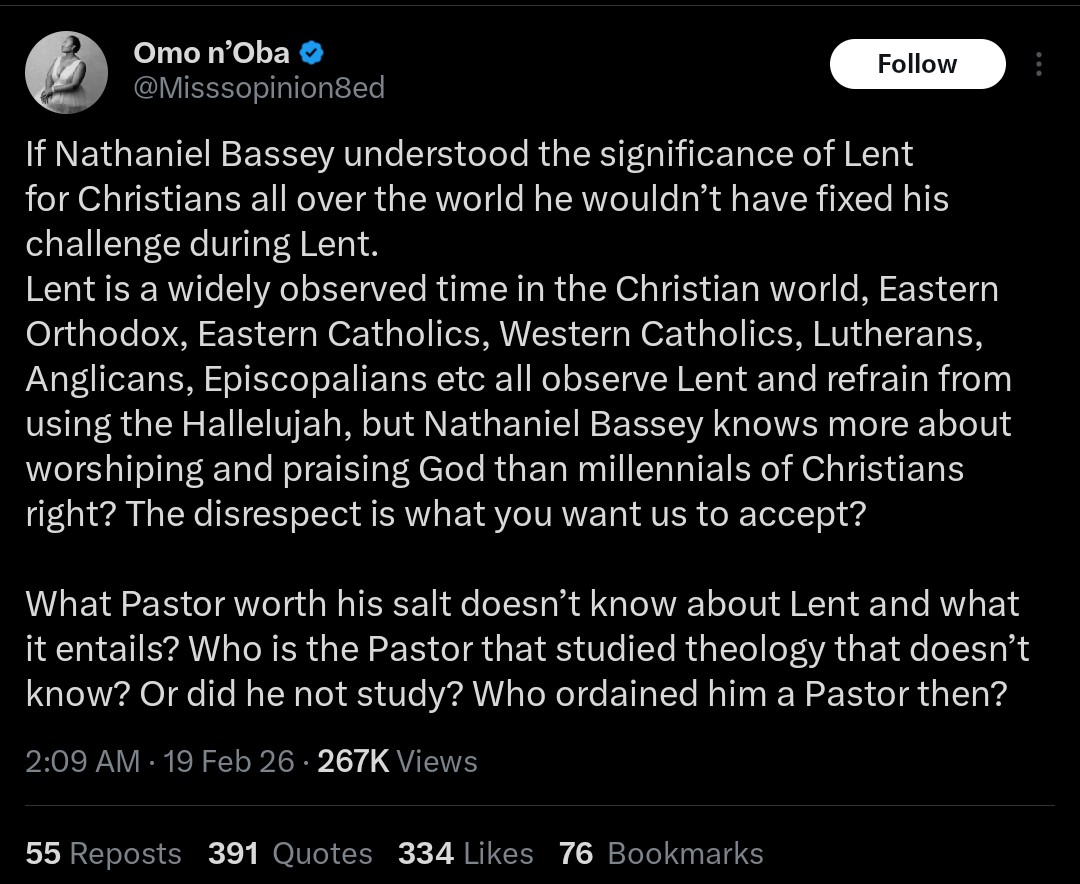
I have been watching the conversations around Lent and Hallelujah Challenge, and honestly, I feel the need to speak — not from a place of attack, but from understanding.
I was once a Catholic. I was in Seminary. I desired to be a priest before life took a different turn. So I understand what Lent means. I understand Ash Wednesday. I understand abstaining from meat on Fridays. I understand confession. I understand the discipline and the doctrine.
And because I understand it, I also know this:
Lent is not just about what you remove from your plate.
It is about what you remove from your heart.
It is not just about avoiding meat on Fridays.
It is about crucifying pride, anger, dishonor, and hatred daily.
It is not just about going to confession every week.
It is about living in a way that reflects what Jesus did on the Cross.
Lent is a season of reflection on the sacrifice of Jesus Christ. A season of humility. A season of repentance. A season of examining your own heart.
So when I see some people on X dragging Nathaniel Bassey over Hallelujah Challenge, I ask myself — is this truly the spirit of Lent?
Hallelujah Challenge has been happening every February for years. It did not start yesterday. It did not start to compete with Lent. It has been a consistent altar of worship long before some of the loudest critics even joined it.
And let’s be clear:
He has never told Catholics to abandon Lent.
He has never preached against Catholic doctrine.
He has never forced anyone to choose between Lent and worship.
So why the dragging? Why the dishonor? Why the insults?
If you are Catholic and you believe that during Lent you should not sing “Hallelujah,” then focus on your Lent. That is your conviction. Honor it. Live it. Practice it with integrity.
But why attack someone who is simply leading worship?
You can: – Pause Hallelujah Challenge and focus fully on Lent.
– Participate in both quietly if your conscience allows.
– Or simply scroll past and mind your devotion.
Spiritual maturity means knowing that not every altar is yours — but you don’t destroy what you don’t attend.
The irony is this:
Lent calls for humility.
Yet some responses are full of pride.
Lent calls for repentance.
Yet some comments are full of accusation.
Lent calls for self-examination.
Yet many are busy examining someone else.
Dragging a man of God publicly, speaking with dishonor, and masking it as “defending doctrine” — is that truly the spirit of Christ?
Even within Christianity, there are different expressions of worship. The Body of Christ is diverse. Catholics have their traditions. Pentecostals have theirs. Evangelicals have theirs. The beauty of the Church is not uniformity — it is unity in Christ.
Maturity is understanding that conviction is personal.
Ignorance is assuming your conviction must control everyone else.
If something offends your doctrine, withdraw respectfully. That is strength.
But attacking, insulting, and misrepresenting? That reveals more about the heart than about theology.
As someone who has walked both spaces, I can say this boldly:
Lent should produce gentleness.
Lent should produce restraint.
Lent should produce Christlike character.
Not online warfare.
The world is already watching the Church. And when believers tear each other apart publicly, what testimony are we giving?
We can disagree without dishonor.
We can uphold doctrine without hostility.
We can stand firm without being rude.
And above all, we can remember that worship is not a competition.
If Hallelujah Challenge is not for you during Lent, that is okay.
If Lent is your focus, embrace it fully.
If you choose both, do it in sincerity.
But let us not reduce Christianity to online arguments and spiritual superiority.
Examine your heart.
Guard your words.
Represent Christ well.
Because at the end of the day, it is not about the programs
And if this season is truly about Him, then our character should reflect Him first.
The Future of Justice is Here!
On February 14th, 2026, we had the distinct honor of hosting the Executive Governor of Enugu State, His Excellency Dr. Peter Mbah, at the Center for DNA Forensics and Criminal Investigation (CEDFOCI).
This wasn’t just a visit; it was a firsthand
@simonsquibb Through @DNALCNigeria I'll invest in buying STEM Equipment to enhance our mission to empower undeserved and under reached students in Nigeria. That way every boy and girl has a decent chance to be a top scientist!
A good time to make this spread and trend again…….
Let’s go !
Jesus just has to be who He says He is. No one gives this joy that He gives.
We celebrate our king, JESUS !
The Farouk Controversy and the Question of Public Responsibility
One of the most talked-about public controersies in recent times is the allegation surrounding Farouk Ahmed. Alhaji Aliko Dangote, President of the Dangote Group, alleged that Mr. Farouk, Chief Executive Officer of the Nigerian Midstream and Downstream Petroleum Regulatory Authority (NMDPRA), spent about $5 million on the secondary school education of his four children in Switzerland. He called for a full investigation and public explanation.
At current exchange rates, $5 million is approximately ₦7.5 billion. In a country with over 18 million out-of-school children — the highest number in the world — this revelation inevitably raises questions of proportionality, public trust, and moral responsibility.
Education is one of the greatest legacies a parent can give a child. No reasonable person begrudges parents for investing in their children’s future. Plato, in The Republic, reminds us that “education and upbringing are what make good human beings,” warning that neglect of education harms not just individuals but the entire constitution of society.
The issue here, therefore, is not education itself, but scale, context, and moral consequence, especially when such spending is attributed to a public official in a country with extreme inequality.
What ₦7.5 Billion Could Do at Home
With ₦7.5 billion, it would be possible to build 25 school blocks, at ₦35 million per block, fully covering construction, furnishing, and basic learning infrastructure. This amounts to ₦875 million in capital expenditure.
Each block contains 6 classrooms.Each classroom accommodates 40 students.
That means:
240 students per block
25 blocks × 240 students = 6,000 students educated every year
Each block would employ 18 teachers, giving a total of 450 teachers. At a monthly salary of ₦125,000, each teacher earns ₦1.5 million per year, bringing the total annual wage bill to ₦675 million. After construction (₦875 million) and one full year of teacher salaries (₦675 million), total expenditure is ₦1.55 billion. This leaves ₦5.95 billion from the original ₦7.5 billion.
Making the System Self-Sustaining
If the remaining ₦5.95 billion is invested in Nigerian government bonds at 19%, it would yield approximately ₦1.13 billion annually.
From this yield, allocating ₦10 million per school block per year for libraries, laboratories, utilities, learning materials, meals, and maintenance would cost:
₦250 million annually (₦10m × 25 blocks)This still leaves ₦880 million per year. From this balance:
₦675 million comfortably pays teachers’ salaries every year
Over ₦200 million remains as surplus, ensuring reserves, expansion, and long-term stability
In effect, the system becomes permanently self-funding, without touching the original capital.
A Moral Contrast (Corrected)
In simple terms, the amount allegedly spent on the education of four children could establish a self-sustaining education ecosystem that:
Educates 6,000 Nigerian children every year
Employs 450 teachers.
Ironically, Nigerian children educated abroad would benefit even more if those who remain at home were educated to comparable standards to work for them and with them when they return. An educated society produces better governance, safer communities, stronger institutions, and a more dignified nation. It is a win-win.
The Larger Question Nigeria has a population of about 240 million people. In a system described by former British Prime Minister David Cameron as “fantastically corrupt,” and by the U.S. President Donald Trump as “a now disgraced country,” it is reasonable to assume that there are at least 2,400 individuals - just 0.0001% of the population - who, like the Farouks, have access to extraordinary resources largely derived from public office.
If 2,400 individuals each sacrificed $5 million, it will achieve the following: