A planet just spoke to us on the radio.
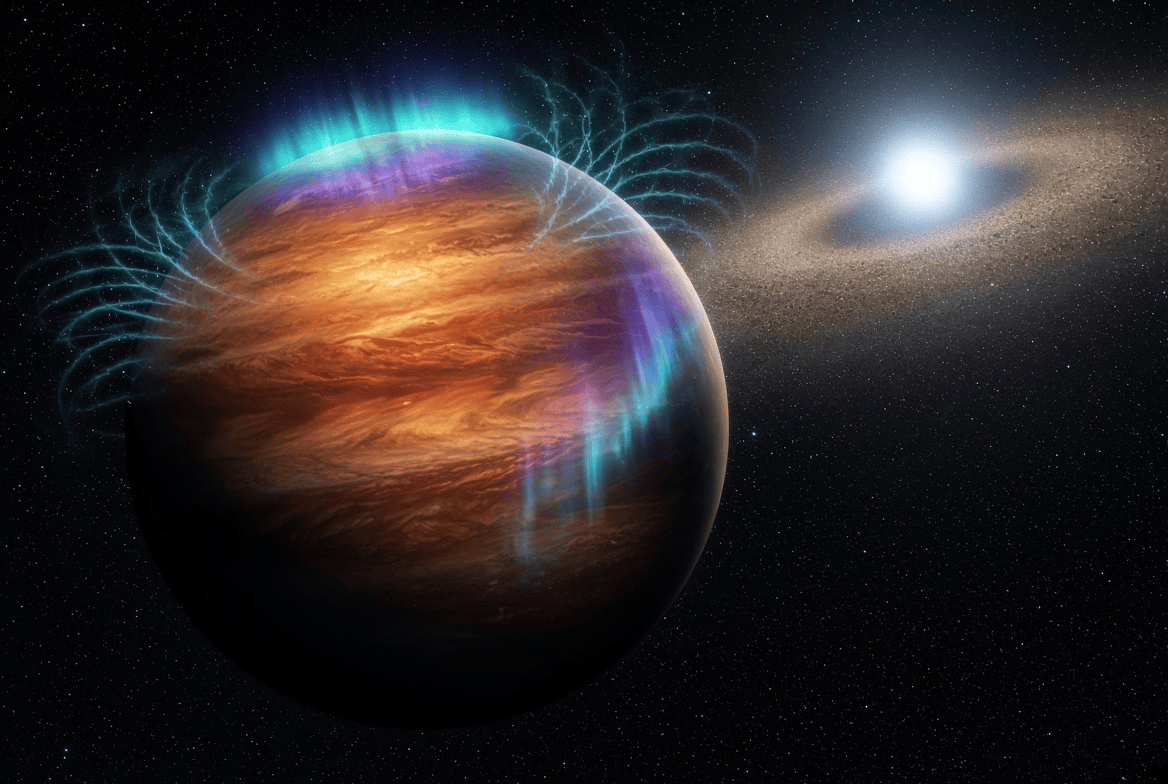
Not a metaphor, and not aliens. For the first time, astronomers have caught a radio signal that comes from an exoplanet itself rather than from its star. The voice belongs to Beta Pictoris b, a young gas giant 63 light-years from Earth. Those bursts did more than announce the planet’s presence: they let scientists measure an exoplanet’s magnetic field directly for the first time.
Beta Pictoris b is a heavyweight, about 12 times the mass of Jupiter. It orbits a young A6V star at roughly 1.5 billion kilometers — about as far as Saturn sits from the Sun. The system is only around 23 million years old. The planet is still hot, massive, and unusually convenient to study. Worlds like this were long expected to have strong magnetic fields and vivid auroras. Now one of them has been heard.
In 2025 and 2026, South Africa’s MeerKAT radio array watched the system four times. Between 0.85 and 3.5 GHz it recorded two kinds of emission: a relatively steady glow and short, repeating bursts. The most telling clue was strong circular polarization. The radio waves arrived as if they were traveling in a corkscrew; some bursts reached about 70 percent polarization. That is the signature of charged particles spiraling in a planetary magnetic field — the same process that powers auroras on Earth and Jupiter.
To prove the source was the planet, the team pinned the radio source to the sky using distant quasars as reference points. The position lined up with Beta Pictoris b. The host star and the neighboring planet Beta Pictoris c were ruled out with high statistical confidence.
From the highest frequency of the bursts, the researchers inferred a magnetic field of at least 1.25 kilogauss at the emission site. That is the first direct measurement of an exoplanet’s magnetic field, and it matches theoretical expectations for a young, massive gas giant.
What powers the bursts? The leading idea is the planet’s rapid spin. One rotation takes about nine hours. In one observing session, the gap between the first and third burst was about eight hours — as if a particular region of the magnetosphere was sweeping into view. Longer campaigns will be needed to confirm that. Stellar wind and a possible moon were considered too, but both would produce a much weaker signal than what MeerKAT saw.
The discovery matters beyond this one world. Magnetic fields shape how a planet interacts with stellar wind, how quickly it loses atmosphere, and what is happening in its interior. They are almost impossible to measure around distant planets by other means. Radio emission now offers a new tool. Several other gas giants have already been flagged as candidates for the same method. Current telescopes are often not sensitive enough, but the next generation should pick up far fainter planetary voices.
Beta Pictoris b simply got through the cosmic noise first. Astronomers can now not only see distant planets, but listen to the invisible shields that surround them.
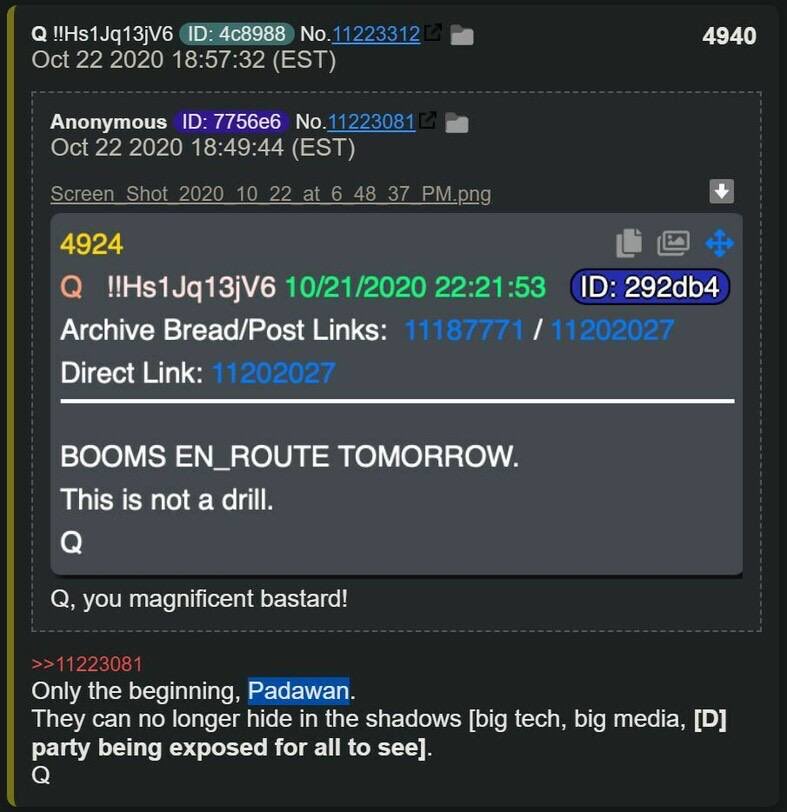
Q makes multiple Star Wars references
To be blunt: It's Literal
The Orion Wars shown in Star Wars is based on True History
You & I came from those Wars
Due to the Universal Law of Noninterference, we couldn't just directly intervene with Earth...how did we get around this?
We incarnated into Earth Bodies
"To my fellow incarnated extraterrestrials" = Q Agreed