how many blobs is enough? ●●
3670 total supply
date: 4 PM UTC may 28
FREE - just tweet / 1 per wallet
WL - 0.0022 ETH / 2 per wallet
public - 0.0044 ETH / 3 per wallet
24h left to earn free access ●●
the path begins at https://t.co/OGSh9LLTa0
blob blob below
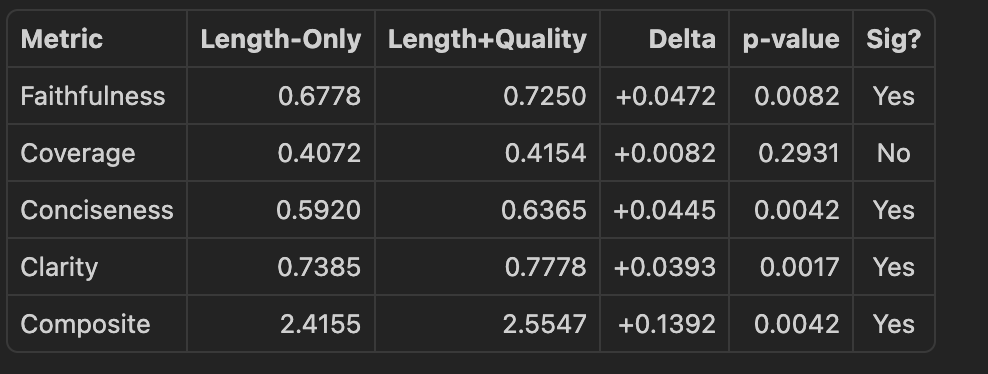
Training Qwen2.5-0.5B-Instruct on Reddit posts summarization tasks with length constraint on my 3xMac Minis with GRPO - evals update
So, I trained two variants of this task:
>using just length penalty
>using a quality reward and length penalty
I ran LLM-As-A-Judge eval for checking the summarization quality using DeepEval tools. Those are:
>Consciencess
>Coverage
>Clarity
>Faitfullness
Th results are as follows:
1) with quality + length penalty rewards: 2.5/4
2) with just length penalty: 2.4/5
Results:
Both are significant with a p-value of 0.0042 using one-sided t-test with a total of 5 rounds of evals for each model.
Performed on the test sample of 200 of smoltldr dataset.
Baseline: length penalty only
Pause AI rhetoric is predicated on the notion that the AI companies are recklessly racing toward dangerous tech and that a government controlled pause button is therefore necessary, but this seems really hard to reconcile with the fact that government is attempting to destroy an AI company because *the government* is racing toward plausibly dangerous AI uses (Sec. Hegseth has stated in official directives that he wants to deploy AI into critical systems regardless of whether it is aligned, for example) and *the company* is pushing back.
The roles are totally reversed from the logic that Pause AI and frankly other AI safety advocates confidently assumed for years. It is *industry* that is in favor of alignment and at least somewhat measured deployment risks, and government whose actions seem much closer to reckless.
I predicted this for years. I said, in particular, that pauses and bans and licensing regimes gave government a dangerously high degree of control over AI, and that the incentives of government are much more dangerous than those of private industry with competitive market incentives.
I believe the events of the last month are good evidence in favor of my view. At this point if you are an AI safety advocate whose policy proposals do not wrestle seriously with the brutal political economic reality of the state and AI, I don’t take you seriously.
It gives me no pleasure to have been right about this, by the way. The state has an incredibly strong structural incentive to centralize power using AI, and we are, all of us, not so empowered to stop it. I am quite concerned about this.
An MQ-4C Triton sent an emergency “7700” signal and disappeared from public tracking near Iran. Some reports speculate it may have been affected by Iranian actions, but no official confirmation exists about it.
Nick Bostrom’s new paper:
>Developing superintelligence is not like playing Russian roulette; it is more like undergoing risky surgery for a condition that will otherwise prove fatal.
> One could equally maintain that if nobody builds it, everyone dies. In fact, most people are already dead. The rest of us are on course to follow within a few short decades. For many individuals—such as the elderly and the gravely ill—the end is much closer. Part of the promise of superintelligence is that it might fundamentally change this condition."
>Along one path (forgoing superintelligence), 170,000 people die every day of disease, aging, and other tragedies.
>The choice before us, therefore, is not between a risk-free baseline and a risky AI venture. It is between different risky trajectories, each exposing us to a different set of hazards.
>Imagine curing Alzheimer's disease by regrowing the lost neurons in the patient's brain. Imagine treating cancer with targeted therapies that eliminate every tumor cell but cause none of the horrible side effects of today's chemotherapy. Imagine restoring ailing joints and clogged arteries to a pristine youthful condition. These scenarios become realistic and imminent with superintelligence guiding our science.
>We assume that rejuvenation medicine could reduce mortality rates to a constant level similar to that currently enjoyed by healthy 20-year-olds in developed countries, which corresponds to a life expectancy of around 1,400 years.
>Developing superintelligence increases our remaining life expectancy provided that the probability of AI-induced annihilation is below 97%.
Micron is moving to expand memory output in Taiwan, signing a letter of intent to buy a Powerchip Semiconductor (PSMC) site in Miaoli County for US$1.8 billion. The company says it expects major production by the second half of 2027.