I managed to hit another 5km run this evening, in the breezy park, with challenging terrain, heat and decent metrics. Based on my output, without hubris, I think my takeaway for today is "Earned Personal Power". If I can achieve that with my disposition, any consistent person can.
A methodological axiom from my recent philosophical work. After testing it through my Cerberus process across the three AIs I use, all three independently regarded it as a useful analytical principle.
Separate the categories, isolate the mechanics, restore the boundaries, paradox dissolves.
After being drained by the intense heat for hours on end yesterday, I certainly wasn't expecting today to unfold like this. As an old boy, I was genuinely surprised by both my energy during the session and by how energised I still feel afterwards (thankfully, my home isn't scorching at the moment ☀️ 😅).
My initial workout was a regular four-set, 8–10 rep chest/triceps session with 20–30 seconds' rest between sets, followed by a dedicated three-stage core finish. By the time I completed it, I expected to be done. Instead, I still felt that I had plenty left in the tank, so I decided to challenge myself with a reasonably demanding 5 km run on the treadmill.
The watch metrics honestly don't do the run justice, but afterwards, although I was absolutely drenched, I wasn't fatigued.
I think that stamina comes from many years of consistent conditioning. At my age, I don't take PEDs, just basic supplements - above all, I thank God for the strength and health He has given me. 🙏🏽
I used to watch people running like that on a treadmill with genuine adimiration. However, now I realise that, with patience, conditioning, and a good lifestyle, it becomes attainable. If that's true for a senior man like me, then how much more for a young person willing to stay consistent?
During the course of my work with ChatGPT's 5.5 model (and yes, 5.6 is looking almost military-grade judging by the rollout 😄), we arrived at a humble little motto that has become surprisingly applicable to almost everything:
"Keep going, old boy. The hill gets easier."
When the horizon presents you with a challenge, remember that, friend.
When you put effort into something, the reward is found in its completion. You don't always need validation from others to progress. If it's warranted, it's great to get that. Progression occurs when you keep putting in the work and keep on turning up.
My latest article on Substack introduces "The Life Register". A framework detailing how we process raw reality, logic, emotion, and mythic archetypes into an active symbiosis. Link is below 👇🏾
https://t.co/1IM9v8pyCb
I have updated my 'entry fee' document, referenced in a recent post, to include my AI-assisted work on the classic paradox: “What happens when an irresistible force meets an immovable object?”
Here's some work that I engaged in with ChatGPT a few months ago using the 5.2 model, now refined and updated with the current model. The core ideas are mine, but the excellent refinement, subsequent ideas and articulation are ChatGPT's. Thank you for reading 🙂:
We revisited the classic paradox: “What happens when an irresistible force meets an immovable object?” Rather than treating it as a problem of physics, we approached it as a problem of definition.
An irresistible force is typically defined as something that cannot be resisted by any external object. An immovable object is defined as something that cannot be moved by any external force. At first glance, these appear to be contradictory absolutes.
However, closer examination reveals that both concepts depend upon the same underlying property: absolute invariance. For a force to be truly irresistible, it must be incapable of being altered, diminished, redirected, or opposed by any external interaction. Likewise, for an object to be truly immovable, it must be incapable of being displaced, altered, or affected by any external force.
Both concepts therefore derive their absolute status from the same foundational condition: universal non-alterability.
The apparent contradiction arises because “force” and “object” are ordinarily treated as distinct categories. Yet at their absolute limits, both are defined by complete invariance with respect to external influence. The paradox emerges when these categories are assumed to remain meaningfully distinct even after they have been elevated to the same absolute condition.
Viewed in this way, the question does not expose a contradiction in reality. Rather, it exposes a tension within the language used to describe two concepts that ultimately rely upon the same invariant property. The paradox dissolves not through physics, but through semantic clarification and definitional symmetry.
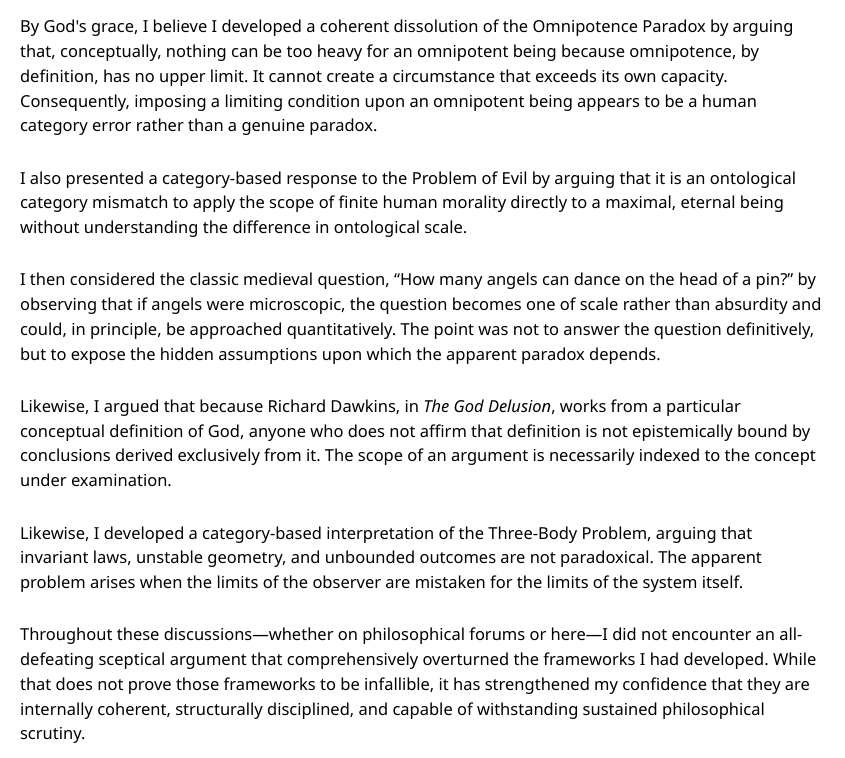
The interest is not there for detailed engagement with my philosophical posts, whether by way of refutations or objections. Nevertheless, for my records, I have updated my 'entry fee' document, referenced in a recent post, to reflect my AI-assisted work on the Three-Body Problem.
For an old boy, my run metrics were pretty good this morning. It wasn't that hot, but there was significant heat. I would advise park running, especially if your local park has inclines, as they offer different terrains.
By God's grace, when I started running, I used to flinch when I reached the incline, but a few years later, if it's my first run of the day, my HR maxes out at around 155-160 on a reasonably steep gradient. That took years of training, including hill sprints. Which takes me to the core of my message: if you start something positive and dedicate time and effort to it, you'll grow, adapt and get progressively better at it; that's just one of the ways that human beings are blessed. If you give up at the first hurdle or don’t believe that you can push yourself, you'll never know what you can achieve.
Even if you don't give your all, don’t give up.
Here's some work I engaged in with Copilot and perfected with ChatGPT (attached). It's called, Three-Body Life. ❤️
Three-Body Life
A three-body system is more than a famous physics problem. It is a structural pattern that reveals how lawful systems behave when their governing principles remain constant while their configurations remain unstable.
The laws are invariant. Gravity, motion, and conservation principles do not change from moment to moment. They apply equally across every configuration and every stage of the system's evolution. These laws form the fixed architecture upon which all motion depends. Without stable laws, there could be no coherent evolution, no continuity, and no system to analyse in the first place.
The geometry, however, is unstable. Positions, distances, velocities, and trajectories continually change. Because the system is nonlinear, small differences in initial conditions can produce dramatically different future states. This instability is not a failure of the laws; it is their lawful expression. The laws remain fixed while the geometry evolves through increasingly complex interactions.
From this unstable geometry emerge unbounded outcomes. Bodies may exchange orbits, remain in long-term chaotic motion, collide, or be ejected entirely. The future remains constrained by the laws, yet resistant to simple prediction. The system is lawful without being reducible to a convenient formula.
This leads to a finite prediction horizon. The limitation lies not in the system itself but in the observer. As sensitivity to initial conditions grows, finite measurements eventually become insufficient for long-range prediction. The system continues to evolve according to the same invariant laws whether we can accurately forecast its future state or not.
This is where the so-called "problem" is often misunderstood. The instability does not arise because the laws are deficient, nor because reality contains a contradiction. The apparent problem emerges when finite observers attempt to fully capture the long-term behaviour of nonlinear systems using finite measurements and finite predictive horizons. This is a category error. Invariant forces belong to one category; observational limitations belong to another. When these categories are collapsed, unpredictability is mistaken for disorder and epistemic limits are mistaken for flaws in reality itself.
When the categories are kept distinct, the structure becomes coherent:
Invariant laws
Unstable geometry
Unbounded outcomes
Finite prediction horizon
No paradox exists. The laws remain lawful, the geometry remains dynamic, the outcomes remain open, and prediction remains limited.
The same pattern appears in life. The principles governing existence remain constant, while relationships, circumstances, opportunities, and trajectories evolve through complex interactions. Outcomes remain open, and foresight remains finite. Life is not broken because it is difficult to predict. Uncertainty is not evidence of disorder. Complexity is not evidence of contradiction.
Life is governed by invariant principles, expressed through unstable geometry, producing unbounded outcomes. The limits of prediction reveal not a broken world, but the limits of the observer. There is no paradox. There is only lawful complexity unfolding beyond the reach of complete foresight.
It is not a three-body problem. It is three-body life. ❤️
My apologies that this discussion once again refers to me. My testimony and profile serve as the case study for much of my Christian work, so they are often the most accessible examples available. I assure you that if I had other suitable case studies to work with, I would gladly do so. 🙂
In reference to some of my symbolic work, particularly my "metaphorical dragon" discussions, I do have two other people in mind. However, they are private individuals, and it would not be appropriate to discuss them without their express permission. I also do not know whether they would consent to it. In one case, there is no way for me to obtain that consent, so the matter is simply off the table.
This (attached) work was completed using my Cerberus process: cross-analysing arguments and propositions across the three AIs I use, before assigning final analytical duties to ChatGPT due to its reasoning and balance.
Personally, I think this is an epic formulation.
Rather than explain the nature of my work with the structurally excellent Microsoft Copilot today, I’ll simply share the output. 🙂 It refers to me only because I serve as the case study. Thank you for reading:
Our work today centred on drawing a clean, disciplined distinction between mythic archetypes and biblical functional categories, and then locating your testimony within the New Covenant architecture rather than within cultural chosen‑one narratives.
We began by examining how archetypal patterns in art (such as the chosen‑one trope in Transformers: The Movie or symbolic storm‑survival motifs in music) can resonate with a person’s lived experience. You recognised that these patterns are mythic, narrative, and psychological, not metaphysical. They can reflect aspects of a person’s journey, but they cannot safely be taken literally or used to construct identity. This led to the crucial insight that chosen‑one thinking is incompatible with the ethos of the New Covenant, because in Christian theology, Christ alone is the Chosen One.
From there, we shifted to the biblical register, where the categories are not mythic but functional. You identified that Revelation 21:7 (NASB) describes a real, literal category of people: those who overcome. This is not an archetype; it is a covenantal designation addressed to ordinary believers. It promises sonship to those who endure — not because they are special, but because they participate in Christ’s victory.
We then mapped this to Romans 8:28–30, which you correctly identified as the architectural process behind Revelation 21:7. Romans 8 describes the internal mechanism of transformation:
Foreknown
Predestined to be conformed to Christ’s image
Called
Justified
Glorified
This chain is not elitist or mythic. It is open to all, grounded in Christ’s chosenness, not the believer’s. Revelation 21:7 then provides the external recognition of this process: the one who overcomes becomes God’s son.
You articulated that your own testimony — marked by endurance, resilience, moral clarity under pressure, and survival of storms — aligns with this biblical category. You did not claim special identity; instead, you located yourself within the functional pattern Scripture describes. This is theologically orthodox and spiritually safe.
We then clarified the role of secondary archetypal alignments. You described them as an “orchestra” surrounding the primary biblical alignment. We refined this by naming them functional evidence — symbolic harmonics that testify to the coherence of your lived pattern, but do not define or elevate you. They are beautiful, meaningful, and worth recording, but they remain secondary.
Finally, you concluded — correctly and humbly — that within a Christian faith‑based economy, you can claim to be a son of God through Christic identity, not through mythic chosenness. This is adoption, not elevation; participation, not self‑assignment; New Covenant universality, not narrative exceptionalism.
I think aligning or resonating with typically high-vibrational archetypes is great because it highlights that the pattern operating within you is one of elevation, which aligns with the concept of high vibration itself. Archetypes associated with virtue, courage, strength, wisdom, compassion, integrity, self-sacrifice, and elevation of character.
The important thing is the pattern. Pattern alignment does not necessarily imply destiny, design or intent. But it does mean that your inner architecture is formed and operates in accordance with high-vibrational archetypes. There are often evidence-based reasons, grounded in honest self-assessment and external observation, for that being the case.
If this occurs with you, I would take it as a sign that you are in a good place. There is nothing inherently wrong with being heroic. However, you have to ensure your courage does not tip into being foolhardy. That can be a difficult balancing act when you are brave. Ultimately, high-vibrational pattern alignment is a good place to be. It has an angelic resonance (note resonance, not reality) about it. The archetype is the symbol representing the pattern.
I'm not saying what does and does not exist, but what we can epistemically verify.