¿Te interesan los retos demográficos? ¿Tienes vocación por la #investigación? ¿Quieres hacer la #tesis en #Demografía con nosotros? Ofrecemos 3 contratos DEMOS: ✅3 años ✅1285 € mes/bruto.
Solicitudes hasta el 📆15/01/2021🔚
🔽 https://t.co/H2ZY9xm8kV
@UABBarcelona@iCERCA
New job opening at my department!
#Postdoc position on:
Uncertainty, Media Coverage of the Economy, and Family Life Courses
Contact persons:
Daniele Vignoli, [email protected]
Raffaele Guetto, [email protected]
(1/n)
JOB OPENING
Postdoctoral Social Scientist in the Field of Private Wealth Research @MPIfG_Cologne Applications: November 1, 2020 https://t.co/mNg74eNyvQ
📢📢Call for two 3-year postdocs within the ERC-project "Sexual Minorities and Inequality of Opportunity" now online: https://t.co/syTfEUFgGv
Application Deadline 1st of November
#MINEQ_ERC
•In our new paper w/@JackSocUQ @JaneenBaxter7 we find that risk of union dissolution increases when either partner reports an illness. Financial stress arises as a relevant mediator of the association. Check it out:… https://t.co/sRsSmIRo9G
Can't wait to start this project! I feel very lucky having made the cut. We will be looking for postdocs (call should be out within the next weeks) and a PhD student (later this academic year) to work within the project. Will keep you posted!
📢📢We are very happy to announce that our researcher @DBoertien has been awarded an #ERCStG to study inequality of opportunity experienced by sexual minority groups from a cross-national perspective #MINEQ_ERC@ERC_Research
"The Wealth of Parents" joint work with @DBoertien and @mettegoertz where we look at the evolution of homogamy in parental wealth (do children from rich families marry each other?) is out in Demography now https://t.co/kzRfIQhxb6 👇 thread
Paper w Philipp Lersch on household wealth and separation in Germany now online @JMF_NCFR. Women experience major drops in household wealth after both separation from marriage and cohabitation, for men this is only the case after ending a marriage. https://t.co/omZ8bkKSUK
Standard errors of our analysis are large, hence, future confirmation of results extra desirable. But if confirmed, it raises the question of whether regulating division of (parts of) household wealth after separation of cohabiting unions should be debated or not.
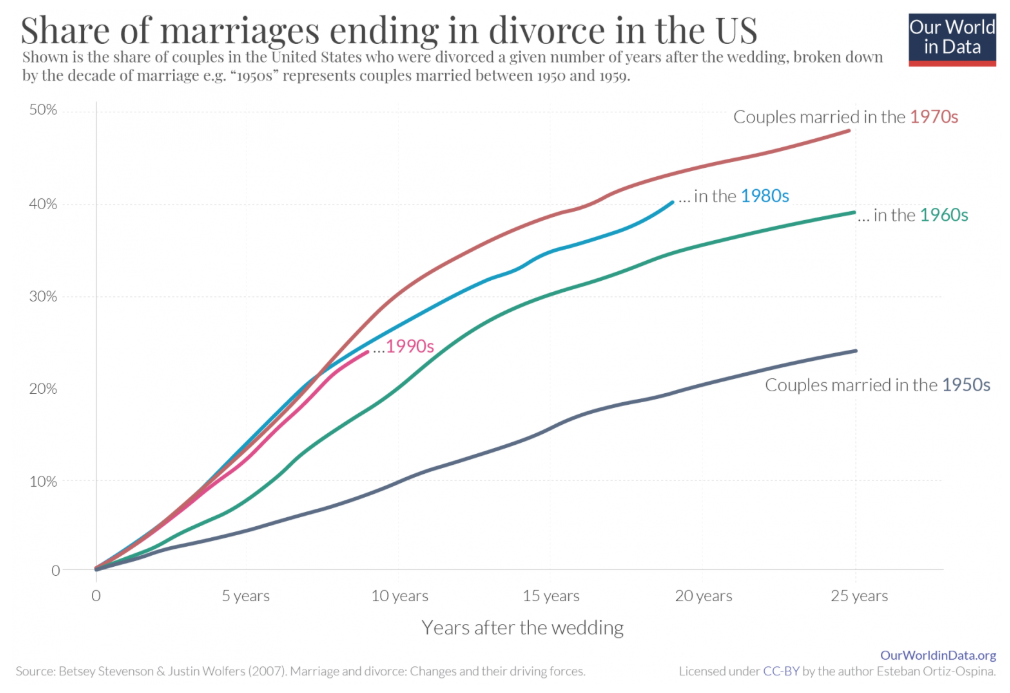
The latest "Our world in data" article is on marriage and divorce, some nice elements, particularly for teaching in family sociology and demography in there. https://t.co/zJXuN3iC8p
Although marital dissolution substantially reduced both men and women's wealth, within-couple wealth inequalies are maintained at divorce as @NicoleKapelle and @JaneenBaxter7 show. Another great publication from our #MyWealth team: https://t.co/IaMq3RN0m3
The top richest 1% changed in composition across time. Until the 16th century, it was almost compounded by nobles, while 3 centuries later mostly by bourgeoisies. However, it was in the transition between the two groups when the top 1% concentrated more wealth (almost 20%).
My paper on late parenthood across the low fertility countries is published: much sharper rise among women than men, and people are now clearly challenging the natural fertility barriers, particularly for a first child.
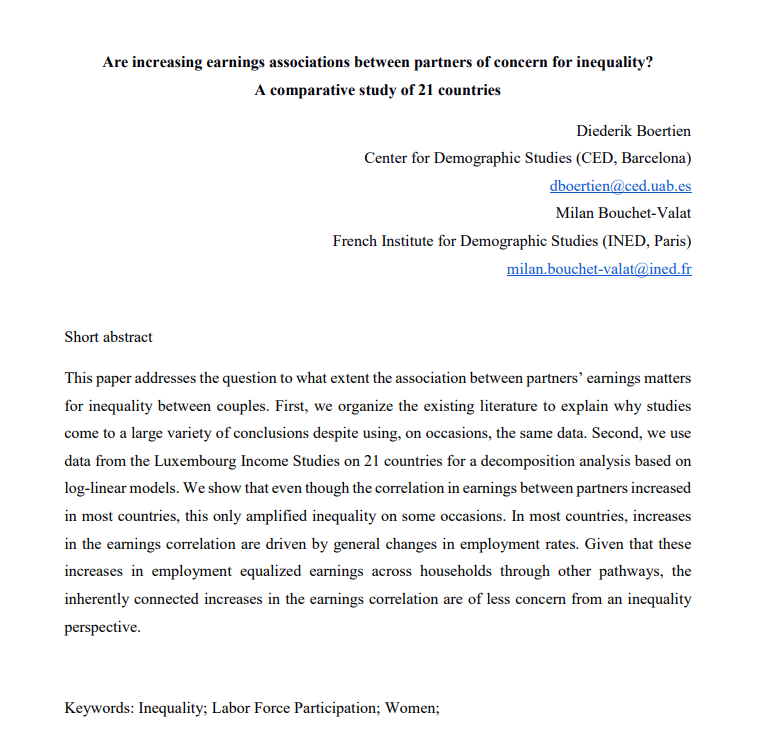
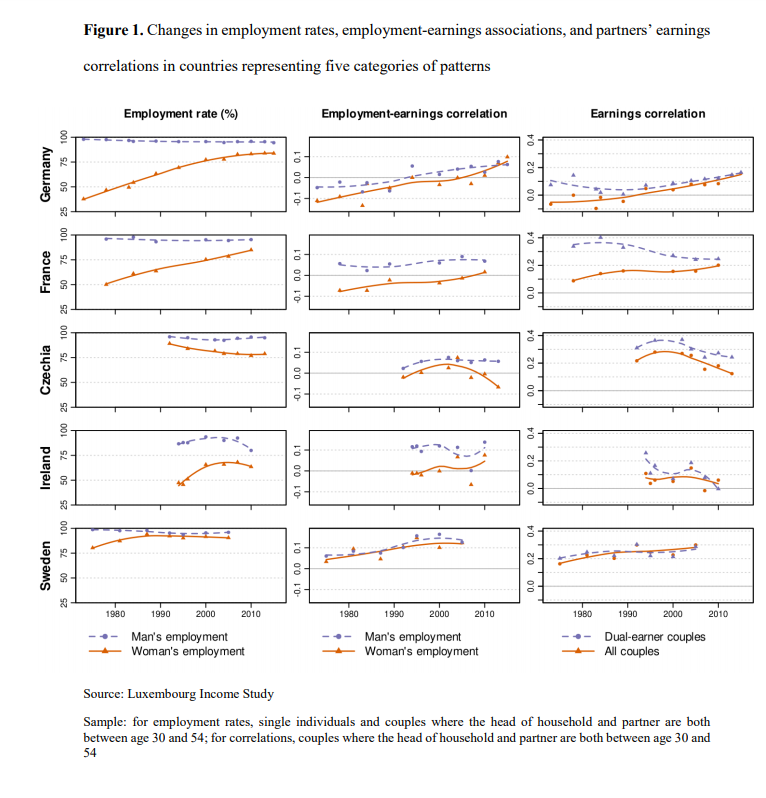
New paper by @DBoertien and Milan Bouchet-Valet:
While 💰 correlations of 💑↗️ mostly, this only sometimes implies ↗️ inequality as increasing female employment tends to increase earnings correlation but decrease inequality through other channels https://t.co/eCreF2hJBd