She’s 54.
And she looks better than most people half her age.
Not from crushing workouts.
Not from a perfect diet.
Just 8 minutes every morning of simple movement to lower stress and inflammation.
20 minute Full Body. My 4 week post surgery, but also a great beginner routine.
Patiently and slowly getting back into working out after my hernia surgery.
1. Squat with single arm high knee kicks
🚨 LO DESPIDIERON DE APPLE A STEVE JOBS
Y luego apareció en el MIT y soltó la masterclass de negocios más salvaje, cruda y sin filtro de 60 minutos que existe.
Cero diplomacia.
Cero imagen que cuidar.
Cero mentiras de corporación.
Solo la verdad más brutal del mismo tipo que construyó Apple… y que estaba a punto de volver a hacerlo 10 veces más grande.
Deja de scrollear AHORA.
Mira esto esta noche en vez de Netflix.
Guárdalo. Vas a volver a él más de una vez
A billionaire went on stage and explained in 42 minutes how the entire economy works. for free. Wall Street spent the next decade pretending nobody saw it.
he didn't sell a course. he didn't plug a fund. he stood at a whiteboard and drew three lines that explain every crash, every recovery, and every rate decision since 1929.
MBA programs charge $200,000 to teach frameworks he covered in the first 15 minutes. six of the models he drew on that board are still classified as proprietary at three major banks. he gave them away on YouTube.
the part nobody talks about: he predicted exactly what happened in 2020, two years before it played out. interest rates hitting zero, the central bank running out of tools, the money printer. he drew it on a whiteboard in 2018 like he was reading tomorrow's newspaper.
a portfolio manager at a top-five firm told me every new analyst on his desk watches this before they're allowed to open a terminal. not the CFA prep. not the internal training. this one lecture.
40 million people have seen it. almost none of them can name the three forces he draws in the first ten minutes.
it is still free.
MIT filmed a calculus course in black and white decades ago and it still teaches better than most of what shipped this year. Almost nobody watches it.
This is Calculus Revisited, Unit 1, Lecture 1, taught by Herb Gross. Analytic geometry from the ground up, chalk on a board, 1 camera locked in place.
Gross built the course for adults returning to math after years away. No prerequisites assumed. Every idea earned in front of you instead of quoted from a textbook.
The opening move is simple division written on the board. From there he shows why coordinates work at all, the thing most courses skip and every student silently fakes.
Watch how slowly he goes. Each step spoken out loud, nothing left implicit, the pace of someone who expects you to actually follow.
A backend engineer I know rewatched Unit 1 twice before touching linear algebra and said it fixed a gap he'd carried for 12 years.
MIT put the whole course online free under Creative Commons.
Production value aged badly. The teaching didn't.
instead of watching 2 hours of Netflix tonight, watch this Stanford lecture
it's the clearest explanation I've seen of how ChatGPT and Claude actually work
useful whether you've never touched AI in your life or have been using it every day for the past year
I took the key ideas and turned them into a practical guide on how to actually get 100% out of Claude
everything in one place
lIf you do anything today, watch @MaeveHalligan at the Cambridge Union. I genuinely think this was the first time many people in that room were confronted with the hard reality of the trans debate, rather than the slogans that usually surround it.
@BuckAngel was exceptional: calm, articulate, humane. Ultimate respect.
And then there was Helen Webberley. I remember once thinking the criticism directed at her by GC women was excessive, especially the claim she was ‘pure evil’. After hearing her speak, I no longer think that. She is totally insincere. I can deal with hard ideologues- they believe they are telling the truth; they are genuine, @HelenWebberley is different.
One audience member, a trans-identified male and former patient of hers, stood to speak during points of information. His account of how he had been treated was deeply disturbing.
Watch the full debate. It is worth your time.
BEST YOUTUBE CHANNELS TO GET FIT WITHOUT A GYM:
1. Bodyweight Training → Calisthenics Movement
2. Home Workouts → FitnessBlender
3. Yoga for Beginners → Yoga With Adriene
4. Mobility and Flexibility → Tom Merrick
5. HIIT Training → Sydney Cummings Houdyshell
6. Street Workout → Hannibal For King
7. Running and Cardio → Global Triathlon Network
8. Nutrition Basics → Jeff Nippard
9. Fat Loss Science → Renaissance Periodization
10. Beginner Strength → Athlean X
11. Stretching and Recovery → Bob and Brad
12. Mental and Physical Balance → Movement by David
13. Functional Fitness → THENX
14. Female Fitness → Heather Robertson
15. Sports Science → Squat University
16. Habit Building Around Fitness → Thomas DeLauer
17. Long Term Athletic Development → Knees Over Toes Guy
18. Pilates at Home → Move With Nicole
19. Senior Fitness → HASfit
20. Kids and Family Fitness → Cosmic Kids Yoga
21. Martial Arts at Home → Howcast Martial Arts
22. Jump Rope Training → Jump Rope Dudes
23. Dance Fitness → The Fitness Marshall
24. Swimming Technique → Swim University
25. Cycling at Home → Global Cycling Network
26. Mindful Movement → Boho Beautiful
27. Posture Correction → Upright Health
28. Core Strength → Caroline Girvan
29. Parkour Basics → Storror
30. Boxing at Home → FightTips
31. Breathwork and Recovery → Wim Hof Method
32. Injury Prevention → Physical Therapy Video
33. Meal Prep for Fitness → Remington James
34. Sleep and Recovery Science → Andrew Huberman Clips
35. Outdoor Fitness → Hybrid Calisthenics
36. Body Recomposition → Greg Doucette
37. Intermittent Fasting → Jason Fung Lectures
38. Mental Fitness and Discipline → David Goggins Clips
39. Gymnastics Basics → GMB Fitness
40. Foam Rolling and Myofascial Release → The Ready State
41. Resistance Bands Training → Anabolic Aliens
42. Postpartum Fitness → Mama Lion Strong
43. Hiking and Outdoor Conditioning → Andrew Skurka
44. Sports Specific Training → Overtime Athletes
45. Hormone and Metabolism Health → Rhonda Patrick Clips
46. Plant Based Fitness → Simnett Nutrition
47. Weight Loss Mindset → Jordan Syatt
48. Balance and Coordination → GMB Elements
49. Cold Exposure and Fitness → Morozko Forge Clips
50. Complete Beginner Fitness Guide → Natacha Océane
Jane Street pays $650,000 a year for quants. MIT wrote the exact bible to get there & released it for free.
51 pages. Zero to quant. Probability, stats, market making, real interview questions from Jane Street, Citadel, Two Sigma & more. Bookmark, before someone takes it down.
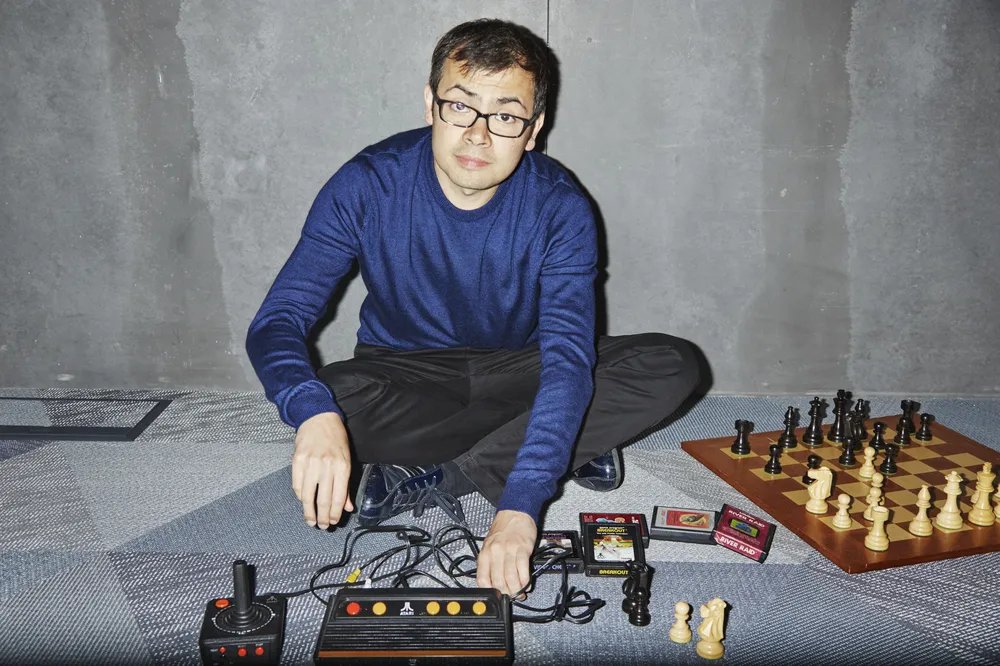
A British kid became a chess master at 13, then a bestselling video game designer at 17, then a PhD neuroscientist at 33, then the CEO of the AI lab that won the 2024 Nobel Prize in Chemistry.
People called him unfocused for twenty years. He was running the most deliberate career plan in modern science.
His name is Demis Hassabis, and the thing almost nobody understood while he was doing it was that every single step was feeding the same underlying obsession.
Here is the thread that connects the whole career, and why it matters for how anyone should think about building toward a hard goal.
The chess came first. He was born in London in 1976 and started playing at age four. By eight, he was the London champion for his age group. By thirteen, he had an international master rating that put him in the top fifty players in the world under his age bracket. He was on a track that would have made him a professional player for the rest of his life.
He walked away.
The reason he gave later, in interview after interview, is the part most people miss. He said chess forced him to think constantly about thinking itself. Every move required him to simulate what his opponent was simulating about him. He became fascinated not with winning the game, but with the process the human brain was running in order to play it. He decided chess was too small a container for the real question he wanted to answer, which was how intelligence actually works.
The video games came next. He used the money he won from chess tournaments to buy a ZX Spectrum. He taught himself to code. By seventeen, he was a lead programmer on a game called Theme Park that sold millions of copies. He could have stayed in that industry and built a career as one of the top game designers in Britain.
He walked away from that too.
He went to Cambridge, did a double first in computer science, and then made the move that looked like the strangest pivot of his life. He enrolled in a PhD in cognitive neuroscience at University College London. He was thirty. His peers from Cambridge were already running companies. He went back to graduate school to study how the human hippocampus builds memories and imagines future scenarios.
His 2007 paper on the link between memory and imagination was named one of the top ten scientific breakthroughs of the year by Science magazine. But the paper was never the point. The point was that he had spent three decades quietly building the exact combination of skills nobody else in the world had put together.
Deep intuition for how intelligent agents behave in complex systems, from a lifetime of chess. Hands-on engineering fluency, from years of shipping commercial software. And a rigorous scientific understanding of how biological brains actually produce cognition, from a PhD in neuroscience.
In 2010, he used that combination to co-found DeepMind with Shane Legg and Mustafa Suleyman. The mission statement he wrote was two sentences long and sounded absurd to most people who heard it. Solve intelligence. Then use it to solve everything else.
For the first six years, DeepMind worked almost entirely on games. Atari. StarCraft. Go. People outside the field could not understand why a lab that claimed to be building artificial general intelligence was spending hundreds of millions of dollars teaching computers to play Pong.
Hassabis kept explaining the reason in interviews and almost nobody was listening. Games were not the goal. Games were a controlled environment where you could iterate on general-purpose learning algorithms fast, measure their progress precisely, and prove to yourself that you had built something that could transfer between domains.
In 2016, AlphaGo beat Lee Sedol, the world champion at Go, in a match that had been considered decades away. And the day after that match ended, Hassabis sat down with his team lead David Silver and asked what they should do next.
The answer was the thing he had been working toward his entire life.
They turned the same deep reinforcement learning approach at a problem biology had been stuck on for fifty years. Protein folding. Given an amino acid sequence, predict the three-dimensional shape the protein would fold into. Every drug discovery effort in the world depended on it. The best computational methods could only solve a small fraction of proteins. Experimental methods took years per structure and millions of dollars per protein.
AlphaFold2 was released in 2020. Within a year, it had predicted the structure of almost every protein known to science. Two hundred million structures. Made freely available to the entire research community. More than two million researchers from a hundred and ninety countries have used it since.
In October 2024, Demis Hassabis and John Jumper were awarded the Nobel Prize in Chemistry for that work.
The line almost nobody quotes from his speeches is the one that explains the whole career. He has said, many times, that he did not build AlphaFold to solve protein folding. He built AlphaFold to prove that the approach he had been developing for thirty years could actually work on a real scientific problem. Protein folding was the demonstration. AGI was always the goal.
The chess taught him how to think about adversarial systems. The games taught him how to ship software. The neuroscience taught him how the only existing example of general intelligence actually worked. DeepMind used all three to build a method that could transfer between domains the way the human brain does. And the moment the method was ready, he pointed it at the single most important unsolved problem he could find in a domain where a breakthrough would save millions of lives.
Most people looking at his career from the outside, at any point before 2016, would have called it scattered. A chess prodigy who gave up chess. A video game designer who walked away from a gaming career. A computer scientist who detoured through neuroscience. A startup founder who burned six years on board games.
From the inside, it was the most focused career in modern science. Every step was quietly answering the same question. How does intelligence actually work, and what would it take to build one that could solve problems humans have not been able to solve alone.
The people who change a field are almost never the ones who looked focused along the way.
They are the ones who were obsessed with a single question so deep and so long that the path they took to answer it looked like chaos from the outside and like a straight line from the inside.
And they almost never get credit for the plan until decades later, when the Nobel Committee calls.
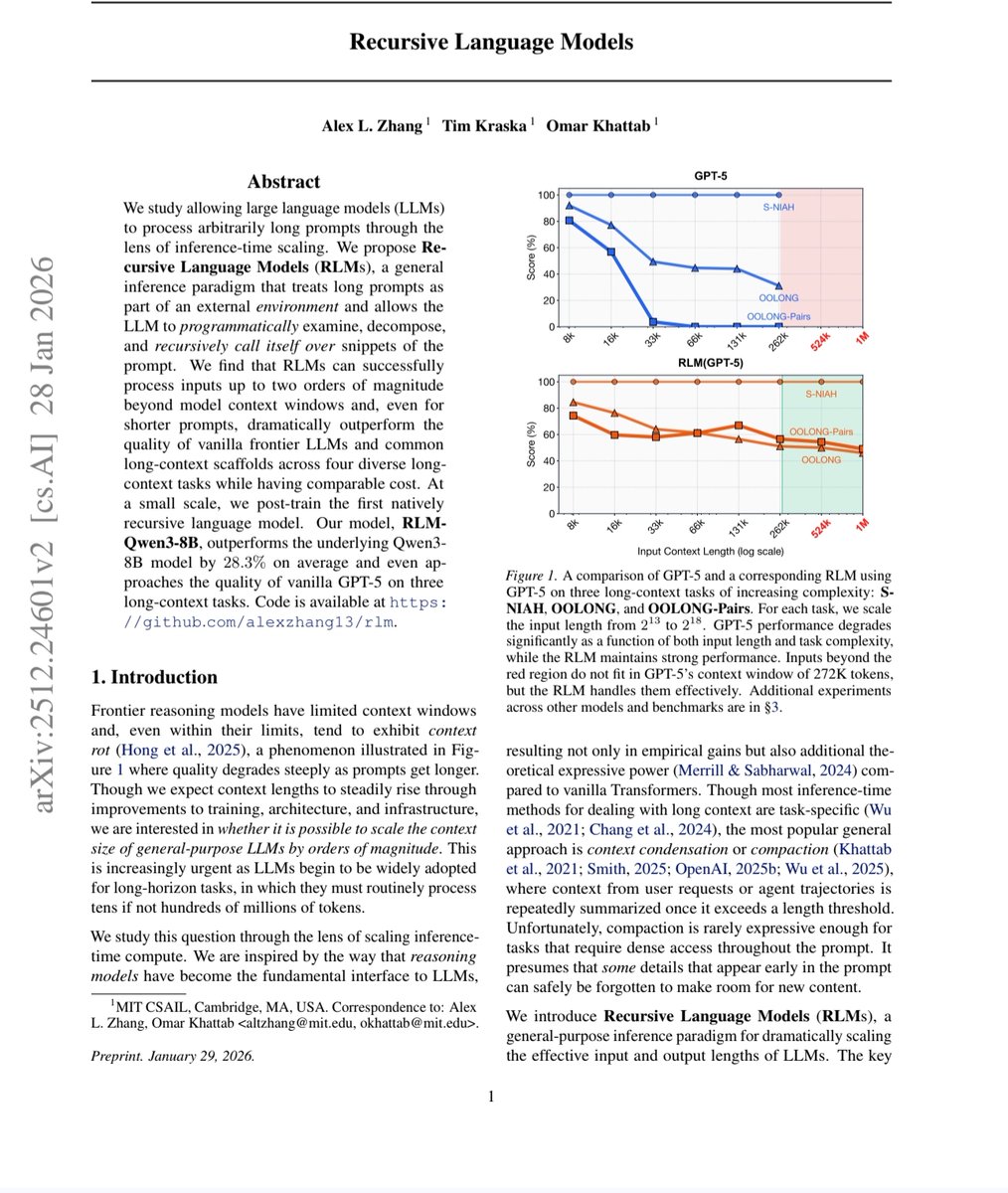
MIT just made every AI company's billion dollar bet look embarrassing.
They solved AI memory. Not by building a bigger brain. By teaching it how to read.
The paper dropped on December 31, 2025. Three MIT CSAIL researchers. One idea so obvious it hurts. And a result that makes five years of context window arms racing look like the wrong war entirely.
Here is the problem nobody solved.
Every AI model on the planet has a hard ceiling. A context window. The maximum amount of text it can hold in working memory at once. Cross that line and something ugly happens — something researchers have a clinical name for.
Context rot.
The more you pack into an AI's context, the worse it performs on everything already inside it. Facts blur. Information buried in the middle vanishes. The model does not become more capable as you feed it more. It becomes more confused. You give it your entire codebase and it forgets what it read three files ago. You hand it a 500-page legal document and it loses the clause from page 12 by the time it reaches page 400.
So the industry built a workaround. RAG. Retrieval Augmented Generation. Chop the document into chunks. Store them in a database. Retrieve the relevant ones when needed.
It was always a compromise dressed up as a solution.
The retriever guesses which chunks matter before the AI has read anything. If it guesses wrong — and it does, constantly — the AI never sees the information it needed. The act of chunking destroys every relationship between distant paragraphs. The full picture gets shredded into fragments that the AI then tries to reassemble blindfolded.
Two bad options. One broken industry. Three MIT researchers and a deadline of December 31st.
Here is what they built.
Stop putting the document in the AI's memory at all.
That is the entire idea. That is the breakthrough. Store the document as a Python variable outside the AI's context window entirely. Tell the AI the variable exists and how big it is. Then get out of the way.
When you ask a question, the AI does not try to remember anything. It behaves like a human expert dropped into a library with a computer. It writes code. It searches the document with regular expressions. It slices to the exact section it needs. It scans the structure. It navigates. It finds precisely what is relevant and pulls only that into its active window.
Then it does something that makes this recursive.
When the AI finds relevant material, it spawns smaller sub-AI instances to read and analyze those sections in parallel. Each one focused. Each one fast. Each one reporting back. The root AI synthesizes everything and produces an answer.
No summarization. No deletion. No information loss. No decay. Every byte of the original document remains intact, accessible, and queryable for as long as you need it.
Now here are the numbers.
Standard frontier models on the hardest long-context reasoning benchmarks: scores near zero. Complete collapse. GPT-5 on a benchmark requiring it to track complex code history beyond 75,000 tokens — could not solve even 10% of problems.
RLMs on the same benchmarks: solved them. Dramatically. Double-digit percentage gains over every alternative approach. Successfully handling inputs up to 10 million tokens — 100 times beyond a model's native context window.
Cost per query: comparable to or cheaper than standard massive context calls.
Read that again. One hundred times the context. Better answers. Same price.
The timeline of the arms race makes this sting harder. GPT-3 in 2020: 4,000 tokens. GPT-4: 32,000. Claude 3: 200,000. Gemini: 1 million. Gemini 2: 2 million. Every generation, every company, billions of dollars spent, all betting on the same assumption.
More context equals better performance.
MIT just proved that assumption was wrong the entire time.
Not slightly wrong. Fundamentally wrong. The entire premise of the last five years of context window research — that the solution to AI memory was a bigger window — was the wrong answer to the wrong question.
The right question was never how much can you force an AI to hold in its head.
It was whether you could teach an AI to know where to look.
A human expert handed a 10,000-page archive does not read all 10,000 pages before answering your question. They navigate. They search. They find the relevant section, read it deeply, and synthesize the answer.
RLMs are the first AI architecture that works the same way.
The code is open source. On GitHub right now. Free. No license fees. No API costs. Drop it in as a replacement for your existing LLM API calls and your application does not even notice the difference — except that it suddenly works on inputs it used to fail on entirely.
Prime Intellect — one of the leading AI research labs in the space — has already called RLMs a major research focus and described what comes next: teaching models to manage their own context through reinforcement learning, enabling agents to solve tasks spanning not hours, but weeks and months.
The context window wars are over.
MIT won them by walking away from the battlefield.
Source: Zhang, Kraska, Khattab · MIT CSAIL · arXiv:2512.24601
Paper: https://t.co/ngovOSNrCQ
GitHub: https://t.co/gT0ootCNoa