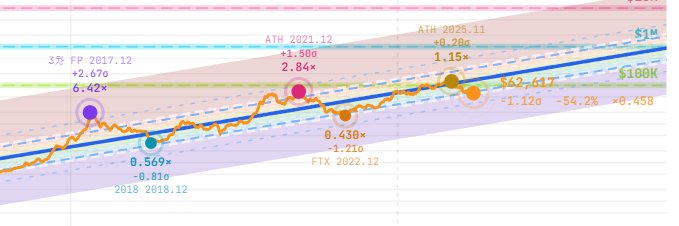
This is the most rigorous Bitcoin paper
I've read. I've been studying —
and testing — it for 20 days.
https://t.co/mCfJQpJTbE
Dr. Santostasi and Dr. Perrenod gave us the ruler —
and the imagination to see the oscillator.
Together: the most falsifiable framework
in crypto economics.
The Power Law isn't just a model —
it's the most precise ruler we have
for measuring where Bitcoin stands.
Most models describe the past.
The Power Law keeps passing tests
it was never designed for.
"Isn't β=5.69 just curve-fitting?"
Fair question.
So I ran a test the paper didn't.
━━━━━━━━━━━━━━━━━━━━━━
Materials & Methods
━━━━━━━━━━━━━━━━━━━━━━
Data: Daily closing price and non-zero balance
address count (BitcoinMagazinePro,
2010-08-17 to 2026-06-04, n=5,771).
Model: log₁₀P(t) = log₁₀A + β·log₁₀(t)
where t = days since Genesis Block (2009-01-03).
Out-of-sample design:
The power law was fitted exclusively on data
up to the freeze date, with zero observations
from the test period used in estimation.
Two freeze points were tested:
① Freeze at 2016-07-08 (2nd halving)
Training: n=2,153 | Test: n=3,617 (10 years)
② Freeze at 2020-05-10 (3rd halving)
Training: n=3,555 | Test: n=2,215 (6 years)
Residuals computed as:
ε = log₁₀(P_observed / P_predicted)
normalized by in-sample σ.
Mean residual and area integrals
(trapezoidal rule) applied to test period only.
The out-of-sample test was my idea.
Computation and analysis executed with
Claude Opus 4.8 (Anthropic).
━━━━━━━━━━━━━━━━━━━━━━
Froze the power law using data up to 2016 only (β=5.717).
Then measured the following 10 years it had never seen.
Result: mean residual −0.05σ. Effectively zero.
Frozen at 2020 instead → next 6 years, −0.13σ.
Same story.
The line drawn in 2016 ran straight through the next decade.
That's not fitting. That's forecasting.
The Power Law: powerful because it can be broken —
and hasn't been.
Knowing where we are won't tell us when things will happen — but it tells us exactly what to do now.
Buy Bitcoin Now.
@Giovann35084111@moneyordebt@ScientificBTC@saylor@natbrunell
#Bitcoin #PowerLaw
BIP-110 failed. Deal with it.
I still think arbitrary data has no business on Bitcoin’s base layer, and I still think Core v30 moved in the wrong direction. But sovereignty cuts both ways: you’re free to enforce your rules, and everyone else is free not to follow them.
They didn’t. Time to move on.
제주도 실종사건은 장윤기 사건보다
더 무서움
장윤기 사건은 경찰이 일방적으로 덮은건데
왜냐면 그거는 장윤기 아버지가 경찰임
그래서 덮으려고 했구나 생각이라도
할 수 있는데..
제주 장미란씨 실종사건은 도대체 왜 그랬는지 이해할 수 없음.
그러니까 여러 근거 없는 추측들이 막 나돌아다님
난 이게 더 무서운거같아..
귀찮아서도 그랬다는것도 무섭고
범죄조직이랑 엮여서 그랬다는것도 무섭고
뭐든 제정신으로 생각할수가 없음
Crows are incredibly clever. This one figured out how to turn a tap on to get water and even remembered to turn it off afterwards. Their ability to learn, remember, and repeat useful behaviours is amazing
이게 참 심각한 문제인데.
경찰대를 수석 졸업을 하고, 경찰 생활을 3년 하다가, 로스쿨에 갔고, 검사로 활동하다가 '대학교 마약 동아리' 사건을 파헤친 검사. 지금은 정부의 검찰 때리기에 환멸을 느끼고, 변호사로 활동 중.
이 분이 말하는 지금 흐름의 위험성. (조선일보 인터뷰)
“충분한 논의 없이 검사의 수사권을 빼앗는 것은 국가의 범죄 대응 체계를 스스로 무력화하는 광기”라며 “제2, 제3의 마약 동아리 범죄는 묻히게 될 수도 있다”
“형소법 개정 이전에도 경찰에서 수사 부서는 일이 많아 수사관들이 기피하는 곳이었습니다. 이런 상황에서 검사가 하던 보완수사마저 경찰에게 넘어가면 경찰관 1인당 담당 사건 수가 폭증할 수밖에 없습니다. 안 그래도 느린 수사가 더 늘어질 수밖에 없죠.”
“경찰이나 검찰에서 담당하던 사건이 중수청으로 넘어가면 수사관이 바뀌는 등의 문제로 연속성이 떨어져 처리가 지연될 수 있습니다. 검찰의 수사 노하우가 그대로 넘어갈지도 의문입니다. 당장 수원지검에 설치된 마약범죄 정부합동수사본부가 존폐 기로에 놓였는데 이런 거 마약 하는 사람들이 다 압니다. ‘이제 안심하고 하자’는 인식이 퍼질 수 있죠.”
비트코인 코어 기여자, 지미 송이 말하는 한국 비트코인 커뮤니티:
"그들에게 트레이딩은 고려 대상이 아니며, 비트코인은 저축 수단입니다. 좀 더 순수하다고 할까요, 비트코인의 정신에 훨씬 더 가깝습니다."
1. 반작용으로 태어난 커뮤니티.
지미 송이 짚은 기원이 정확함. 한국은 2017년부터 2020년까지 세계 최대급 알트코인 붐을 겪었고 지금도 알트 투자자가 주류임. 한국 비트코인 커뮤니티는 그 광풍에 대한 반작용으로 형성됐다는 것. 규모는 작고 역사도 짧지만 훨씬 더 열정적이고, 커뮤니티 안에 집단적 도덕성이 강하게 자리 잡았다고 했음. 카지노를 정면으로 통과해본 사람들이 만든 공동체라서 카지노로 되돌아갈 이유가 없음.
2. 미국 밋업과의 대비.
그가 그린 미국 쪽 풍경은 이렇다고 함. 밋업에 가면 자유지상주의자, 트레이딩에 관심 있는 사람, 도박하러 온 전문 포커 플레이어까지 온갖 사람이 섞여 있음. 진행자도 지난 6년간 미국 커뮤니티에서 비트코인의 정신이 점점 희미해지는 걸 지켜봤다고 인정했음. 한쪽은 목적이 하나로 수렴하는 중이고, 다른 쪽은 목적이 흩어지는 중임.
3. 배경까지 보면 더 흥미로움.
같은 대화에서 지미 송은 한국의 레버리지 문화도 언급했음. 자국 통화 가치 하락에 대응하느라 개인 투자자들이 2배, 3배 레버리지 ETF와 반도체 상품에 몰리는 나라라는 것. 그 한복판에서 레버리지도 트레이딩도 배제한 저축 공동체가 자라났다는 게 이 평가의 진짜 무게임. 유혹이 없는 곳에서 지킨 원칙과 유혹의 진원지에서 지킨 원칙은 무게가 다름.
한국이 문화적으로 서구보다 몇 년 뒤처져 있다는 흔한 얘기를 지미 송 본인도 언급했음. 그런데 이 대목에서는 순서가 뒤집힘.
알트코인이라는 우회로를 가장 깊이 들어가 본 나라가, 그 우회로의 끝이 어딘지도 가장 먼저 확인했음. 늦게 출발한 게 아니라 실수를 먼저 끝낸 것임. 나머지 세계가 지금 그 구간을 통과하는 중임. ⏳
Everyone keeps saying multisig eliminates single points of failure.
Cool.
But what happens when the security system itself becomes the point of failure?
That’s the part nobody wants to talk about.
A 2-of-3 multisig gives you three keys and requires two to move your Bitcoin.
Lose one? You’re protected.
Great.
But now you have three seeds to generate correctly, multiple signing devices and backups to secure, wallet configuration to preserve, locations to manage and an inheritance plan someone else will eventually need to understand.
You didn’t eliminate risk.
You traded one set of risks for another.
And here’s where the multisig debate goes wrong:
People compare PERFECT multisig against BAD single-sig.
That’s not an honest comparison.
Of course a professionally designed 2-of-3 setup, ideally constructed with guidance from an experienced Bitcoin security expert, using multiple hardware vendors, geographically separated keys, tested recovery procedures and a carefully constructed inheritance plan can provide incredible security.
Nobody is arguing otherwise.
But compare that to GOOD single-sig:
A properly generated 256-bit seed.
A reputable hardware wallet.
A strong, high-entropy passphrase stored separately.
Secure backups.
Tested recovery.
A clear inheritance plan.
No seed ever entered into an internet-connected device.
Now the conversation gets interesting.
The question isn’t whether multisig provides redundancy.
Obviously it does.
The question is whether that additional fault tolerance outweighs the additional complexity and failure modes FOR YOU.
And here’s another test:
If you needed your Bitcoin within the next 10 minutes, could you access it?
Security isn’t only about preventing someone else from accessing your money.
It’s also about ensuring YOU can access it when it matters.
If an emergency requires gathering pieces of a treasure map from multiple locations, coordinating with family members, calling a lawyer or custodian, or traveling to retrieve another key, that complexity matters.
Every additional person, device, institution and location can introduce another failure point.
Someone can misplace a backup.
Someone can accidentally photograph it.
Someone can become unreachable, incapacitated or die.
Two parties could potentially collude.
A company you depend on could change its policies, shut down or disappear.
And NONE of that requires Bitcoin’s cryptography to fail.
Your Bitcoin can remain perfectly secure on-chain while YOU lose the ability to access it.
That’s why accessibility is part of security.
Multisig can absolutely be the right solution for an experienced Bitcoiner who understands and can maintain it.
But I reject the idea that multisig should automatically be considered the ONLY responsible way to secure serious Bitcoin wealth.
Security isn’t measured by how many keys you have.
It’s measured by how effectively you protect against realistic attacks AND failures without creating new ones you’re more likely to screw up yourself.
For some people, multisig wins that equation.
For others, a hardened single-sig setup they deeply understand and can reliably recover 10, 20 or 30 years from now may be safer.
Bitcoin’s cryptography is extraordinarily strong.
Humans are the weakest link.
The best custody setup is the one you can actually secure, access quickly, recover and eventually pass on.
Because the greatest threat to your Bitcoin may not be someone breaking the cryptography.
It may be you building a security system so complicated that one day, you can’t get through it yourself.
The goal of self-custody isn’t to build the most sophisticated fortress.
It’s to build one that keeps everyone else out, without ever locking YOU out.
$BTC
If we observe the 2022 bottom, most of the time bottoms form with 1 major impulse candle, like what we have seen.
In terms of retests, we usually don't see the "ideal retest". After BTC broke from 16K to 25K, it retested 19K, aligning with the 0.618.
If we apply the same principle to this impulsive candle up, then any push down is likely to be shallow, with the 73-70K region potentially serving as the local range bottom before pushing through 80K.
Before that, I expect some sort of range to form, accumulating late longs and building liquidity. We may even see another sweep above 79.5K before the final flush into the low 70s, followed by expansion.
You usually don't see an instant retrace of these trend shifting impulsive candles because it defeats the objective. The market needs to build long liquidity first before the final sweep and expansion.
So before we test any of these lower regions, I think we can expect more range based movement to accumulate liquidity.