@teneo_protocol Great move. AI becomes far more useful when it integrates into the tools people already use daily. The growing list of supported agents and IDEs makes Teneo feel increasingly accessible, while plain-English queries make powerful AI workflows available to a much wider audience.
The Teneo CLI installs from wherever you already work. There are now setup guides for seven of them.
AI coding agents:
- Claude Code: https://t.co/0CXaQdNc9N
- Codex: https://t.co/K9vZ8wuyt1
- Manus: https://t.co/JVCAyP38A6
IDEs:
- Cursor: https://t.co/JWOAmPEHwE
- Antigravity: https://t.co/e8vMwuuLUg
-VS Code: https://t.co/7xnxHXDZHQ
Agent platforms
Hermes: https://t.co/g9A5HG89S3
Each guide walks through installing the CLI, then listing and querying 50+ Teneo agents in plain English: scrape social data, swap and bridge tokens, pull on-chain data. Some agents are free; paid queries settle per call in USDC via x402.
Two more are in progress:
OpenClaw (managed hosting) and Teneo Father (query agents straight from Telegram).
Full list: https://t.co/bnbIJYAAVk
What are we missing? If you'd run the CLI in a tool that isn't here, tell us.
@teneo_protocol Impressive progress. Turning community participation into infrastructure that AI labs and enterprises can actually use gives the network genuine utility and value.
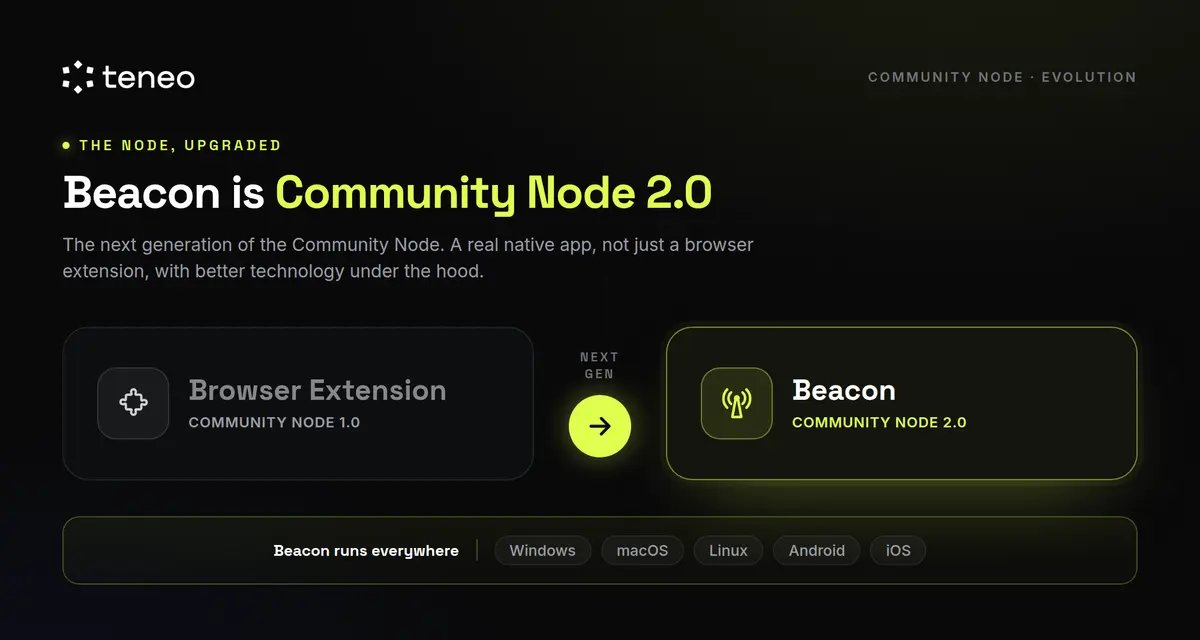
Community Node 1.0 → Community Node 2.0
1.0 was a browser extension.
2.0 is the Teneo Beacon: a native app on Android, iOS, Windows, macOS, and Linux, built in-house.
Owning the infrastructure changed what's possible:
- More stable connections
- Higher-quality access to the live web
- Better fraud detection
None of it gated by someone else's browser.
It also opened a second market.
AI labs, market-intelligence platforms, and ad-verification services need to see the live web from different places around the world. Data-center IPs keep getting blocked.
Teneo can route that traffic through the Beacon network, and the people running Beacons are rewarded for the uptime and bandwidth they contribute.
1.0 showed what was possible. Beacon shows what comes next.
Link in the replies: 👇
@teneo_protocol What I like most is the long-term vision. Community Node validated the concept, and Beacon turns it into production-grade infrastructure that can support real-world AI applications at scale
Teneo Community Node 1.0 is a browser extension.
Easy to install, it built one of the largest data networks in the space with more than 6.5m nodes at peak and powered the first agents on Teneo Protocol.
But it ran on browsers and third-party infrastructure we didn't control.
Teneo Community Node 2.0 is the Teneo Beacon: a native app built entirely in-house, running on Android, iOS, Windows, macOS, and Linux.
Owning the full stack means more stable connections, higher-quality access to the open web, and better fraud detection, with no dependency on anyone else's browser.
It also opened up something bigger!
AI is only as good as the data it can reach, and the open web blocks data center proxies harder every month.
Beacon is a network of real devices in real places, which makes it one of the few reliable ways left to read the live web at scale. That access is what every agent on Teneo Protocol runs on.
Community Node 1.0 proved the model. Beacon is what comes next.
Keep your Beacon running!
@teneo_protocol@ManusAI Love seeing Teneo expand across different AI environments. The ability to install the CLI with a single prompt and immediately access on-chain, social, and market data agents lowers the barrier to entry significantly.
The Teneo CLI setup guide for Manus is live.
@ManusAI is a cloud-based autonomous AI agent. No local install, no terminal, no folder to create.
The sandbox is a cloud computer with Node.js already configured. You skip the local setup entirely.
From there it's three steps:
1) Create a free Manus account (starter credits included)
2) Send the one-line install prompt
3) Manus downloads the CLI, configures the daemon, and generates a wallet, usually under a minute
The exact command is in the tutorial.
Once installed, you can list and query 50+ Teneo agents in plain English: pull on-chain data, swap and bridge tokens, scrape social data.
Some agents are free; paid queries settle per call in USDC via x402.
You can also connect Manus to Telegram and run agents straight from chat.
Guide:
https://t.co/JVCAyP38A6
@teneo_protocol Love the transparency here. Clear qualification requirements and rewarding long-term Beacon uptime encourages genuine participation rather than short-term farming. Excited to see the ecosystem grow!
Last Friday we announced $AGENTIC!
It consolidates everything you've earned so far: Points, Fragments, Discord roles, NFTs. Nothing you've built up is lost.
To qualify, three things:
1) Connect your wallet to your Teneo account
2) Connect your X account
3) Run your Beacon for at least 72 hours
72 hours is the floor. Longer uptime means a larger allocation, so the time you put in now is worth more than time you put in the week before the snapshot.
$AGENTIC isn't the $TENEO token. It's how everything you've already earned gets carried into what comes next.
Keep your Beacon running! 💪
@teneo_protocol This is exactly the kind of progression communities want to see before TGE. Transparent rewards, wallet ownership, and a clear path from contribution to allocation. Looking forward to earning more through Beacon uptime.
Every reward you've earned on Teneo is going on-chain.
Points, Fragments, Discord Roles and NFTs stop living in separate databases. They consolidate into $AGENTIC, a single non-transferable reward token claimed directly to your wallet. Once claimed, your allocation cannot be modified, reduced or taken away.
This is a major milestone on the road to TGE! Bringing rewards on-chain lets us battle-test the reward system before $TENEO launches, and at TGE, eligible users will exchange their $AGENTIC for $TENEO.
Your contribution history becomes your stake in what comes next.
Qualifying for the first distribution is free. Before the snapshot: connect a wallet, connect your X account, and run Beacon for at least 72 hours. 72 hours qualifies you; longer uptime grows the allocation.
The full post covers how Beacon fits alongside the Browser Extension and why it plays a bigger role going forward:
https://t.co/a3W4Nzq4KJ
@teneo_protocol@CoinMarketCap Well deserved. Building alongside a platform as influential as CoinMarketCap is a strong validation of the work the team has been putting in. Excited for what's next.
Genuinely proud to be working with @CoinMarketCap on this!
CMC has been the front door to crypto for years, so having Beacon featured here means a lot to the team.
If you've ever been curious what an agent data network looks like from the inside, this is the easiest way to find out!
@teneo_protocol It's a good balance between rewarding consistency and keeping participation meaningful. Plus, knowing that my Beacon is contributing unused bandwidth to support the Teneo AI agent network makes keeping it online feel productive beyond just earning Fragments.
Keep your Beacon Running!
Your Beacon earns Fragments every hour it is running.
The part most people miss is Beacon boosting.
It's a personal multiplier that climbs every time you boost on schedule, from 1.00x up to a 3.00x cap.
Your first ten boosts add 5% each.
Miss a window and it decays 10% on the spot, so a couple of skipped days can undo a week of progress.
So the math is simple:
- An idle Beacon still earns the base rate.
- A consistent one earns it multiplied, and the multiplier compounds fastest early.
Why it's important:
A Beacon is the supply side of Teneo Protocol.
It uses your unused bandwidth to power our AI Agent framework!
Keep your Beacon running!
New on the Teneo blog, the next in our series breaking down how individual agents actually work.
This one: the @CoinMarketCap agent.
Most market-data APIs bury the price in a monthly tier.
The CoinMarketCap agent puts a separate price on every command.
Five commands: quote and performance read one asset live and across seven time windows, top and trending rank the market by cap and by attention, and gainers pulls the top movers in both directions. Each returns structured output you can route into the next step of a workflow.
Every command settles per query in USDC through x402. Four of the five are $0.005, top is $0.01, and the catalog price is only the base: the exact signed total comes from a live quote before anything runs.
Two ways in:
1) Install the Teneo CLI in one command through Claude Code, Codex, or any AI coding agent. The exact npx command is in the blog post.
2) Or find the agent directly on the Agent Console at https://t.co/jqacFFCe6j.
The full post covers all five commands, when per-query actually beats a subscription, and the limits worth knowing before your first paid call: one asset at a time, symbols must match CoinMarketCap's listings, prices are builder-set:
https://t.co/xOYbuugirw
@teneo_protocol@CoinMarketCap I like how the post goes beyond features and explains the economics behind the pricing model. The per-query approach makes a lot of sense for developers who only need occasional market data instead of paying for an entire subscription tier.
The Teneo CLI setup guide for Cursor is live.
If you already build in @cursor_ai, this is the fastest way in: no separate model key, no extra tooling.
Two ways to install:
Run the command in Cursor's built-in terminal, or Ask Cursor's Agent to run it for you
Either path takes the same few minutes. Works on Windows, Mac, and Linux.
The exact command is in the tutorial.
Once installed, you can list and query 50+ Teneo agents in plain English: scrape public social data, swap and bridge tokens, and pull on-chain data.
Some agents are free; paid queries settle per call in USDC via x402.
Guide: https://t.co/JWOAmPEHwE
@teneo_protocol@cursor_ai Great guide. The two installation paths make onboarding much easier since users can choose between the terminal or Cursor Agent workflow.