@merebortz500 This is a great example of AI being used to replace humans, instead of work with them. Photo editing already makes for an uncertain internet landscape. If an advertisement is completely generated using AI, how can consumers trust what they are being shown?
@edmondperezic I like how this tweet focused on trust and accountability with AI systems, something that we lack on the internet as AI outpaces legislation and regulatory bodies.
This study provides an insightful look into how image generation works, and the seemingly limitless potential for even an AI that does not commit art theft. Even without sourcing from art, AI is capable of bringing used as a tool to create, not steal. #RUVirtualSU25#RutgersDCIM
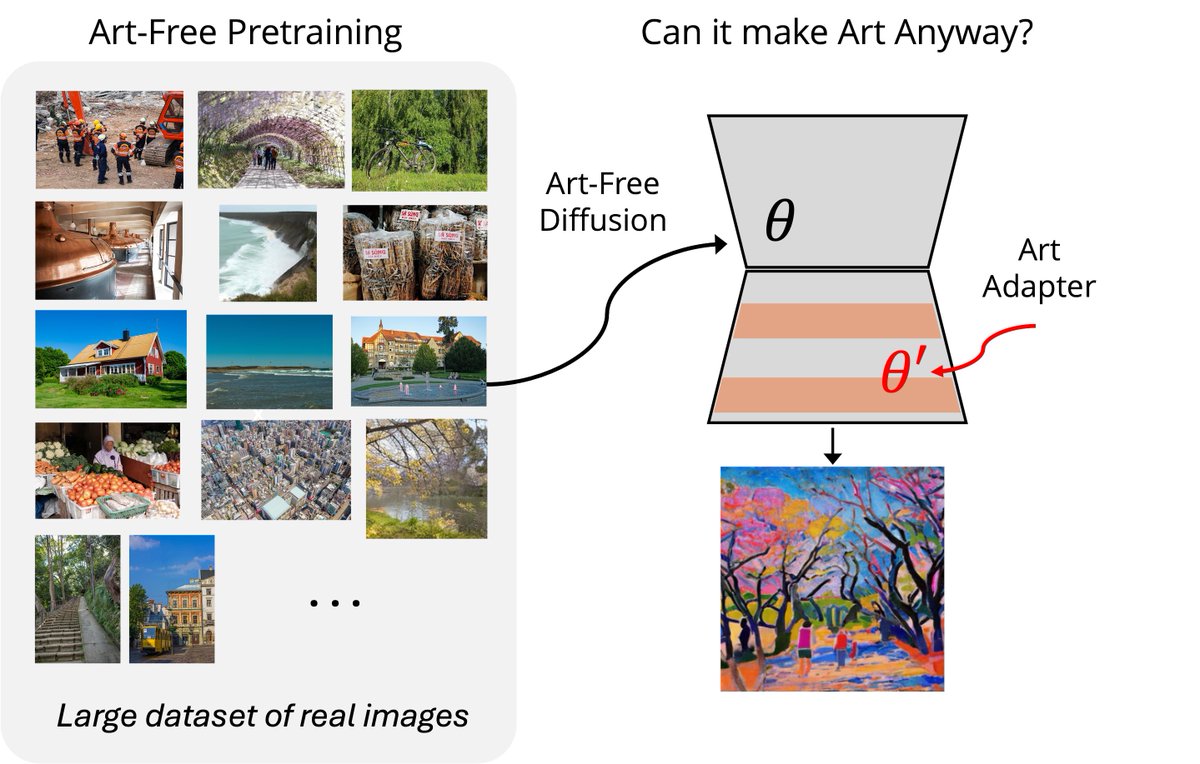
1/ 🎨✨ If an AI has never seen art before, can it develop artistic capabilities?
Our team from MIT, Northeastern and ShanghaiTech University analyzes this question in our Art-Free Diffusion paper.
@Fransheska_RU@MITshapingwork This conversation really connects to the piece by John Oliver on the future of automation in jobs. If we don't focus investments into education and re-training of workers with displaced jobs, can we really say that automation creates an equal exchange of jobs lost and gained?
@merebortz500 This post really illustrates the concepts described in our reading. Automation isn't as simple as jobs being replaced and created—it means redefining how people and machines interact. If automated systems make the decisions, we may see ourselves changing our behavior for them.
This strongly connects to the ideas presented in Andrejevic's "Automated Media." If decisions are not made now about the limits of automation, we will see not only jobs but human characteristics increasingly threatened by the simplification of our behavior into simply "patterns."
While not a researcher, this speech by Sen. Slotkin highlights AI's capabilities, and how it will increasingly automate once-human tasks. She warns about change coming. Whether it be by policy or education, it is necessary that we move to keep up. #RUVirtualSP25#RutgersDCIM
AI has the potential to change our economy more than the internet did. In the Midwest, we’re used to being the first to go from economic change—bad trade deals, automation. Change is coming again, and my Economic War Plans calls for us to get our ass in gear.
@classgreg2 As we learned in an article by Natasha Singer, students prefer human teaching, but that doesn't mean they aren't receptive to teachers getting AI assistance. AI must not seek to replace teachers, and instead focus on making it easier for teachers to personalize education plans.
@JocelynColleton This is such an interesting concept. One would think this is the true, current purpose of AI—to provide the truth, free from human bias. However, as we know, AI is far from unbiased, mirroring and even magnifying much of our own biases today. "Socratic" AI seems worth exploring.
This discussion highlights the importance of transparency in AI and emphasizes the need for users to have access to AI's sources. This enables them to verify information provided by generative AI, resulting in greater accountability for AI responses. #RUVirtualSU25#RutgersDCIM
AI can’t be ethical on its own. It reflects the values of the people using it.
This session unpacks the human responsibility behind AI-powered decision making: https://t.co/bQKwvTIuWE
@merebortz500 It's nice you see large educational institutions not only funding AI programs, but also making sure AI instruction education is regulated—without mandates and guidelines for ethical AI use, it's clear to see how this technology could easily get out of hand.
@kaceyylewiss This is a forward-thinking way to look at AI. Rather than try to fight this new technology that is becoming part of our everyday lives, we should look to integrate AI in healthy ways, where it is a tool to aid students in learning rather than a replacement for critical thought.
I found the article to provide helpful information about how cognitive learning works and how AI can shortcut learning, preventing students from thinking critically. Her conclusion about how AI can be used to aid education was an insightful look into AI's potential in teaching.
Anjali Singh's article is about ways that using generative AI tools can harm the development of critical skills. She suggests ways that teachers can help students think critically about AI responses to ensure it is acting as a tool, not a replacement. #RUVirtualSU25#RutgersDCIM
As tools like ChatGPT and Gemini reshape learning, students risk outsourcing their thinking.
Anjali Singh explores how we can help learners stay reflective, curious, and cognitively engaged—even in the AI age.
Read more: https://t.co/UIqjJPzLCS
#AIinEducation#DeepLearning