The OG Trader Challenge has officially concluded, with 25 traders securing their place as @risextrade OGs.
Congratulations to all the winners and credit to everyone who participated. The competition showcased the dedication and activity of the RISEx trading community.
As part of the OG program, winners will receive a share of the 25,000-point reward pool, distributed based on weighted contribution. They will also benefit from a 2x points boost during the first month of the points program, a one-month Tier 4 fee rate trial beginning on July 1 2026 and priority access to the XLP Vault.
These are only the initial benefits with additional exclusive perks expected to be introduced in the future.
To claim the OG role, participants can visit the RISEx Guild, connect the wallet used during the challenge, link their Discord account, and complete the claim process.
The challenge may have ended, but this marks the beginning of a new chapter for the most dedicated traders within the RISEx ecosystem.
RISEx Shifts the Scarcity From Capital to Creativity
For most of financial history, the main constraint has been capital.
Whoever controlled more capital could generally access more opportunities, absorb more risk, and generate more influence.
RISEx introduces a subtle shift where creativity starts becoming just as important as capital itself.
Think about the evolution of the internet.
In the early days, owning expensive hardware created significant advantages.
Over time, infrastructure became more accessible, and creativity became the real differentiator. The most impactful outcomes often came not from those with the most servers, but from those with the most innovative ideas.
Programmable markets create similar conditions.
When users can build custom account behaviors, combine different collateral types, automate execution logic, and compose multiple financial primitives together, the advantage increasingly comes from how intelligently these pieces are arranged.
Two traders with identical capital may produce dramatically different outcomes depending on how they design their systems.
This creates a fascinating transition.
The scarce resource becomes imagination.
Markets stop rewarding only balance sheet size and start rewarding architecture.
That doesn't eliminate the importance of capital, but it elevates creativity into a first-class competitive advantage.
And historically, whenever creativity becomes more important, innovation accelerates.@risextrade
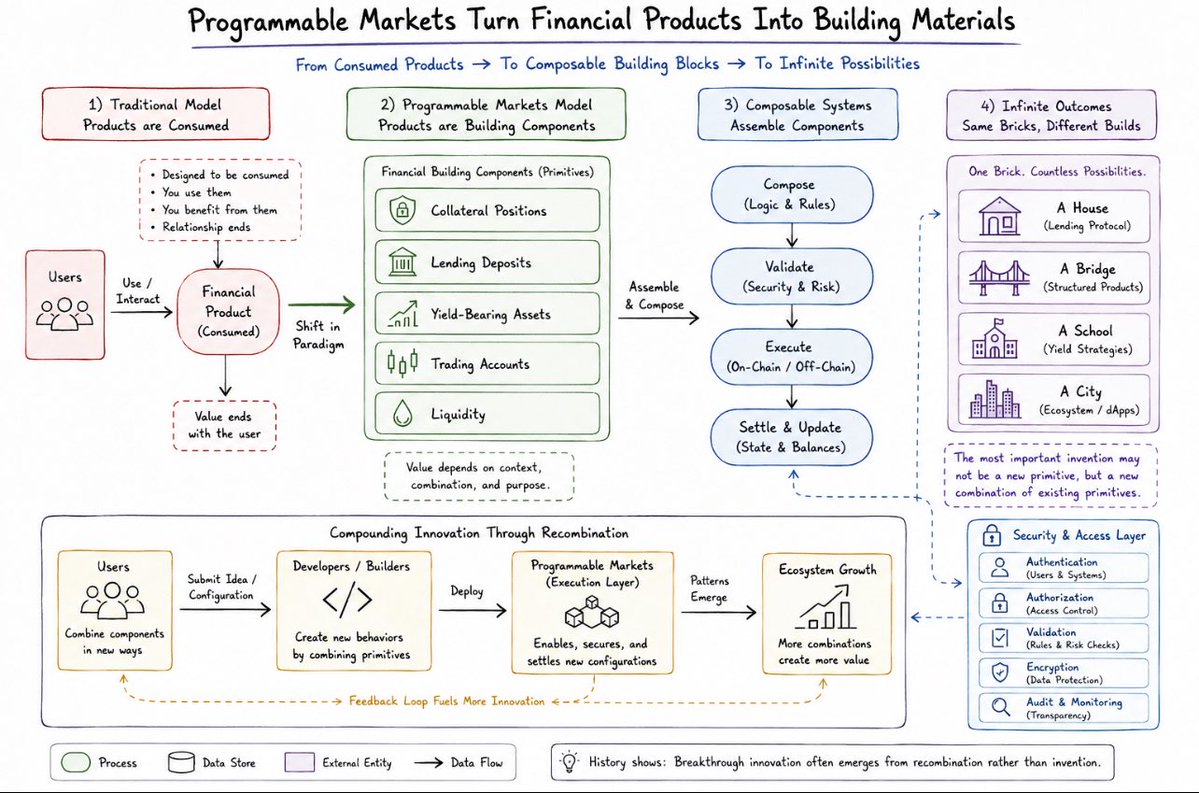
Programmable Markets Turn Financial Products Into Building Materials
Most financial products are designed to be consumed.
You use them.
You interact with them.
You benefit from them.
The relationship ends there.
RISEx pushes toward a model where financial products behave more like building materials.
Think about bricks.
Nobody values a brick because of the brick itself. Its value comes from what can be constructed with it.
A house.
A bridge.
A school.
A city.
The same brick participates in countless different outcomes.
Programmable markets create similar conditions.
Collateral positions, lending deposits, yield-bearing assets, trading accounts, and liquidity become components that can be assembled into larger systems.
Their value increasingly depends on context rather than isolation.
This creates compounding innovation.
Instead of waiting for developers to launch new financial products, users can create new behaviors by combining existing components in unexpected ways.
The most important invention may not be a new primitive.
It may be a new combination of existing primitives.
And history repeatedly shows that breakthrough innovation often emerges from recombination rather than invention. @risextrade
RISEx Reduces the Cost of Coordination
One of the least discussed costs in finance is coordination.
Not capital.
Not fees.
Not volatility.
Coordination.
Every time multiple systems need to interact, there is a hidden cost associated with making them work together.
Think about organizing a meeting between ten people.
The challenge isn't the meeting itself. The challenge is coordinating schedules, locations, communication, and timing.
Financial systems face similar challenges constantly.
Protocols coordinate with protocols.
Collateral coordinates with trading engines.
Strategies coordinate with liquidity.
RISEx lowers this cost by allowing everything to exist within a shared execution environment.
The significance goes beyond efficiency.
When coordination becomes cheaper, entirely new forms of collaboration become viable.
Ideas that previously felt too complex suddenly become practical.
And historically, reducing coordination costs has been one of the strongest drivers of economic growth.
Cities grew because proximity reduced coordination costs.
The internet grew because communication costs collapsed.
Programmable markets may produce similar effects within financial systems.@risextrade
Why RISEx Could Change the Economics of Attention
Traditional trading often rewards constant attention.
Watch charts.
Monitor positions.
Track markets.
React quickly.
The model assumes that more attention leads to better outcomes.
RISEx challenges that assumption.
Programmable accounts and automated behaviors allow users to shift effort from monitoring to designing.
Think about irrigation systems.
A farmer can carry buckets of water every day, or invest time building channels that distribute water automatically.
The second approach doesn't eliminate effort.
It changes when and where effort is applied.
RISEx encourages a similar transition.
Users spend less energy managing every moment and more energy designing systems that manage themselves.
The economic value of attention changes.
Instead of being rewarded for constant presence, users are rewarded for intelligent preparation.
That is a fundamentally different relationship with markets.
@risextrade
RISEx Quietly Reduces the Importance of “Where”
Traditional DeFi constantly asks users where something exists.
Where is the collateral?
Where is the liquidity?
Where is the lending position?
Where is the trade being executed?
These questions emerge because systems are fragmented.
RISEx gradually reduces the importance of location as a concept.
Think about cloud computing.
Most users no longer care which physical server stores their data. The infrastructure abstracts away location and focuses attention on functionality.
RISEx does something similar for financial interactions.
Because assets, trading logic, and collateral operate within a shared environment, users increasingly think about what capital is doing rather than where it resides.
That shift sounds small, but it fundamentally changes user experience.
The mental overhead of navigating fragmented systems starts disappearing.
And whenever location becomes less important, innovation tends to accelerate because builders can focus on behavior rather than logistics. @risextrade
The Platform Rewards Structure More Than Activity
Many trading environments reward constant action.
More trades.
More entries.
More exits.
More management.
RISEx introduces an environment where structure itself becomes valuable.
Think about engineering.
A well-designed bridge creates value long after construction ends. The quality comes from the structure, not from constant adjustments.
Programmable markets work similarly.
A carefully designed strategy may continue generating utility through intelligent relationships between collateral, risk, and execution long after it is initially configured.
This changes incentives.
Success becomes less dependent on frequent intervention and more dependent on thoughtful architecture.
That attracts a different type of participant someone interested in designing durable systems rather than constantly reacting to market noise.
@risextrade
Unified Execution Quietly Compresses Financial Distance
A hidden problem in DeFi is financial distance.
Even if protocols technically connect, every interaction requires movement across separate systems: bridging logic, routing layers, approvals, settlement paths, synchronization checks.
RISEx compresses that distance dramatically.
Imagine living in a city where every important building is hours apart. Even simple errands become exhausting because movement itself creates friction.
Now imagine everything existing within walking distance.
The tasks themselves don’t change, but the cost of coordination collapses.
That’s what unified execution does inside financial systems. It reduces the “travel time” between actions.
Collateral doesn’t need to journey across fragmented infrastructure to become useful elsewhere. Trading logic doesn’t need external orchestration to coordinate with vaults or lending systems.
Everything already exists nearby within the same execution environment.
The result is not just efficiency. It changes what kinds of strategies become practical because complexity no longer carries the same coordination burden. @risextrade
Programmable Markets Turn Traders Into System Designers
Traditional trading rewards prediction: guessing direction, timing, volatility.
RISEx introduces another layer entirely: designing financial behavior itself.
Think about sandbox games where some players focus less on winning objectives and more on building automated systems inside the world. They create farms, machines, transportation networks, and self-sustaining structures.
Programmable markets create a similar shift.
Success stops depending only on predicting price movement and starts depending on designing intelligent interactions between collateral, execution, leverage, and automation.
This attracts a different mindset. Traders begin behaving more like architects.
The interesting part is that the “edge” moves higher up the abstraction stack. Instead of optimizing a single trade, users optimize entire behavioral systems operating continuously.
That’s a very different model from traditional exchange dynamics. @risextrade
RISEx Quietly Redefines What “Settlement” Means
Settlement is usually treated as the boring backend phase after trading happens.
RISEx changes that relationship entirely because settlement is no longer separate from execution.
Imagine paying for groceries and ownership updating weeks later. That’s essentially how many traditional systems behave execution and finality are separated processes.
RISEx merges them.
The important implication is psychological certainty. Traders no longer think in terms of “pending completion.” The trade outcome already exists as finalized state within the same environment.
This removes a huge amount of invisible complexity surrounding reconciliation, counterparty uncertainty, and delayed state alignment.
Settlement stops being a delayed administrative process and becomes part of the action itself.
That sounds subtle, but it changes how trust forms inside the system.