This story is so incredible (literally) that @el_pais has decided to feature it in its English-language edition (open access, no paywall): https://t.co/gL8WRHx1Zy
#chess#ajedrez
How does Adani grow so fast?
1. Debt (much written on this)
2. Govt concessions (airports, etc)
3. Acquisitions (some through state-backed coercion like Mumbai airport/Gangavaram)
4. Bankruptcy courts (Cos get pushed into bankruptcy and weak auctions follow). See link below.
OK, everyone, time is up! We have synthesised your feedback into the first crowdsourced strategic template for world cricketing domination by the year 2082. We now have our ten-point plan:
1) Absorb England after Scottish independence (target 2047) and rebrand the ECB as Iceland Cricket.
2) Appoint Ravi Shastri as head coach and guarantee him unlimited booze for the next 56 years.
3) Hire Gautam Gambhir immediately as co-coach to supply the necessary intensity.
4) Build ice pitches immediately and wait for global warming to extend the playable window beyond 15–26 July.
5) Flood Icelandic schools and colleges with subsidised kits, indoor facilities and coaching so every child can play.
6) Enter English and European club leagues at every available age-group and professional level.
7) Do not build anything expensive; simply wait for the BCCI revenue model to thin the field until the World Cup final is India v Iceland.
8) Adopt the PCB broadcast model: skip live coverage of ICC events, then hold a victory parade as undisputed champions.
9) If it is not going well by 2060, form a Nordic coalition team (the West Indies model) to accumulate ranking points and Test status faster.
10) Let the volcanoes assist in any way they can.
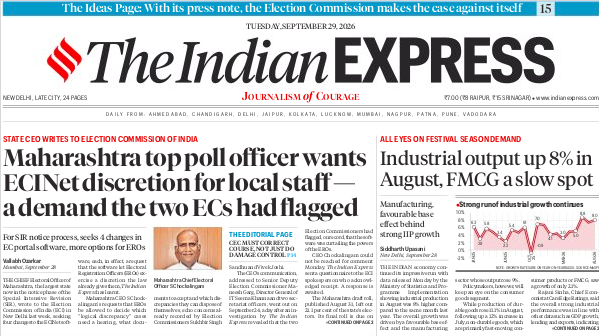
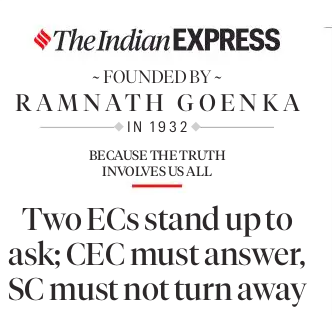
Another day, another @IndianExpress break on the EC.
Sept 23. Our investigation breaks. The EC responds the same day: its platforms are protected against "unauthorized tampering", and EROs "function as per statutory powers."
What we didn't know was this.
The very next day, Maharashtra's Chief Electoral Officer (CEO) wrote to the EC in Delhi asking for FOUR changes to ECINet, so EROs could use the discretion the law already gives them.
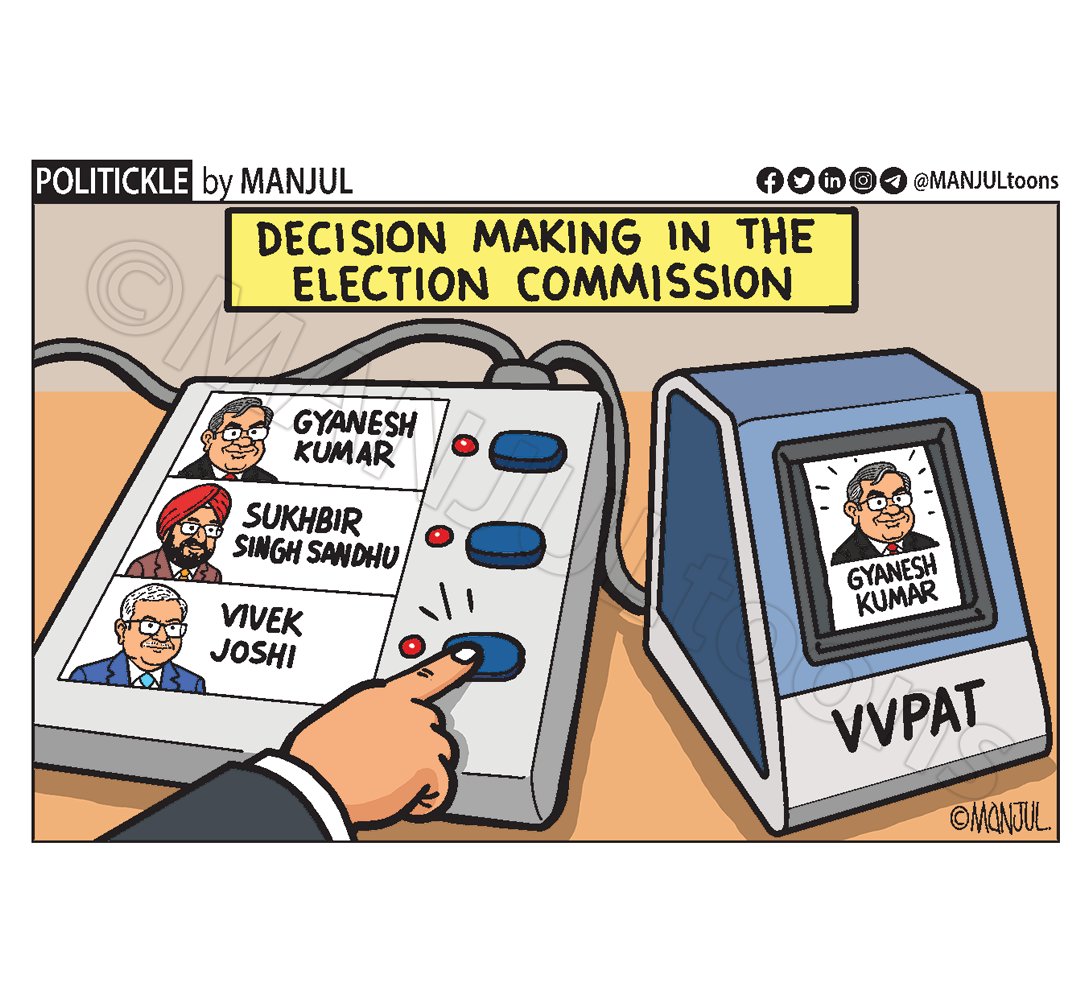
The same concern Election Commissioners Sukhbir Singh Sandhu and Vivek Joshi had put on record.
Stay with me for @vallabhozarkarr's cracker of a story in today's edition
(1/11)🧵
BBC Impact: An FIR has been registered by the Gandhinagar CID Crime Branch against three of the six parties in Gujarat that we investigated—three weeks after our investigation into India’s “paper parties” triggered a huge public outcry and demands for accountability.
I've been thinking about Meta's impending Muse India launch.
I'm sitting on an invite code waiting to try it out, but I can't help but think that when Meta launches Muse in India, this may lead to a few things:
1. Calls for regulations of agents. Muse, my guess is, will be the trigger. Leave alone that ChatGPT, Claude, OpenClaw and Hermes (I am now running 6 hermes agents btw) have been around for a while, but Meta brings crazy scale with it. Razorpay has launched Ray as a whatsapp agent for merchants.
Muse will be the trigger because it has distribution, and Meta has cracked ease of use it seems, as has Instinct. But more than anything, it's because it is Meta, and of late, different arms of the government have been going at Meta (not without reason in many cases, but the intensity is hard to understand, and it reminds me of how they went after twitter in 2021 in order to justify weakening of safe harbor. They're scaring every platform into compliance, so they can exert more control over speech).
So, the moment Muse launches, someone will raise issues about agents with MEITY, and MEITY will be under pressure to say it's doing something to regulate agents.
Rajeev Chandrasekhar will write an oped on Muse and the need for regulating agents. Same guy who asked, in a MEITY PPT no less, why we need safe harbor, knowing fully well that no platform or ISP can survive the loss of safe harbor. Same guy who issued and defended an advisory that said AI models need to be registered to operate in India.
2. Concerns are going to be raised about Meta's data collection and the usage of this data for Meta's advertising business. Note that ChatGPT and Gemini are cheap/free in India, train on Indian data, and they have ad businesses. Btw, even some courts are using ChatGPT for judgments it seems. I see AI language in govt press releases. How are summaries of cabinet meetings created? Our govt needs to get its shit together wrt national security and AI usage by govt officials, because OpenAI has a deal with the Dept of War. Instinct's data collection issues have been raised recently, but it's not Meta in India.
3. Liability of agents will become a discussion. My view is, and I'm doing a research paper on agents, that agents have 3 body problem: model, harness (self-learning) and memory each bring variance to behaviour, and they are interdependent. You cannot have deterministic outcomes. Agents will make mistakes, as much as harnesses keep evolving to contain mistakes. How will we deal with this? I'm not sure.
4. Concerns may be raised about how easily these tools can game the system: for example, book tickets on IRCTC, thus putting humans at a disadvantage. This is especially since Meta seems to have cracked speed, and browsing. As has Instinct btw. Muse it currently tops https://t.co/kL4IHsy3Ld with Instinct not very far, and I've been amazed by Instinct and how effortlessly it works.
5. Autonomous activity is going to freak people out and journalists will make headlines out of autonomous behaviour. I was pleasantly surprised when Instinct read my email, realised that I have got a payment notification from OpenCode for my monthly subscription, there's no receipt, and I had complained to opencode about payment failures (thank you RBI) in the past. All on its own. It's freaky and amazing at the same time.
On another note, I'm experimenting with setting up an autonomous OS for Reasoned (calling it ROS), where a majority of the work is done by agents autonomously, and I largely monitor. Starting with approvals, and after a few weeks of training Ed and Ev (two of my agents), I'm going to experiment with full autonomy. I've had Saki (my Chief of Staff agent) code autonomously for my in the past, and now each of my seven agents autonomously learn something new each night.
6. Some people will try and get agents to do things just so that they can raise an issue about what the agent did or said. We've seen this happen with chat outputs, going back to Bard in 2023.
Broader problem is:
It's really early for agents, and most people don't know how they work, where they fail, how they're built, how wonderful they can be, and how they change our lives for the better, how something breaks (every day) and how frustrating that can be, and while we've had a lovely year so far with agents empowering us and making things better for some of us, we're possibly going to see restrictions coming our way. Most people wanting agents to be regulated are operating out of ignorance and fear because they don't know how they work.
This is not about Meta, Google, ChatGPT, Anthropic, or even OpenClaw, Hermes, Instinct or the over 100 personal bots out there. Muse shouldn't be the trigger for panic. I want to keep using my hermes agents, and maybe set a few others up (11 at last count btw... 4 I'm not using)
My hope is that regulations are not drafted in ignorance, for political benefit, or speech control, or as a knee jerk reaction to people freaking out, but as with everything MEITY and Govt of India, and their feudal outlook on society, that's likely to be the case. My take here is: agents should have safe harbour protections, and due diligence should be on a best effort basis, else no agent will be able to function in India.
Someone repeatedly asked at a closed door discussion a couple of days ago: How do you respond when an agent goes rogue? Nobody knows. Regulation won't stop them.
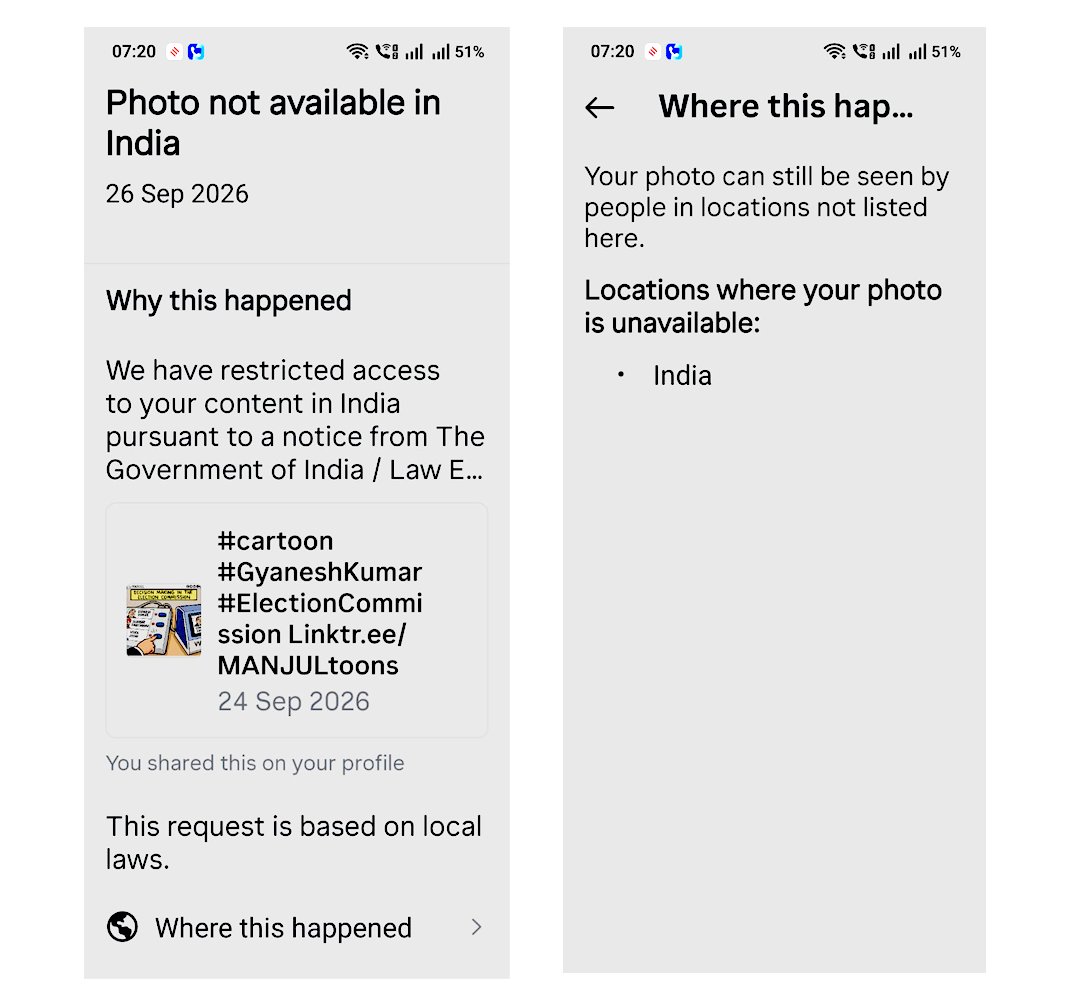
Instagram has restricted this cartoon in India.
I am posting the cartoon again, along with the notice I received from Instagram.
According to the notice, access has been restricted in India “pursuant to a notice from the Government of India / Law Enforcement” and based on local laws.
The cartoon is still visible outside India.
A cartoon about the Election Commission has been stopped from being seen by Indians. When satire gets censored, perhaps the cartoon has made its point. 🇮🇳
#Censorship #FreeSpeech #Satire #PoliticalCartoon #FreedomOfExpression #ElectionCommission #MANJULtoons
A long post!
The Election Commission never had the bandwidth or manpower to carry out such a gigantic clean up of the electoral rolls. It instead relied on an AI-powered application called ERONET.
It uses AI to identify Photo Similar Entries (PSE) and Demographic Similar Entries (DSE) to flag potential mismatches between current voter rolls and legacy databases, like the 2002 base rolls.
The software is essentially a black box, with little to no publicly available information about the AI models actually used in deployment. We do not know the model specs, similarity threshold used, its performance metrics, evaluation benchmarks, false positive rates, how it was trained or evaluated for Indian languages, whether it was developed indigenously or based on a known model/provider. We simply do not know enough.
Anyone with even a basic understanding of AI will tell you that these systems are prone to hallucination errors, and out of distribution (OOD) problems. Even the best large language models, vision models, state-of-the-art OCR technology in the market still struggle to peform with perfect accuracy, particularly on non-Latin scripts.
The 2002 electoral rolls were in native languages and scripts across different states, such as Kannada, Telugu and Bengali. Many AI systems continue to have substantially weaker performance on low-resource languages and scripts compared with English. For ex, a model trained on English will generalize poorly to a low resource language like Telegu or Odia. The old electoral rolls were not originally structured digital databases. They had to be digitised and processed, including through automated conversion into English in some workflows, before they could be compared against contemporary electoral data.
Effectively, it creates multiple points where errors can enter the pipeline through scanning, OCR, transliteration, and finally the AI based matching itself.
That means some level of rigorous human oversight is essential to keep such a system robust and control false positives. We do not know whether adequate human oversight was actually in place, or whether the entire workflow, from OCR and data extraction to AI based matching and automated notice generation, was effectively handed over to the system. The ECI needs to be completely transparent about how this entire workflow was carried out and make the relevant technical documentation, evaluation results, and human-verification procedures publicly available.
There is also a major question around the system's access control and privilege architecture. We do not publicly know the role-based access control (RBAC) structure of ERONET, who has read/write access to the underlying electoral databases, whether EROs or other field level officials can directly modify records, what privileges are available at each administrative level. The Indian Express report seems to indicate that EROs, who have the statutory authority to add/ delete voters, were denied this privilege through the software.
We also need to know whether there is a complete, immutable audit trail recording who accessed, modified, approved or deleted a record, when the action was performed, and what changes were made. Without this information, it is difficult to independently establish the chain of custody and accountability for changes made to electoral roll data.
On Tuesday, the Election Commission said all was well:
The 14 objections by two of its three members were "suggestions," every decision was "unanimous."
With in 48 hours, on Saturday, it issued NINE decisions. Read them against the 14 notes. It's a U-TURN, not in what it says, but in what it does.
And it still leaves some hard Qs unanswered.
Stay with me.
(1/10) 🧵
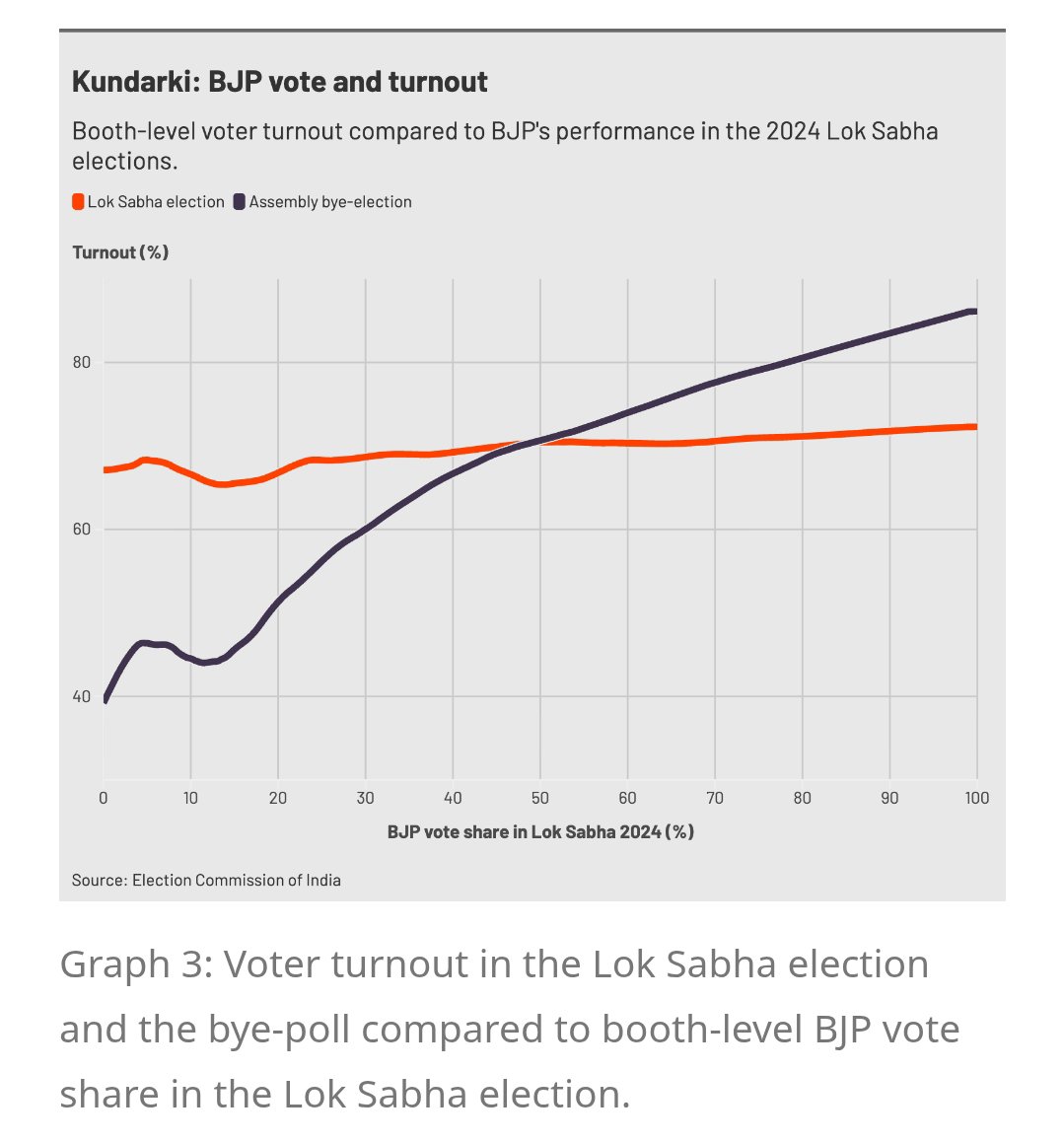
One of the most outrageous election statistics under Gyanesh Kumar. In Kundarki bye-election in 2024, mostly BJP voters were able to vote.
Result? BJP got 77% vote share in a seat with more than 50% Muslim voters. This is official EC data.
People are asking why we withdrew our plea in the Supreme Court against prescrption of Homeopathy...for Covid-19 immunity.
This was not because we were threatened.
This was not because Ayush (Center or State) provided us proper evidence to shut us up.
This was not because Homeopathy works.
The response from the State and Center Ayush departments were idiotic, nauseating, ad-hominem and utterly rubbish, it was an insult to our intelligence.
We withdrew the case because we lost faith in the judiciary system and has understood that sometimes, justice is delayed, to deny it. This line of what happened during Covid-19 with Homeopathy just does not work anymore now, because we are way past it.
We worked hard to make this case, but the case was dragged on purposefully for years, the responses from the Center and State Governments came 3 years after we filed the petition and in between, a Homeopathy group from Kerala impleaded with the Center and State and, as a response, submitted an affidavit that was pure ad-hominem, to which responding was also beneath our status.
The case ultimately became "infructuous" as per legal terms - meaning unproductive, fruitless, or lacking any useful purpose or value - because it was for Covid-19 time and Covid-19 related interventions which the Court, at present, found no value in reasoning with. We were advised to start a fresh petition against the guidelines issued by Ayush - and not focus on what happened during Covid-19. We simply did not have the money or the legal power to do this afresh.
We feel horrible about this situation.
The question we asked Center and State was simple:
- why was arsenicum album homeopathy given on mass public scale even to children when there is no proof of studies and no evidence of safety?
The Ayush would say, it is safe, because there is nothing in it - so then why are they giving nothing?
Or they would claim arsenic in it is useful to boost immunity - so then why are you giving the king of poisons to children without evidence to show for boosting or safety?
Answering this core question would have thrown Homeopathy out of this country. But instead of getting to those answers quickly, delayed tactics, made us run on fumes and ultimately the case got cold.
But we dont want to stop. We want to start fresh a petition against Homeopathy use among children and for public health. We want the Government to stop funding Homeopathy. We need lawyers who can help us get this done with a fresh set of eyes and hands and want to push this as a Public Interest Litigation. We want citizens to pool in funds so that we can at least pay the people who will fight for us in the court.
So we are not backing out. We are taking a few steps back to gather energy and force to make sure the next cut, is the final cut.
We want to work on it...lay the strongest foundation and fight pseudoscience, not just through medical communication, but also through legal channels.
If you are a lawyer or a group of lawyers who want to take this up as a PIL, please email us: [email protected]
https://t.co/ifs3PUz2GB
@arifhussaintm@Lucythebiped@DrTonyPhilip@kaippally
A journalist hosted a television debate about a religious leader's remarks on women.
She then received death threats, rape threats, and had her home address circulated online.
She went to the police.
2 days later, the same police registered a case against her.
Her name is Aparna Kurup.
She is a senior coordinating editor and news anchor with Big TV, a Malayalam news channel.
Speaking at a meeting in Kochi, the Sunni scholar Kanthapuram A P Aboobacker Musaliar, who holds the title Grand Mufti of India, had said that women should remain at home and should not share public stages with men.
The remarks drew wide criticism. Kurup hosted a debate on them, on the channel's programme Big Dialogue, and criticised them.
What followed, according to her petition, was organised. Obscene abuse. Threats to kill her. Threats to rape her. Fake social media accounts circulating her address and the details of the people living with her. Photographs of her family used in the threats.
On 5th September, the Kochi Cyber Crime police registered a case on her complaint.
On 7th September, the same police station registered an FIR against her, under the Bharatiya Nyaya Sanhita and the Kerala Police Act, over what she had said during that programme. The complaint had come from a man in Kasaragod.
So within 48 hours she had gone from complainant to accused.
Her channel deleted the debate and issued an apology.
She went to the Kerala High Court.
On 14th September, Justice Bechu Kurian Thomas ordered the Station House Officer of Ernakulam South to provide adequate protection to her life and to her apartment, and to ensure nobody obstructed or interfered around her residence.
That order stands until the case is decided. It returns to court on 26th October.
Her position is simple. The programme was a journalistic discussion and an exercise of free speech, with no intention of hurting anyone's religious feelings.
Nothing has been proved against her, and she has not been convicted of anything.
Here is the part worth sitting with.
A woman was threatened with rape and murder for asking questions about a public statement made on a public stage.
She reported it.
The police found something to charge her with before they found anyone to arrest.
Press release by @SpokespersonECI almost fully corroborates the investigative report by @RitikaChopra__ and @DaminiNath in the @IndianExpress. For anyone tracking the legal and administrative nuances, this comes as no surprise. But it is baffling to see that some zealots still find this press statement a vindication of the CEC and other ECs. Here is part 1 of the factual, administrative, and legal position regarding the points raised in the ECI's press note:
✅First and foremost, does it require an IIT Professor to tell the Commission as to what statutory powers are vested in EROs, DEOs, CEO and ECI? The ECINET Portal was illegally centralised, even if for varying durations, and I know it from the horse's mouth! Did the other two ECs concur with this decision? Answer is no. The last line of point (iv) is particularly telling.
✅And look at point number (vi). So, agenda will be circulated and minutes will be issued now onwards? Was this not already being followed as a matter of standard and fair administrative practice all along?
✅ Making matters worse, during the SIR since 2025, the preparatory timelines was compressed from 74 in 2002-03 days down to just 6 days, leaving field officers with rushed, & inadequate training. The ECI should have listened to the early warning signs and feedback from its own ground staff and reversed this decision months ago at least after administrative fiasco in Bihar, instead of waiting until an Indian Express investigation and wrath of 'VIPs' pushed them to the wall.
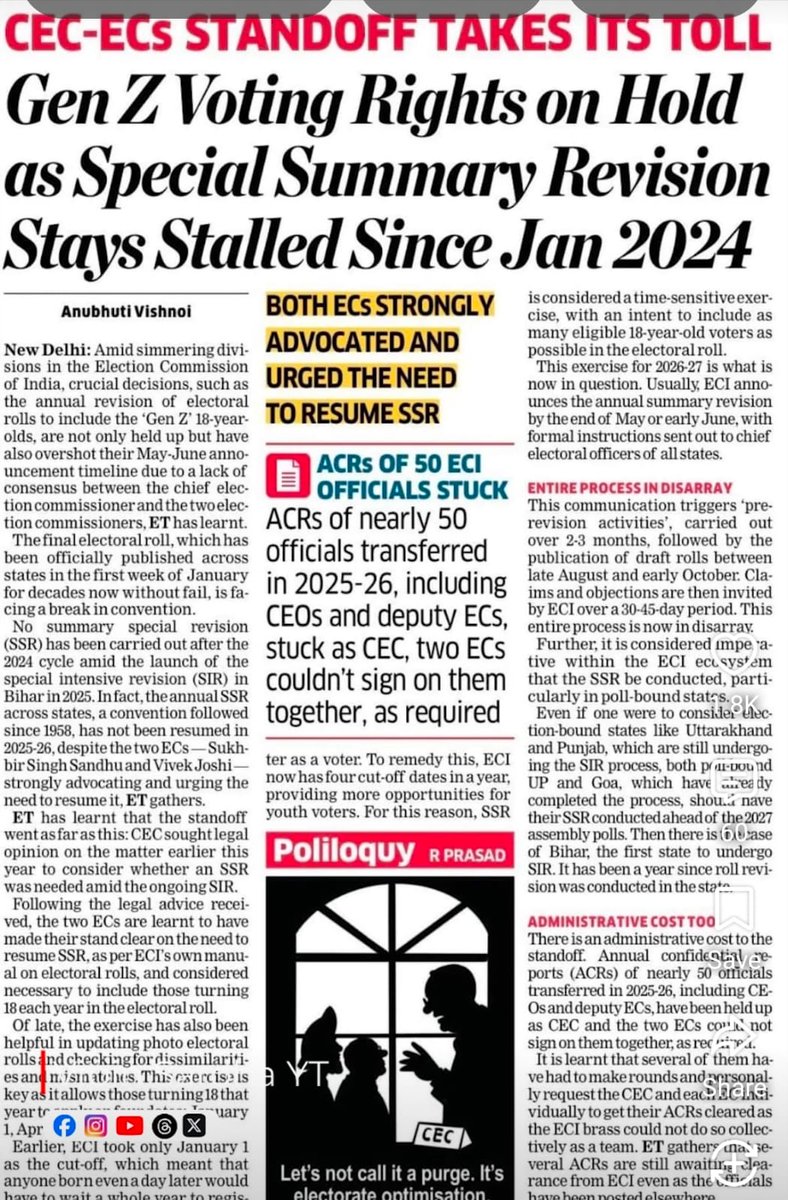
✅ After not letting Special Summary Revision take place since January 2024 as reported by @anubhutivishnoi of @EconomicTimes, Gyanesh Kumar CEC seems to have now relented under public pressure as per point no. 2 of the Press Note.
✅ I have continuously questioned the bizarre administrative decision to dump the entire burden of voter mapping onto the citizens (with a glitchy web interface) while abdicating the rest of the verification process to automated machines for issuing mass notices. This automated purge would have gone completely unchecked if 'VIPs' in the national capital hadn't started receiving these notices themselves.
Now, there appears to have been a belated realisation of a major faux pas, and the onus is being shifted to the BLOs. But why was this not done right from the outset - saving everyone’s time and effort and, more importantly, avoiding unnecessary harassment of genuine voters?
The irony is that the BLOs, most of whom are teachers, will now have to return to the field and undertake this exercise, requiring far more time and effort than would have been necessary had this important verification been incorporated into the original house-to-house survey. @vijaita has rightly highlighted this aspect.
Let's dig this aspect deeper:
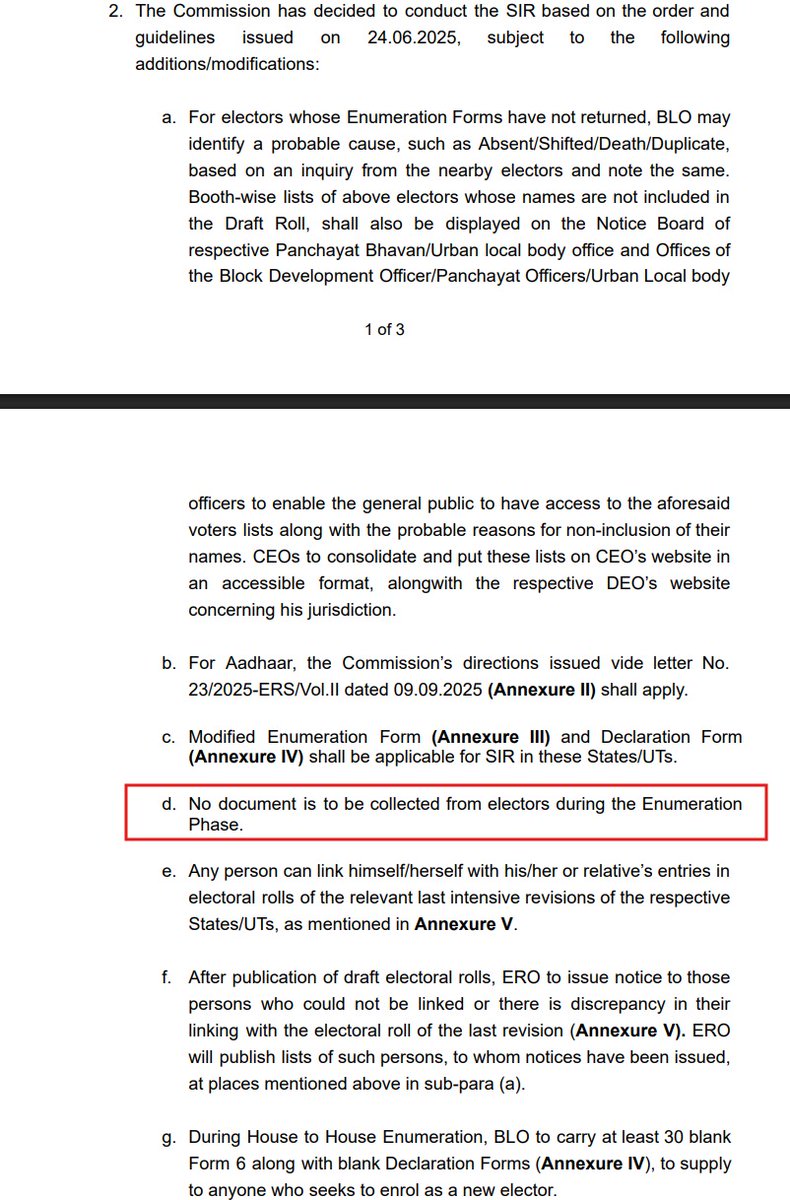
1⃣ Point number 2(d) of the ECI circular 14.05.2026 on SIR in 19 States and UTs prohibits collection of any document during the Enumeration Phase. So, an earlier directive of not collecting one of the 11/12 documents, for the unmapped electors or those having discrepancies with SIR 2002-03 was reiterated in unequivocal terms exacerbating the mess further.
2⃣ Instead of allowing the BLO to apply his/her own judgment during the second round of house-to-house visits - after assessing the nature and extent of the mismatch with the SIR 2002–03 records, or the circumstances underlying a so-called “logical discrepancy” - the process appears to have been left largely to the computerised system. Thus, if “S.S. Sandhu” happened to be recorded as “Sukhbir Singh Sandhu” during the 2002–03 SIR, the system automatically generated a notice! Singular differences triggered the rejection instead of seeing the voter data holistically.
3⃣ And so did several millions in Delhi and crores in the entire nation. An alarmingly large part of the electorate was thus driven to completely unnecessary chaos.
One hopes that the legal eagles like @KapilSibal@Mukul_Rohatgi Harish Salve @_YogendraYadav et al and serious journalists like @sardesairajdeep@RitikaChopra__@dhanyarajendran@BDUTT will continue to follow this issue of paramount importance to the nation.
It's a backhand compliment to my colleagues at @reporters_co that a Rs 450 crore annual revenue newspaper @htTweets, in order to fill its page 1, has to plagiarise a story from a tiny newsroom run on citizens' donations.
Read the original story: https://t.co/wVzYWDQ7lG
Donate to support journalists at The Reporters' Collective, who help Hindustan Times pretend once in a while to have a spine: https://t.co/ToOfqI8q4C
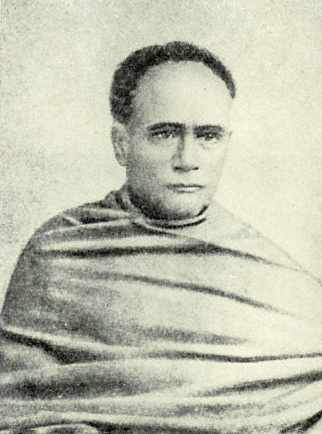
It's never too late to change your views and make a difference.
Gurudas Banerjee was a prominent Indian academic and the first Vice Chancellor of Calcutta University. He was devoted to his mother, who was extremely orthodox, and would personally fetch 'Ganga Jal' for her every morning.
When she was dying she called Gurudas and made him promise that Ishwar Chandra Vidyasagar, somebody whose views she had bitterly opposed for most of her life, would be present and play a prominent part in her last rites.
Vidyasagar was at that point the most hated man in orthodox society for championing and piloting through the Widow Remarriage Bill and his presence there caused a huge furore. But he went and that formidable lady's final gesture went a long way in making his cause more acceptable in orthodox households.
The amazing Vidyasagar's birth anniversary today.
25 years of working. Story no. 2.
Sometime in 2009 I was working at the Mint office in Delhi. I was still in the weekend team and hadn't yet joined the digital team as Managing Editor.
One day I was asked to write a profile of a then celebrity entrepreneur who was running a national chain of retail stories. In fact at the time he was India's largest retailer of mobile phones.
I was handed this job because the entrepreneur was an IIMA alumnus, and so was I, and I had some access to alumni networks, people who went to school with him and so on.
At the time the company was going through some turmoil. But they had just acquired a logistics firm, and talking heads on TV were talking about how this was going to turn things around.
The one problem they had was logistics, the experts said. This acquisition was a super smart move. The channels even had investors come on air to discuss the whole thing.
So as part of my profile research I checked out the logistics company's website. And I was like: wait. This is just a Wordpress template with minor tweaks. There was nothing here. There was no sign at all that this was an actual company. No sign of contact details either. But then I checked the domain registry, looked at the WHOIS information, and got a phone number in Chennai.
An old man picked up. Said nothing and hung up.
Weird. So then I decided to look at the source code of the website. Because back in the day web developers often left comments or a trail of info in the source code.
I could clearly see this was a shoddy, low-effort thing. That had been put together just days before the announcement. So weird.
And so I had a word with the editors and then called up the celebrity entrepreneur's company. I didn't go through the usual PR channel. Instead I just called up their HO in Chennai.
Guess what? The same old man picked up.
I immediately knew what was going on. This dude was acquiring an entirely fake company that he himself had created, in order to desperately siphon funds out of the parent company.
Two hours later we noticed that several previous acquisitions had been similar frauds.
The next day we broke the story, the investors sued him, and the dude eventually went to jail. For someone in the weekend team to get a Page One story was pretty rare. But to have one with this impact was rarer still.
And all because I decided to make a few phone calls and look at the source code of a website or two. Something that none of the TV channels thought to do for days and days even as they covered the story breathlessly.
Moral of the story: Always always always look at the details. Forensic journalism is the best. I still do some of it these days. But mostly pass on the leads to working journalists and so on. But friends, there are always trails. Always. Look into almost any corporate announcement closely enough and you will see stories that you are not supposed to.
It's been heartening to see our investigation into the inner workings of the Election Commission travel so far this week. Thank you for reading, sharing, arguing with it.
Now the harder ask.
Work like this takes months, and it doesn't happen on its own. If you believe there should be someone reading the notes nobody else reads, asking the questions nobody answers, and reporting what they find, fairly and accurately, however uncomfortable, then this is the moment to say so.
Subscribe to @IndianExpress. It costs less than your daily coffee at Starbucks ☕️.
LINK: https://t.co/nTC07oqyHi
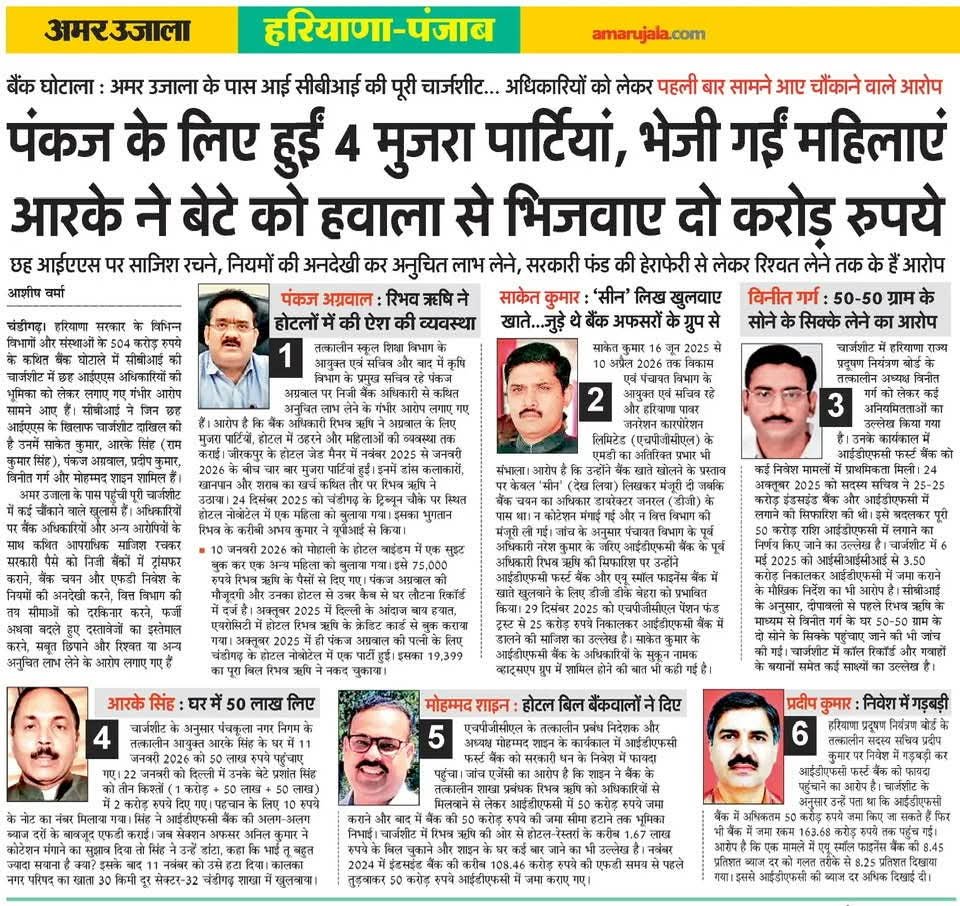
ये सब IAS अधिकारी हैं।
इनके कुकर्म पढ़ लो।
सरकारी मशीनरी कैसे काम कर रही है, ये ख़बर आपको हैरान कर देगी।
ये सब हरियाणा के IAS अधिकारी हैं
और ये जिन पंकज का नाम लिखा है हेडिंग में, ये IAS हैं, इनके शौक देख लो, ज़ीरकपुर से लेकर चंडीगढ़ और दिल्ली के ऐयरो सिटी के फाइव स्टार होटल में मुजरा करवाया गया साहब के लिए। साहब को महिलाएं भिजवाई गईं।
एक से बढ़कर एक कांड किए अधिकारियों ने। करोड़ों की डील हुईं। खूब भ्रष्टाचार हुआ।
अन्य अधिकारी हैं
पंकज अग्रवाल, आरके सिंह, विनीत गर्ग, साकेत कुमार, मोहम्मद शाइन, प्रदीप कुमार।