Our final episode of @DEXintheCitypod on @Unchained_pod is out today. I will miss it.
Every week, I got to work through hard questions about crypto, markets, and the law with two of the most brilliant women in the space. For our last episode, we did something a little different: instead of the news of the week, we reflected on being lawyers in crypto and how far the industry has come.
We are so grateful to everyone who came on the show, let us into their workouts and morning commutes, rooted for us, or yelled at us through the screen 🙂.
Most of all, I’m grateful to @kkirkbos and @Jessi_Brooks1 for their fearlessness, friendship, and willingness to go down every regulatory rabbit hole with me. I’ve learned so much from you guys over the years and had the most fun doing it. Thank you also to @laurashin and the @Unchained_pod team for the opportunity and support.
For now: peace out from @DEXintheCityPod 🏙️✌️
Stay tuned for whatever questionable idea we come up with next.
"Real institutions that laughed us all out, whether it be the FBI or a bank, are now the ones that are curious about it"
Jessi on how crypto got adopted through a bullheaded push, despite FTX and everything else
"The crypto technology has obviously improved, but it all starts from the technology we had when Bitcoin was created. You can add Ethereum and smart contracts and a lot of variety to it, but the concept is blockchain and tokenization, and tokens moving in a way that maybe governments can't control. Some freedom in that way."
"AI, on the other hand, is changing all the time. It's hard to keep track."
"Instead it's been a bullheaded push by all the people on this call, all the people listening, to really show the world that despite everything you may read, despite this FTX thing, despite this person that wants to go to North Korea and doesn't quite understand it, this is a cool thing that needs to be adopted. And it's happening."
"You don't have to look at everything in the space to understand that this is happening."
"Around 2016, 2017, we had to beg the FBI to take our cases involving terrorists using Bitcoin."
Jessi on how fast crypto went from ignored to sought-after
"A surreal one, I was in government prosecuting crypto cases, and literally nobody cared."
"The amounts weren't huge, but they were significant enough, and to me it was important enough that we pushed it. We had a small group who really believed in the tech, but honestly, nobody in the government cared."
"That was part of why I wanted to leave and work in the space, if we can make this safer, this can be great."
"And then, when people started learning that terrorists were using crypto, I got more reach-outs about that one case, the one I couldn't get the FBI to touch, than at any time in my career."
"It shows how fast the industry can change. You look back and think, have we really done anything? And then you go back to the beginning, and it's truly amazing what's happened."
TuongVy Le on the day after FTX, a Senate meeting, and learning to separate her identity from the industry
"One of the biggest lessons, you can care a lot about this work without letting it become your whole identity. So many of us left stable careers to join, so defending the industry got tied up with defending our own life choices."
"I'll give a personal example I've never really told anyone. When FTX happened, it hit me really hard. A day or two after it collapsed I had a scheduled meeting with a Senate office."
"I showed up with all my usual talking points about clear rules and responsible regulation, and partway through I got so emotional I had to stop. The staffers were kind, gave me a moment and a tissue."
"It was a real wake-up call. I'd attached part of my identity to the belief that this industry was worth defending, so even though FTX had nothing to do with my work, it felt like a personal betrayal."
"The lesson, separate the potential of the technology from the individual actions of people who do bad things. You can learn from those failures and still keep building."
No news docket this week. DEX in the City is leaving Unchained. For their farewell episode, @kkirkbos , Jessi Brooks and @tuongvyle12 , three general counsels at the center of crypto, reflect on practicing law and being women in this male-dominated industry.
Live today, 12pm ET:
DEX in the City is live! 🏛️
This week: the 9th Circuit's rogue-AI-agent ruling, the control fight at Ondo Finance, and the CLARITY Act countdown. @kkirkbos, Jessi Brooks, and @TuongvyLe12 get into it.
https://t.co/07pCFisedh
Surprise! After 2 incredible years at the indomitable @StarkWareLtd, I've joined @chainlinklabs as Head of Legal. Chainlink is powering DeFi & bringing the global financial system onchain & there's never been a better place and a better time to help let the builders build.
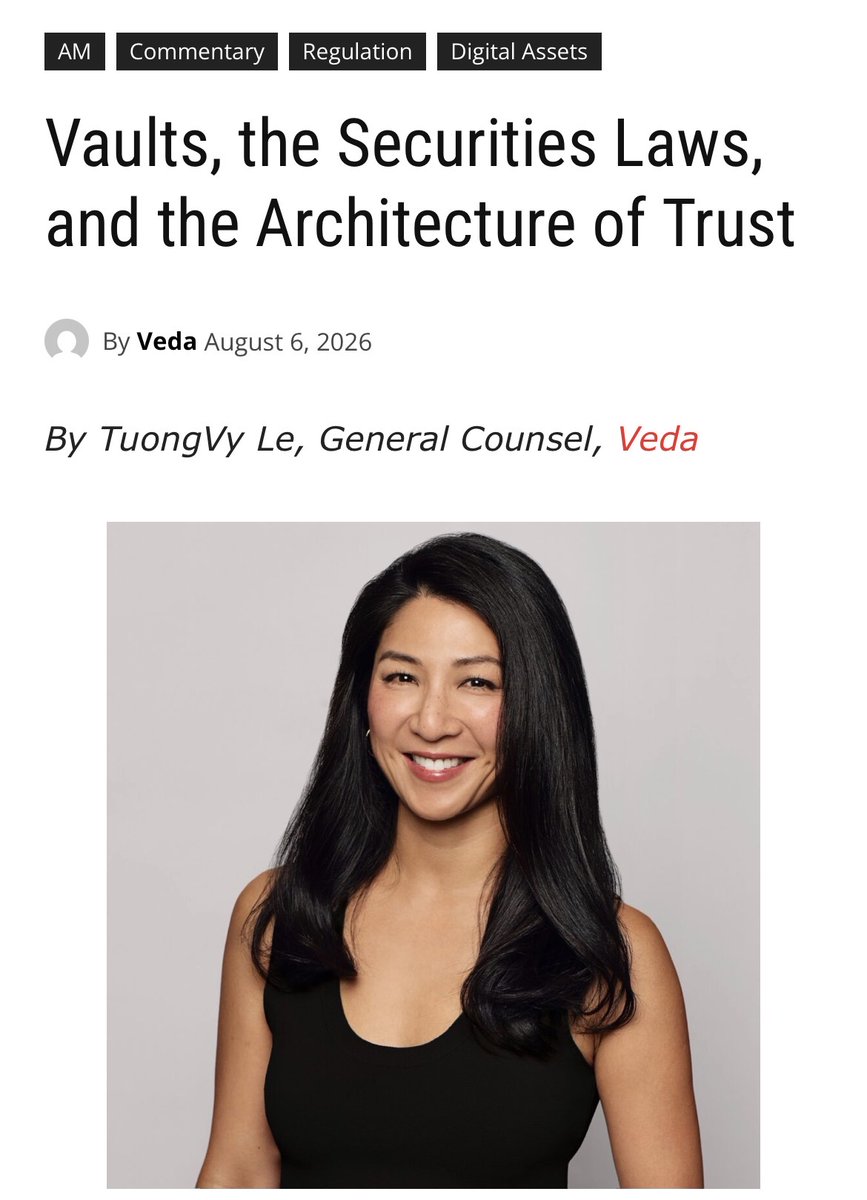
@traders_tweets asked me to write about vaults and the securities laws in light of Comm'r Peirce's recent statement. Here's how we're thinking about it at @veda_labs:
For nearly a century, securities regulation has addressed a recurring problem: investors entrust assets to intermediaries who exercise legally significant authority on their behalf. Because that authority creates opportunities for abuse, the law imposes fiduciary duties, governance requirements, disclosure obligations, custody rules, and other protections. In fact, much of the federal securities laws can be understood as a response to the need for investors to trust intermediaries with continuing authority over their assets.
Modern software like vaults and decentralized on-chain lending present a different possibility. Some forms of authority that once had to be entrusted to an intermediary can now be constrained or eliminated through system architecture and cryptography. Investors may still rely on markets, pricing, counterparties, and the integrity of the software itself, but not necessarily an intermediary that exercises the same degree of continuing authority over their assets. Many vaults instead automate participation in an underlying market while leaving each participant’s custody, ownership, and legal relationship to their assets materially unchanged.
That does not make the securities laws less relevant, but it does change the threshold question: where do investors still have to trust a third party with legally significant authority over their assets? Viewed through that lens, I think it becomes less obvious that Reves, Howey, and the Investment Company Act apply in the traditional ways, if at all.
Should we talk about this and the latest PM drama next week? Seems like everyday there’s a court ruling in one of the hundred cases across the country 👀!
Statutory interpretation (like admin law 😊) was one of my favorite subjects in law school. The statutory canon against absurdity is an actual statutory canon! dating back to a Supreme Court case from 1868. It’s not invoked often and has been controversial bc it can require courts to depart from a statute’s literal reading, which some people are very offended by. But yes it is real.
(Also that case was about a sheriff who arrested a mailman who had been indicted for murder; the court ruled that the sheriff couldn’t be prosecuted for violating a federal law that made it illegal to “obstruct the mail” because that’s obviously not what Congress meant. Lol)
⚖️ @kkirkbos and Jessi Brooks argue this Michigan-Kalshi fight could be the case that finally sends prediction market jurisdiction to the Supreme Court.
@DEXintheCityPod
https://t.co/ARnjha9fQY
What caught my attention: @TuongvyLe12 asks who actually owns the real tokenized Apple stock once five companies claim to issue it. 🍎
New clip from @DEXintheCityPod.