Teachers like Mrs. Higgason make all the difference. 💡 She’s using Khanmigo to bring creativity to her science classroom, and we’re so grateful she shared her story with us. Thank you, Mrs. Higgason! 📷
Watch here: https://t.co/LUWvd0hE2E
W/a tool that supports them while they practice +learn, teachers can focus on assessing their growth +mentoring them to be independent, thoughtful individuals.
These tools aren’t about replacing teachers—they’re about empowering us. This is the mission I left the classroom for🙌
Khan Academy was featured on @60Minutes with Anderson Cooper this past weekend🎉
I met and talked w/ Ms. Higgason (featured below!), a chemistry teacher at Hobart HS in Indiana about how she uses our AI-chatbot, Khanmigo. It was eye-opening and inspiring. https://t.co/TyJvhrl3gg
An AI-powered tutor alerts teachers if a student shows signs of emotional distress, which can allow a counselor to intervene immediately when they are needed. https://t.co/r6mOGk2qkz
And while it isn’t always perfect, it can fill certain gaps, enabling teachers to focus on more impactful, individual teaching moments.
The teacher is still the expert who knows their context and students best🧑🎓
@andy_matuschak ++the rigor of academic writing and the relatability of blog posts. Making great ideas accessible to many is definitely an art form you have honed. When I teach physics and chemistry to high schoolers, this is critical!
Had a great time connecting w so many open-minded, creative ppl focused on improving education.
Appreciated the hyper-efficient facilitation and access to useful tools.
Favorite project: Restorative Justice post-incident reflection tool. No judgement and eternally patient! :)
Another hackathon? Yes!
Teachers, techies & students across the Bay gathered yesterday to learn about #AI and get hands-on building the #edtech tools we need. Thank you to our partners @ReinventionLab@aiedu_org@nsvf for making this happen.
New Science *Activities* from Khan Academy are out!
Love:
-polished Teacher Guide w/ common misconceptions explained so you can address them in those powerful learning moments
-minimal 'fluff', allowing you to add your own personal 'fluff' for your context 🐑
Teachers - ignite scientific creativity in your students with our new hands-on science activities. ✨
Try one out: Explore light interactions in art and create masterpieces using physics and color. 🎨
These activities are made possible with support from @Adobe.
@PepsMccrea Interesting, I wonder if those highly active pieces are closer to inquiry and are supported on either end with EI? Both are important but sequence is critical.
Really appreciate the Means vs. Ends perspective though, +agree that open inquiry gets messy and frustrating quickly!
@PepsMccrea I agree w/ most points and teaching HS chem and physics has also shown Ss struggle with open-ended learning methods when they have little domain knowledge.
I wonder when/how we should shift the experience from being slightly more passive (explicit instruc) to more experiential?
Can we feed AI our science textbooks and let it build a world based on our human-translated rules?
I have a feeling we might find some discrepancies and could be cool to see how those emerge.
Some good examples on using chatgpt in an English class (have Ss compare an old essay they wrote w/ Chat's version), + rethinking writing prompts in general (a speech for a friend's wedding vs a fictional character in an old book).
Love seeing it evolve.
https://t.co/0VjiMxeTqM
@codeEtweets @CWingUexkull Also my thought, w/ reference to Rovelli. I think of 'time' as our way of quantifying entropy (humans made up 'time' & 'seconds', etc). What if everything around you stopped 'changing' for a moment (increasing microstates, toward disorder), it would seem as if time stopped!
I know my former Navy co-worker/fellow teacher would agree with this approach. His students were always the most challenged and always the most successful in the end.
Once they figured out this was a no- nonsense, real problem solving experience, they rose.
I also learnt something that — in retrospect — seems obvious:
You really want to train with controlled simulations of the ACTUAL competitive environment.
This sounds obvious, but all sports have drills that are more removed from the competition env. Therefore more useless.
Sometimes the tool is content-specific, but my favorites were ones that were learning-specific.
I always asked my students what they would want to be an expert in. Rarely would anyone say, "expert learner."
But what could be better? 'It's a cheat code!' they'd say.
I miss 'em🙃
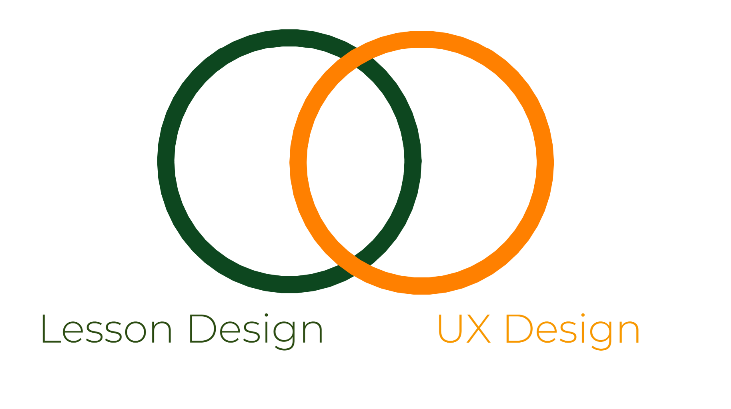
The early stages of problem solving in UX Design are so similar to how I would design my lessons as a teacher that it's worth pointing out the areas of overlap and where each field could learn from the other.
Before I share those insights, a question for my fellow teachers:
So I also spent a ton of time buried in the same content they were learning. This is something I did every single year: Do the problems you are assigning. All of them.
Find the tricky parts and note what your expertise guides you to do. Turn this into a tool they can use.