The latest issue of New Eastern Europe is out!
To anyone who observes the situation in Ukraine and ongoing Russian attacks it is unfortunately crystal clear that the main obstacle to peace is the unwillingness to end the war by the Russian Federation.
https://t.co/U3zVNHudwS
The pace of events following the parliamentary elections in Georgia on October 26th 2024, has stunned both Georgian society and international observers. The vote, marred by intimidation, vote-buying, abuse of state resources, and other fraudulent tactics, has plunged the country into a deep political crisis.
In recent weeks, Georgians from all walks of life have taken to the streets in peaceful protest, demanding accountability and defending their European future. While demonstrations have been concentrated on Tbilisi’s Rustaveli Avenue, they have also spread across the country, uniting towns, villages, and communities.
Now is the time to act. We cannot allow Georgia to descend into authoritarian stagnation, enriching only a select few. The calls for help beyond the Black Sea are clear. We must answer them.
By signing this letter, we express our unwavering solidarity with Georgian society and make the following appeals to leaders, friends, and partners:
To the global community and friends of Georgia: Share this open letter widely and amplify the voices of Georgian society;
To the Georgian authorities: Immediately end the arrests of peaceful protesters and release all individuals unjustly detained;
To policymakers in Western countries: Increase pressure on Georgian authorities to pursue a peaceful resolution that aligns with public expectations, including the option of snap elections;
To Western leaders: Travel to Georgia in a show of solidarity, meet with representatives of all sides, and actively encourage a peaceful, democratic resolution;
To citizens of the world: Support Georgian society’s struggle for freedom by donating to organizations providing aid and resources.
Find out more on the link below.
https://t.co/NdozrHf5tb
This tragic-comic video was shot at the 48th election station in Marneuli and accurately reflects the injustice that happened during the elections in Georgia. 🇬🇪 Here, I am trying to prevent a person who came with someone else's personal number in his passport from voting, while 30 people are trying to drag me out of the election station to let him vote.
They still couldn’t move me, but outside, dozens of people were waiting to physically abuse me. They followed me after I was kicked out of the 50th election station, disappointed that despite the intimidation, I didn’t stop exposing the fraud. And now, you’re telling us that Georgian Dream got 54%? No, friends, we will not let you steal our homeland, and we will fight for every vote, even in such a disproportionate battle.
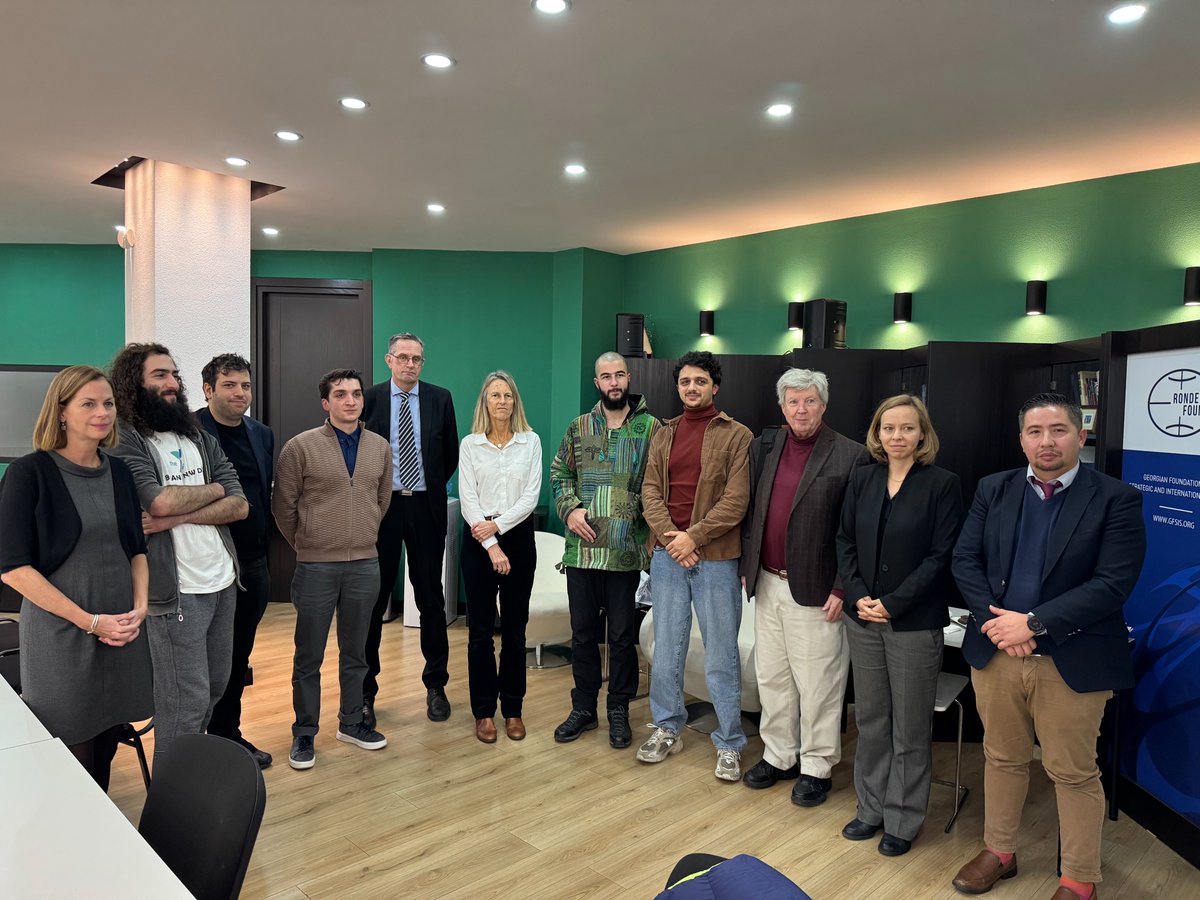
The McCain Institute led a mission to Tbilisi, Georgia to meet with a diverse cross section of Georgian society and learn more about how Georgians are dealing with the stress caused by the October 26 parliamentary elections. https://t.co/AFssa3KdM4
As the existential philosopher Karl Jaspers once wrote, “uncertainty is not to be overcome but understood”. In this issue, our aim is just that: to shed light on the uncertainties shaping our world, to inform you about these broader challenges and to explore how we might navigate them.
Read more in our latest issue, 'Age of uncertainty', on our website.
https://t.co/V1KzKTFWoP
Don't forget to join the live session of Talk Eastern Europe to celebrate the 200th episode of our podcast. Chat with our hosts, ask questions, and connect with a community of our fellow listeners.
The event will be streamed via Facebook & YouTube.
Facebook: https://t.co/niM7KcA03x
YouTube: https://t.co/bmFXSXlJVY
Azerbaijani political analyst Bahruz Samadov has been detained in Baku, according to media sources. Bahruz wrote for @NewEastEurope most recently last April about Belarusian artist in exile Darya Cemra:
➡️https://t.co/yQ3pgpvozv
More on his detention⤵️
https://t.co/w6nNlBgAPA
The start of July saw Britain elect a Labour government for the first time in well over a decade. While promising change to voters at home, a level of continuity still appears to dominate London’s foreign policy. This is particularly true regarding the region, with a desire to overcome the tensions of Brexit adding nuance to well-established support for Ukraine.
Read more in the article by Niall Gray on our website.
https://t.co/lu1Dp73PXt
New issue alert!
Twenty years ago, the European Union experienced its largest enlargement ever, the so-called Big Bang, with the addition of 10 new member states. This enlargement included many of the countries in our region – Poland, Hungary, Czechia, Slovakia, Slovenia and the three Baltic states of Estonia, Latvia and Lithuania. This momentous occasion marked the culmination of hard work by the EU and the post-socialist countries, which aptly referred to it as the final “return to Europe”. With a newly united Europe (and more members on the way), it seems as that Euro-optimism had reached its pinnacle moment.
And since 2004, the new member states have certainly made some remarkable achievements. The GDP per capita in purchasing power parity of the new states grew from 59 per cent of the EU average in 2004 to 81 per cent in 2022. The income gap between the older and newer states has also narrowed over the last 20 years. Some countries’ living standards, such as Czechia or Slovenia, have even surpassed those of older EU members.
Yet, at the same time, these past two decades were not without challenges. Issues related to democratic backsliding, the rule of law and corruption have tainted the legacy of the enlargement. Voices in many western European capitals began questioning whether the enlargement itself was too soon. After a series of crises hit the EU, which began with the 2008 financial crisis, a rise in Euroscepticism began to counter the accomplishments of the previous generation of Euro-optimists and putting a major damper on any future enlargements.
Thus, the question today is: how united is Europe after these past 20 years? Certainly, the east-west divide remains a point of contention. However, other issues have also emerged, such as the rise of far-right populism and the debate over support for Ukraine. These phenomena can be found throughout Europe, and especially worth considering following the elections to the European parliament this June. As geopolitics once again becomes a key factor in European decision-making, we can only hope that unity prevails over division. Otherwise, the legacy of the EU Big Bang will be lost to the history books.
Find answers to this question in our latest issue '20 year later. Is Europe still united?'
Subscribe now: https://t.co/FsyHLJLScQ
@RammSvart @oyvindsteensen Festlig at dere tror det dreier seg om 'semitter' - et raseteoretisk begrep som har gått ut på dato. Begrepet 'antisemittisme' beskriver fiendlighet mot jøder. Kun jøder. På tide å åpne en bok.
@oyvindsteensen Ingen er uskyldig: Antisemittisme på venstresiden - Torkel Brekke 2023. Muligens en nyttig bok for deg. Alt for mange eksempler på at du tar feil. Anti-sionist kampanjen til Sovjetunionen påvirker venstrebevegelsen globalt til den dag idag.
@StevenGWalker74@Mr_Andrew_Fox The marriage between the far left and islamists corupting youth with their simplified narrative will make it hard for the last of us to remain in Europe. The same Europe that tried to wipe us out just two generations ago. But ofc, what about them rabbis and ministers over in 🇮🇱