Developer and Cybersecurity / I am an Information Security professional responsible for analyzing corporate risks related to information managed by IT systems.
@heliotsx@devjuninho Véi é frustrante demais. Acho que a saída é aplicar rate limit (Fair Use) na garantia. Trava X reqs de IA e Open Finance. Passou os 7 dias sem estorno? Libera 100%. Você deixa testarem sem sangrar o caixa.
@YuuZeraa Vai fica mais caro, dei uma olhada hoje e não tem mais TVs OLED c5, disponíveis. Comprei a minha em fev de 2025 a c4 por 5900, acho que quando chega vão vim na faixa dos 6500 em diante, quem puder compre agora.
@1Iucas Da Ems é triste, gosto muito da pharlab também, mas sinceramente? O original tem diferença, mal tem efeito colateral, e não dar aquele cansaço do fim do dia, único ponto ruim que o pharlab dar é esse.
Cara, acho incrível ver isso. Em 2022 era react de vídeos aleatórios, agora em 2026 serão 52 jogos exclusivos da Copa. Isso só me faz ter ainda mais certeza de que constância traz resultado. 🙂
@acgfbr Já fiz uma loucura um tempo atrás implementando numa vps poderosa da hetzner, foi fortes emoções e ela aguentou kkkk Mas não faria isso nunca novamente.
GitHub just confirmed unauthorized access to its internal repositories.
Read that again carefully.
Not customer repos.
Not enterprise orgs.
Not your private codebase.
Their internal repositories.
But here’s the part most people are missing:
“We are closely monitoring our infrastructure for follow-on activity.”
That line matters more than the breach itself.
Because modern attacks rarely stop at initial access.
This is usually how it unfolds:
1/ Initial foothold
attacker gets access to an internal system, repo, token, or credential
2/ Recon phase
map infra, identify secrets, CI/CD pipelines, deployment configs, internal tooling
3/ Privilege escalation
move laterally into higher-value systems
4/ Persistence
backdoors, stolen tokens, automation abuse, shadow access
5/ Follow-on activity
the real attack starts after defenders think they contained it
And GitHub explicitly mentioning “follow-on activity” means they know this too.
What makes internal repo breaches dangerous:
internal repos often contain:
infrastructure configs
deployment scripts
staging credentials
internal APIs
undocumented services
feature flags
monitoring hooks
employee tooling
Even without direct customer data access, internal code can expose the blueprint of the entire system architecture.
This is why mature security teams assume:
source code access = potential infrastructure intelligence leak
Now the interesting part:
GitHub said they currently have:
“no evidence of impact to customer information stored outside internal repositories”
That wording is extremely deliberate.
“No evidence” ≠ “impossible”
It means:
investigation still ongoing
logs are being reviewed
blast radius not fully finalized
containment likely still active internally
This is also a reminder for every startup shipping fast with AI and automation:
Your GitHub repo is not “just code.”
It’s:
secrets
infra assumptions
auth flows
deployment logic
business intelligence
One leaked token + weak IAM + over-permissioned CI pipeline can become a full production compromise in hours.
Security isn’t optional once you have users.
Even for startups. Even for MVPs. Even for “just testing.”
The Silver Situation:
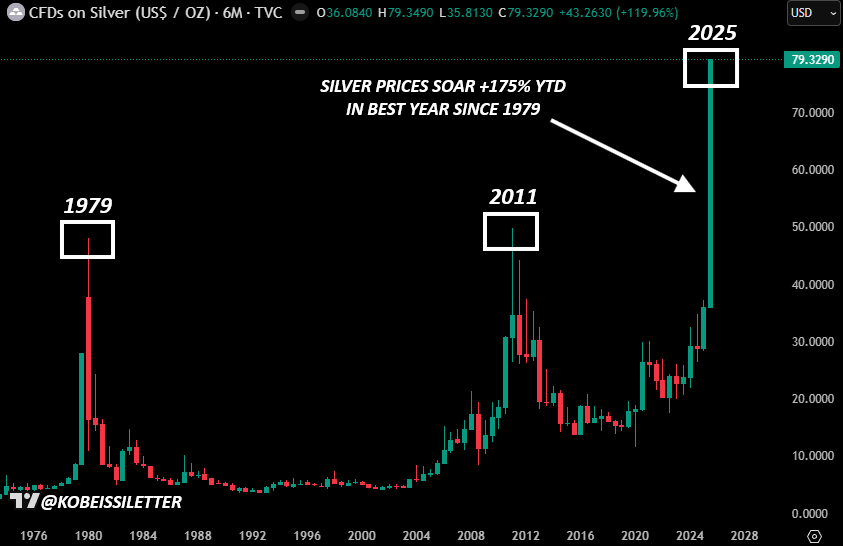
Silver prices are now up a MASSIVE +175% in 2025 and set to post an 8-month win streak for first time since 1980.
Gold and silver have added a combined +$16 TRILLION in market cap this year ALONE.
What is happening? Let us explain.
(a thread)