🌟 鑽石恆久遠,代幣永流傳!DIMD行業首款錨定實物鑽石的RWA代幣震撼登場。
每一枚均對應真實鑽石珠寶所有權,由中國華比鑽石集團、印度KGK珠寶集團等頂級供應鏈實物支撐。
投資門檻低至0.15USDT,完美融合「鑽石永恆價值+區塊鏈高效流通」雙重優勢,開啟珠寶資產數位化新紀元!
DIMD Diamond Jewelry Token—the first RWA token in the industry anchored to physical diamonds is officially launched.
Each DIMD corresponds to the ownership of real diamond jewelry, supported by top supply chains such as China Huabi Diamond Group and India KGK Jewelry Group.
The investment threshold is as low as 0.15USDT, realizing the perfect integration of "diamond's eternal value and blockchain's efficient circulation", and opening a new era of jewelry asset digitalization! @RWA_LTD@waptx
#DIMD #DiamondRWA #RealWorldAsset #BlockchainFinance #Web3Investment #LuxuryTokenization #AssetDigitization
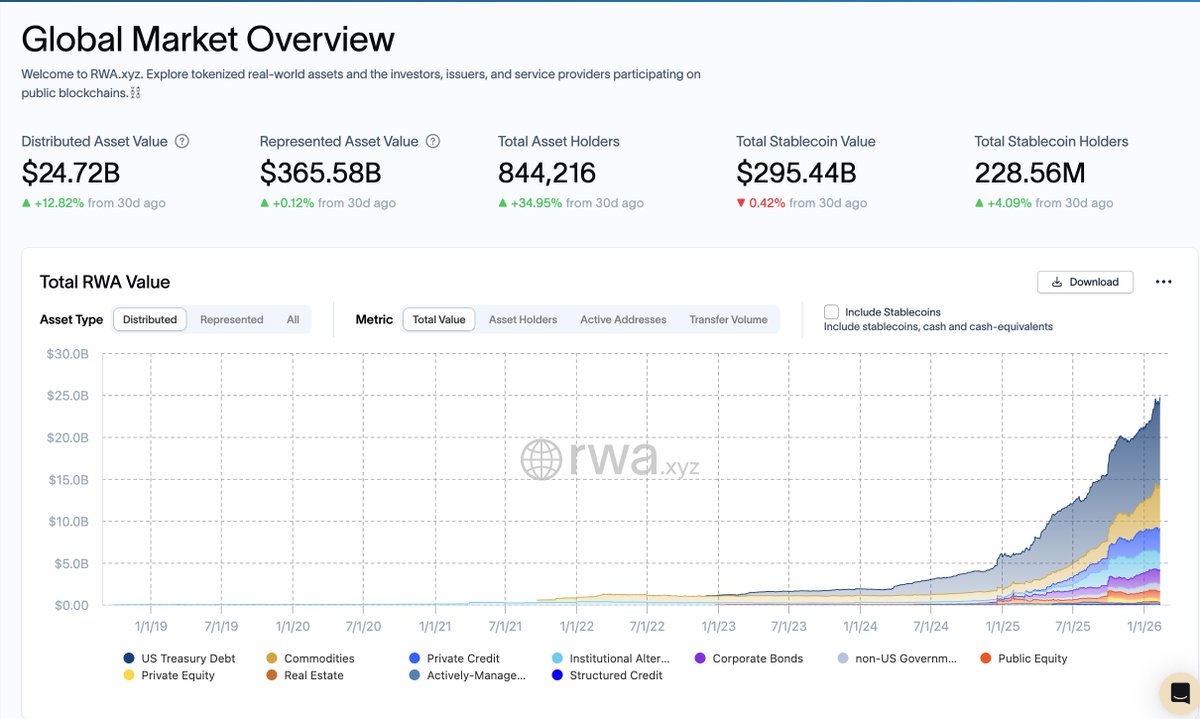
RWAs keep scaling — quietly, structurally.
• Distributed RWA value: $24.72B (+12.8% in 30 days)
• Asset holders: 844K (+35.0% MoM)
• Stablecoin holders: 228.6M (+4.1% in 30 days)
• Represented asset value: $365.6B (steady)
What stands out isn’t just capital inflow — it’s participation growth.
More holders.
More asset categories.
More on-chain settlement.
Even with minor fluctuations in stablecoin value (-0.4% over 30 days), user growth and distributed asset expansion continue upward.
Commodities, private credit, treasuries, and other tangible RWAs are steadily increasing their on-chain footprint — suggesting this trend is less about hype and more about structural integration.
This doesn’t look speculative.
It looks like infrastructure compounding.
Source: https://t.co/r98WDLtxRW
RWAs keep scaling — quietly, structurally.
• Distributed RWA value: $23.95B (+11.3% in 30 days)
• Asset holders: 830K (+36.3% MoM)
• Stablecoin holders: 224M+, still rising
What’s notable isn’t just growth in value, but growth in participation.
More users, more assets, more on-chain activity — even as headline numbers fluctuate.
Commodities, private credit, and other non-financial, tangible RWAs continue to expand their footprint, reinforcing a simple trend:
real assets are moving on-chain because they need better settlement, transparency, and accessibility.
This looks less like speculation — and more like infrastructure taking shape.
Source: https://t.co/r98WDLtxRW
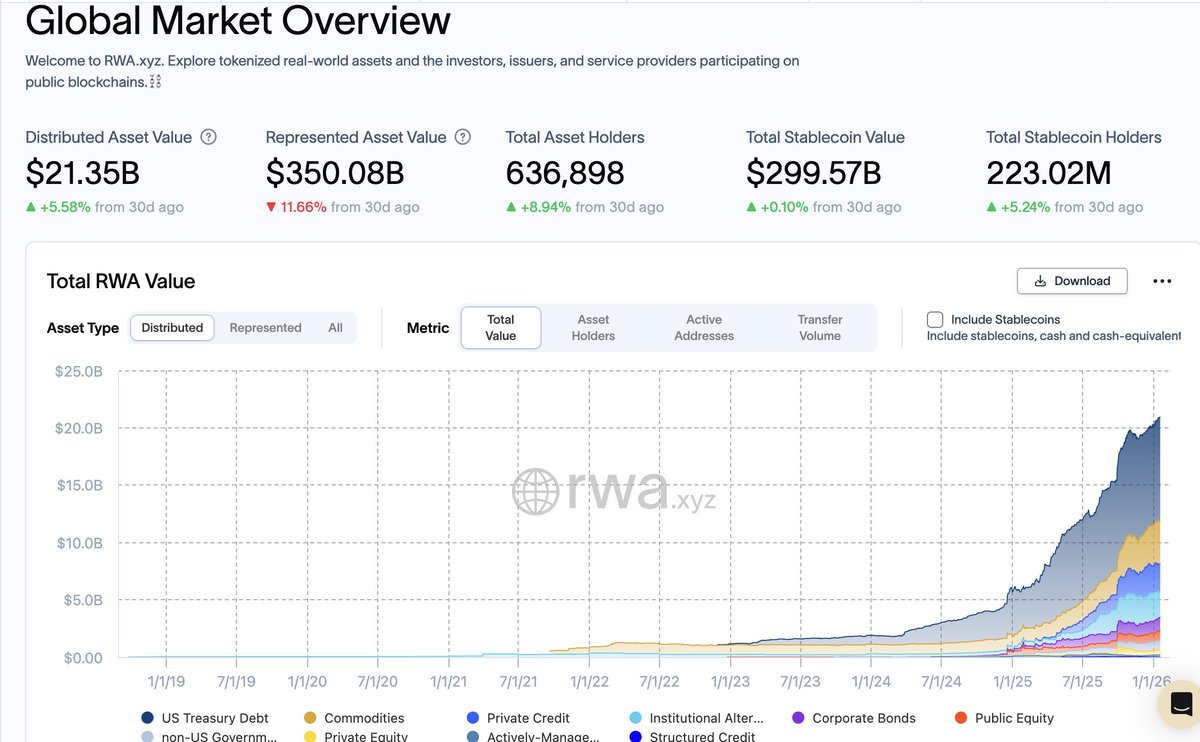
RWA market snapshot — Jan 20, 2026
Tokenized real-world assets continue to expand steadily across public blockchains.
According to the latest https://t.co/B85mrVaJeA data:
• Distributed RWA value has reached $21.35B (+5.6% in 30 days)
• Total asset holders increased to 636,898 (+8.9%)
• Stablecoin value remains stable at ~$300B, while holders continue to grow
What’s notable is the divergence we’re seeing:
📈 Participation and on-chain distribution are rising
📉 Represented asset value remains volatile
This reinforces a broader RWA pattern: adoption is being driven less by headline valuation and more by use-case expansion, asset diversity, and real-world integration.
As the market matures, growth appears increasingly structural rather than speculative.
Source: https://t.co/r98WDLtxRW
Tokenized real estate continues to move from pilot projects to scaled offerings.
Vince Trust has announced the expansion of its tokenized real estate investment portfolio, targeting broader investor access across Europe and North America.
What stands out is not just digitization itself, but the direction of adoption:
• Real estate as a non-financial, tangible RWA
• Simplified access without direct property ownership
• Custody, compliance, and institutional-grade infrastructure as core design elements
This reflects a broader RWA trend we’re seeing:
real-world adoption is being led by assets that users already understand — property, infrastructure, and physical value — rather than purely financial instruments.
As tokenization matures, trust appears to come less from yield narratives, and more from clear asset backing, custody, and real-world utility.
Source (press release via Business Insider):
https://t.co/J8dQAk6y1A
Gold-backed RWAs continue to move from concept to infrastructure.
VCI Global recently announced a US$200M RWA consultancy mandate to develop Bridge Gold — a fully allocated, independently audited digital gold asset with multi-currency settlement support (USD, EUR, SGD).
What’s notable here isn’t just tokenization, but the institutional design choices:
• Physical gold held in bank-grade vaults
• Independent Big Four audit assurance
• Clear custody, verification, and settlement structure
This highlights a broader RWA trend:
non-financial, tangible assets (commodities, goods, inventory) are increasingly becoming the entry point for real-world adoption.
As RWAs evolve, trust appears to come less from yield engineering — and more from assets users can verify, understand, and redeem.
Source (official press release):
https://t.co/Wxy7EOKPpK
📊 RWA market check — January 5
On-chain RWAs continue to grow steadily into the new year.
• Distributed RWA value: $19.22B (+3.28% MoM)
• Total asset holders: 602,570 (+7.5% MoM)
• Stablecoin holders: 217M+ (+4.8% MoM)
What stands out isn’t just growth — it’s participation.
More users, more real assets, and increasingly clear demand for verifiable, on-chain representations of the real world.
RWAs are moving from experimentation to infrastructure.
2026 will be about what gets tokenized, not whether it should be.
Source: https://t.co/McaOTPVGWM
Gold-backed RWAs continue moving from theory to execution.
DWF Labs has reportedly completed a test transaction involving a physical gold bar, marking another step toward real-world asset tokenization beyond purely financial instruments.
What stands out isn’t speculation — it’s execution:
• Physical commodity settlement
• Verifiable ownership transfer
• On-chain infrastructure supporting real assets
This reinforces a broader trend: non-financial RWAs (commodities, goods, inventory) are becoming practical entry points for real-world adoption, where trust comes from assets users can verify and understand.
Source (syndicated via CryptoRank):
🔗 https://t.co/9v2zZYdRbG
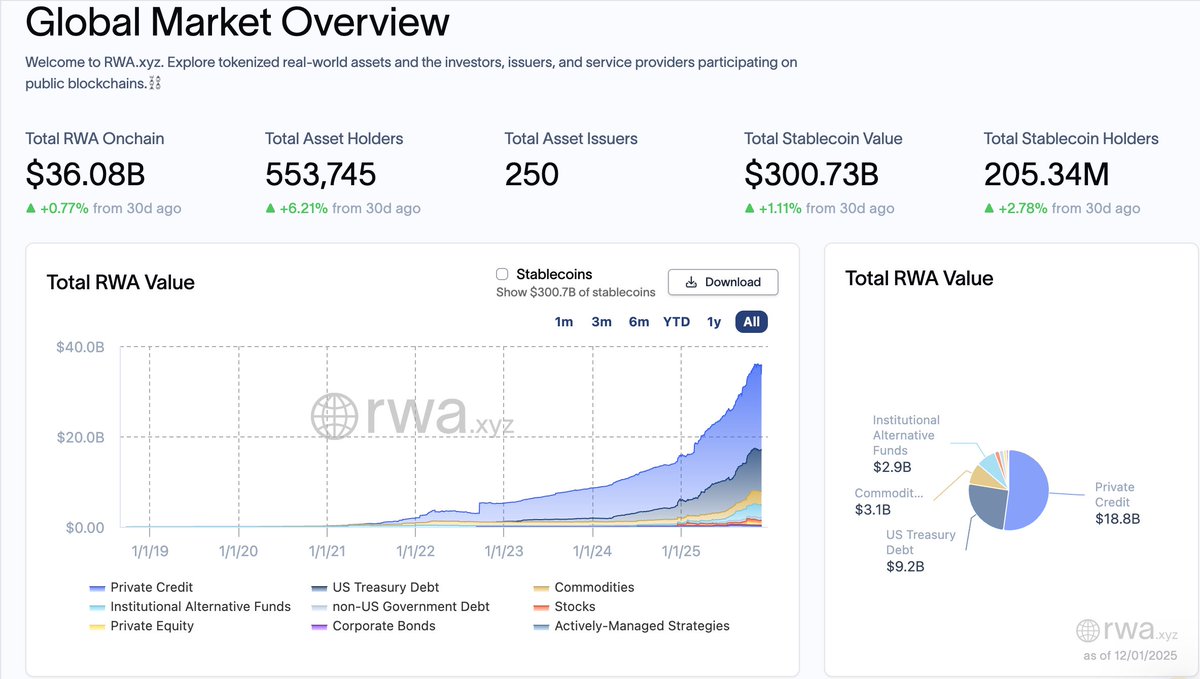
The latest @rwa_xyz update is in — RWAs keep climbing.
RWA on-chain: $36.08B (+0.77%)
Asset holders: 553,745 (+6.21%)
Stablecoin value: $300.73B (+1.11%)
Where the value sits today (Dec 1, 2025):
• Private Credit — $18.8B
• US Treasuries — $9.2B
• Commodities — $3.1B
• Alt Funds — $2.9B
Private credit still dominates, but the bigger trend continues:
Financial RWAs built the base layer.
Consumer & product-backed RWAs will drive the next adoption wave.
Users trust what they can redeem, not just what yields.
RWAs aren’t just growing —
they’re becoming the backbone of Web3’s real economy.
🚀 BREAKING! https://t.co/GCvSt29xXC promo video lights up Admiralty's core landmark billboard!
Victoria Harbour skyline as backdrop, global attention focused📍
With Hong Kong's RWA market growing 178% annually, we're showcasing the new era of "Chain-Commerce" at https://t.co/sCuL0w5QLo!
🔥 Why it matters?
▫️ Daily reach: 100,000+ financial elites
▫️ Demonstrating real-world asset tokenization capabilities
▫️ Hong Kong's dual-driver policy: Stablecoin + RWA compliance
✨ See it live:
https://t.co/sCuL0w5QLo
Unit 2001, United Centre, Admiralty, Hong Kong
👇 RT & tell us:
What real-world assets do you want to see tokenized?
RWA #Tokenization #Web3 #HongKongWeb3 #Blockchain #FinTech #AdmiraltyLandmark #DigitalTransformation
The latest @rwa_xyz market dashboard (Dec 10, 2025) is out — and RWAs continue to show strong user growth despite market volatility.
Distributed Asset Value: $18.45B (-0.23% from 30d ago)
Represented Asset Value: $391.66B (-8.07%)
Total Asset Holders: 564,846 (+6.23%)
Stablecoin Value: $308.87B (+1.23%)
Stablecoin Holders: 208.17M (+3.24%)
The underlying trend remains clear:
User participation keeps rising even when asset values fluctuate.
Where distributed RWA value sits today:
• US Treasury Debt
• Private Credit
• Commodities
• Alternative Funds
• Corporate Bonds
(Private credit + treasuries remain the backbone)
And the broader shift continues 👇
Financial RWAs are the base layer.
Product-backed, redeemable RWAs will be the adoption layer.
Users trust what they can verify, redeem, and use.
That’s where real-world tokenization becomes real utility.
RWAs aren’t slowing down — they’re maturing into the infrastructure of the on-chain economy.
The latest @rwa_xyz dashboard (Dec 18, 2025) is out — and RWAs continue to compound quietly.
Distributed RWA value: $18.74B (+3.29% / 30d)
Represented asset value: $410.38B (+3.65%)
Total asset holders: 575,752 (+6.82%)
Stablecoin value: $300.18B (+1.17%)
Stablecoin holders: 210.72M (+3.76%)
Despite short-term market noise, participation keeps accelerating.
What stands out 👇
• Treasury debt and private credit still anchor value
• Commodities and alternative funds are steadily expanding
• User growth remains strong across the board
This reinforces a familiar pattern:
Financial RWAs build the rails.
Non-financial, product-backed RWAs unlock scale.
People trust what they can verify, redeem, and understand.
That’s where real adoption comes from.
RWAs aren’t a narrative anymore —
they’re becoming part of the global digital infrastructure.
🏪 【產業端價值】DIMD鑽石珠寶幣為珠寶商戶提供庫存盤活新工具。商戶可將珠寶庫存轉化為DIMD代幣,提升資金周轉率;借助全球銷售聯盟實現快速流通,無需自建門店即可拓展全球市場,助力珠寶產業數位化升級。
【Industry Value】DIMD Diamond Jewelry Token provides a new tool for jewelry merchants to activate inventory. Merchants can convert jewelry inventory into DIMD tokens to improve capital turnover; realize rapid circulation through the global sales alliance, and expand the global market without building their own stores, helping the digital upgrade of the jewelry industry.
#DIMD #DiamondRWA #RealWorldAsset
#RWA
#Blockchain #Web3 #LuxuryTokenization #AssetDigitization
💌 【收藏者價值】DIMD鑽石珠寶幣為收藏者提供個性化體驗。持幣者可自主選擇兌換時機,無論是紀念重要時刻,還是等待鑽石價值提升,均可實現鑽石收藏的情感與價值雙重沉澱,賦予鑽石收藏全新意義。
【Collector Value】DIMD Diamond Jewelry Token provides a personalized experience for collectors. Token holders can choose the redemption time independently. Whether commemorating an important moment or waiting for the diamond value to increase, they can realize the dual precipitation of emotion and value in diamond collection, endowing diamond collection with new significance.
🌟 【普惠金融】DIMD鑽石珠寶幣踐行普惠金融理念,將鑽石投資門檻降至0.15USDT,讓普通投資者與高淨值會員均可共享鑽石資產價值增長紅利,開啟「人人可收藏鑽石」的行業新生態,推動珠寶資產數位化的全民化進程。
【Inclusive Finance】DIMD Diamond Jewelry Token practices the concept of inclusive finance, reducing the diamond investment threshold to 0.15USDT, allowing both ordinary investors and high-net-worth members to share the dividend of diamond asset value growth, opening a new industry ecosystem of "everyone can collect diamonds" and promoting the popularization of jewelry asset digitalization.
#DIMD #DiamondRWA #RealWorldAsset
#RWA
#Blockchain #Web3 #LuxuryTokenization #AssetDigitization
The latest @rwa_xyz market dashboard is out — and RWAs continue their steady climb.
Total RWA on-chain: $35.69B (+1.47% from 30 days ago)
Total asset holders: 543,121 (+9.07%)
Stablecoin value: $297.17B
Stablecoin holders: 204.01M (+2.95%)
RWAs remain one of the fastest-growing segments in Web3 — with user adoption rising even as broader markets stay uncertain.
Where the value sits today (as of Nov 24, 2025):
• Private Credit — $18.6B
• US Treasury Debt — $9.2B
• Commodities — $3.0B
• Institutional Alternative Funds — $3.0B
Private credit continues to dominate — reflecting strong institutional momentum pushing yield strategies on-chain.
Zooming out at the 5-year chart:
RWAs have evolved from a small experiment into a global multi-billion-dollar category, with 2024–2025 showing the steepest growth curve.
And here’s the key insight 👇
Financial RWAs built the infrastructure.
Consumer RWAs will unlock mass adoption.
This direction directly aligns with https://t.co/GCvSt29xXC’s model and recent multi-million-dollar angel round:
✨ Anchor value to real products — not speculative tokens
✨ Redeemable, inventory-backed tokens = immediate user trust
✨ A dual-layer chain-commerce model built for scalable, real utility
Why this matters:
Users trust what they can redeem, verify, and understand.
That’s why the next wave of RWA growth won’t come from complex financial engineering — it will come from real products and real demand.
RWAs aren’t just growing.
They’re transforming into the foundation of Web3’s real economy.
New risk alert in the RWA sector:
Tokenized stocks may misprice over weekends when TradFi markets are closed — creating arbitrage gaps and oracle “ghost prices.”
🔗 https://t.co/rph1yhnj49
Crypto trades 24/7.
Wall Street doesn’t.
When markets shut down, many oracles freeze price feeds — so tokenized stocks may show “stale” prices while they keep trading on-chain.
RedStone warns this could create:
• price dislocation
• weekend arbitrage attacks
• under-collateralized lending positions
• mispriced tokenized portfolios
This risk grows as more complex financial products (credit, commercial paper, equities) move on-chain.
Our View (https://t.co/GCvSt29xXC)
This risk applies to financial RWAs, where value depends on external market hours and real-time price feeds.
It does not apply to non-financial, inventory-backed RWAs — where value is based on real products, not fluctuating markets.
That’s exactly why we focus on:
• redeemable product tokens
• verifiable inventory
• no reliance on oracle-driven market pricing
• stable, understandable utility for users
As tokenization expands, one thing becomes clear:
Not all RWAs share the same risk profile.
Financial RWAs = market-linked risk
Non-financial RWAs = product-linked utility
The future of mass RWA adoption lies in models users can verify, redeem, and trust — even on weekends.
Securitize is expanding its RWA reach — now launching institutional-grade assets on @PlumeNetwork’s Nest protocol.
🔗 https://t.co/I5R8DUL7sT
Plume connects Securitize’s regulated tokenized funds to 280,000+ on-chain RWA holders, giving institutions a bigger distribution network and users more access.
The rollout starts with Hamilton Lane funds, targeting $100M through 2026.
Plus: Solv will deploy up to $10M into Plume’s RWA vaults — bringing BTC-based yield into regulated RWA products.
Our View (https://t.co/GCvSt29xXC)
Financial RWAs grow through distribution + access, not hype.
The next expansion will come from non-financial RWAs — real products, real inventory, real redemption.
Users trust what they can understand and verify.
That’s where the future of tokenization is heading.
The global Supply Chain Management Software (SCMS) market is projected to reach $22.9B by 2030, growing from $19B in 2024.
Digital transformation, AI, and blockchain are reshaping how goods move — not just data.
This isn’t just software growth.
It’s global infrastructure shifting.
🔗 https://t.co/3C0IzectvY
SCMS platforms are evolving from simple inventory tools → intelligent, real-time, multi-tier systems.
They centralize:
• visibility
• predictive analytics
• automation
• supplier performance
• risk alerts
Supply chains are becoming the “operating system” of global commerce.
Key drivers of this growth:
• rising supply chain complexity
• e-commerce expansion
• multi-warehouse logistics
• demand for transparency
• climate & geopolitical disruptions
• automation and AI forecasting
Global trade shocks are accelerating system upgrades across all regions.
The article highlights a major shift: sector-specific SCMS customization.
Think:
• pharma → temperature tracking
• retail → SKU-level forecasting
• automotive → parts lifecycle monitoring
• food → traceability + compliance
This is where blockchain-enhanced tracking becomes essential.
One of the most important evolutions is digital twins — virtual replicas of supply chain operations.
Companies can simulate:
• shortages
• delays
• bottlenecks
• raw material scarcity
Supply chains are becoming predictive, not reactive.
Blockchain gets special mention as a game-changer for:
• traceability
• compliance
• fraud prevention
• document verification
• supplier transparency
This is where RWA intersects supply chain transformation — but not in the financial-security sense.
https://t.co/GCvSt29xXC’s POV
This SCMS growth confirms a global reality:
Businesses want transparent, verifiable, real-world inventory data — not financialized derivatives of assets.
That’s exactly the foundation of non-financial, inventory-backed tokenization.
Real products → real digital primitives.
As SCMS expands, the next wave will be:
“Digitize the asset + digitize the product claim.”
Not financial tokens.
Not yield-bearing instruments.
But redeemable, inventory-linked product tokens that act as digital proof-of-ownership within supply chains and commerce ecosystems.
This aligns 1:1 with our model.
The supply chain market will hit $22.9B by 2030 because global industries are racing toward:
• transparency
• traceability
• automation
• digital interoperability
The next logical layer?
Turn real products into verifiable on-chain assets, not speculative instruments.
This is the future https://t.co/GCvSt29xXC is building.
Source: @rwa_xyz dashboard
🔗 https://t.co/r98WDLt02o
The latest RWA market dashboard is out — RWAs continue to scale steadily.
Total RWA on-chain: $35.84B (+1.41% from 30 days ago)
Total asset holders: 550,194 (+8.35%)
Stablecoin value: $298.78B (+0.25%)
Stablecoin holders: 204.57M (+2.91%)
Even with broader market uncertainty, RWA participation keeps climbing.
Where the value sits today (as of Nov 27, 2025):
• Private Credit — $18.7B
• US Treasury Debt — $9.1B
• Commodities — $3.1B
• Institutional Alternative Funds — $3.0B
Private credit remains the dominant category — but the interesting story is the growing diversification across commodities and alt-fund structures.
Zooming out over 5+ years:
RWAs consistently show one of the strongest adoption curves in Web3 — moving from early experimentation to a multi-billion-dollar, multi-sector infrastructure layer.
The key insight:
Financial RWAs built the base layer.
Consumer and product-linked RWAs will drive the next wave of adoption.
https://t.co/GCvSt29084 POV
The rise in RWA holders (+8.35% in 30 days) highlights one thing:
Users want real-world verifiability, not speculative instruments.
This is exactly where non-financial, inventory-backed tokens enter the picture:
✨ Real products → real digital claims
✨ Redeemable asset tokens → user trust
✨ Chain-commerce infrastructure → real utility at scale
As the market pushes toward transparency, traceability, and digital interoperability, the next logical evolution is clear:
Digitize inventory itself.
Digitize the product claim.
Not yield. Not securities.
This is the future https://t.co/GCvSt29084 is building — a real-economy layer powered by real assets.
RWAs aren’t just growing.
They’re becoming the foundation of the next phase of Web3 commerce.