@VedicWisdom1 Bhai, leave them. They can't understand. Apart frm bhagvat puran and a few othr books tht have been created in the last 3-4 centuries, there is no mention of radha anywhere, nt even in Mahabharat. Even Nimbark sampraday is nt older than 11th century who worship Radha Sarveshvar.
@Kharagket_ Lol, Sikhism expanded because every hindu family gave his elder son to be sikh. You and your kind are the ones who are creating rifts between both communities.
@aravind Same thing I opposed when the CEO of IBM Ginni Rometty visited India in July 2015 and met Modi. Post that she visited our office. I raised the issue in front of her. She agreed on it, and orders were issued within the office, and later, we informed it to all our clients.
@bairagi78083@BRAHMAN_BR28 गंगाबाई सकपाल(लोखंडेकर): सबसे बड़ी बहन, विवाह लोखंडे परिवार में
रमाबाई सकपाल(मालवंकर): दूसरी बहन, विवाह मालवंकर (मराठी क्षत्रिय) परिवार में
मंजुलाबाई सकपाल(पंदिरकर): तीसरी बहन, विवाह मराठी ब्राह्मण परिवार में
तुलसाबाई सकपाल (कांतेकर): चौथी बहन, विवाह मराठी ब्राह्मण परिवार में
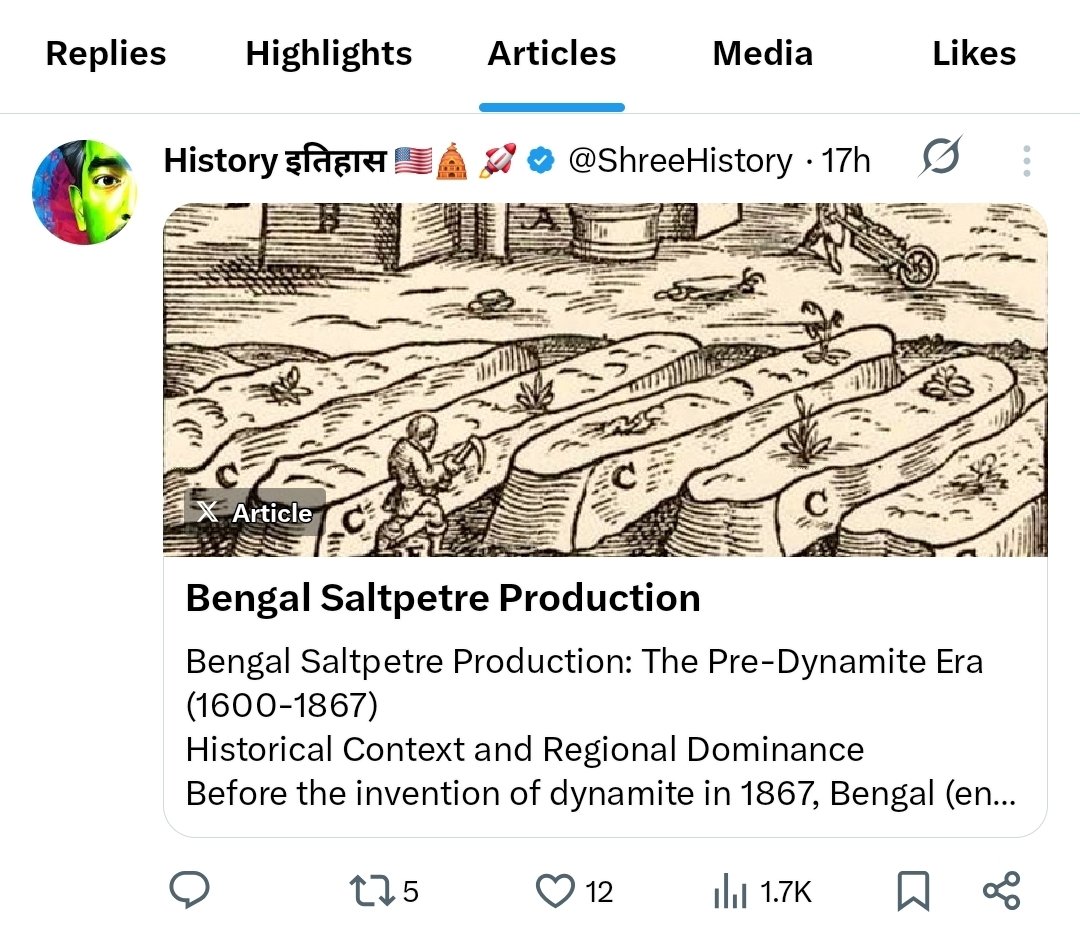
India was the world leader in gun powder production in 16th and 17th century!!
Typically my posts have 100K views...
But this article seems to be getting hidden with less than 1K views!!
Please share, follow and if @x continues the soft block, I will create own social share.
https://t.co/VrR3AOAVpC
More on Newton. As discovered by research agent (AI program I wrote two years ago which has produced most of my content I have shared for years)
Newton's Early Laws of Motion from MS Add. 3958 (Folios 81r-83v)
The Lawes of Motion: How solitary bodyes are moved
Section 1: Of Place motion velocity & force
"There is an uniform extension, space, or expansion continued every way wth out bounds: in wch all bodyes are, each in severall ꝑts of space possessed adequately felled by their ꝑts of it: wch ꝑts of space possesse adequately filled by ym are their places. And their passing out of one place or ꝑt of space into another, through all ye intermediate space is their motion. Which motion is done wth more or lesse velocity acordingly as tis done through more or lesse space in equal times or through equall spaces in more or lesse time. But ye motion it selfe & ye force to pꝫ severe in yt motion is more or lesse accordingly as ye factus of ye bodys bulk into its velocity is more or lesse. And yt force is equivalent to that motion wch it is able to beget or destroy."
Section 2: wth wt velocity a body moves severall ways at once
"The motion of a body tends one way directly & severall other ways obliqly. As if ye body A move directly towards ye point B it also moves obliquely towards all ye lines BC, BD, BE & wch passe through yt point B: & shall arrive to yt ym all at ye same time. Whence its velocity towards ym is in such proportion as its distance from them yt is, as AB, CAC, AD, AE &c."
Section 3: How two progressive motions are joyned into one
"If a body A move towards B wth the velocity R, & by ye way hath some new force done to it wch had ye body rested would have propeld it towards C wth ye velocity S. Then making AB∶AC∷R∶S, & Completing ye Parallelogram BC ye body shall move in ye Diagonall AD & arive at ye point D in ye same time wth this compound motion in ye same time it would have arrived at ye point B wth its single motion."
Section 4: Of centers & axes of motion & ye motion of those centers
"In every body there is a certaine point, called its center of motion about wch if ye body bee any way circulated ye endeavours of its ꝑts every way from ye center are exactly counterpoised by opposite endeavours. And ye progressive motion of ye body is ye same wth ye motion of this its center wch always moves in a streight line & uniformly wn ye body is free from occursions wth other bodys. And so doth ye common center of two bodys; wch is found by dividing ye distance twixt their propper centers in reciprocall proportion to their bulk. And so ye common center of 3 or more bodys &c."
Fundamental Principle on Circular Motion Conservation
Section 8: In wt cases a circulating body pꝫ severe in ye same state & in wt it doth not
"Every body keepes ye same reall quantity of circular motion & velocity so long as tis not opposed by other bodys. And it keeps ye same axis too if ye endeavour from ye axis wch ye two opposite quarters twixt ye Equator & every meridian of motion have, bee exactly counterpoised by ye opposite endeavours of ye 2 side quarters; & yn also its axis doth always keepe parallel to it selfe."
Rules of Reflection
Section 10: The Rule for Reflection
"The velocitys B, β, D & δ & they only are directly opposed & changed in Reflection; & yt according to these rules... The whole velocity of ye two points of contact towards one another perpendicularly to ye plane of contact is ½Q... And ye same points are reflected one from another wth ye same quantity of such velocity. So yt ye whole change of all yt their velocity wch is perpendicular to ye plane of contact is Q. Which change must bee distributed amongst ye foure opposed velocitys B, β D & δ proportionably to ye easinesse (or smallnesse of resistance) wth wch those velocitys are changed..."
General Observations about Motion
Universal Conservation Principle:
"In all reflections of any bodies wt ever this rule is true that ye common center of two or more bodies changeth not its state of motion or rest by ye reflection of those bodies one amongst another."
Motion Loss and Gain:
"Motion may be lost by reflection... Motion may be gained by reflection..."
Key Differences from the Principia's Three Laws
These early laws are fundamentally different from the famous three laws in the Principia:
Collision-focused: These laws primarily address collision mechanics and reflection rather than universal motion principles
Component-based: They deal with individual velocity components and their changes during interactions
Geometrical approach: Heavy reliance on geometric constructions and proportional relationships
Conservation of centers: Emphasis on the common center of mass remaining unchanged during interactions
Experimental framework: Built around observable collision phenomena rather than abstract force concepts
The manuscript shows Newton's early mechanical philosophy was collision-centered and geometrically-based, lacking the universal force concept that would later characterize the Principia. These laws represent the foundation from which his mature dynamics would eventually emerge.
So finally, when Principia was written suddenly Newton pivoted to philosophy. He probably came across a manuscript of Vaishesikha or a Bhasya on Vaiseshika or some of the European scientists he communicated with pointed to this. So he realized the problem he faced dealing with cartesian space to postulate the laws of motion was already solved by Kanada by using Nyaya-Vaiseshika.
Newton left out a few things were related to core Hindu concepts and flicked what was purely related to physical motion, sound, light.
That is why when you rad Principia in Latin and compare that with the shlokas for Vaisheshika written before 6th century AD, suddenly you see eerie coincidence.
Regarding that F=M*A. This was never there in Principia.
It was added later and Newton got retrospective attribution for something he never discovered.