Civil asset forfeiture should be abolished.
Taking people’s property without convicting them of a crime and using it to fund the very agencies doing the seizing is legalized plunder.
Justice should never depend on how much cash police can confiscate.
The Foreign Intelligence Surveillance Act will expire soon.
FBI Directors Mueller, Comey, Wray, and even Patel have used this law to unconstitutionally snoop on Americans without getting a warrant.
It’s easily fixed if/when reauthorized by Congress.
Add 3 words: Get a Warrant!
American soldiers are dying in a war Congress never authorized and the American people never wanted.
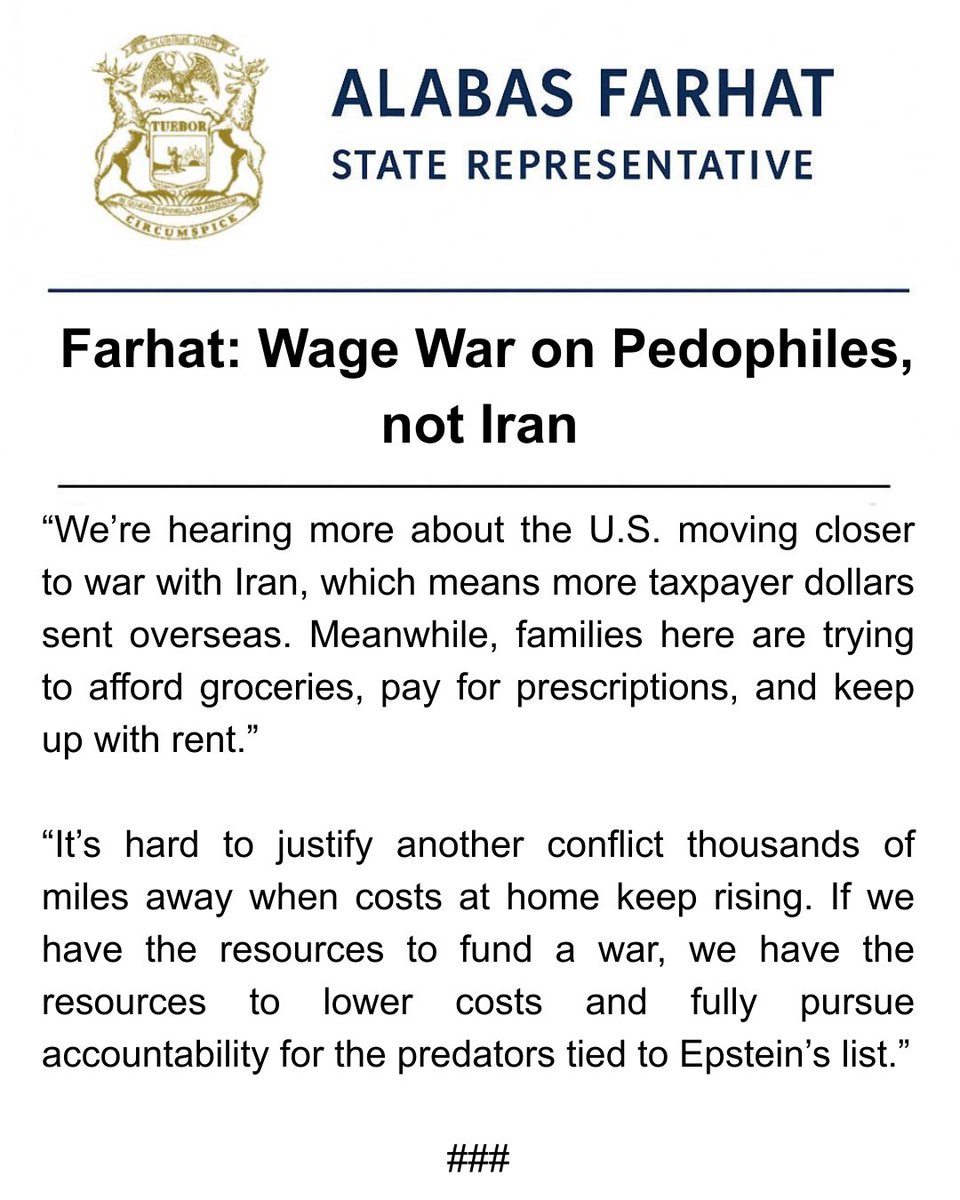
We have no money for schools, healthcare, or groceries but we always find money to fight Israel’s wars. Trump must end this war now.
Charlie Kirk, in June of 2025, explaining why a massive US war against Iran, and an attempt to facilitate regime change, as pushed by people like Lindsey Graham, is "pathologically insane":
“Oregon landowner Gary Harrington was convicted of nine misdemeanors and sentenced to 30 days in prison, as well as slapped with a $1,500 fine, for diverting snow runoff and rainwater into three reservoirs on his property.”
https://t.co/e0AZgCtNzE
Follow the Constitution.
Read the bills.
Stop governing by emergency.
End the forever war.
Cut taxes & spending.
Stop borrowing trillions.
No CBDC.
Protect free speech.
Repeal the Patriot Act & FISA 702.
No qualified immunity for government officials.
End civil asset forfeiture.
One of the most frequently misrepresented federal statutes—often falsely used to justify unconstitutional presidential war powers—is the War Powers Resolution (or Act) (50 U.S.C. §§ 1541–1550).
If only more people would read it.
Contrary to what you may have heard about the War Powers Resolution, it does not allow the president to take military action for any reason for 60–90 days without congressional approval so long as the president notifies Congress within 48 hours.
Section 1541(c) of the War Powers Resolution states clearly:
"The constitutional powers of the President as Commander-in-Chief to introduce United States Armed Forces into hostilities, or into situations where imminent involvement in hostilities is clearly indicated by the circumstances, are exercised only pursuant to (1) a declaration of war, (2) specific statutory authorization, or (3) a national emergency created by attack upon the United States, its territories or possessions, or its armed forces."
Of the three cited authorities, not one indicates a presidential power to take unilateral (without Congress's approval) offensive military action.
The first two authorities allow the president to take offensive military action but only with Congress's express approval (Article I of the Constitution grants Congress the exclusive power to declare war). The third authority allows the president to take defensive military action without Congress's approval in the event of a specific type of national emergency, a sudden unforeseen attack on the United States (happening too quickly for Congress to meet) necessitating immediate action to protect Americans.
It's for this last situation (or for situations in which the president introduces forces into hostilities unlawfully) that the War Powers Resolution provides for the oft-mentioned 48-hour report to Congress (§ 1543) and 60-day (up to 90-day) timeline (§ 1544). If there's an attack in progress on the United States (i.e., currently happening), we expect the president to respond swiftly to neutralize the attack and protect Americans—and then we will hold the president to account.
The Framers of the Constitution agreed at the debates in the federal convention of 1787 that the president should have the "power to repel sudden attacks" but not the power to otherwise introduce forces into hostilities without congressional approval.
The War Powers Resolution does not confer any new authority on the president to take offensive military action without congressional approval—nor could it under our Constitution. It instead checks the president when, as the Framers contemplated, the president introduces our Armed Forces into hostilities to repel a sudden attack.
There’s no authority for strikes on terrorists in Nigeria or anywhere on earth.
The 2001 AUMF is only for the perpetrators of the 9/11 attacks.
The War Powers Resolution doesn’t grant any authority beyond the Constitution. Offensive military actions need congressional approval.
The Framers of the Constitution divided war powers to protect the American people from war-eager executives.
Whether the United States should engage in conflicts across the globe is a decision for the people’s representatives in Congress, not the president.
BREAKING: Trump openly talks about taking Venezuela’s oil and now says he’s willing to put "boots on the ground." Americans did not vote for another war.
Whose children will he send?