You keep conceding the distinction and then rebuilding the same argument with different words.
A vote is a vote. A donation is a donation. A PAC expenditure is a PAC expenditure. A policy consequence is a policy consequence. None becomes proof of a larger motive or coordinated operation simply because you place them in the same paragraph.
Take H.R. 2. Yes, Democrats opposed it in the House. But H.R. 2 was not a referendum asking, “Should America have a border?” It simultaneously changed asylum rules, parole authority, treatment of unaccompanied children, E-Verify, border-wall construction and numerous other policies. So “voted against H.R. 2” is the public record. “Voted for open borders” is your interpretation of that record.
Same with immigration economics. CBO found the recent immigration surge imposed a $9.2 billion direct net cost on state and local governments in 2023. That belongs in the ledger. CBO also estimates that the same surge increases federal revenues by roughly $1.2 trillion and reduces projected federal deficits by roughly $900 billion over 2024–2034. That belongs in the ledger too.
You cannot call one side “civics and economics” while deleting the part of the government's own economic analysis that complicates your conclusion.
And “one coalition” still doesn't solve the logic problem. Of course political coalitions vote across immigration, energy, social policy and foreign affairs. Nobody disputed that. What does not follow is that every adverse consequence associated with every policy becomes evidence of one coherent causal mechanism.
That requires evidence connecting the steps.
China dominating battery manufacturing does not, by itself, prove that an American EV regulation financed an Iranian proxy attack. An immigration-policy vote does not, by itself, prove responsibility for a particular crime committed years later. A donor supporting several progressive organizations does not, by itself, prove those organizations share operational command.
Those are additional propositions. Additional propositions require additional evidence.
And you actually concede that yourself:
“Same shop needs money, vendors, or command, not vibes.”
Correct.
Then you end with:
“Same shop, same punchlines, same skipped votes.”
You cannot establish an evidentiary requirement in one paragraph and abandon it in the last sentence.
“Same donor class” and “same talking points” are claims you can document.
“Same shop” is a different claim.
That is not semantics. That is the difference between correlation, ideological alignment, financial association and operational coordination.
And this line—“a missing org chart is not a hall pass”—reverses the burden of proof. Nobody needs a “hall pass” from an allegation that hasn't been demonstrated. If you allege coordinated control, the burden is on the person making that allegation to produce evidence of coordinated control. The absence of disproving evidence does not become evidence for the allegation.
That principle has to apply equally to Soros, Hoffman, Trump, Musk, PACs, NGOs, prosecutors, media organizations and everybody else.
I'm not asking you to throw away the ledger.
I'm asking you to stop writing conclusions into the ledger that aren't actually entries in it.
Record the vote. Record the money. Record the policy. Record the consequence. Then prove the connection you claim exists between them.
Otherwise you aren't merely “keeping the ledger.”
You're narrating it.
You’re actually conceding most of my argument while insisting the original narrative survives unchanged.
“Funds” is not “controls.”
“Same donor class” is not “same shop.”
A contact, photo, donation, or visit is not participation in someone else’s crime.
An audit finding is not whatever larger number a political meme turns it into.
That isn’t “softening.” It’s accuracy.
And accuracy matters precisely because the underlying facts can still be serious. DHS OIG really did find major failures involving unaccompanied children: more than 31,000 problematic release addresses, more than 233,000 children not served NTAs as of January 2025, and more than 43,000 who had been served NTAs but failed to appear for court. Those findings are bad enough without transforming them into a different claim.
Biden really did give Fauci a broad preemptive pardon covering relevant federal offenses from January 1, 2014 through January 19, 2025. That is a fact and can be criticized on its own terms.
But this is the distinction you keep stepping around:
A true fact does not automatically prove the implication attached to it.
A donation proves a donation.
A pardon proves a pardon.
A vote proves a vote.
A photograph proves a photograph.
An audit failure proves an audit failure.
If you want those facts to establish coordination, corruption, control, trafficking, conspiracy, or some unified political operation, that additional conclusion needs additional evidence.
Putting six true things in one paragraph does not create evidence connecting them.
And there’s an important correction to the “75–24” Laken Riley point too: 75–24 was the vote on an amendment. The final Senate passage of the bill was 64–35. The Congressional Record is explicit about that. That’s exactly why I keep insisting on precision instead of treating every politically useful number as interchangeable.
You also say, “same talking points and same donor class keeps showing up.” Fine. That is a materially narrower claim than “same shop.” Similar politics and overlapping donors can be demonstrated. Centralized coordination requires evidence of centralized coordination. You cannot retreat from the stronger allegation to the weaker one and then pretend nothing changed.
And no, my standard isn’t “association means nothing when it involves Trump, Musk, or Israel.” My standard is the same for everyone:
Association establishes association. It does not establish criminal participation or operational control without further evidence.
Apply that to Trump. Apply it to Musk. Apply it to Hoffman. Apply it to Soros. Apply it to Democrats, Republicans, donors, activists, prosecutors, and journalists.
That is one evidentiary standard.
So yes, keep the ledger. I have no problem with a ledger.
But a ledger records what happened.
It does not get to quietly turn:
A happened. B happened. C happened.
into:
Therefore A, B, and C are one coordinated thing
and then accuse anyone asking for the missing evidence of “ignoring the record.”
That’s the entire disagreement.
I’m not disputing facts because they are politically inconvenient. I’m disputing conclusions that outrun the facts used to support them. Precision isn’t betrayal. It’s the difference between documenting a record and constructing a narrative.I also corrected the Laken Riley vote number here—the final Senate vote was 64–35, not 75–24; 75–24 was an amendment vote.
But potentially adverse connections involving favored figures are subjected to a completely different evidentiary standard:
unless criminal involvement is affirmatively proven, association means nothing.
Those standards cannot both operate at once.
If association with Epstein means nothing without evidence of involvement—and legally and logically, that's correct—then the same rule has to apply to Democrats, Republicans, billionaires, activists, journalists and donors alike.
And if indirect donor relationships prove political control, then that principle would have to be applied equally to conservative donors, PACs, advocacy organizations, media organizations and Republican politicians.
That consistency is absent here.
So I would describe your passage as:
Some accurate historical facts + some legitimate criticisms + several misleading representations + numerous unsupported insinuations + guilt by association + cherry-picking + emotionally loaded partisan language.
Its central weakness isn't simply that it's conservative. It's that it repeatedly lowers the evidentiary bar for claims against one political side while raising it for claims involving the other.
Historical federal campaign-donation compilations do show Epstein's disclosed donations skewed substantially Democratic, while also including Republican recipients.
But political donations are not evidence that the recipients participated in Epstein's crimes.
Likewise, Alexander Acosta was the Bush-appointed U.S. attorney whose office negotiated Epstein's controversial 2007 non-prosecution agreement. DOJ's own professional-responsibility review later concluded that Acosta exercised poor judgment in resolving the investigation that way.
That's legitimate criticism.
But phrases such as:
> “Obama- and Clinton-era holdovers”
are so vague they are functionally impossible to test. Which officials? What decisions? What redactions? Who ordered them? Under what statutory or court authority?
Without those answers, it's political insinuation masquerading as institutional analysis.
And the more recent Epstein releases themselves demonstrate why broad statements about “ties” need precision: documents can establish that someone communicated with Epstein without establishing involvement in trafficking. AP's reporting on the large 2026 release, for example, describes communications involving numerous prominent people—including Elon Musk—while explicitly distinguishing those contacts from proof of criminal conduct.
“100,000-plus unaccompanied kids the OIG could not track” substantially distorts the OIG findings
This is one of the clearest factual problems.
DHS OIG did find serious tracking deficiencies. But the numbers were not simply “100,000+ children disappeared.”
The later OIG audit found that, among more than 448,000 unaccompanied children transferred to HHS from FY2019–2023, more than 31,000 had incomplete or problematic release addresses; ICE had also failed to issue notices to appear to large numbers of children, and tens of thousands who had court dates failed to appear. Those are serious administrative and child-safety problems. They are not equivalent to a verified finding that the government literally lost 100,000 children.
That transformation—from “ICE's systems could not effectively monitor everyone” to “100,000-plus kids disappeared”—is exactly how partisan talking points turn a legitimate government failure into a more dramatic claim than the source supports.
The Laken Riley reference is cherry-picked
There certainly were lawmakers who voted against it. But the final Senate passage was 75–24, meaning the legislation received substantial bipartisan support.
So presenting it generically as something “the other side” opposed erases a politically inconvenient fact: many members of that side voted for it.
That's selection bias.
Then the argument stops even pretending to prove things
Look at the sequence:
> “DEI that erases sex…”
“EV rules that enrich China…”
“Iran’s proxies…”
“October 7…”
“‘resistance’ talk…”
“a bounty on U.S. troops…”
These aren't logically connected propositions.
They are issue stacking: mentioning enough emotionally powerful controversies in rapid succession that the reader associates them all with the same political enemy.
No causal chain is demonstrated.
Then:
> “Padellan can light a Cybertruck for mood and still miss the invoice…”
That's sarcasm.
“Soros and Hoffman-backed noise.”
That's loaded labeling.
“The mill wants a villain on a thumbnail.”
That's a metaphor.
“Civics, history and economics illiteracy is your decision.”
That's an ad hominem attack.
None of those establishes the truth of an underlying proposition.
Why it is clearly partisan
The giveaway isn't that it criticizes Democrats. Criticizing Democrats can be perfectly factual.
It's the asymmetry of evidence.
Every adverse Democratic connection is treated as meaningful:
donation → association → political support → suspicion → network.
Grassroots makeup. Donor lighting.” is especially revealing: it is innuendo written as a punchline, not a factual claim with evidence.
And whether Ed Krassenstein supplied “a clip” rather than personally bringing a legal case says nothing about whether the underlying information in a clip is true. That's an attack on the messenger rather than the proposition.
The Biden pardon paragraph mixes facts with insinuations
There is a genuine factual core here. Biden did issue extraordinary preemptive pardons near the end of his presidency. Fauci's pardon explicitly covered relevant federal offenses potentially committed from January 1, 2014 through January 19, 2025. Biden also pardoned members and staff of the January 6 committee and law-enforcement officers who had testified before it, as well as several members of his family.
Those decisions are perfectly legitimate subjects for criticism.
But:
> “Hunter and the family Burisma trail are still on the table.”
That's insinuation, not a specified factual finding. A “trail” doesn't tell the reader what offense allegedly occurred, who committed it, what evidence proves it, or what adjudicative body found it.
That's a recurring device throughout the passage: put a real fact next to an allegation and let proximity imply proof.
The “Soros network” paragraph is a textbook example
George Soros and Open Society unquestionably fund many progressive and civil-rights organizations; Open Society openly describes itself as a major funder of groups pursuing rights, equity and justice.
But this:
“Soros money funds SPLC, ACLU, the Brennan Center, activist judges, Bragg, Krasner, Newsom.”
collapses fundamentally different relationships into the single verb “funds.”
Take Alvin Bragg. Soros gave $1 million to Color of Change PAC. Color of Change separately supported Bragg and ultimately spent roughly $420,000 in independent expenditures. Soros did not directly give Bragg that $1 million, and no evidence establishes that Soros controlled Bragg's prosecutorial decisions.
That distinction matters.
Donor → organization → independent political spending → candidate
is not equivalent to
Donor → controls candidate.
Calling unidentified people “activist judges” makes the passage even weaker because it is impossible to fact-check without names, payments and relationships.
Reid Hoffman/Epstein is another association argument
Even where the underlying Hoffman/Epstein contacts or Hoffman's political donations are documented, the argument needs another step that isn't supplied.
Hoffman's political donations do not establish wrongdoing by the politicians he supported. His association with Epstein does not make recipients of Hoffman's political contributions responsible for Epstein. And his financial assistance to an organization that supported E. Jean Carroll's litigation doesn't invalidate the jury verdict against Trump.
Reuters reported in 2026 that the government was examining an organization linked to Hoffman that helped finance Carroll's litigation. But Carroll herself was not reported as the target, and an appeals court had previously found her explanation concerning the funding plausible rather than perjurious.
Again: association is being substituted for evidence of coordination or misconduct.
The Adult Survivors Act sentence contains a true fact followed by an implied conspiracy
Hochul did sign New York's Adult Survivors Act. It created a one-year window in which adult survivors of sexual assault could bring otherwise time-barred civil claims.
E. Jean Carroll used that law.
But:
Hochul signed law → Carroll benefited → therefore the law was engineered for Carroll/against Trump
doesn't follow without evidence of that purpose.
That's the post hoc/circumstantial fallacy.
The Epstein paragraph is particularly selective
This statement has a factual basis:
“Epstein donated to both parties and more to Democrats.”
🧢 we all knew it was happening 🇺🇸
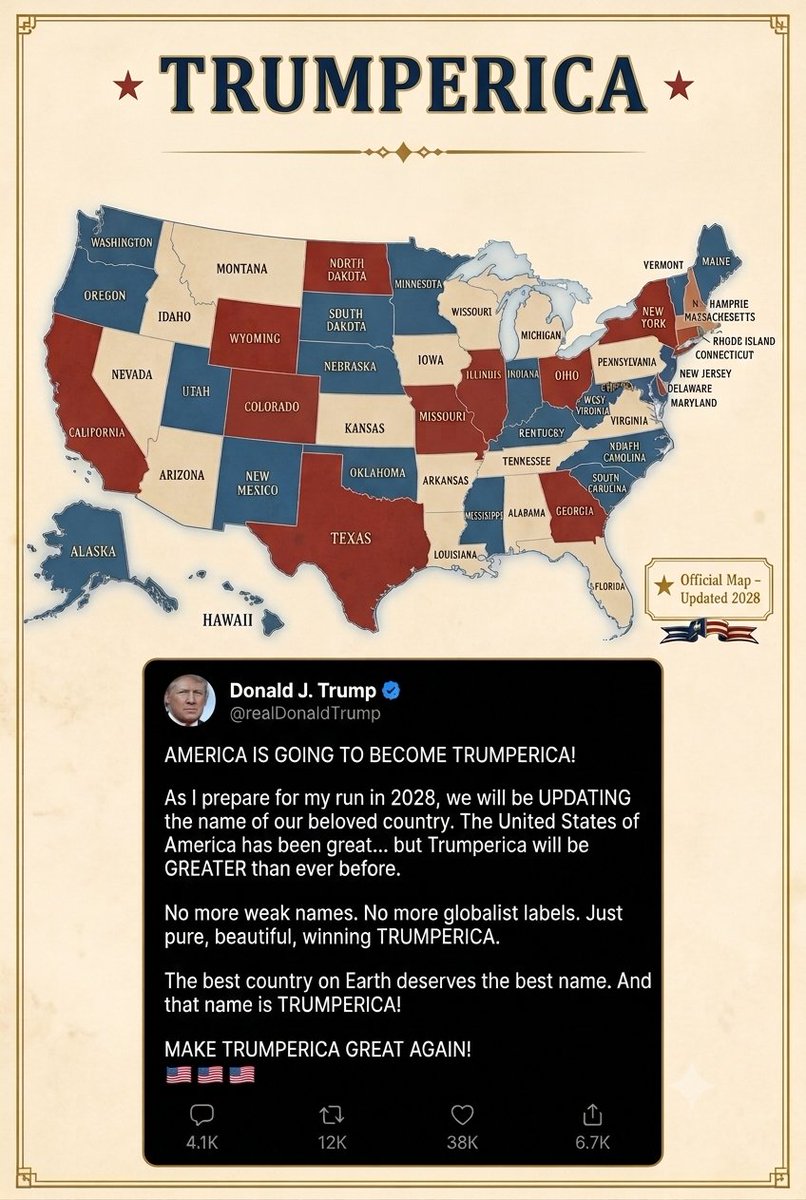
AMERICA IS GOING TO BECOME TRUMPERICA!
As I prepare for my run in 2028, we will be UPDATING the name of our beloved country. The United States of America has been great… but Trumperica will be GREATER than ever before.
No more weak names. No more globalist labels. Just pure, beautiful, winning TRUMPERICA.
The best country on Earth deserves the best name. And that name is TRUMPERICA!
MAKE TRUMPERICA GREAT AGAIN!
@piersmorgan discernment is questionable on many levels
His career has repeatedly raised serious questions about journalistic ethics:
• As *Daily Mirror* editor (1995–2004), a High Court judge in 2023 accepted evidence he knew about widespread phone hacking and unlawful information-gathering at the paper. The Leveson Inquiry called his denials “utterly unpersuasive.” He has always denied personally hacking phones or ordering it.
• 2004: Sacked after publishing fake photos of British soldiers abusing Iraqi prisoners. The paper apologised for a “calculated and malicious hoax.” Morgan refused to apologise and still disputes they were proven 100% fake.
• 2000 “City Slickers” scandal: Bought shares in a company the day before his paper’s financial column tipped it. Cleared after investigations, but widely seen as a conflict of interest.
• Privacy invasions: Long-lens photos of Charles Spencer’s wife leaving an eating-disorder clinic; photos of Naomi Campbell leaving Narcotics Anonymous (she successfully sued). Classic aggressive tabloid tactics.
• Broadcasting era: Stormed off *Good Morning Britain* after saying he didn’t believe Meghan Markle’s claims of suicidal feelings (record Ofcom complaints; later cleared on free-speech grounds). Later had to apologise and edit an *Uncensored* episode after a guest made false claims about Jay-Z and Beyoncé.
Morgan frames most of this as free speech or industry-wide practices and has never been charged over phone hacking. Critics point to a pattern of prioritising scoops, controversy and ratings over verification, privacy and accuracy.
#PiersMorgan #JournalismEthics #MediaAccountability
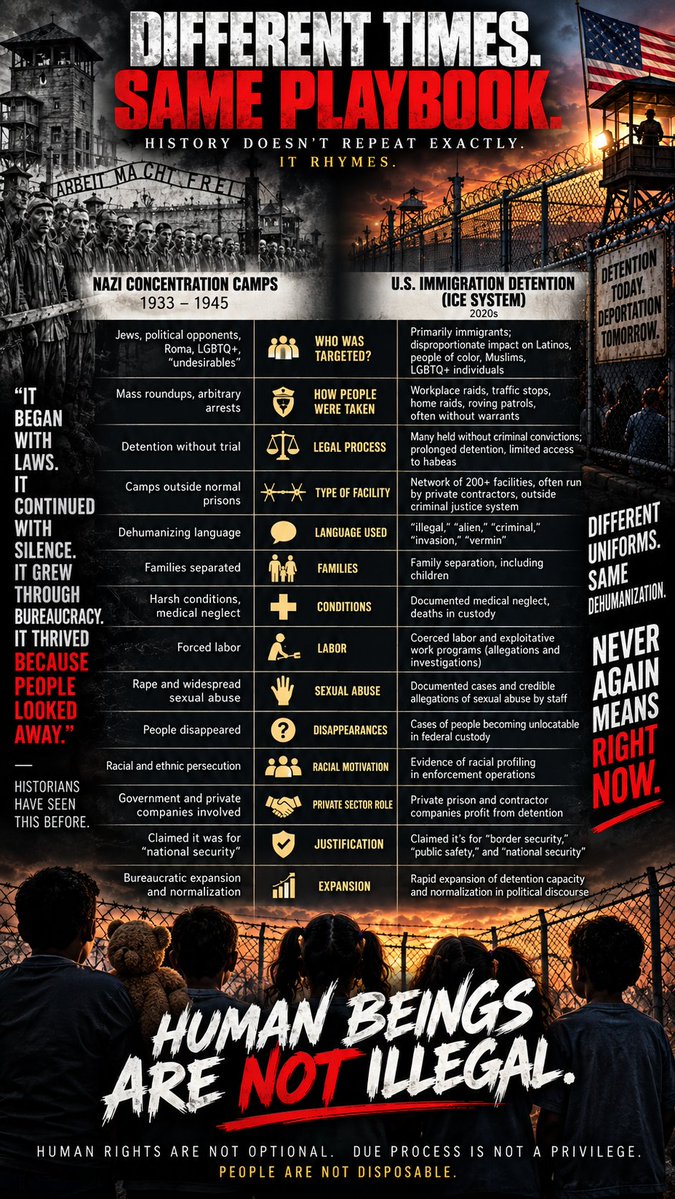
History’s worst atrocities didn’t begin with their worst acts.
They began with fear, dehumanization, targeted groups, weakened due process, mass detention—and people looking away. This is disgusting.
Human beings are not disposable. “Never Again” means recognizing the road BEFORE the destination.
This is an indictment of what we are allowing ourselves to become.
When a government can build a massive detention apparatus, warehouse human beings, separate families, hold people without criminal convictions, and face documented cases of abuse alongside serious allegations of racial profiling, medical neglect and obstruction of meaningful due process, disgust is an appropriate response.
And history gives us no excuse for pretending we don't recognize the architecture.
The most shameful chapters of human history did not begin with their worst atrocities. They began with categories. Euphemisms. Fear. Dehumanizing language. Exceptional powers. People being treated as problems instead of human beings. And millions of ordinary citizens convincing themselves that whatever was happening behind the fence was somebody else's problem.
I refuse that bargain.
Immigration status does not erase humanity. A border does not erase human rights. A uniform does not erase accountability. And calling a cage a detention facility does not make whatever happens inside it morally acceptable.
We were taught “Never Again” as though it were a promise.
A promise means nothing if we only recognize injustice after history has already named it.
Never Again means while it is happening.
Never Again means everyone.
Never Again means NO ONE disappears behind a fence and beyond the protection of law.
If defending due process, human dignity and equal protection is considered revolutionary, then perhaps revolutionary is exactly what conscience requires.