Bunch of qualifications n banker by profession. Interested in gradual long term investing while exploiting long/short equity options arbitrage opportunities.
India has been consistently warming up. Decade after decade, temperatures have been rising, and this is a one-way journey unless humanity makes a dramatic course correction.
All the heatwave deaths that are in the news are the result of this relentless warming. You will see a lot of numbers floating around, especially the recent viral study that a single day of extreme heat causes roughly 3,400 excess deaths across India, and a five-day heatwave nearly 30,000. But the truth is, we still don’t have good statistics on how many Indians are losing their lives because of heatwaves.
What we do know is this: a vast majority of Indian employment is still informal. The number of people employed in agriculture, construction, gig work, and other outdoor work remains disproportionately high. We have come a long way, but this is still the reality for a very large number of Indians.
For many Indians, staying indoors when temperatures rise is simply not a luxury they can afford. There is also a deep inequality in access to cooling. Yes, the fact that almost all of India has been electrified is a genuine achievement. But access to air coolers, let alone air conditioners, is still low and mostly concentrated among people with higher incomes. Fans only do so much when the heat is this brutal.
This is the inequality of heat. People with good incomes can afford coolers and ACs. They can work from home and can avoid the worst hours of the day. But this is a small subset of India.
Remember, more than 40% of Indians are still employed in agriculture, even though agriculture’s share of India’s GDP has consistently declined. These are the real Indians who will be most affected by rising temperatures. Many of the regions most exposed to climatic shocks like El Niño and heatwaves are also among the poorer regions of northern India.
So the people who will be hit the hardest by rising temperatures are the poorest Indians, across regions that are yet to see real prosperity.
Sadly, this is a systemic crisis. Individual actions help, but they are not enough. We need collective action, not just at a country level, but at a global level. Climate change is not an Indian problem but a global problem.
That said, there are still some low-hanging fruits that can start making a difference.
There is a lot of debate and controversy over India’s forest cover and whether it has increased or decreased. But when it comes to cities, we can see the loss of green cover firsthand. Trees are cut to make way for roads, houses, flyovers, and buildings. Whatever few trees remain are often trapped under pavements and concrete. This weakens them. This is one reason why trees often fall even after moderate rains.
If you have space, you can plant native species like neem, moringa, jamun, amla, and curry leaves. These trees have deep roots and can survive better. People often avoid planting trees because they worry that the roots will damage the foundations of their homes. But in many cases, this fear is overstated.
These are small things which help.
But as depressing as it sounds, this problem ultimately needs systemic, collective action at a global level. And judging by the way the world is heading, it is very hard to have hope.
Rising temperatures are a serious challenge. They don’t have easy explanations, and they definitely don’t have easy solutions.
@correspondens@LearningEleven Sekharji's timepass talk provides great insights on high quality companies. Lot of hard work is put in providing these gems. I can't wait for it every Sunday. Hope Karma rewards Sekharji to the fullest in future.
Just published a detailed deep dive on the Coal Gasification theme. link 👇
https://t.co/U0eGD2HtOl
Over the last few weeks, I've noticed a lot of discussion around the sector. Most of it focuses on which stocks might benefit, but very little explains how the industry actually works, where value gets created, and what investors should really be paying attention to.
That's exactly what this piece aims to do.
I along with @EquityValueIn break down the entire value chain- from coal and oxygen production to gasification, syngas, downstream chemicals, and the key economic drivers that ultimately determine whether a project succeeds or struggles.
My goal wasn't to create another "stocks to buy" list.
It was to help investors understand the business, the process, the risks, and the opportunity so they can form their own views with conviction.
One thing I've learned over the years is that whenever a new policy or industry theme emerges, there's often a rush to package it into webinars , special sessions, and quick stock recommendations. The excitement around the theme becomes the story.
I'd rather spend time understanding the theme itself.
Because good investing starts with understanding the underlying business, not chasing the narrative around it.
If you're interested in the coal gasification opportunity, I think you'll find this worth your time.
It's a weekend read, so grab a coffee and go through it at your own pace.
Would love to hear your thoughts and feedback once you've read it.
Thais have canceled visitor visa of all Indians.
They cancelled only 3 nationalities from entering visa free and must obtain visa on arrival — Serbia, Somalia and India .
They said they want to promote “quality over quantity” of tourists.
Indians must do a self introspection at this immense insult — do a deep soul search.
A tiny country known primarily (in the west) for prostitution and lady boys is calling you “low quality”. Putting you in same league as Somalis.
WTF 😳 is going on folks. This is Pearl Harbor moment for Indians.
On this World Earth Day, we bring you the true story of the “Namma Kere” (our lake)-the Alkoda lake.
Based in Raichur district of Karnataka, this 100-acre waterbody was crucial to the primary profession of the region, its farmers.
A few years back, the lake had become dry due to erratic rainfall, weed and silt accumulation, severely affecting its water holding capacity. Farmers were barely able to grow one crop a year and were forced to move out of their villages in search of other livelihoods.
With the collaborative efforts of @ICICIFoundation - the CSR arm of ICICI Bank, Gram Panchayat and local communities, things began to change.
What was once considered a dry, forgotten lake has become a thriving water body today.
The revival of the 100-acre lake has:
- Created 64 crore litres of annual water holding capacity
- Brought 600 acres of land under cultivation
- Replenished groundwater enabling the creation of 80 new borewells
Watch the video below to see the stunning visuals of not just ripples being restored but also hope.
Numbers are at October 31, 2024.
Tank so big, it doesn’t fit in the frame!
Flagging off India’s largest ever 1500 m3 LNG cryogenic tank as it crosses the seven seas to the Caribbean!
So proud of my colleagues @INOXCVA for constantly taking on bigger challenges and redefining our capabilities!
Made in India. Made for the World!
Excited to share that we have got approval from PFRDA to sponsor a Pension Fund under the National Pension System (NPS).
We’ll soon start managing retirement savings for NPS subscribers through a dedicated pension fund company.
Managing people’s retirement funds is a big responsibility. At PPFAS, our focus is, and will always be on safety, discipline, and long-term growth while safeguarding investors’ interests.
This is an important step for us in contributing to India’s retirement planning ecosystem.
#PPFAS #NPS #RetirementPlanning #InvestorFirst #FinancialServices
When all the trees have been cut down, When all the animals have been hunted, When all the waters are polluted, When all the air is unsafe to breathe, Only then will you discover you cannot eat money.” — Cree Prophecy
72k trees and 720 mangroves to be cut to make new Highway.
Pre-Market Update by GSN - Part 1! 💹
We go through 1000+ filings everyday to bring you the 20 most interesting ones.
Please Retweet♻️ if this adds value and follow (@bharatbetpf) to receive these everyday.
🌱1. Dabur (weak) - Low single digit growth across Healthcare, F&B and International businesses. Home and personal care growth pushes business to mid single digit revenue growth.
🛒2. DMart (strong) - Holding steady amidst competition. 18.9% revenue growth despite Qcomm, store growth accelerates - now at 500 total stores.
⚡️3. IEX (strong) - Q4 highest ever vol at 39.4 BU (24.3% yoy). RTM +48.2%, Green +26.5%. Similar growth momentum in March.
🩺4. Metropolis (strong) - Revenue +23% yoy; B2C up 19%, B2B up 30%. Organic growth at 14.5%. (Organic – Excludes recent acquisitions of Core Diagnostics, DAPIC, Scientific and Ambika)
🥻 5. Sai Silk (weak)- Revenue growth of 5% yoy in Q4. 2 new stores opened in Q426.
🏦6. L&T Finance (strong) - Retail disbursements grow at 62%. Rural business +41%, Urban finance +61%. 2700cr+ of gold finance. Retail loan book growth of 26% to 1,19,550cr (h/t to @abhymurarka who had spotted this emerging giant fairly early)
🛒7. V2 Retail (moderate): Revenue +59%; SSSG 8%; 31 net store opens. SSSG at lower end of guidance/expectations.
🛒8. VMart Retail (strong): Revenue +24%; SSSG 12%; 23 net store opens. Best SSSG amongst peer set. ⭐️
🛒9. Style Bazaar (moderate): Revenue +35%; SSSG 8%; 11 net store opens.
🥥 10. Marico (strong): Copra prices corrected ~35% from its peak and is expected to be rangebound in the coming months. High single digit volume growth in India business, driven by value added oils. Consolidated revenue grew in the low twenties.
[This is an AI assisted output and can have errors - please do your own diligence. Purely educational tweet, no recommendation]
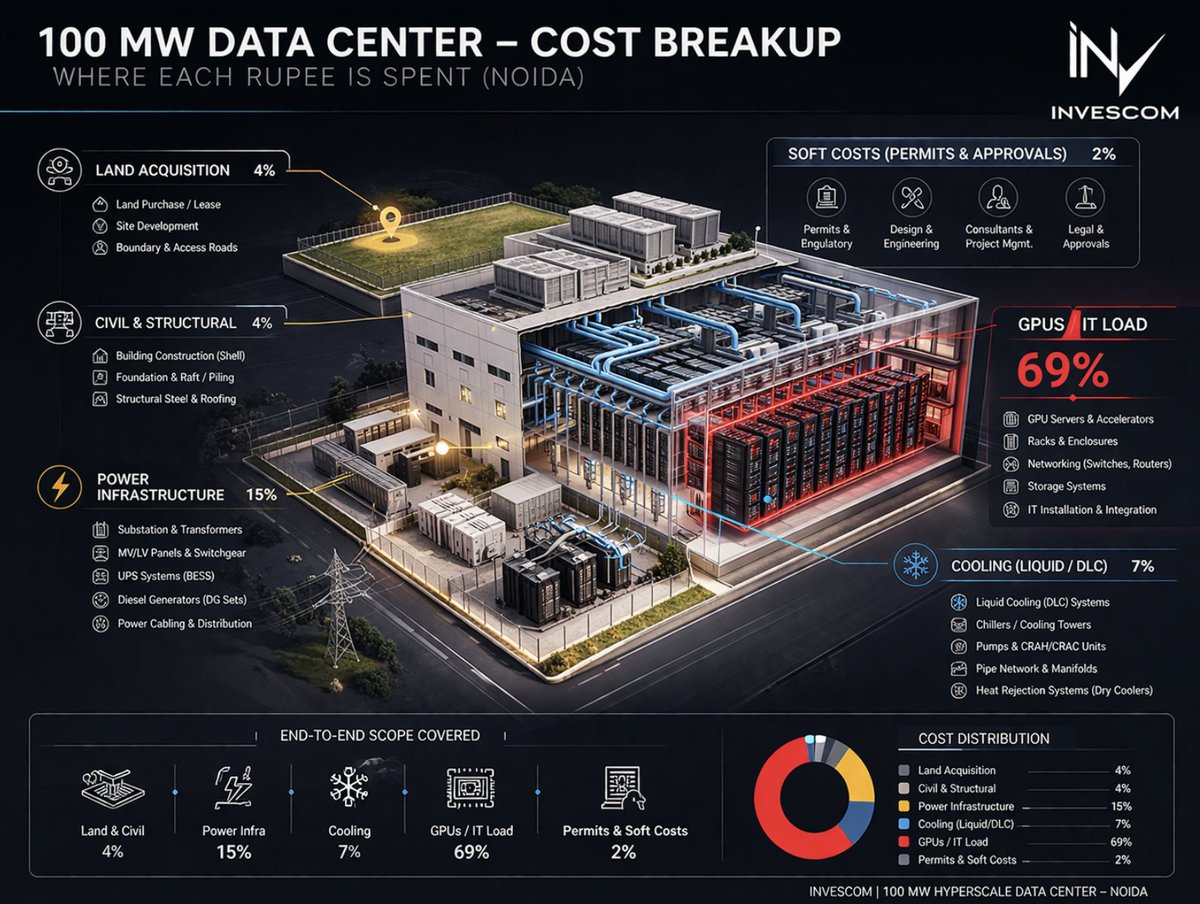
Everyone is talking about #DataCentre
But ever wondered what's the
- cost of a 100 MW Data Center in Noida
Total Cost = Rs. 16600 Cr
Segmental breakup-
1.#GPUs - Rs. 11500 Cr, 69%
- 25000 GPUs at Rs. 46 lacs / GPU
2. Power Infra - Rs. 2500 Cr, 15%
- Dedicated 220 KV Substation
- Generators
- BESS , UPS
3. Cooling - Rs. 1100 Cr, 6.6%
- #LiquidCooling
4. Civil Structures - Rs. 600 Cr, 3.6%
5. Land - Rs. 600 Cr, 3.6% of costs
- 20 acres at Rs. 30 Cr / Acre
6. Permits and Soft Costs - Rs. 300 Cr, 1.8%
- Environmental clearances, Fire, and Project Management.
- If you found this insight interesting, repost and follow for much such insights.
If you want a detailed deep dive on Data Centre Industry
- comment below
- And subscribe to our YouTube channel where we post quality research twice a week. (Link in the first comment)
Billions of ancient Trees at risk in Oregon as Trump plans to cut them down to boost profits of lumber industry
which will be devastating for wildlife birds and bees and human health as these trees filter the water and much more
I travelled to Mizoram's Dampa Tiger Reserve where a single female elephant roams. No herd, no mate, no family.She destroys crops to eat. Farmers lose livelihoods. Compensation never comes. And yet villagers don't want her gone.
Read my story 4 @PARInetwork to know more.
Put everyone in management of this company in prison for life. I’m so deadly serious. Millions of years of evolution, tens of thousands of species, irreversible damage to OUR world for a few extra dollars for someone. Can we get legit about this??? 😡😡
I literally can’t even comprehend to you all how depressing this is. Tens of thousands of species to just be all gone soon in Indonesia. When will the world wake up and help them value and protect their forests, they belong to all of us! 🦧🦋❌