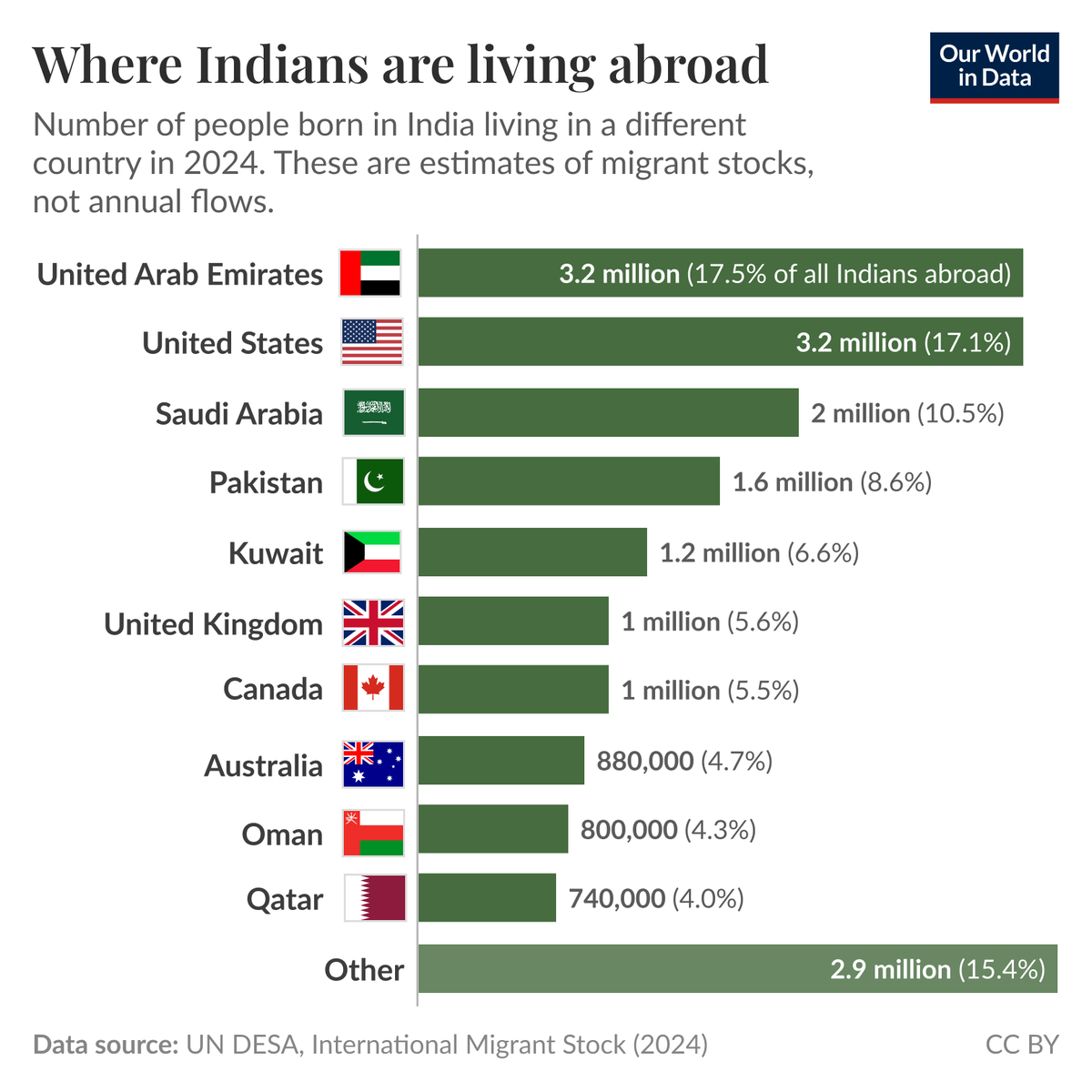
In a little less than a decade, Asia’s share of CO₂ emissions has grown from 53% of the total to 60%. China’s has grown from 27% to 32%: it now emits more than every rich country put together. India’s share, for its part, has grown from 6.8% to 8.3% of the total.
Meanwhile, emissions keep falling in the developed world — not just in relative terms but also in absolute numbers. The U.S. used to emit 5.3 billion tonnes of C
https://t.co/GQgoA5o0bB
Epitaph for an academic from John Williams’ classic novel, Stoner.
William Stoner entered the University of Missouri as a freshman in the year 1910, at the age of nineteen. Eight years later, during the height of World War I, he received his Doctor of Philosophy degree and accepted an instructorship at the same University, where he taught until his death in 1956. He did not rise above the rank of assistant professor, and few students remembered him with any sharpness after they had taken his courses. When he died his colleagues made a memorial contribution of a medieval manuscript to the University library. This manuscript may still be found in the Rare Books Collection, bearing the inscription: “Presented to the Library of the University of Missouri, in memory of William Stoner, Department of English. By his colleagues.” An occasional student who comes upon the name may wonder idly who William Stoner was, but he seldom pursues his curiosity beyond a casual question. Stoner’s colleagues, who held him in no particular esteem when he was alive, speak of him rarely now; to the older ones, his name is a reminder of the end that awaits them all, and to the younger ones it is merely a sound which evokes no sense of the past and no identity with which they can associate themselves or their careers.
My new blog post is an essay by Devon Halliday, "Literary Fiction Has Lost the Plot," recently published in her Substack.
I'm less interested in her critique of literary fiction, which I generally don't read, than in her tight focus on the need for writers to grab the reader on the very first page. I learned this during my brief and unhappy stint as a newspaper reporter (don't ask). Journalistic writing demands that you put the good stuff up front in a compelling lead paragraph (which for some reason journalists insist on calling the"lede" rather than the "lead").
Academic writers would benefit from following the journalistic imperative, "Don't bury the lead!" Too often academics take a long time getting to the good stuff, sometimes holding back until the paper's conclusion. But readers give up long before they get there. Why keep reading past the first page if the writer has given you no good reason to think that the argument is going to be interesting, the topic significant, and the findings provocative?
Much of the problem comes from the strictures of the five-paragraph essay and the five-chapter dissertation that have been drilled into budding academics during the their long apprenticeship in the educational system. See my post about this topic. As I've written elsewhere, scholars would do well to look for models not in the journals or in literary fiction but in genre writers like Elmore Leonard. They write for a living and know that they have to hook you on the first page or you'll go elsewhere for your entertainment. I talk about this in another post, pairing Leonard with Philip Jackson, who knows how to set up a story.
Another reason for posting this essay is that it's just a lot of fun watching a skilled writer skewer another writer with a judicious mix of dexterity and venom. Enjoy.
https://t.co/0xbH5pAfOg
My new blog post is an essay by Devon Halliday, "Literary Fiction Has Lost the Plot," recently published in her Substack.
I'm less interested in her critique of literary fiction, which I generally don't read, than in her tight focus on the need for writers to grab the reader on the very first page. I learned this during my brief and unhappy stint as a newspaper reporter (don't ask). Journalistic writing demands that you put the good stuff up front in a compelling lead paragraph (which for some reason journalists insist on calling the"lede" rather than the "lead").
Academic writers would benefit from following the journalistic imperative, "Don't bury the lead!" Too often academics take a long time getting to the good stuff, sometimes holding back until the paper's conclusion. But readers give up long before they get there. Why keep reading past the first page if the writer has given you no good reason to think that the argument is going to be interesting, the topic significant, and the findings provocative?
Much of the problem comes from the strictures of the five-paragraph essay and the five-chapter dissertation that have been drilled into budding academics during the their long apprenticeship in the educational system. See my post about this topic. As I've written elsewhere, scholars would do well to look for models not in the journals or in literary fiction but in genre writers like Elmore Leonard. They write for a living and know that they have to hook you on the first page or you'll go elsewhere for your entertainment. I talk about this in another post, pairing Leonard with Philip Jackson, who knows how to set up a story.
Another reason for posting this essay is that it's just a lot of fun watching a skilled writer skewer another writer with a judicious mix of dexterity and venom. Enjoy.
https://t.co/0xbH5pzHYI
Norway's Prime Minister rips apart Trump's stupid letter. Love this!
Every leader that receives a letter like this from DJT should do the same.
Thanks for your attention to this matter! BRILLIANT!
How Did Academia Not See It Coming The Ideological Diversity of the American Academy
Within these ivy’d halls, not monolith, but schism. Since the 1960s, there has emerged a very deep ideological divide within academia. It is not between liberals and conservatives, but rather between liberals and leftists. This distinction is mostly imperceptible to mainstream political discourse, especially on the right, yet it is crucial for understanding the internal politics of elite universities over the past half-century.
https://t.co/8VeHxmT1Fl
Disappointingly, this article says that what I already knew about recycling (it’s good for aluminum but not really for plastic) is basically correct.
https://t.co/VgVqeWiJ9W
OPINION: It’s time to stop teaching the fun out of childhood and let kids be kids. Give them a ball and get out of their way
For most of human history, kids learned how to become functioning adults with no formal classrooms, lessons or teachers
https://t.co/hBHtPwC8dz
We Put Reading on Screens. It Backfired.
Previously, students were asked to read five complex passages of roughly 750 words each and answer approximately ten questions about each passage. In the new online version, they are tasked with reading 54 short passages of roughly 75 words and answering a single question about each one.
Think about what just happened: rather than assessing the skill of reading comprehension as it’s traditionally been understood, the test developers simply redefined the skill itself to better suit the digital medium. And that, ultimately, captures the larger problem with our two-decade EdTech experiment.
https://t.co/I3kyRUZT6k
#126. Sticking Our Collective Heads in the Sand
Why are we adults so unable to see (or say?) that school is a (the?) major cause of children’s psychological suffering?
https://t.co/K3mJ1FLYS9
A compelling argument for the foundations of the institution of marriage:
Although biologically, a man is naturally free to sow his oats widely, traditional marriage aims to restrict him to one woman, which allows his labor and resources to be consolidated for the benefit of fewer mouths—mouths he is obligated to feed. This is a bad bargain for the man, unless he can be fairly sure that those fewer mouths are his. This need for certainty in paternity drives society to restrict the female in all manner of ways, limiting her to a life of near servitude. However, one might say (and indeed, I do), that despite the fact that the woman bears the greater restrictions, the principal target of the institution is the male, correcting for the imbalance that nature itself brings.
Sex is a potentially life-altering event for a woman, but costless to men. He may “cut and run” after the act, but the woman will be bound should she conceive a child—her body captive and her mind transformed to better meet the needs of the offspring that is, unjustly, still only half hers. Worse, she does not need to consent to this arrangement–he has the strength and the desire to compel her by force. He can “succeed” reproductively by sheer sociopathy. But a culture that allows a man this level of freedom will be crippled—the misery of woman and the impoverishment of her offspring will have wide-ranging and injurious ripple effects.
Societies throughout history have sought to rectify this state of affairs, crafting various arrangements to provide the female with protection and her children with support. The maternal family may be enlisted, for example–the brothers of the mother providing for their sister and her children (who are guaranteed to be at least somewhat related to their uncle).
But if the simple fact of mass adoption is anything to go by, the best method is the institution of marriage.
https://t.co/KbWOnjaoPq
My new blog post is an overview of the book I published two years ago. It’s available on Amazon both as an e-book and a paperback. The title is The Ironies of Schooling.
It's available as both an e-book and paperback. As I did with my earlier book, Being a Scholar, I published this one myself using Kindle Direct Publishing. One result is that the book appeared for sale one hour after I submitted the manuscript -- rather than the usual two-year delay I was used to in working with university presses. Another result is that it's available dirt cheep: $5 for the e-book and $15 for the 300-page paperback.
The book is made up of 21 chapters, which are all pieces I published elsewhere over the last 30 years that never found their way into one of earlier books.
https://t.co/0xbH5pzHYI
My new blog post is an overview of the book I published two years ago. It’s available on Amazon both as an e-book and a paperback. The title is The Ironies of Schooling.
It's available as both an e-book and paperback. As I did with my earlier book, Being a Scholar, I published this one myself using Kindle Direct Publishing. One result is that the book appeared for sale one hour after I submitted the manuscript -- rather than the usual two-year delay I was used to in working with university presses. Another result is that it's available dirt cheep: $5 for the e-book and $15 for the 300-page paperback.
The book is made up of 21 chapters, which are all pieces I published elsewhere over the last 30 years that never found their way into one of earlier books.
https://t.co/0xbH5pzHYI
The Vikings did not disappear. They became the Normans, the Rus, the Kings of Dublin, and the settlers of Iceland. They became part of the medieval world instead of the force disrupting it. The transformation was complete. The people who arrived at Lindisfarne in 793 seem almost incomprehensibly different from the settled, Christian, feudal Scandinavians of the twelfth century, although the thread connecting them runs without a break.
https://t.co/jOO7DEwn5N