I'm an independent hobbyist investigator and commentator with an “unlaw” focus. I’m not really interested in law, legal theory, etc. Methodologically, I’m a microbiologist who studies law-related things. I measure court processes and activities, and track pseudolaw phenomena.
I engage in data-driven research using science-based investigation and analysis. Little is known on how Canadian courts truly operate. My studies quantify Canadian appellate litigation, including the controversial SRL phenomenon. I also investigate anti-authority false-law pseudolaw phenomena, Canadian pseudolaw groups and their beliefs, and how pseudolaw is embedded in the junkheap of information sociologists call the “cultic milieu”.
I used to be an Alberta Court of King's Bench staff lawyer, the “Complex Litigant Management Counsel”, who assisted management of problem litigants and litigation. Any of my often cranky statements and publications are my own opinion and perspective, and not that of my former workplace, its personnel, and judges.
Most of my published research is archived on ResearchGate, if you are curious (https://t.co/NVFzvDzLE0).
Oh yeah, and I’m an unrepentant weirdo. It kind of leaks through, sometimes.
(Fursona art courtesy of brightkarma - https://t.co/kpaxbvh5iT).
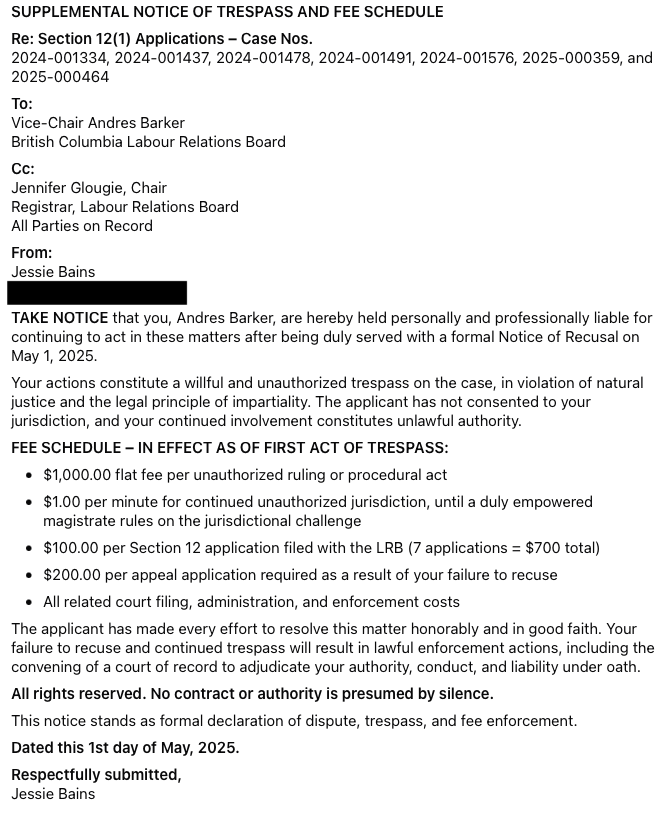
Sometimes digging is needed to confirm pseudolaw is in play in litigation. A series of British Columbia court decisions all emerge from an underlying labour dispute. The unsuccessful party sues a lawyer, a tribunal member, a judge. But in a strange way:
People are sued in their “private capacity”, versus the professional roles (e.g. Bains v Morishita, 2026 BCCA 241; Bains v Barker, 2026 BCCA 65)
An official did not provide their “oath of office” (e.g. Bains v Morishita, 2026 BCCA 241; Bains v Barker, 2026 BCCA 243)
Targeted actors have “trespassed”, but not in a physical sense, but into legal matters (e.g. Bains v O'Rourke, 2025 BCSC 2534)
That’s pretty close to a smoking gun that this is a pseudolaw process. The idea that officials must present their “oath of office” on demand is an ancient pseudolaw gambit. If you can’t prove you are authorized to act, you automatically must be illegitimate. In fact, in law the presumption is the other way around. People like judges and government officials are presumed to have valid authorization. It’s up to the other side to prove otherwise.
“Private capacity” points to Strawman Theory, the idea people have multiple identities, and that with the correct language you can dig underneath a title and get to the human being below. Usually that’s a defensive thing. I am not FIRSTNAME MIDDLENAME LASTNAME.
But followers of Carl (“Karl”) Lentz, Sovereign Citizen and renowned walrus imitator believe one can sue “trespassers” in a kind of do-it-yourself court process. The litigation here suggests that influence.
So I dug online for awhile and found the smoking gun, attached below. A fee schedule where an individual unilaterally assigns penalties to another. A classic pseudolaw document based on the concept that silence means consent, and one can foist contractual agreements on others. Fee schedules are a notorious tool of intimidation.
So, these are pseudolaw-based disputes. None of the relevant court decisions seems to indicate that, but the proof is in the substance of the litigation, rather than its label.
I counted nine reported tribunal and court decisions relating to this dispute. Off to the Supreme Court of Canada next, I suspect.
Your tax dollars at work.
Can't help you with that one.
I have no idea what "Access To Justice" means. I even took a university course about "Access To Justice".
The prof said "I did not embrace the values and concepts of the course."
I just call that me being really stupid.
Seemed like a label you can stick on pretty much anything. Like paint colour schemes in courthouses.
Not making that up.
There are few formal reports of social and procedural conduct of court hearings with pseudolaw adherents. I have seen many first-hand, but never documented those.
And I've certainly not witnessed a judge singing along with a pseudolaw adherent.
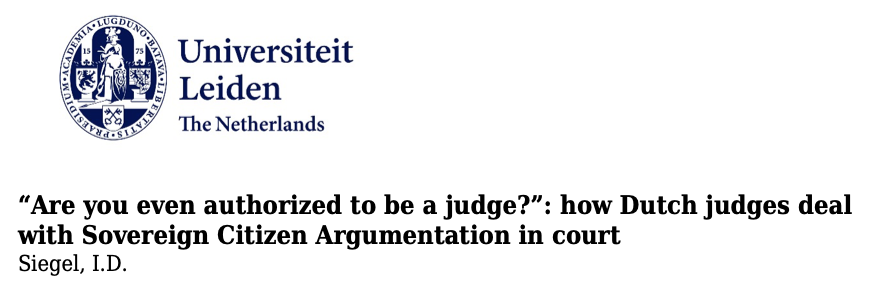
That makes the recent academic article by I. D. Siegel of pseudolaw court proceedings in the Netherlands interesting. While the sample set is fairly small (6 proceedings), the author dissected out different judicial/litigant interaction patterns, and their functional aspects. There are some interesting points.
One is that pseudolaw arguments basically had no effect on court proceedings. That might surprise non-court personnel, but I expected that. Pseudolaw claims, usually intended to control or end proceedings, just are irrelevant to the court’s authority, so those were bypassed. Courts in most jurisdictions have an expectation of “procedural fairness”, which basically means you have to listen to the litigation participants and let them say their piece. There is no reason to respond to an argument on the spot, and judges in the Netherlands usually did not.
One dramatic proceeding was a criminal proceeding where a mother abducted her children, and arrived with an entourage and advanced “anti-institutional worldviews”. She ran the usual Strawman Theory motifs on nomenclature and such, and when the mother used unusual language that was narrowed and bypassed. Basically, the mother was allowed to stake out her political/social perspective, but not direct the flow of the proceeding.
Another litigant was primarily oriented on satanic ritual abuse theories, but then added pseudolaw motifs. While the defendant, again with an entourage, was aggressive and disruptive, the judge elected to manage rather than escalate interactions, culminating in this exchange:
... She finished her plea by demanding due process, threatening with an appeal for recusal of the judge. She then requested to play a Michael Jackson song into the microphone, making the song audible for the audience. The judge allowed this, even sang along with parts of the song, while giving assuring looks to the municipality. The audience sang along, and some cried. The end of the song was met with applause.
The pseudolaw litigant did not insist the judge recuse themself because: “We sense a form of humanity.”
I’ve watched a lot of court interactions in Canada between problematic litigants and court personnel. Every judge has their own approaches. This article illustrates that. The end objective of any judge is to complete and conclude their court proceedings in a permanent manner – to end the process and avoid re-litigation. Preferred strategies with that objective are quite different from what one sees on television and in movies.
Siegel’s report is useful to illustrate that. And it’s just interesting to see how the fake pseudolaw “common law” gets applied in a completely foreign civil law jurisdiction. Nice summary of goings on in that jurisdiction too.
Definitely worth a read, particularly as pseudolaw is comparatively new in the Netherlands, but has developed a substantial following.
Full article is here: https://t.co/SWkDSPlRsR
@RuleofLawCanada By definition, any decision that is otherwise final can be appealed to the Supreme Court of Canada, except for criminal acquittals.
It's Supreme Court Act s 40(1).
Now, that doesn't mean the SCC will accept and hear the appeal. But you can file.
@RuleofLawCanada If you disagree with a court decision, the appropriate response is an appeal.
That is the only mechanism in Canada to alter a court-ordered outcome. You go to a higher court.
More reporting on Australian pseudolaw activities:
https://t.co/2HWEqgHSst
Since this is outside Canada I'm just going to point at it and not comment further.
I didn't notice until today this excellent report by Dan Neidle concerning another offshore pseudolaw scam that has settled its roots into the UK. It's a combination of the bill of exchange scheme where a promise to pay eliminates debt as money for nothing, and "notaries as judges".
I bet Dan is correct that the bill of exchange argument is the US variation, because in common law countries there's a marvellous and real quote - by Lord Denning no less - that states:
"We have repeatedly said in this court that a Bill of Exchange or a Promissory Note is to be treated as cash."
From Fielding & Platt Ltd v Najjar, [1969] 2 All ER 150 at 152 (UK CA). So this is real UK law.
Now, (retired) Associate Chief Justice Rooke of the Alberta Court of King's Bench rejected that means a promise to pay eliminates a debt in ... a colour manner:
"Much like other OPCA schemes, this ‘promissory note is cash’ concept is a scam that dissolves when scrutinized. A promissory note is a promise to pay. Does it make any sense that a person can eliminate a debt with another IOU for (effectively) the same debt? Wouldn’t this then inevitably lead to a conga line of promissory notes, each purporting to satisfy the debt of the note one step up the queue?"
From Re Boisjoli, 2015 ABQB 629 at para 35.
Now the notary as a key player is a Canadian gambit, linking back to the inventor of Freemanism, street comedian Robert Arthur Menard. He combined bizarre claims about notaries with the widespread "Three/Five Letters" as a method by which notaries purportedly become super-judges. If you're curious, I've written about that here:
https://t.co/vBmqAGStTk
Personally, I think lawyers should be held accountable for reading the documents they sign or stamp. Not every lawyer agrees with me, though.
Dan's article is very much worth reading. Excellent investigation and analysis.
@RuleofLawCanada@jonkay It's an old phenomenon, dating back to the 1980s in the US.
Can't think of any in Canada until the mid 2010s, and those only had a short duration. The most amusing was the "Alberta Court of Kings Bench" where you are the king!
Or so the slogan went.
Criminal proceedings against HRM Romana Didulo, the Queen of Canada, were recently discontinued. Why? Uncertain.
But I just read something that suggests another legal avenue for sanctions against HRM Didulo.
Security-related illegalities.
Say what?! Securities?
Not as implausible as that might seem at first. I read a lovely little essay/summary this morning by Ronke Balogun and Solomon Ngoladi, staffers with the Alberta Securities Commission, on how the definition of a security is pretty loosey-goosey and more driven by function than form. It’s here (https://t.co/vxW7CHuZ1n). The authors explain that securities aren’t limited to the usual things like shares or bonds. The scope of a security is functional, that it creates or captures certain kinds of investment and contribution relationships.
So names don't really matter. That makes sense. You shouldn’t be able to contract out of securities legislation put in place to protect the public. The authors summarize the characteristics of a security this way:
Investment of Money – Participants must contribute money (or money’s worth) into the scheme.
Common Enterprise – The fortunes of investors must be interwoven with those of the promoter or other investors. This can include pooling of funds or a functional interdependence between investor and promoter.
Expectation of Profit – Investors must enter the arrangement with the expectation of profit.
Profit to Come Significantly from the Efforts of Others – The expected profit must depend primarily on the efforts, skill, or expertise of the promoter or a third party, not the investor.
Substance Over Form – Courts look at the economic reality of the arrangement, not its label or formal structure.
If you’re scratching your head and asking ... Well, I don’t remember HRM Didulo issuing shares or structuring the Kingdom of Canada as some kind of investment apparatus, let me remind you of something. HRM Didulo is continually seeking contributions from her followers. What do they get? In a lot of ways, it’s the long con. She promises big stuff, ranging from debt elimination, to “Med Beds”, to orbital laser strikes and invisible commandos against oppressive factors and agents, most likely including me.
But she has done something else. She’s issued something she calls “Loyalty Money”. Loyalty Money, pictured below, has usually been given to her followers in one-on-one meetings, Didulo’s “Meet and Greet” sessions. I suspect that was also presented to those who attended the Kingdom of Canada’s purple fortress in Richmound, at the swearing in ceremonies Didulo conducted there.
Now, I’m not sure if anyone knew exactly what you could do with Loyalty Money. It looks fancy. It has a denomination on it. She apparently has said this is backed by gold and silver, under natural law. Ok – so it has value independent of usual modern currency systems, and instead under the old non-fiat currency model where paper money stands in place for gold.
Is Loyalty Money a security?
Let’s go through the criteria:
(1) Investment of Money? If Loyalty Money is linked to donations/contributions to HRM Didulo, then yes.
(2) Common Enterprise? Yes. One becomes a citizen of the Kingdom of Canada, subject to HRM Didulo. Citizens/followers/serfs are promised benefits from that membership, ranging from free utilities, debt elimination, quantum computers, Med Beds, lots of stuff. HRM Didulo is the provider, on behalf of her followers, thanks to the Galactic Federation or whatever. Or King Carlson. It varies.
(3) Expectation of Profit? Yes – at a minimum you’re getting your Loyalty Money, which can be exchanged for gold and silver, unlike that worthless fiat currency.
(4) Profit to Come Significantly from the Efforts of Others? Yes. HRM Didulo, her inner cadres, and the various terrestrial and off-world actors take care of everything. You build the Kingdom of Canada by donating and believing real hard.
(5) Substance Over Form? If HRM Didulo is promising real value of some kind for her Loyalty Money, then the answer is yes.
So... it’s a little weird, but I think there’s an argument here! The leading case is Canada, Pacific Coast Coin Exchange v Ontario Securities Commission, [1978] 2 SCR 112, which even has the flavour of HRM Didulo’s scheme. Pacific Coast Coin offered you the right to put money down now to buy a partial interest in bags of silver coins. Not actual currency, but bags of silver. (Oh, settle down Judas.) The SCC concluded this was a kind of investment arrangement. Hmm – interesting – though the Court doesn’t formally call that a security, as it didn’t have to decide that issue.
The best way to test out whether HRM Didulo has been issuing securities without a licence would be if someone who has received Loyalty Money from HRM Didulo went to a Canadian security regulator and submitted a complaint. Now, I know very little about those processes, but if nothing else, it’d be interesting. The folks at the regulatory agency would be gossiping about it for years!
Of course, finding someone with a few million in Loyalty Money to head this might be a challenge. Orbital laser bombardment strikes, and all that. Do you really want to take the risk?
Sometimes hard to believe the little field I've written in for years is expanding so much! A further indication is the newly formed International Pseudolaw Research Network.
The website is here:
https://t.co/TOzrzKzokb
Largely a seedling at this point but it will grow.
Speaking of conferences, the newly formed International Pseudolaw Research Network is holding online and in-person events on June 18-19. Registration is free, and it looks like the "in person" part has the option to watch online.
I'll be observing but not presenting.
Here's the conference sign-up links:
https://t.co/Nid4ZGwzgR
https://t.co/RJNsAj5xow
It's free! The pseudolaw research world is really friendly and welcoming, so if you're curious, I'd say join in!
I'm not affiliated with anyone or anything - I'm entirely independent. Good for maneuverability, bad for resourcing.
I'm very interested that you pointed to information preservation. This is actually a key focus for me on the pseudolaw front. I've discovered so much has and is being lost. The weird result is the one who is writing the history of groups I've studied, like the Detaxers and Freemen-on-the-Land - is me. An outsider, skeptic, and in certain senses, "the enemy".
Many old figures are now dead. Their online resources are evaporating or gone. They didn't write much documentary material, and I'm pretty sure I have the largest library of Canadian books and other paper materials produced, much of it in the original physical format.
At present I am trying to maintain a strong quick access history, so that if others years from now try to retrace my steps they will have some starting point with archived websites, court citations that will provide files that can be investigated. And I try to in a succinct manner capture what I can of what happened. Obviously my perspective, but I attempt to be fair about it, and I don't get much criticism from "the other side of the hill".
Because I think it's important there is a record. Thousands of people adopted peculiar beliefs, then fought wars of paper with institutions and government. The "why" and "how" of that phenomenon is very important, in my opinion.
If you look to older pseudolaw groups in the US there are periods where nothing survived. Like in the 1990s where most activity was on dial-up bulletin board systems. All we have from that is a few text files accumulated into book-like collections.
So yes, I am busily archiving and documenting.
Being old sucks.
I attended my likely final academic conference this week. Due to physical issues air flight is simply very painful.
That twists me because interest and investigation of pseudolaw is rapidly expanding. Conferences, research groups, wonderful writing. It's so exciting to be a part of a lively, thoughtful, insightful research community.
And what we're studying matters. People's lives are affected and degraded by pseudolaw.
I can't stress enough how the current stream of publications is delicious, adding new understanding and angles to what pseudolaw and its people represent. If you enjoy my writing - there's more out there by other authors - I urge you to explore. We're even getting books on the subject by people who have thought hard and long about the phenomenon, its source(s), and effects.
So I sincerely regret I won't be able to share more with these investigators, with students. I remember with great affection the long evenings of scheming and musing over data and conundrums while emptying pitchers of beer. I've have in the past had the privilege of meeting others interested in this subject area. It's not just engaging and productive, it's fun. I miss these people. I miss these exchanges.
Well, that's it for me on that kind of intellectual/social experience. Bleh.
I'm not going to say much about the final conference I attended. Not pseudolaw, but my other area of work, quantifying court processes. I'll just say the conference was a near total waste. What had been advertised as a data-focused event turned out to be just another law conference which ... urgh, I don't even want to start. There was essentially no interest in the data I had to share. Eventually I just gave up and went and sat in the airport, waiting to go home.
So I exit my academic social life on a sour note. But I tried - both to see if I could travel, and make useful contributions. That was "No" and "No".
One of the amazing things about this current situation is how much stuff that used to be sequestered away in university libraries is out there, ready to be plucked for free.
SSRN is a great place, here's a simple "pseudolaw" search:
https://t.co/PyUWy4Wdy0
Google Scholar is also excellent:
https://t.co/aeuGgs9Yio
Some of the literature is more easily located searching for "Sovereign Citizen":
https://t.co/yRlXfI1Z4w
Lots of neat stuff. If you want a real fun contrasting branch, try searching these databases for "Reichsburger". Unsurprisingly, German academics have been pretty thorough with their own special local variation.
It's really a fun space to read and research.
I'm not a video guy. It's a medium I dislike consuming, so unless I was able to avoid the issues with the podcast/videocast culture I would hesitate to move that direction.
A lot of what I discuss is technical, particularly since I like to use data-driven approaches. Love my graphs, I do. Video, particularly YouTube, favours narratives and story-telling, not analysis. Trying to flip back 3 minutes to clarify a complex point is frustrating. With a book or paper I can just head back a few paragraphs. Or flip back and forth between parts of the publication. Video inhibits that.
In fact, I'd argue that pseudolaw gurus and their materials became much easier to market when they switched to video, and the stream and narrative information format. It's really hard to fact check the content of these sources, when contrasting with a written book or other publication. Internal inconsistencies are a real issue to dig out.
But while it's easy to tell a story, that's not usually what I am trying to convey.
I think I'm best in text, which is why I continue to write.
Something I know you know as well is that with the development of online academic and media resources we can direct information straight to the public. I'm happy leaving the flashier presentations to others, especially since I know that the public is reading and making use of data and context.
In a lot of ways, this is a golden age for information sharing. Who'd have imagined something like SSRN or ResearchGate 20 years ago?
(Until the large language model "AIs" mangle our information into distorted and superficial variations.)
@modus_pwnenz Thanks for saying that.
I do hear from others working in the field, and I also try to engage in positive feedback loops, highlighting the work others are presenting.
It's just good reciprocal back-scratching. Nice to see others are reading and enjoying your work.
I do ask, and during the pandemic there seemed to be much more willingness to organize in that way. But ... well, we're both in the academic game. We know for many conferences are as much about schmoozing as presenting and sharing information.
The old funding games ... who you know makes a difference.
So I entirely agree. This last conference I attended amounted to nearly a month of my annual income. And I was playing it cheap.
@modus_pwnenz It's a nice idea, but I'm just a single individual, a retired pensioner. I have very limited resources. No, worse than you think.
I am not affiliated with or supported by any institutions.
Canada's law faculties are utterly disinterested in what I do.
Surprising? Not really.







![DNetolitzky's tweet photo. Criminal proceedings against HRM Romana Didulo, the Queen of Canada, were recently discontinued. Why? Uncertain.
But I just read something that suggests another legal avenue for sanctions against HRM Didulo.
Security-related illegalities.
Say what?! Securities?
Not as implausible as that might seem at first. I read a lovely little essay/summary this morning by Ronke Balogun and Solomon Ngoladi, staffers with the Alberta Securities Commission, on how the definition of a security is pretty loosey-goosey and more driven by function than form. It’s here (https://t.co/vxW7CHuZ1n). The authors explain that securities aren’t limited to the usual things like shares or bonds. The scope of a security is functional, that it creates or captures certain kinds of investment and contribution relationships.
So names don't really matter. That makes sense. You shouldn’t be able to contract out of securities legislation put in place to protect the public. The authors summarize the characteristics of a security this way:
Investment of Money – Participants must contribute money (or money’s worth) into the scheme.
Common Enterprise – The fortunes of investors must be interwoven with those of the promoter or other investors. This can include pooling of funds or a functional interdependence between investor and promoter.
Expectation of Profit – Investors must enter the arrangement with the expectation of profit.
Profit to Come Significantly from the Efforts of Others – The expected profit must depend primarily on the efforts, skill, or expertise of the promoter or a third party, not the investor.
Substance Over Form – Courts look at the economic reality of the arrangement, not its label or formal structure.
If you’re scratching your head and asking ... Well, I don’t remember HRM Didulo issuing shares or structuring the Kingdom of Canada as some kind of investment apparatus, let me remind you of something. HRM Didulo is continually seeking contributions from her followers. What do they get? In a lot of ways, it’s the long con. She promises big stuff, ranging from debt elimination, to “Med Beds”, to orbital laser strikes and invisible commandos against oppressive factors and agents, most likely including me.
But she has done something else. She’s issued something she calls “Loyalty Money”. Loyalty Money, pictured below, has usually been given to her followers in one-on-one meetings, Didulo’s “Meet and Greet” sessions. I suspect that was also presented to those who attended the Kingdom of Canada’s purple fortress in Richmound, at the swearing in ceremonies Didulo conducted there.
Now, I’m not sure if anyone knew exactly what you could do with Loyalty Money. It looks fancy. It has a denomination on it. She apparently has said this is backed by gold and silver, under natural law. Ok – so it has value independent of usual modern currency systems, and instead under the old non-fiat currency model where paper money stands in place for gold.
Is Loyalty Money a security?
Let’s go through the criteria:
(1) Investment of Money? If Loyalty Money is linked to donations/contributions to HRM Didulo, then yes.
(2) Common Enterprise? Yes. One becomes a citizen of the Kingdom of Canada, subject to HRM Didulo. Citizens/followers/serfs are promised benefits from that membership, ranging from free utilities, debt elimination, quantum computers, Med Beds, lots of stuff. HRM Didulo is the provider, on behalf of her followers, thanks to the Galactic Federation or whatever. Or King Carlson. It varies.
(3) Expectation of Profit? Yes – at a minimum you’re getting your Loyalty Money, which can be exchanged for gold and silver, unlike that worthless fiat currency.
(4) Profit to Come Significantly from the Efforts of Others? Yes. HRM Didulo, her inner cadres, and the various terrestrial and off-world actors take care of everything. You build the Kingdom of Canada by donating and believing real hard.
(5) Substance Over Form? If HRM Didulo is promising real value of some kind for her Loyalty Money, then the answer is yes.
So... it’s a little weird, but I think there’s an argument here! The leading case is Canada, Pacific Coast Coin Exchange v Ontario Securities Commission, [1978] 2 SCR 112, which even has the flavour of HRM Didulo’s scheme. Pacific Coast Coin offered you the right to put money down now to buy a partial interest in bags of silver coins. Not actual currency, but bags of silver. (Oh, settle down Judas.) The SCC concluded this was a kind of investment arrangement. Hmm – interesting – though the Court doesn’t formally call that a security, as it didn’t have to decide that issue.
The best way to test out whether HRM Didulo has been issuing securities without a licence would be if someone who has received Loyalty Money from HRM Didulo went to a Canadian security regulator and submitted a complaint. Now, I know very little about those processes, but if nothing else, it’d be interesting. The folks at the regulatory agency would be gossiping about it for years!
Of course, finding someone with a few million in Loyalty Money to head this might be a challenge. Orbital laser bombardment strikes, and all that. Do you really want to take the risk?](https://pbs.twimg.com/media/HJvXrNcboAA6pRZ.jpg)


