This Google Drive link gives you free access to a compilation of relevant law notes and materials on land law as well as contract law in Ghana.
https://t.co/nlEWEzTBZW
Custodial sentence for failure to pay lower fines don’t make sense in this day and age.
He’s a cost to the state. Even if his expenses for the month is Ghc500, that’s 6,000 a year. We’re talking about the state taking care of food, “accommodation” etc.
Unless he’s put to hard labor that will earn the state income.
Can Foreigners Own Land in Ghana? Understanding Land Interests for Foreigners.
One of the most frequently asked questions by foreign investors, expatriates, members of the diaspora, and international businesses is whether foreigners can own land in Ghana.
The answer is both straightforward and nuanced.
While foreigners can acquire interests in land in Ghana, the Constitution places significant restrictions on the nature and duration of those interests.
Constitutional Framework
The right to acquire and hold interests in land in Ghana is regulated by the 1992 Constitution.
Although Article 17 guarantees equality before the law and prohibits discrimination, the Constitution itself establishes special rules governing land ownership by non-citizens.
Consequently, foreigners are permitted to acquire interests in land, but not to the same extent as Ghanaian citizens.
Foreigners Cannot Hold Freehold Interests
The most important restriction is contained in Article 266 of the Constitution.
A freehold interest is the highest form of land ownership, conferring perpetual rights in land without any fixed duration.
Article 266 expressly prohibits the grant of freehold interests in land to non-citizens. Accordingly, a foreign individual, foreign company, or other non-citizen entity cannot lawfully acquire a freehold interest in land in Ghana.
Any purported grant of a freehold interest to a non-citizen is unconstitutional and unenforceable.
Leasehold Interests: The Principal Interest Available to Foreigners
Although freehold ownership is prohibited, foreigners may acquire land through leasehold interests.
A leasehold grants the holder the right to possess, occupy, use, and develop land for a specified period, subject to the terms and conditions of the lease.
Leaseholds are therefore the primary mechanism through which foreigners acquire interests in land in Ghana.
The 50-Year Constitutional Limitation
Article 266 further provides that no interest in land granted to a non-citizen shall exceed fifty years at any one time.
This means that:
A foreign individual may acquire land under a lease.
A foreign-owned business may acquire land under a lease.
A foreign investor may develop residential, commercial, industrial, agricultural, or hospitality projects on leased land.
However, the lease term cannot exceed fifty years at any one time.
This constitutional limitation applies regardless of the value of the investment or the nature of the project.
Renewal of Leases
The Constitution prohibits leases exceeding fifty years at any one time but does not prohibit renewal.
Consequently, many leases granted to foreigners contain provisions permitting renewal upon expiry, subject to agreement between the parties and compliance with the law.
Each renewed term must nevertheless comply with the constitutional limitation.
The Policy Behind the Restriction
The restrictions imposed by Article 266 reflect a constitutional policy choice.
The framers of the Constitution sought to protect Ghana's land resources for the benefit of citizens while simultaneously encouraging foreign investment and economic development.
The result is a framework that permits foreigners to invest in, develop, and occupy land without granting permanent ownership rights.
The Importance of Due Diligence
Before acquiring any interest in land, foreign investors should undertake comprehensive legal due diligence, including:
• Verification of ownership.
• Searches at the Lands Commission.
• Investigation of the root of title.
• Review of the proposed lease term.
• Examination of renewal provisions.
• Confirmation of the lessor's authority to grant the lease.
• Registration of the lease after execution.
Failure to conduct proper due diligence can expose investors to significant legal and financial risks.
Conclusion
Foreigners can legally acquire valuable interests in land in Ghana, but those interests are constitutionally regulated.
HOW TO TRANSFORM YOUR SOLE PROPRIETORSHIP INTO A PRIVATE COMPANY IN GHANA; THE FULL LEGAL PROCESS.
Many Ghanaian businesses start as: • Business names • Sole proprietorships • “Enterprise” businesses
At the beginning, that structure is fine.
But once your business starts growing, you eventually need:
• A proper company structure • Regulatory compliance • Tax registrations • Corporate banking • Industry certifications • Investor readiness
This is how lawyers usually help businesses legally transition from a sole proprietorship into a fully incorporated private company limited by shares in Ghana.
STEP 1; REVIEW THE EXISTING BUSINESS
The lawyers first examine: • The current business registration • Nature of business activities • Existing debts or liabilities • Existing contracts • Tax compliance status • Industry regulations affecting the business
This determines the most suitable company structure.
STEP 2; INCORPORATE THE NEW PRIVATE COMPANY
The lawyers then: • Conduct a company name search • Reserve the company name • Draft the company constitution • Determine shareholders and directors • Structure the shares properly • File incorporation documents with the Registrar of Companies • Register beneficial ownership information
Once completed, the company becomes a separate legal entity from the owner.
STEP 3; OBTAIN THE COMPANY DOCUMENTS
After incorporation, the company receives: • Certificate of Incorporation • Certificate to Commence Business • Company Constitution • Company Regulations • Company TIN
These documents become necessary for: • Banking • Contracts • Tenders • Regulatory approvals • Investor transactions
STEP 4; ACTIVATE THE COMPANY’S TAX STATUS
The lawyers then assist with: • Activation of the company TIN • Ghana Revenue Authority registration • VAT registration where required
This stage is critical because many companies are registered but not fully tax compliant.
STEP 5; REGISTER WITH SSNIT
If the company will employ workers, the lawyers assist with: • SSNIT employer registration • Employee contribution setup • Compliance documentation
Many institutions now request SSNIT clearance certificates before awarding contracts.
STEP 6; OBTAIN BUSINESS OPERATING PERMITS
The company must obtain: • Municipal or Assembly business operating permits • Fire certificates where required • Environmental permits where applicable
This depends on the business location and industry.
STEP 7; OBTAIN INDUSTRY-SPECIFIC LICENSES OR CERTIFICATIONS
Depending on the business sector, lawyers may assist with: • FDA approvals • Petroleum Commission licensing • Minerals Commission licensing • Tourism Authority licensing • FinTech approvals • Import/export certifications • Professional practice licenses • Construction permits and certifications
This is where many businesses face legal problems because they operate without the required sector approvals.
STEP 8; TRANSFER THE OLD BUSINESS INTO THE NEW COMPANY
This is one of the most important legal steps.
The lawyers may prepare: • Asset transfer agreements • Assignment of contracts • Intellectual property transfers • Employment transition documents
Without this stage, many people incorporate companies but still legally operate as individuals.
STEP 9; OPEN CORPORATE BANK ACCOUNTS
The lawyers then assist the company to prepare: • Board resolutions • Corporate account documents • Compliance documents requested by banks
The business now begins operating fully as a company instead of as an individual.
STEP 10; CORPORATE GOVERNANCE AND COMPLIANCE
Lawyers usually continue assisting with: • Annual filings • Corporate secretarial services • Board resolutions • Share transfers • Regulatory compliance
The reality is simple:
A sole proprietorship may help you start a business.
But a properly incorporated and compliant private company helps you grow it.
Parliament just passed the LGBT Bill. However the Bill is not an effective law. There were cases like Amanda Odoi v AG and Richard Sky v Ag which challenged the validity of these Bills but the Supreme Court held that once the Bill is not passed into law, it is not recognized as an enactment until it’s assented to by the President.
The President under article 106 of the 1992 constitution can refuse assent and submit the Bill to the Council of State for Review. Also the President can point out problematic clauses and send the Bill back to Parliament for review. However if Parliament passes the Bill again by 2/3rds majority then it is binding on the President to assent to it into law.
Unlike the lion king of Africa, President Mahama said the Bill is not a priority yet so it will probably take some time and review before assent.
I’ll later break down the implications of this Bill when we obtain the certified copy.
A lot of Ghanaian businesses are doing very well until they meet one big client or try to expand.
Then suddenly they are asked to provide: • Company documents • VAT registration • Tax Clearance Certificate • SSNIT Clearance Certificate • Company profile • Business bank account details • Certifications
And that is when many people realize:
“Ei… I only registered a business name.”
No proper company structure. No directors. No company secretary. No shares.
Some businesses do not even have TIN numbers yet. Meanwhile the business is making money every day. This is one of the biggest mistakes many entrepreneurs make. A business can be popular and profitable but still not properly structured.
So when opportunities come: • Big contracts • Partnerships • Investors • Government work • International clients
The business struggles because legally and corporately, it is not ready. This is where corporate lawyers become very important.
Most people think lawyers are only needed when there is a court case. Good lawyers help you structure your business properly before problems even arise.
They help with things like:
Structuring the company properly For example: • Who owns what shares • Who the directors should be • Whether you need a parent company or subsidiary companies as you grow
Preparing proper company documents This includes: • Company Constitution • Incorporation documents • Statutory forms • Internal corporate documents
Ensuring compliance Lawyers help make sure the company complies with: • Registrar requirements • GRA obligations • SSNIT obligations • Annual filings and statutory requirements.
Acting as Company Secretary Many people do not know every company is expected to maintain certain records and filings.
Lawyers help manage those obligations properly so the company stays compliant.
Handling incorporation and registrations This includes: • Company incorporation • TIN registration • VAT registration guidance • Corporate filings • Post-incorporation compliance support
The truth is simple:
There is a difference between: “I sell things” and “I have a properly structured business.” One attracts small transactions.
The other attracts banks, investors, contracts, partnerships, and long-term growth. Many Ghanaian businesses are hardworking and successful, but they delay proper structuring until an opportunity is already at the door.
By then, they are rushing to fix years of neglected compliance in a few days.
Your business may be growing.
But the real question is: Is it properly structured for the next level?
Illegal mining is a criminal offense. These criminals do it openly, post themselves destroying the lands, post themselves holding bands of cash that they’ve earned from their criminal activities. Mind you, the mining sites can be located, their TikTok accounts can be traced.
These criminals do not even pay tax. Under the constitution, taxes belong to the state and minerals in their natural form belong to the state.
It’s the people who work legal jobs that are taxed, that have to pay for licenses and permits to do business. It’s the IT professionals that will be taxed and will be paying exorbitant fees just to operate their means of living. However those imposing these fees promised that galamsey can be combatted within a short period of time.
We employ and pay people with our taxes to combat and solve the galamsey crisis directly or indirectly including;
1. Policemen and security agencies
2. The President who all these minerals are vested in
3. The Ministry of Land and Natural Resources
4. The Minerals and Mining Commission
5. The Environmental Protection Agency
6. The local authorities
Yet these people are mining illegally and posting tons of videos on TikTok. They cannot be traced.
Sigh, we have to save money to pay the fees of Presec students who enter public law schools in Ghana as an undergraduate.
University of Ghana school of law
Knust law faculty
UCC law faculty
UDS law faculty
Upsa law faculty
Gimpa law faculty
Quite a lot but only a few Presecans make it to law schools anyways.
This is to encourage them
When they say a lawyer must review the land agreement (lease, indenture, conveyance, document, instrument etc), what is actually meant is that YOUR LAWYER must be the one to review it for you.
When the person selling the land or landed interest to you says HIS LAWYER has drafted and gone through so the terms are fine and it is legal, it means the terms are fine for HIM. You have to get your own lawyer to ensure the document is reviewed before signing so the terms are fine for YOU.
Every lawyer will work for the best interest of his client and will draft the agreement in a way that will benefit his client. Hence if there’s a dispute between you and the other party be rest assured that his lawyer drafted the terms to favor the other party. You need your lawyer to also review the terms to favor you before signing.
This is the same for Employment Contracts, Intellectual Property Contracts, Brand Deals, Partnership Agreements, Joint Venture Agreements Etc.
After you’ve finished paying for the land, let’s say you paid Ghc100,000 for a piece of property; then you’ll now contact a lawyer to “review” the indenture that you have already signed.
It doesn’t work that way. A signed contract is a binding contract. If there’s a matter with the indenture it will go against you.
Even the law is to the effect that such instruments and land assignments or conveyance must be drafted by a lawyer.
Someone is selling you property; the person has drafted his terms to you, then you read and sign. Afterwards you contact a lawyer. It cannot be changed. It’s binding on you.
And after you’ve paid Ghc100,000 for the land, you cannot tell the lawyer “oh your fees are expensive o. See I paid 100k now I have to pay your fees too?”
What do you mean by that? You had no problem paying 10% agent fee, paying chief’s percentage and buying a property from someone without doing due diligence.
Now that a lawyer has to help you protect your interests and register your property for you, you’re claiming let’s say a 10% fee is too much.
You want to negotiate with your protector?
DOES HAVING AN INDENTURE MEAN YOU OWN THE LAND IN GHANA?
Many land buyers proudly say: “I have the indenture, so the land is mine.”
Not necessarily.
One of the most common misconceptions in Ghanaian land transactions is the belief that once an indenture is signed and handed over, ownership is automatically secured.
An indenture is a very important legal document. It records and evidences a transaction involving land and may show that parties intended to transfer or create an interest in land.
However, possessing an indenture alone does not automatically guarantee a legally protected interest free from challenge.
Here is why:
1. An indenture records the transaction but does not eliminate legal risk.
The document may show that parties agreed to transfer land and set out the terms of that arrangement.
However, the existence of a signed indenture does not by itself resolve issues relating to ownership disputes, competing claims, boundary problems, fraud, or defects in title.
The critical question is not only “Do you have an indenture?” but also “Was the transfer legally valid?”
2. The seller may not have had a valid title to transfer.
A fundamental principle of land law is that a person generally cannot transfer a better interest than the one they possess.
If the transferor lacked authority, was not the true owner, acted without required family or stool consent, or transferred disputed land, the purchaser may face serious legal difficulties despite holding an indenture.
A document can only transfer rights that the transferor lawfully had.
3. Multiple sales continue to create land disputes.
One persistent challenge in Ghanaian land transactions is the practice where the same land is sold to multiple purchasers.
Two or more people may each possess documents relating to the same parcel of land.
This is why documentation alone should never replace investigation and due diligence.
Proper searches and inquiries remain essential.
4. Registration serves an important protective function.
Under Ghanaian land law, registration assists in recording and protecting interests in land and giving notice of claims.
Failure to complete registration procedures may create difficulties where competing interests arise or future disputes occur.
An unregularized transaction may expose a purchaser to avoidable legal problems.
5. Due diligence protects your investment
Before and after receiving an indenture:
• conduct searches; • verify the identity and authority of the transferor; • inspect the land physically; • confirm boundaries and site plans; • investigate pending disputes or litigation; • verify planning status; and • complete registration procedures.
An indenture is a major part of a land transaction.
But in Ghanaian land practice, it should never be treated as the final step.
The safest position is not simply to possess a document. It is to ensure the transaction itself is legally sound.
Seth Doe Esq.
If you’re purchasing land worth Ghc300,000 will you pay 10% for legal experts to handle the process for you or you’ll do everything yourself and take the risk?
In this short 5 minute video I break down who are the “Owners” of land in Ghana.
Certain lands in Ghana are owned by families, some are owned by stools and others are owned by clans and even the state. Individuals can own property too.
Be mindful of whom you’re dealing with.
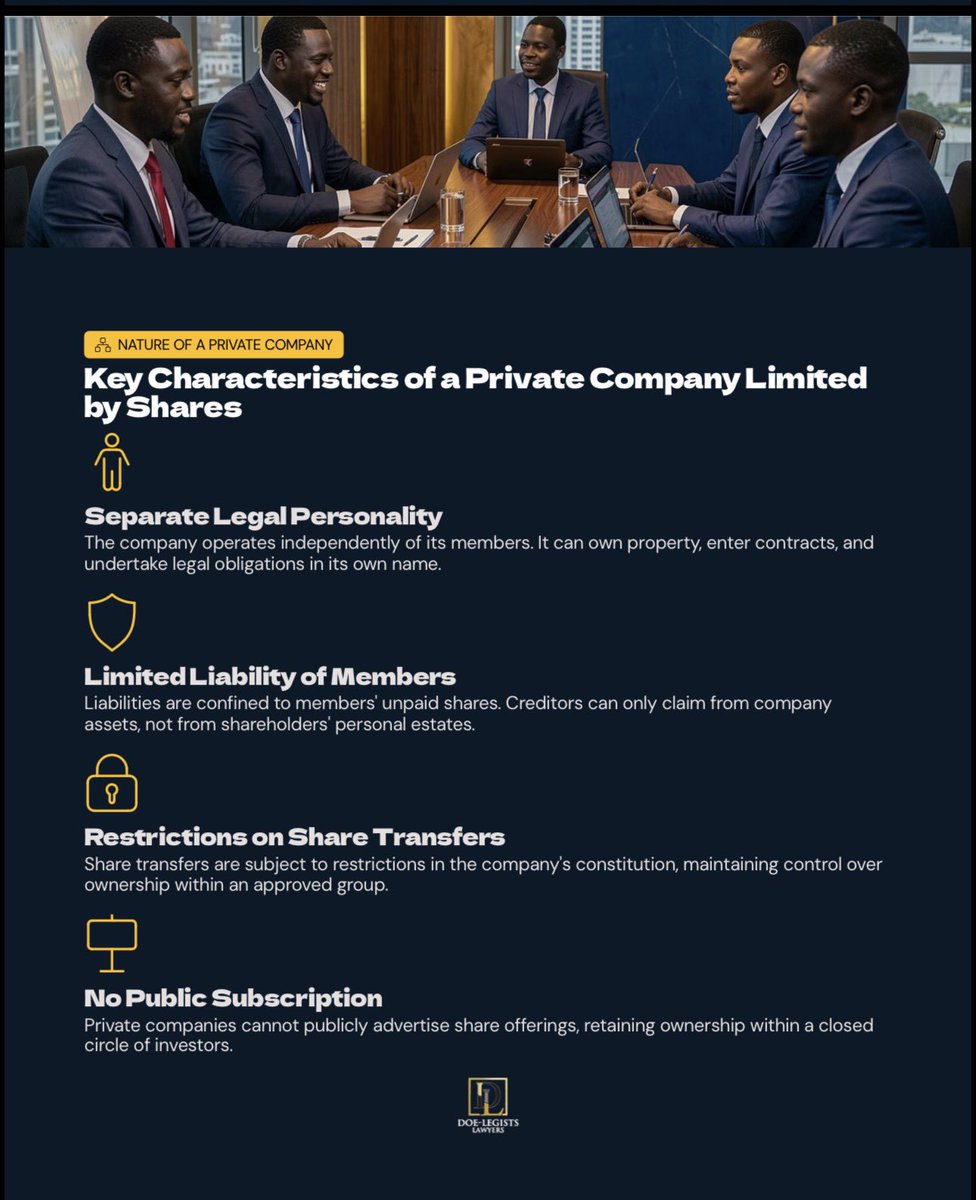
90% of the companies in Ghana are private companies limited by shares. This is where the shareholders are between 1-50 and the shares are not offered to the public maintaining private control.
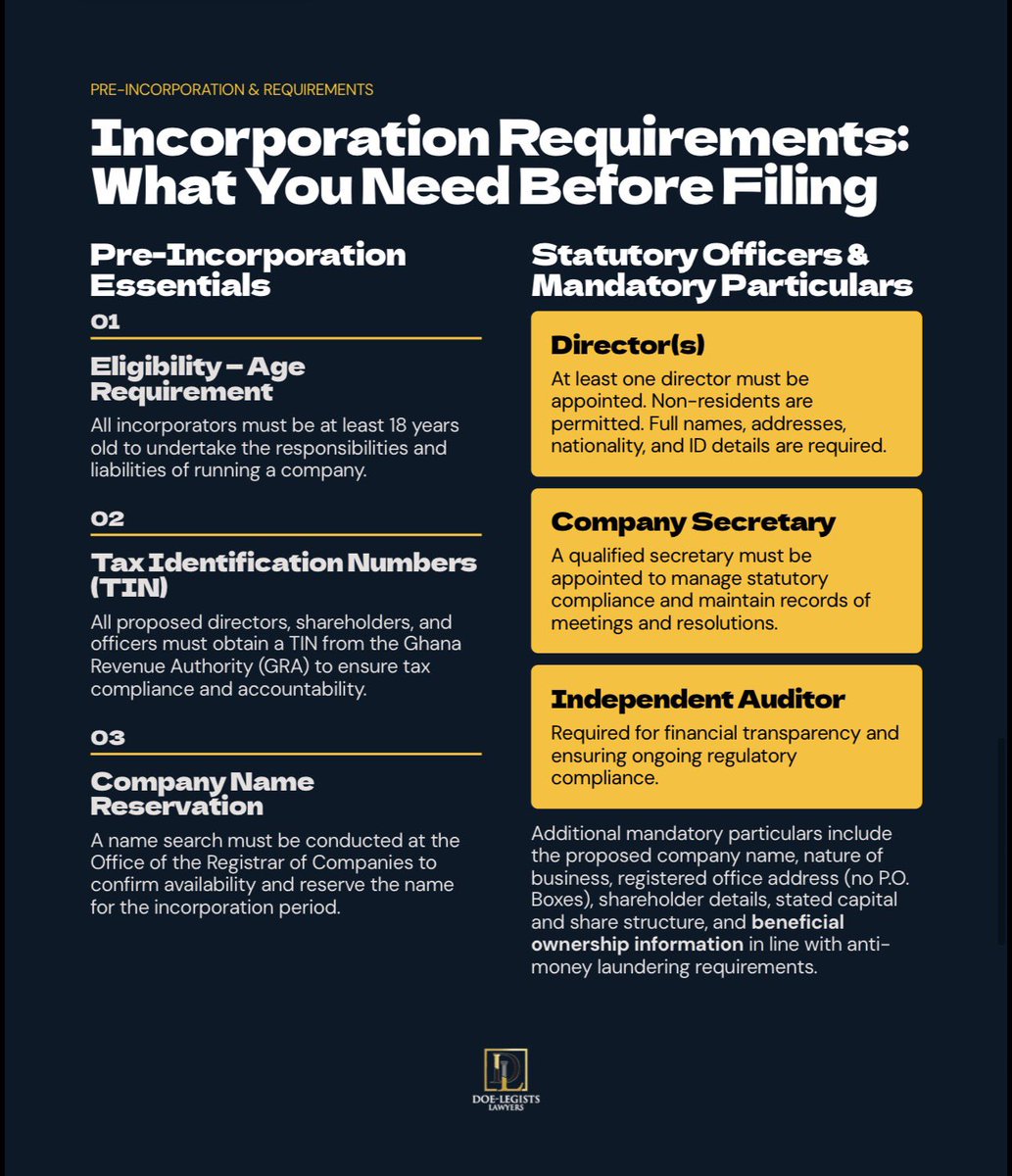
Incorporating a Private Company Limited by Shares.
Here is the step by step process.
YUDAH BROWN* presents
FINAL MOCK EXAM PREP WITH KONKI*
Tricks & Strategy [Webinar]
Dear Learning Colleagues,
The Ghana School of Law presents a unique and demanding academic environment. To navigate it successfully, guidance from those who have excelled on this path is essential.
*On 25th April at 7:00 PM*, Yudah Brown will host *Konki* for an insightful session focused on *our final mock preparations.*
We are all here with one goal, to *succeed and advance.*
Join the platform below and position yourself for *ACADEMIC XCELLENCE*.
🔗: https://t.co/GdaIbl3WO6
═════════════
*YUDAH BROWN COMMUNICATIONS*
▬▬▬▬▬▬▬▬▬❂❂❂❂❂❂▬▬▬▬▬▬▬▬
Someone pays his business lawyer Ghc1,200 a month. I was like “well that’s against rules because minimum retainer for a business should be probably from 4,000 onwards. Even GBA says 8,000”
His response;
“Well it’s a business association and about fifty of them pay the lawyer.”







![YudahBrown's tweet photo. YUDAH BROWN* presents
FINAL MOCK EXAM PREP WITH KONKI*
Tricks & Strategy [Webinar]
Dear Learning Colleagues,
The Ghana School of Law presents a unique and demanding academic environment. To navigate it successfully, guidance from those who have excelled on this path is essential.
*On 25th April at 7:00 PM*, Yudah Brown will host *Konki* for an insightful session focused on *our final mock preparations.*
We are all here with one goal, to *succeed and advance.*
Join the platform below and position yourself for *ACADEMIC XCELLENCE*.
🔗: https://t.co/GdaIbl3WO6
═════════════
*YUDAH BROWN COMMUNICATIONS*
▬▬▬▬▬▬▬▬▬❂❂❂❂❂❂▬▬▬▬▬▬▬▬](https://pbs.twimg.com/media/HGWiAjTW0AAJe-z.jpg)


