It's been while since my last deep dive into $S.
So, now that market is rotating and we'll likely going through an altseason I thought an updated was needed!
Here what's new in the @SonicLabs ecosystem 👇
1. 𝐏𝐫𝐢𝐜𝐞 𝐀𝐜𝐭𝐢𝐨𝐧 𝐌𝐨𝐯𝐞𝐦𝐞𝐧𝐭
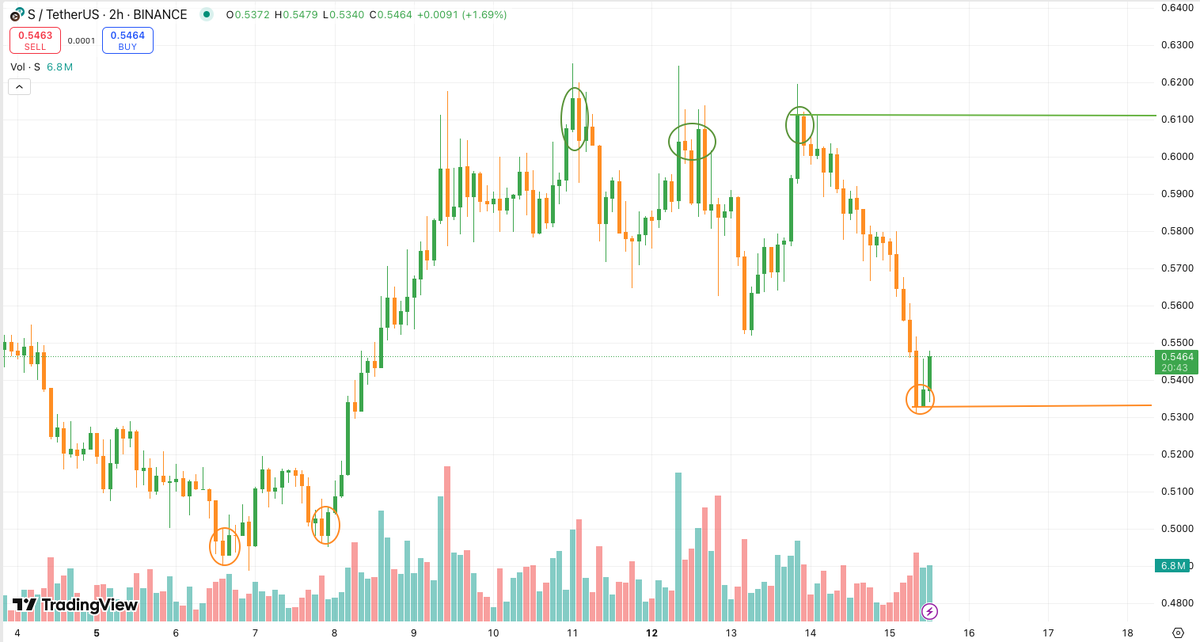
$S just tapped a key support zone around $0.533 after a clean rejection from local highs near $0.615.
But the pattern is clear: higher lows, repeated top traps, and now another strong base forming.
Structurally, this pullback looks more like opportunity than weakness.
Imho the current price action doesn’t reflect the deep value of the token across Sonic’s stack.
A reclaim of $0.565 could send it right back toward the previous range highs.
2. 𝐃𝐚𝐩𝐩 𝐑𝐞𝐯𝐞𝐧𝐮𝐞𝐬 & 𝐏𝐫𝐨𝐭𝐜𝐨𝐥𝐬´ 𝐓𝐕𝐋
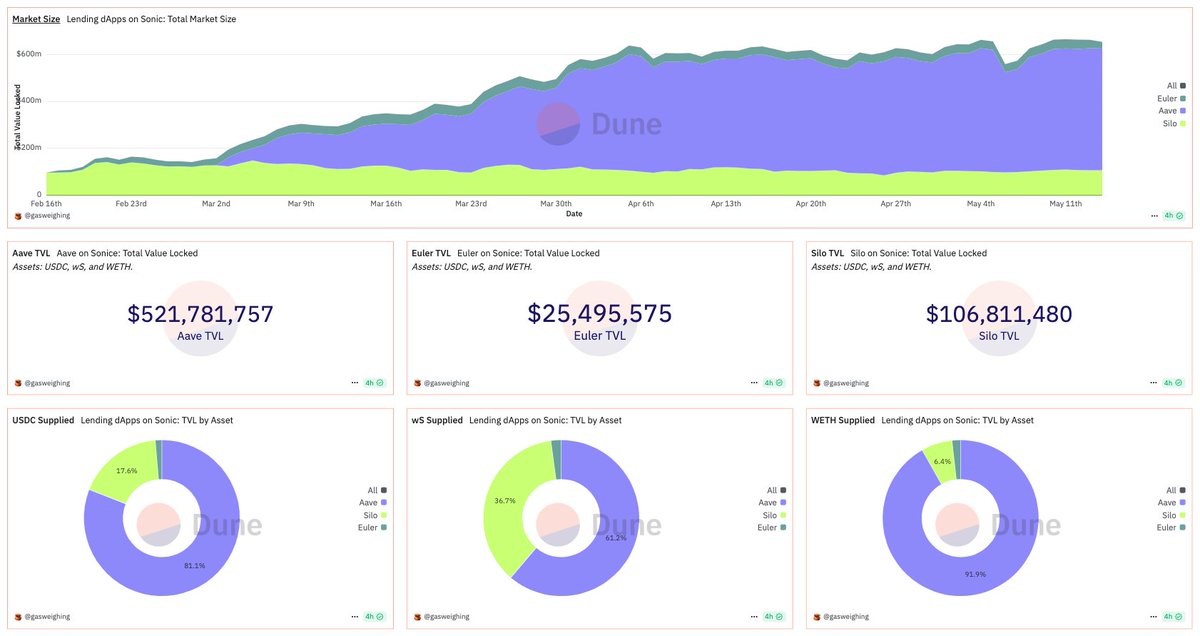
These charts shows how Sonic is becoming a serious DeFi layer.
With over $650M in cumulative TVL, Aave dominates at $521M, but what's striking is the traction across multiple protocols.
Silo already pushing past $100M, while Euler builds steadily. Lending dApps here are commanding real value, with $USDC and wSUI making up the majority of assets supplied.
Sonic’s DeFi stack is about sticky capital, diversified usage, and a foundation that's maturing fast beneath the surface.
3. 𝐔𝐬𝐞𝐫 𝐁𝐞𝐡𝐚𝐯𝐢𝐨𝐮𝐫
Despite the label of a "CALM market," Sonic’s on-chain behavior tells a different story.
User activity is steady and surprisingly robust!
DAUs consistently hover around the 50k–100k mark, and transaction volume remains resilient even without major volatility spikes.
What stands out is the diverse global footprint: US and European users dominate, but Asia is picking up pace.
This is sticky engagement, signaling a healthy and maturing base waiting for the next catalyst.
4. 𝐂𝐨𝐧𝐜𝐥𝐮𝐬𝐢𝐯𝐞 𝐍𝐨𝐭𝐞
Looks like the market’s about to start rewarding fundamentals again and Sonic has them in spades.
Robust TVL, engaged users, active protocols, and a native token quietly reclaiming ground. In two easy words? ACTUAL SUBSTANCE.
𝑨𝒓𝒆 𝒚𝒐𝒖 𝒕𝒓𝒂𝒄𝒌𝒊𝒏𝒈 𝒕𝒉𝒆 𝒏𝒐𝒊𝒔𝒆, 𝒐𝒓 𝒍𝒊𝒔𝒕𝒆𝒏𝒊𝒏𝒈 𝒕�� 𝒕𝒉𝒆 𝒔𝒊𝒈𝒏𝒂𝒍?
This is actually a smart way to structure a presale.
Unsold supply goes straight back into the 80M player pool instead of sitting in treasury.
Round 1: $0.015 — $100 gets you 6,666 $BTOWN + founder mark.
Presale:
https://t.co/m65et6COT6
One line in the tokenomics that most people skip.
Whatever doesn't sell in the presale doesn't go back to the team. Unsold public and corporate tokens land in Mining and Rewards, the pool players get paid from.
The whitepaper puts 80,000,000 BTOWN there, 26.67% of supply, and describes it as where unsold tokens go rather than a pre-cut allocation.
Rewards from it step down 20% every two years from TGE, so it stretches across a decade. The 75,680 NFT tournament pool stays flat through all of it.
All of it planned, none of it live yet.
https://t.co/c4q3HFE0pM
24/7 trading is where tokenized equities start to differentiate from traditional markets.
@OndoFinance is enabling continuous price discovery for names like Apple and Microsoft, removing one of the biggest limitations of legacy exchanges.
More Ondo Stocks just went 24/7.
Tokenized Apple, Microsoft, Meta, Corning, and Roundhill Memory ETF (DRAM) are now available for real 24/7 trading.
Trading overnight, weekends, and holidays.
Mobile-native NFT trading is the right direction.
The real unlock is making discovery, trading and community participation feel as effortless as any other consumer app. @opensea bringing Robinhood Chain into that flow is exactly how onchain activity reaches a much wider audience.
$3.6B in RWA open interest and $11B total OI makes one thing clear:
Hyperliquid is evolving far beyond crypto-native perpetuals.
Traditional markets are moving onchain, and liquidity is following them.
10/ Conclusive Thoughts
Crypto cards went from a niche workaround to a $18B annualized market riding the same rails as your existing debit card.
The trend won't slow.
🔗 If you want to see where the stablecoin-native version of this looks like: https://t.co/cwUCK33jyu
Crypto card spending went from $100M a month in 2023 to $1.5B+ by late 2025. 106% compounded growth annually.
We can't call it a niche product category anymore.
A thread on what's actually driving it, and where @KASTxyz fits 🧵👇
9/ Regulation is the Next Filter
MiCA's grandfathering deadline and the GENIUS Act enforcement window are both landing in the next 12 months.
Cards that comply with both frameworks access the two largest regulated markets. The ones that don't get boxed into smaller jurisdictions.
It will be the actual test for every product in this category, KAST included.
5/
Whether you’re actively testing or just following along, the Dojo is a clean look at how Cardano handles major upgrades.
Testing first, iteration second, deployment only when it’s ready.
If you’d like to explore, start here 🫳🏻 🔗 https://t.co/qWyonKql1A
@IOGroup
If you’ve been seeing people mention the Musashi Dojo or Leios testnet and aren’t quite sure what it all means, here’s a simple walkthrough.
No deep technical knowledge needed. 🧵
4/
Worth remembering: this isn’t a finished product, and it carries no real ada.
The point of a public testnet is to validate the design, gather feedback and improve the protocol before mainnet.
Every bug found and every test run helps move the upgrade forward.
US government pulled an AI model used by hundreds of millions of people.
Fable 5 and Mythos 5 suspended for all foreign nationals: Anthropic had to disable both for everyone to comply.
The stated reason: a jailbreak bypassing Fable’s safeguards.
Anthropic disputes it, saying the same technique works on models already deployed industry-wide.
Crypto read it as a decentralized AI moment.
$TAO +26%. $FET +16%.
The thesis: models on decentralized infrastructure can’t be government-recalled.
First time export controls have been applied to a commercial AI model at this scale.
If this precedent holds, who decides which model is too dangerous to run?