A Web3 venture studio Cascading Disruption. We build research-based products, foster frontier tech, and invest in projects that empower communities globally.
Cardano's Leios public testnet opened, Hydra reached 1.0, and on-disk storage gives stake pool operators a way to run a node with less RAM.
Part 1 looks at what changed for Cardano's builders and operators.
Read about our record run: https://t.co/VRmGDTlgNV
How's life in Midnight City?
We want to hear from the people spending time here. Tell us what brought you in, what keeps you coming back and what you'd like to see next.
Share your experience in our citizen survey:
https://t.co/xhw4UPUopU
ICYMI: Every week, IO shares a roundup of the latest progress across the technical development stack. Missed this week? Catch up here 👇
https://t.co/l7cwd47A5g
In this week's development report: consensus advances Leios, Hydra opens recovery tests, Lace prepares 2.5.2, High Assurance advances Blaster, and Research works on paper explainers.
See the full report for more details 👇
https://t.co/l7cwd487UO
Today, trusting an AI agent means trusting its operator’s logs. Zero-knowledge proofs replace that trust with a check anyone can run.
Our new post covers three layers of agent behavior these proofs can verify: policy compliance, execution integrity, and model inference – and which are practical now.
Learn more: https://t.co/BsrjWQSPGW
Hydra engineering is moving to @blcokpqr on Dec. 1, 2026.
The connection runs through the code: Hydra uses Cardano's ledger rules off-chain, and BlockPQR already works on that ledger.
Read about the move: https://t.co/XX8SCErqLC
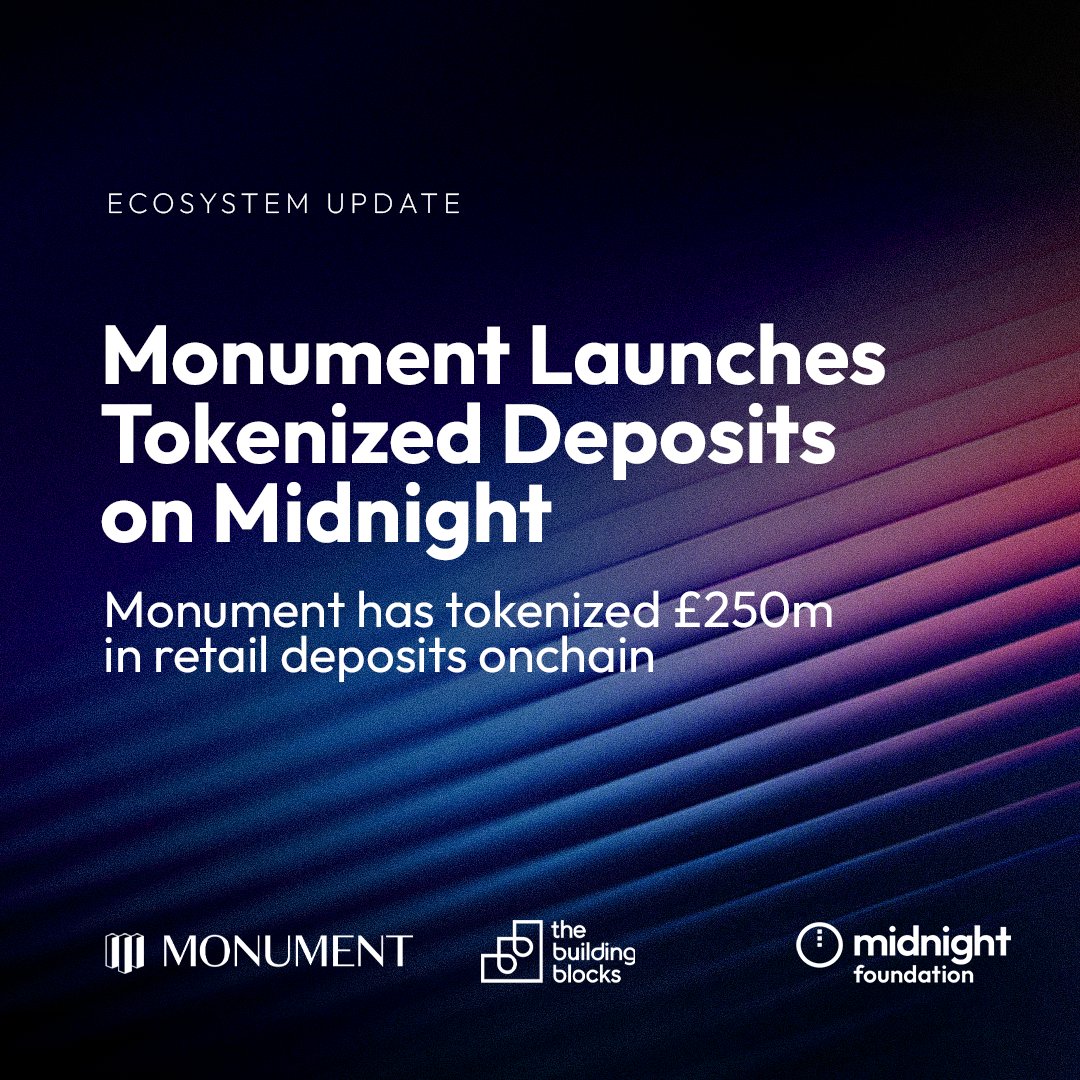
Monument's tokenised deposits are live on @MidnightNtwrk.
A bank deposit in pounds. A record on a public blockchain. Customer personal data kept offchain.
The first phase targets up to £250m in deposits. Fahmi explains what this means for institutional adoption.
Congratulations to @Monument_bank who has today gone live with the UK’s first tokenised retail savings deposits on a public blockchain, built on @Midnightntwrk.
When we announced our partnership earlier this year, we set out to show that a regulated bank could run customer deposits on public blockchain infrastructure. Monument is now doing so, giving customers interest-bearing tokenised deposits through the app they already bank with, under an initial programme of up to £250 million.
For Midnight, the significance of today’s launch goes beyond the deposits. With tokenised investment and lending products to follow, Monument will bring more regulated assets and activity onchain, and give other institutions a live deployment to point to when they decide to build on Midnight.
The launch, which we believe is one of the first of its kind globally, also answers the first question we hear from almost every institution, which is how to use a public chain without exposing client data. Programmable privacy allows Monument to meet the confidentiality and regulatory requirements of its business while still running on open infrastructure.
My congratulations to Mintoo Bhandari, Ian Rand and the wider Monument team for bringing this to market, and to @thebldgblocks for its role in establishing the partnership. We’re proud to be working alongside them as Monument develops its next generation of financial products on Midnight.
https://t.co/AK63yRfxtx
Privacy apps need to work on the devices people already use.
@midnightfdn, @GoogleCloud and @BCW_llc moved heavy proof generation into confidential cloud environments, reducing the workload on phones and laptops.
The engineering behind it 👇
How do you make zero-knowledge privacy work for real-world applications? 🤔
The @midnightfdn worked with @GoogleCloud and @BCW_llc to move complex zero-knowledge proving workloads into trusted execution environments using Confidential Space and Google Kubernetes Engine (GKE) Confidential Nodes.
Google Confidential Space attestation supports workload verification, while Google Cloud Attestation helped unblock critical security prerequisites for commercial wallet integrations, including Lace.
The team took the deployment from concept to live production in just two months. By open-sourcing its reference architecture and Terraform configurations, it also cut third-party developer onboarding time from hours to under one minute.
🤝 Read the Google Cloud case study to learn more: https://t.co/IgBTS1xhAX
Prove you're old enough. Keep your date of birth private.
That's one example of selective disclosure: apps verify the fact they need while you control what you reveal.
See how @MidnightNtwrk explains it:
ICYMI: Every week, IO shares a roundup of the latest progress across the technical development stack.
Missed this week? Catch up here 👇
https://t.co/dxJDhVJLei
What makes a Leios endorser block valid?
Today’s BlockPQR report covers the ledger rules that check and apply it, the formal specification behind that process, and new Dijkstra tooling for builders and SPOs.
https://t.co/NRVsf0WHEC
In this week's development report: ledger advances Leios validation, Hydra expands Head capacity, DevX releases cardano-init v0.4.0, and Research continues portfolio work and explainers.
See the full report for more details 👇
https://t.co/dxJDhVJLei
The Cardano ledger can now validate and apply Leios endorser blocks, and the Agda specification covers their full processing. cardano-api 11.12.0.0 and cardano-cli 11.7.0.0 add Dijkstra transaction guards and more protocol parameters, along with BLS key rotation for SPOs.
More in this week’s report: https://t.co/W5YkdEr5gg
Cardano's core engineering functions are taking the final steps into autonomy.
Meet the leads behind these legendary teams, and learn how they operate now, independently but with close collaboration, for Cardano's benefit.
https://t.co/uGMfPH4NRf