Insurers are spending $10.5B on core IT modernization. Yet McKinsey reports results are "mixed." Landmark failure cases include an 8-year modernization that led to a $500M+ write-off.
Why do these programs collapse mid-transformation? A thread 🧵 https://t.co/3x3Oh1sPth
The off-the-shelf vs. custom software decision usually comes down to one question nobody asks:
What happens when your business process outgrows the package?
Your software project isn't behind because the developers are slow.
It's behind because the scope wasn't grounded in what the business actually needed to ship.
Fix the scope first.
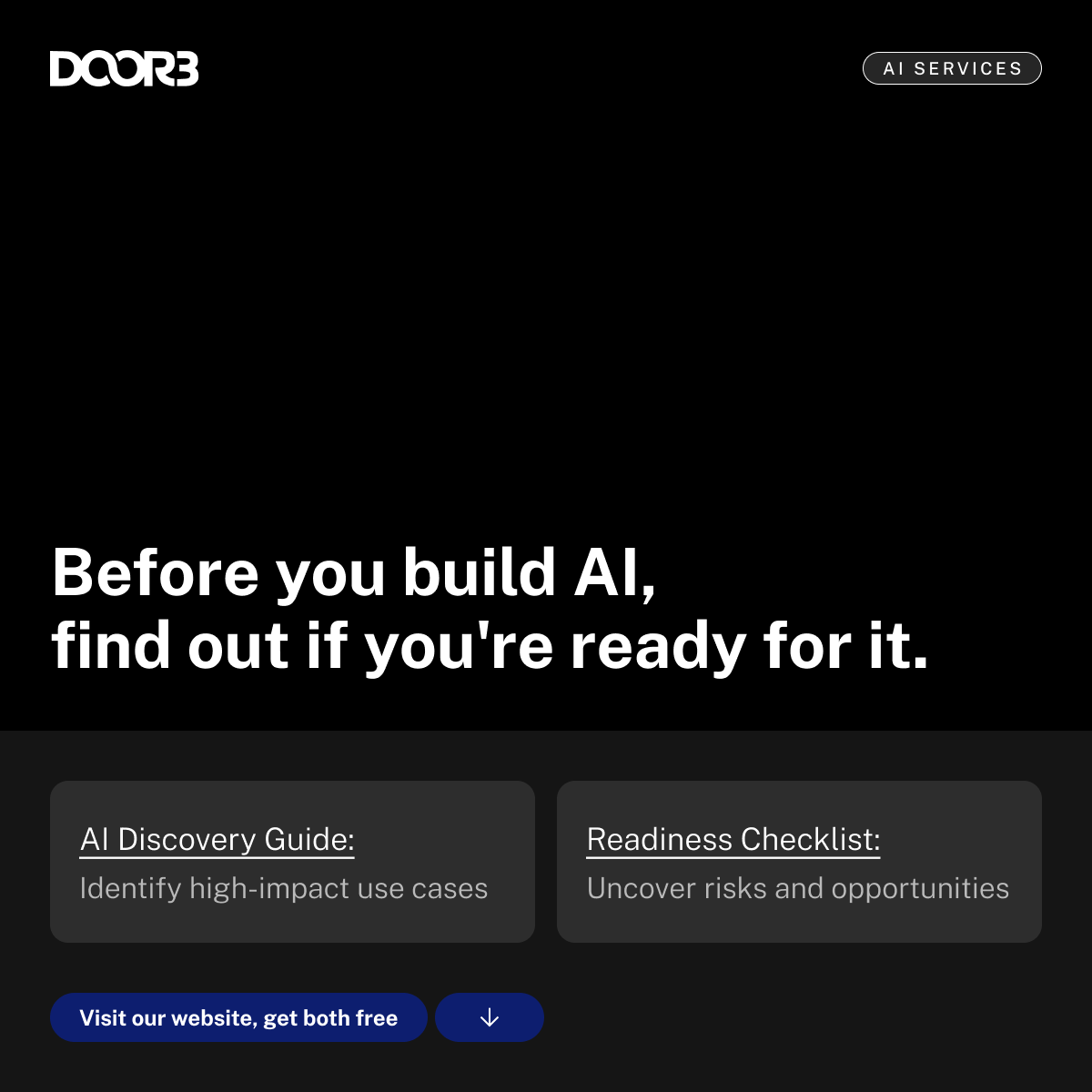
Before you build AI, find out if you're ready for it.
We put together two free resources to help:
→ AI Discovery Guide: evaluate readiness, identify high-impact use cases, and build a strategic roadmap
→ AI Readiness Checklist: assess your capabilities, spot opportunities, and uncover risks before you commit
Both free. Both practical. No fluff.
https://t.co/JUViROkeDl
#AI #AIReadiness #AIStrategy #EnterpriseAI #DOOR3
The insurance platform market is a $143B machine today, heading to $366B. Every carrier and MGA will make a core platform decision soon. Most will frame it as "upfront cost vs. flexibility."
That framing is broken. Here is why: 👇 https://t.co/LnRIVyvRZ4
The board asks: "Is our AI strategy on track?"
The CTO hears: "When will we be like our competitor?"
Neither question addresses the real risk: deploying AI into systems that weren't designed to support it.
The 2026 hiring theme: do more with fewer seats. The companies threading this needle aren't just adopting AI — they built the operating systems for it first.
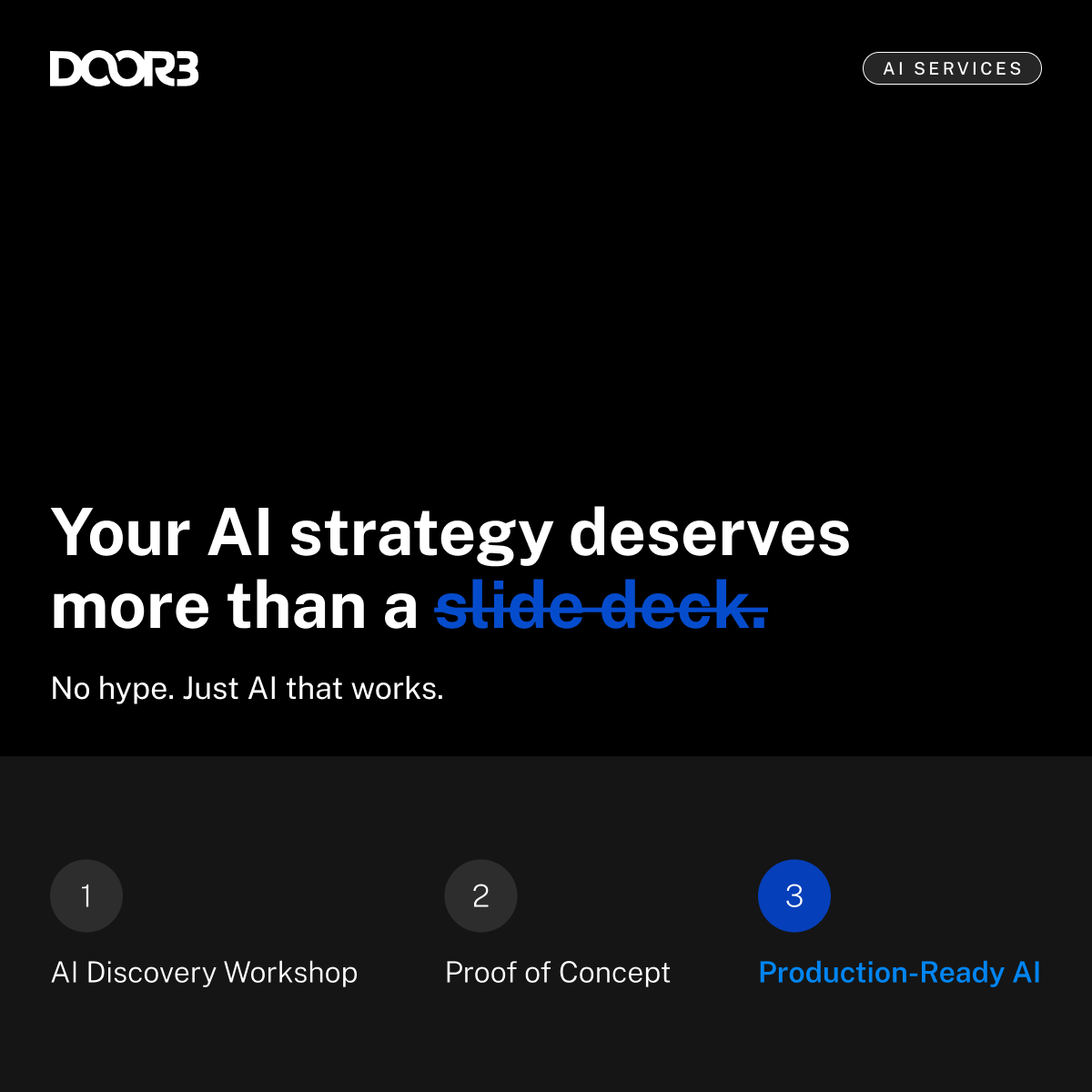
Your AI strategy deserves more than a slide deck.
DOOR3's three-phase approach takes you from idea to production with minimal risk:
→ AI Discovery Workshop: align on objectives, define readiness, build a practical roadmap
→ Proof of Concept: uncover what's blocking growth and fix it fast
→ Production-Ready AI: launch applications, build agents, modernize legacy systems
No hype. No vague timelines. Just AI that works in your reality.
https://t.co/iRpV2TpwkS
#AI #ArtificialIntelligence #EnterpriseAI #Innovation #DOOR3
Most enterprise AI projects don't fail because the technology broke.
They fail because the organization wasn't ready when it worked.
The technical problem is almost never the real problem.
Explore how we help enterprises turn AI vision into production reality with a structured, risk-managed approach that delivers measurable outcomes.
Discover:
- Why successful AI starts with clarity, not code
- Our proven 3-phase path from discovery to production
- How we partner with top brands like AIG, PepsiCo, and Munich RE
- Free resources to assess your AI readiness and roadmap
If you’re ready to move from ideas to impact, this page is your starting point for building an AI strategy that works.
Check it out now and start your AI journey with confidence! https://t.co/XYj8p73gmH
#AIstrategy #EnterpriseAI #DigitalTransformation #Innovation #DOOR3
Most enterprise AI projects don't fail because of the technology.
They fail because no one asked the hard questions first: Is the data clean? Are teams aligned? Does this use case actually move the business forward?
We built D3 Labs AI Services to answer those questions before they become expensive problems. From discovery workshops to production-ready systems, we meet you where you are.
Read: https://t.co/Do8oxDRzUM
#AI #EnterpriseAI #AIStrategy #DigitalTransformation #DOOR3
If your senior team spends 70% of their day on document data extraction, you don't have a tech problem—you have an execution problem.
Generative AI investment in insurance is past the hype cycle and deep into production. The carriers winning the market are simply choosing the right use cases.
THE GENAI PRODUCTION IMPACT:
UNDERWRITING: GenAI agents extract structured data from unstructured broker submissions in seconds, letting underwriters focus on risk judgment rather than data entry.
CLAIMS HANDLERS: Systems read FNOL reports and medical records simultaneously, boosting claims processing capacity by up to 40%.
ACTUARIES: Data preparation that used to consume weeks of manual scraping now completes in days, freeing teams to test more scenarios.
CLIENTS: Correspondence drafting for renewals and claims drops human review time from 30 minutes to under 10 minutes per letter, driving higher retention.
Stop running uncontrolled experiments. Build the data foundation first, sequence your workflows, and scale what actually drives margin. 🚀
Read the 7 use cases scaling insurance operations today: https://t.co/2Qnk32DqjK
#InsurTech #InsuranceAI #OperationalExcellence #DataStrategy #DigitalTransformation
Designing a Seamless Mobile Experience for Leon Market in Saudi Arabia
We partnered with Leon Market, a disruptor supermarket in Saudi Arabia, to create a modern mobile app that makes grocery shopping and quick delivery effortless for customers.
The Challenge
Leon Market wanted to stand out from traditional delivery services by offering a superior user experience.
The biggest hurdles were building an intuitive app that works perfectly in both English and Arabic, with flawless right-to-left layout support, while integrating smoothly with their SAP backend and respecting local cultural nuances.
What We Did
Before a single wireframe was drawn, our team invested heavily in cultural and user research — understanding the digital behaviors, linguistic nuances, and purchasing expectations of the Saudi consumer.
From there, we delivered end-to-end:
- Full technical discovery and functional strategy
- Brand alignment workshops to ensure the app reflected Leon Market's identity on and off the shelf
- A comprehensive design system named "El-Souk" (The Market), built for both LTR and RTL experiences
- Three tightly integrated applications, developed and QA-tested for a production-ready launch
- Post-launch digital hypercare to ensure zero disruption to on-ground operations
The Result
The platform was recognized in the prestigious 60th Anniversary GDUSA Graphic Design Annual Showcase — a testament to the quality and craft behind every design decision.
More importantly, Leon Market launched with a competitive, scalable platform that positioned them for national prominence in the Saudi supermarket industry.
Read the full case study:
https://t.co/Ve8lOUBnTI
Also featured on Clutch:
https://t.co/0C2RSO7XM0
What challenges have you faced when designing apps for bilingual or culturally diverse markets?
#UXDesign #MobileApp #Ecommerce #SaudiArabia #DigitalTransformation #UIUX #Door3 #QuickCommerce #EcommerceTech
Most companies have pilot AI. Almost none have enterprise AI.
The distinction matters more than most leadership teams realize, and it explains why so many AI investments produce impressive demos and disappointing returns.
Pilot AI is built to succeed under controlled conditions. The dataset was curated by a team that knew exactly what the model needed. The users were selected because they were enthusiastic adopters. The workflow it touched was isolated from the messy dependencies of the broader organization. The pilot worked, because it was designed to.
Enterprise AI has to survive contact with reality. It runs on production data with missing fields, inconsistent formatting, and edge cases that were never in the training set. It has to integrate with systems that predate the cloud. It needs to be adopted by the full user population, including the skeptics and the people who have been doing it manually for fifteen years. Its outputs need to be explainable to a compliance team, an auditor, or a regulator. Every decision it makes needs an audit trail.
The gap between pilot and enterprise is not a model problem. It is an infrastructure, governance, and change management problem. And the organizations that close this gap are not the ones with the best data science teams. They are the ones that designed for production from day one.
When we run an AI Pathfinder engagement at DOOR3, this is the question at the center of every assessment: Is this organization building pilot AI or enterprise AI? The answer shapes every recommendation, every sequencing decision, and every infrastructure investment that follows.
Which stage is your AI program at right now?
#EnterpriseAI #EnterpriseAISolutions #AIStrategy #AIAdoption #DigitalTransformation #AICconsulting #AIReadiness #TechLeadership #ArtificialIntelligence #SoftwareDevelopment
A healthcare organization. A critical intranet. And a departing employee who left behind a "tangled web" of undocumented spaghetti code.
That was the situation when PRISM Vision Group — a rapidly growing healthcare company acquiring optometry practices across multiple locations — called DOOR3.
Their existing intranet was deeply integrated with external systems but nearly impossible to maintain. Staff couldn't access it without a VPN. And with an aggressive acquisition strategy in motion, adding new practices to an unstable platform wasn't just difficult — it was a hard stop.
We didn't just fix it. We rescued it, then rebuilt it.
Phase 1 — Emergency stabilization: We immediately secured business continuity, keeping operations running while we architected the long-term solution.
Phase 2 — Cloud migration to Azure: We moved the entire infrastructure to Microsoft SharePoint Online hosted on Azure, eliminating VPN dependency and making the platform accessible to every employee, at every location, instantly.
Phase 3 — M365 integration and modern UX: We rebuilt the resource center and internal tooling with clean information architecture, responsive design, and seamless M365 connectivity.
The results:
- Employees gained instant, frictionless access to critical tools and data — no VPN, no workarounds
- The platform earned a design award for balancing aesthetic quality with real functional utility
- PRISM now has a secure, enterprise-grade Azure infrastructure that scales with every new acquisition
And in the client's own words: "DOOR3 was spectacular in managing the project. They delivered on time and on budget." — Sr. Program Director, PRISM Vision Group
When the stakes are high and the clock is running, this is what thoughtful technology intervention looks like.
Full case study: https://t.co/LLTgGucAuB
Verified on Clutch: https://t.co/42N5XT79sR
#ProjectRescue #HealthcareTech #CloudMigration #SharePoint #UXDesign #DigitalTransformation #DOOR3
Is your insurance AI initiative truly ready?
Despite near-universal AI adoption claims, most carriers struggle with a critical gap: their data foundation. Without a governed, unified, and AI-ready data layer, even the best models fail to deliver enterprise value.
In our latest article, we uncover the five biggest mistakes insurers make before training their first AI model—from starting with models instead of data to overlooking regulatory data requirements.
Building a robust data foundation isn’t just infrastructure work—it’s the core AI project that powers sustainable transformation.
Ready to accelerate your AI journey with confidence? Discover how to build the foundation that drives results: https://t.co/S0yyDCmgAu
#AIReadiness #InsuranceTechnology #DataStrategy #AIinInsurance #Insurtech #DigitalTransformation #DataGovernance #Leadership
88% of enterprise digital transformations fail to meet their stated objectives.
That number comes up constantly in client conversations. What comes up less often is why — and more specifically, why the same three failure modes show up across industries, company sizes, and geographies.
1. No outcome was defined clearly enough to be measured.
Most transformation programs are launched with language like "modernize our operations" or "become more data-driven." These are directions, not destinations. When there is no specific, measurable outcome attached to the initiative, scope drifts. Every quarter adds new requirements. The original business case becomes unrecognizable, and eighteen months in, no one can agree on whether the project is succeeding.
2. The data foundation was treated as a follow-on task.
Enterprise AI, automation, and analytics all depend on accessible, well-structured data. Organizations that treat data infrastructure as something to be "cleaned up later" consistently find that later never comes. The transformation stalls at integration because the systems the new platform needs to connect to were never prepared for it.
3. The partner was chosen for technology, not domain fit.
A consulting firm that has never worked in your industry will spend the first three months learning what your internal team already knows. Domain knowledge is not a nice-to-have in digital transformation. It determines how quickly a partner can identify the real constraint, as opposed to the stated one.
The organizations that make it to the other side of transformation share one trait: they treated the planning phase with the same rigor as the execution phase.
What would you add as a fourth failure mode?
#DigitalTransformation #DigitalTransformationConsulting #EnterpriseAI #TechLeadership #CTO #CDO #SoftwareDevelopment #BusinessStrategy #ChangeManagement
Revolutionizing the insurance industry with Claims Automation with AI! 🚀
Did you know AI can shorten claims settlement time from weeks to hours? Carriers are cutting processing time by 75%, improving accuracy, detecting fraud faster, and boosting customer satisfaction -- all while saving money.
If your insurance company is not automating claims yet, you risk falling behind in a fast-paced market. See how AI-powered automation is changing claims workflows and delivering real production results.
Read the full story and learn the strategic steps every insurer needs to take: https://t.co/9oBTG0XZrr
#ClaimsAutomation #AIinInsurance #InsuranceTech #FraudDetection #StraightThroughProcessing #Insurtech #DigitalClaims #CustomerExperience #Automation #InsuranceInnovation
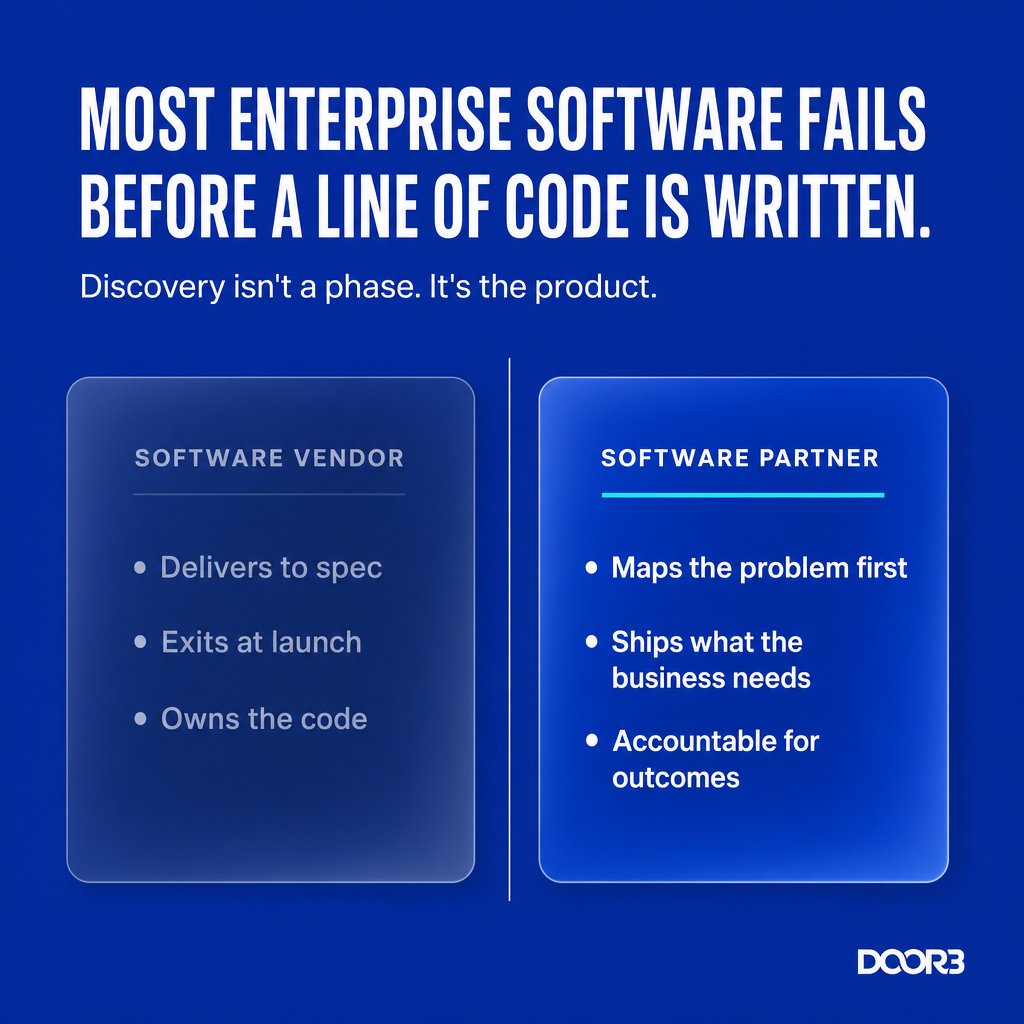
Most enterprise software fails before a single line of code is written.
The requirements document looked comprehensive. The vendor's proposal was detailed. The timeline seemed reasonable. And then six months after launch, the platform is technically live and functionally abandoned, because the team that built it and the team that runs the business were never truly aligned on what the software was supposed to do.
Custom software development is a translation problem more than a technical one. The hardest work is not building the feature. It is agreeing on precisely what the feature needs to accomplish, for which users, in what sequence, and how you will know when it is working.
In 22+ years of building platforms for organizations like AIG, PepsiCo, Munich Re, and J&J, the pattern in every failed engagement is the same: discovery was treated as a formality rather than the most important phase of the project.
Discovery is where you learn that the "simple interface" the stakeholder described actually handles 11 edge cases no one documented. That the daily users are different from the people who signed off on requirements. That the data model has inconsistencies that will surface the moment real users touch the system.
Teams that invest properly in discovery ship software that gets used. Teams that skip it ship software that gets worked around.
If you are evaluating a custom software build, the most important question to ask any vendor in the first meeting is not about their tech stack. Ask how long their discovery phase takes and what it produces.
That answer will tell you everything about whether the engagement will succeed.
#CustomSoftwareDevelopment #SoftwareDevelopment #SoftwareDevelopmentAgency #EnterpriseAI #DigitalTransformation #TechLeadership #ProductManagement #CTO #SoftwareEngineering