Not every tokenized asset should be expected to behave the same way onchain.
Credit is built around holding an asset against a stream of future cash flows. Its onchain value will therefore show up differently, not necessarily through constant turnover, but through how effectively that position can be used within financial markets.
On September 17, the SEC granted temporary, conditional relief to facilitate limited onchain trading of tokenized U.S. stocks. As regulatory pathways clear and issuance of real-world assets onchain accelerates, the most interesting question, besides how much is onchain and how much is used, is whether these markets behave like the ones they reference or differently enough to produce new signals and opportunities.
That's what this report set out to measure, across cash equivalents, credit, commodities and equities.
After Issuance: Reading the Onchain RWA Market → https://t.co/1nmoGwsvea
A fund can be onchain while its information remains offchain.
Tokenized ownership, 24/7 transferability, and smart-contract settlement do not automatically make the underlying risk more observable.
If portfolio data still arrives monthly, the investor is holding a digital asset with an analogue information cycle.
For onchain credit, the real upgrade is not just tokenizing the fund. It is shortening the distance between what happens in the underlying asset and what the investor can actually see.
Most credit data will continue to originate offchain.
The interesting question is whether lenders can verify its source and integrity before it reaches the credit engine.
This becomes particularly relevant for receivables and working-capital finance, where underwriting depends on transaction and settlement data generated continuously by the underlying business.
Trust in official statistics underpins evidence-based policy. But how can a user know a data set they downloaded is the one the publisher released? Our new paper proposes an answer. https://t.co/ezD1w5qxJb
#SDMX#OfficialStatistics
One under-discussed effect of blockchain in private markets is that it can change the minimum economical size of a financial asset.
Traditional private credit carries a lot of fixed overhead: documentation, reporting, reconciliation, servicing and administration. Below a certain ticket size, the economics simply stop working.
Automation changes that threshold.
When more of the lifecycle can be standardized and executed programmatically, smaller and more granular assets become economically viable to finance at scale.
That may be one of RWA’s more important effects: not just making existing markets more efficient, but making previously uneconomic markets financeable.
@volo_sui’s latest deep dive unpacks the full architecture behind our joint USDC vault on Sui.
From e-commerce financing and underwriting to monitoring, collections and repayment, it walks through how the underlying credit process is translated into an onchain product.
A detailed look at what actually sits behind the vault.
Dow Protocol Institutional Vault is coming soon.
Built for institutional capital seeking exposure to short-duration, self-liquidating e-commerce credit.
The Vault is backed by an overcollateralized receivables pool with ≥120% coverage, alongside structured repayment controls and short underlying asset duration.
Institutional access to real-world working capital, built around repayment.
The next phase of RWA is not about moving the real economy onchain.
It is about rebuilding the financial infrastructure around it.
The SEC’s new tokenized-stock framework is a useful signal. The company stays the same. Shareholder rights stay the same. Securities law still applies. What changes is the market infrastructure around the asset: public ledgers, auditable smart contracts and programmable execution.
That is a more realistic model for how onchain finance scales.
Businesses do not need to become crypto-native for their financing to become programmable.
The real opportunity is to upgrade the financial layer without asking the underlying economy to rebuild itself.
Blockchain spent years building parallel financial rails.
Now the more consequential shift is happening in the opposite direction: regulated finance is absorbing the rails.
That is when tokenization starts becoming infrastructure rather than a market category.
💡 Did you know?
Swift's blockchain-based ledger has been built with our community and is ready for use, with 17 early adopter institutions helping bring tokenised value into the regulated financial system.
Find out how the industry is preparing for always-on, cross-border value transfer: https://t.co/9ZLF2UIGT0
#CrossBorderPayments #SwiftBlockchainLedger
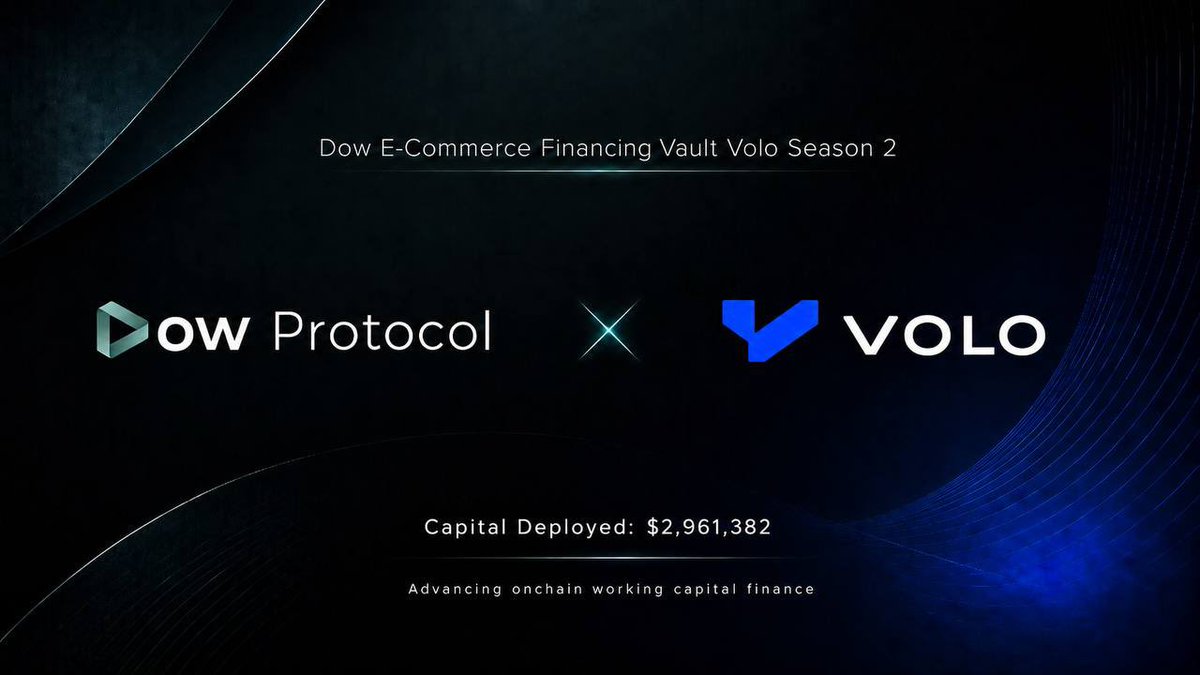
Dow Protocol’s E-Commerce Financing Vault on @volo_sui has completed Season 2 deployment.
A total of $2,961,382 has been deployed to finance short-duration merchant receivables on the world’s largest e-commerce platform.
Dowsure has an exclusive partnership with the world's largest e-commerce platform, under which merchant sales proceeds are repaid directly by the platform, without passing through the merchant. This materially reduces collection and diversion risk, contributing to an industry-low average default rate of 0.05%.
Each financing position is also backed by 120% receivables coverage, creating a substantial protection buffer against settlement delays, adjustments, or other uncertainties.
Risk management is powered by platform-native merchant data accessed directly from the underlying e-commerce ecosystem, enabling underwriting based on real operating and transaction data rather than self-reported information. The underlying credit-risk infrastructure is also used in financing workflows by multiple top-20 global banks.
The Dowsure Stable Vault remains open for deposits until SEP 9.
Grab the opportunity for a 15% target APR for your USDC, powered by real-world yields.
Deposit now: https://t.co/VYeB12Vl3I
Goldman Sachs, Bank of America, Citi, Deutsche Bank and 17 other financial institutions are now preparing a joint dollar stablecoin.
The important shift is not another stablecoin entering the market. It is that programmable money is moving closer to the banking system that originates and finances real-world economic activity.
For Dow Protocol, that convergence matters. We are building the credit side of the same infrastructure: bringing commerce receivables, funding, ownership and repayment onto programmable rails.
24/7 markets will become inevitable as banks begin overhauling the accounting and ledger infrastructure beneath the financial system.
And once that foundation changes, the rest of the asset lifecycle will have to follow.
Trading, underwriting, servicing and settlement cannot remain on different clocks forever.
Exclusive: Securitize will become NYSE’s first digital transfer agent, allowing it to create shares for stocks and exchange-traded funds as digital tokens on a blockchain https://t.co/57vh0UKVyw
Figure and its partners have already originated over $30 Billion of loans through a blockchain-native capital-markets stack. BIS argues why this matters since tokenization can collapse messaging, reconciliation and settlement into one operation, replacing multiple ledgers and hand-offs with a single programmable asset record.
Dow Protocol applies that architecture to commerce credit with ownership, repayment waterfalls and risk triggers are defined at origination, not reconciled after the fact. The important point is not that blockchain eliminates credit risk, but that live underwriting plus pre-programmed cash-flow control leaves fewer places for risk to hide.
One thing we’ve appreciated about @ArcaneGrp is that they really understand DeFi and RWAFi from the user side.
We can obsess over building the right underlying asset and the right product, but ultimately adoption comes down to understanding what users actually want and why they would choose to participate.
Arcane has that instinct. We’re lucky to have them with us.
The deeper we dive into @DowProtocol, the clearer it is how well e-commerce working capital aligns with onchain finance. We’ve long held that early blockchain adoption will emerge from fast-turning markets held back by clunky traditional finance. Honored to join this journey.
Traditional lending uses collateral largely because cash flow is difficult to observe. Digital commerce changes that equation. Daily GMV, refund ratios, chargebacks, payout cadence, inventory turns and platform concentration can reveal deterioration long before a quarterly balance sheet does. For the right merchant, the operating account is becoming a better credit signal than the asset register.
Dow Protocol's underlying asset servicer underwrites the cash conversion engine itself based on how reliably a dollar of inventory becomes a sale, a settled receivable and ultimately repayment. When those flows can be observed continuously and repayment can be connected to them directly, credit capacity no longer has to be anchored primarily to static collateral. The borrowing base can move with the business.
Grateful to have @moonhillcap backing the next generation of working capital finance.
Their conviction strengthens our mission to reshape how working capital is originated, financed, and settled globally.
@Jeyhonn@mhventures@Maple_block@ArcaneGrp@moonhillcap@HSKChain Dear user, this is a false-positive report from Blockaid/MetaMask caused by malicious reporting.
Dow’s website and contracts are safe and audited by @bailsecurity, with report in our docs. https://t.co/1KEP4RuyER. We’re in contact with MetaMask to resolve this. Thank you.
Publishing our audit report for our partners @DowProtocol.
BailSec was tasked with an audit of the Core.
Link to the report on Github👇:
https://t.co/rTyP33G6LZ
We are thrilled to announce Dow Protocol’s $10.5 Million Seed Round, backed by @mhventures, @Maple_block, @ArcaneGrp, @moonhillcap, @HSKChain, Essentia Partners, and Quartet Group.
Dow Protocol builds the novel PayFi RWA structure for e-commerce working capital to reach merchants within fractions of a second.
E-commerce merchants typically wait 14–28 days for platforms to pay out their sales. Dow Protocol’s asset servicers close that gap by funding merchants early against their pending platform receivables and credit risk data.
The repayment and risk systems are integrated natively into the world’s largest e-commerce platforms. Funds are deducted automatically from merchants’ platform balances, ensuring world-leading repayment discipline.
With instant cross-border settlement and risk analysis built on platform-integrated data, funds reach merchants as fast as same day. Traditional financing takes 2-3 months.
Time is money in this $2.8 trillion working capital market, and merchants are willing to pay premium interest for fast and flexible funding.
The future of finance originates on-chain. Working capital will be among the first sectors to move, because programmable on-chain loan terms cut through the default handling and accounting complexity that burdens traditional lending.
Dear user, this is a false-positive report from Blockaid/MetaMask due to false reports from malicious bots/users. Our audit was completed by @Bailsecurity and can be found at https://t.co/wm6YqqTLem. There are no security risks or threats. We have contacted MetaMask regarding this false-positive report. Thank you.
In merchant credit, the scarce asset is not capital. It is information velocity and cash-flow control. A merchant doing $10M of annual GMV on a 14-day payout cycle can have roughly $380K of gross sales economically earned but not yet settled at any given time. The real underwriting work is separating that headline GMV into what is actually financeable: refunds, chargebacks, platform reserves, fees, inventory turns and cohort-level repayment behavior.
Dow Protocol's underlying asset servicer is designed around that borrowing base moving in real time. Risk data continuously informs credit capacity, repayment is tied to the merchant’s actual cash-flow path, and on-chain settlement removes another layer of timing friction once capital is approved. Blockchain makes working capital credit behave more like a live market than a monthly spreadsheet.