Today, the Chief Minister's Office in Jaipur hosted a high-level 'Electronics and Semiconductor Sector Dialogue.' Ultimately, Rajasthan is working to align itself with industry leaders in Electronics, System Design, and Manufacturing (ESDM).
Why only UP ? What about other states
Country should stop the practices of medical reports being issued when there are no medical professionals practicicing in a clinical setting, without checking, supervising, verifying the processes
This rampant practice of remote signing of medical reports by doctors should stop
Lab Medicine needs strong controls
Midterms show that the incompetent hegemonism of Trump, was unique to him. The underlying strategic calculus of post-Trump USA will change by less than 10%-15% from trend.
For next 2 yrs, India has to, (1) continue to pursue FTAs/CEP, technology & defense partnerships with HICs, (2) manage relations with DJT, perhaps resurrecting the archived Feb 2025 DJT-NM MOU.
Efficient Atman Nirbharta, needs more economic policy reform!
I’ve known @jamescrabtree for many years & have always been an avid follower of his writing.
But this latest piece of his really caught my attention.
It’s a fascinating & at times startling account of the contradictions within China’s economy.
James describes being “blown away by the power of its tech ecosystem” during a visit to Shenzhen.
But he also describes an economy in which:
“Investment is falling, demand is weak, property is in free fall, and private business has stopped spending.”
And his description of the extraordinary intensity of competition in China’s EV industry is quite an eye-opener:
“The EV market is a well-known bloodbath: well over a hundred brands are locked in relentless price wars, margins are razor-thin, and almost nobody besides a handful of sector leaders is making money.”
Of course, that very intensity of competition has helped create some formidable global players.
But the larger picture James paints is of an increasingly K-shaped economy, where remarkable technological progress coexists with deep economic stresses.
There’s a German word, Schadenfreude, which means taking pleasure in someone else’s misfortune.
That’s certainly not the sentiment with which I read this piece. Nor would I take any pleasure in a potential downturn in the Chinese economy.
But it did make me reflect on how we sometimes seem to view the achievements of other nations through a magnifying glass, & our own through a microscope trained on every flaw.
There’s much to admire & learn from China. And much that we in India still need to improve.
However, there’s enormous value in looking at every economy, including our own, with the same critical eye.
Neither excessive admiration nor excessive criticism should get in the way of deeper understanding…
Trump’s midterm setback is more than an electoral reversal. It is a referendum on his style of governance, economic choices and increasingly unilateral approach to domestic and international affairs. With Democrats taking control of both chambers of Congress, the balance of power in Washington has shifted decisively.
Trump will remain President, but the next two years will be considerably more difficult. His legislative agenda will encounter resistance, his administration will face intense congressional scrutiny and his appointments and budgetary priorities will become contested. He will retain significant executive powers, particularly over foreign policy, trade and immigration, but exercising them will invite greater political and institutional pushback.
For India, however, this is not necessarily a moment of unqualified relief. American economic nationalism and protectionism are structural trends, not merely Trump’s personal preferences. Trade disputes, tariff barriers, pressure over Russian oil and demands for greater market access will survive the midterms. A change in congressional control does not automatically translate into a change in America’s economic priorities.
The geopolitical equation is equally complex. Washington’s competition with China will continue to make India strategically important, but bipartisan American support for a stronger India does not mean unconditional acceptance of India’s strategic autonomy. New Delhi will have to negotiate this relationship on its own terms.
There is also the possibility of a more adversarial Congress on issues concerning India’s domestic politics. Democratic lawmakers and influential advocacy groups could use their new institutional leverage to revive scrutiny of India on human rights, religious freedom and Kashmir, and seek to target organisations such as the RSS. Such efforts may not necessarily translate into legislation, but they can shape the political and diplomatic atmosphere.
Trump, for his part, could emerge more unpredictable. A President facing domestic political resistance may become more transactional abroad, looking for foreign policy victories to compensate for setbacks at home. His diminished political authority should not be confused with diminished executive power.
India must therefore resist the temptation to view American politics through the binary of a Republican or Democratic victory. Neither party has a monopoly on friendship towards India, and neither can be taken for granted. The relationship must be anchored in enduring national interests rather than personalities or party equations.
Trump’s midterm defeat may have altered the political arithmetic in Washington. It has not necessarily altered the strategic calculus towards India.
For New Delhi, the task remains the same: engage both sides, protect national interests and preserve strategic autonomy. A weaker Trump does not automatically mean a friendlier America.
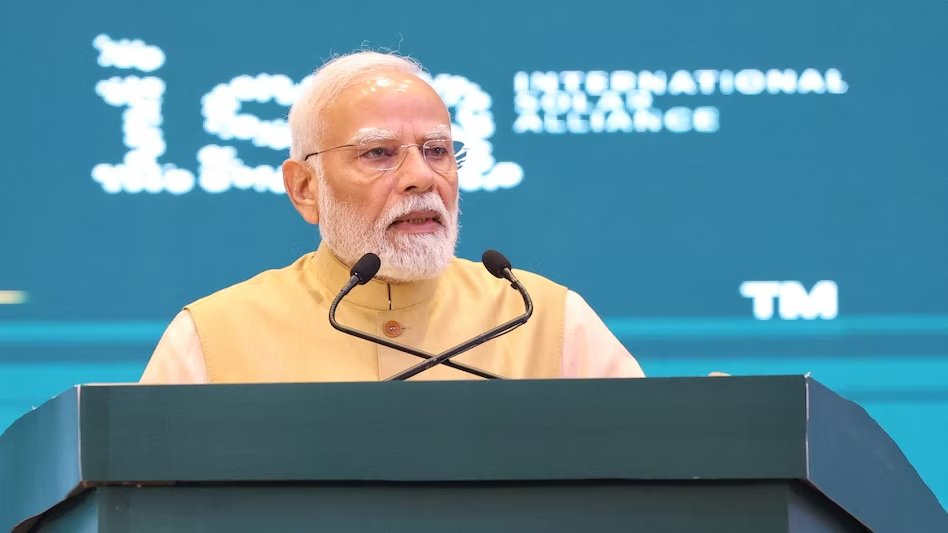
वैश्विक संकट के बीच भारत का बड़ा ऊर्जा प्लान, PM मोदी बोले- खुलेंगे 20 लाख करोड़ रुपये के मौके
प्रधानमंत्री नरेंद्र मोदी ने बताया कि भारत अगले 10 से 11 सालों में 500 गीगावाट अतिरिक्त नवीकरणीय ऊर्जा क्षमता जोड़ने के लिए पूरी तरह तैयार है. उन्होंने बताया कि भारत ने पेरिस समझौते का लक्ष्य 5 साल पहले हासिल कर लिया है. इसके साथ ही अब भारत में 2030 तक 20 लाख करोड़ रुपये से ज्यादा निवेश के अवसर सामने आएंगे.
पूरी खबर : https://t.co/iebYOPizZG
#NarendraModi #PMModi #IndiaEnergyPlan #RenewableEnergy #GreenEnergy
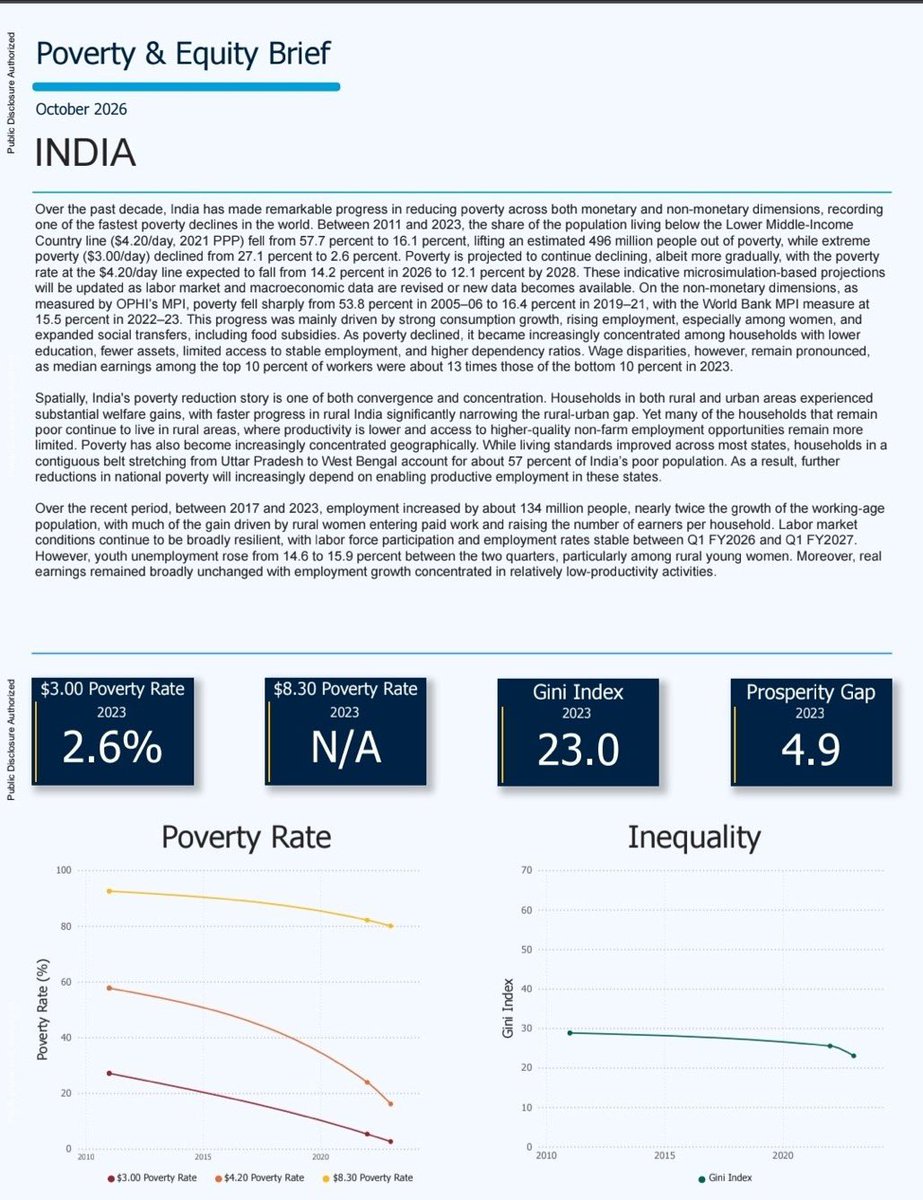
The World Bank October 2026 report on Poverty and Equity Brief is heartening news for India.
✔️496 million people lifted out of poverty
✔️Extreme poverty ie $3 a day down from 27.1% to 2.6%
✔️Poverty ie $4.2 a day down from 57.7% to 16.1%
✔️Multidimensional Poverty down from 53.8% to 15.5%
✔️Inequality shows reduction too.
Ashoke Sen has been awarded the prestigious Oskar Klein Medal for 2026, becoming the first Indian physicist to receive the honour.
Previous recipients include Nobel laureates Chen-Ning Yang, Steven Weinberg and Hans Bethe, who received the medal in its first three years.