At 9:00am on Black Friday your customer gets your email.
At 9:00am they also get your text.
Same offer, code and page.
To you, that looks like coverage.
But to the receiving side it's one brand saying the same thing twice, and people resolve it by cutting a channel.
Usually SMS is the one to get cut since it interrupts and it (sometimes) costs them money to receive. That's also the list that costs you the most to rebuild.
Nobody intended for this to happen.
Email and SMS get planned on two calendars by two people who never check each other's work.
That’s why you need to give each channel a job instead.
Email announces → Code, products, terms, the thing people search for later.
SMS handles timing → The early-access code dies when the public sale opens and a text two hours out is how they find that out while they can still use it.
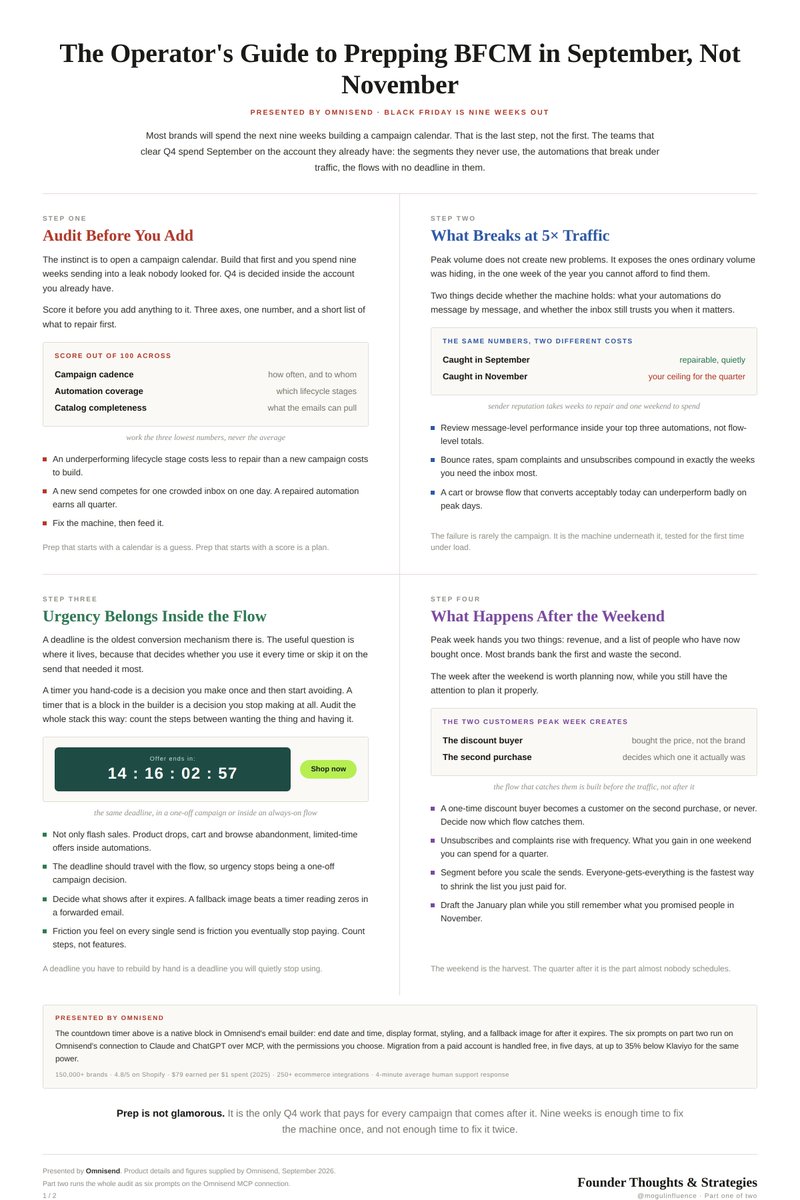
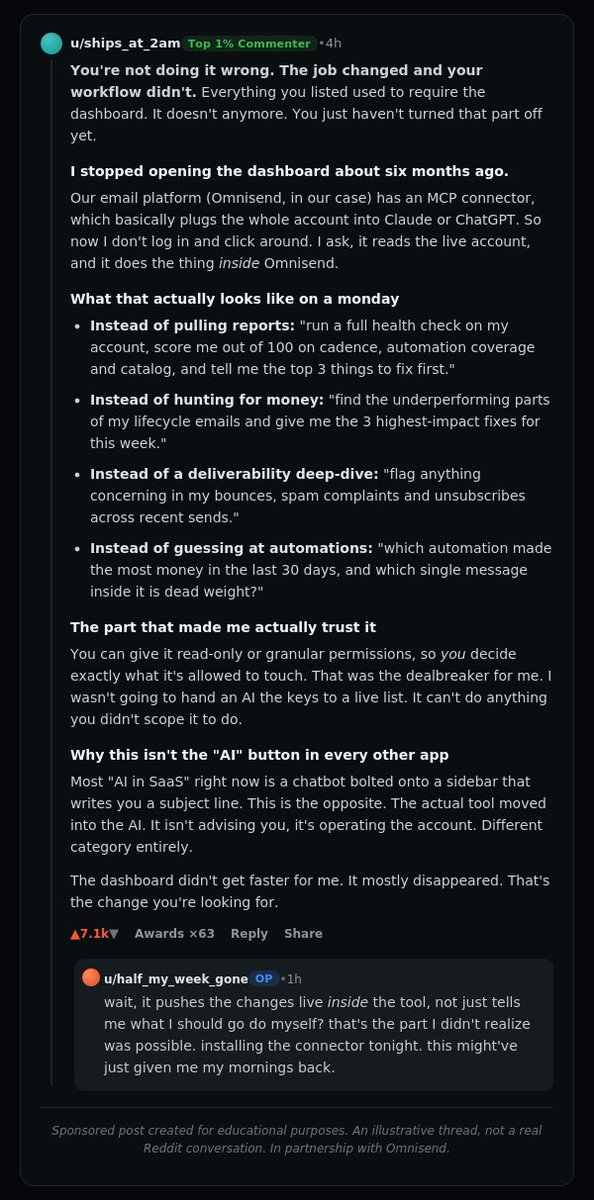
Our proud partner @omnisend now runs inside Claude and ChatGPT, live in the Connector Directory since July 30, so building it is one instruction:
"On 'BFCM Early Access Welcome,' add a two-hour delay and then an SMS after the current email. Send SMS only to SMS-subscribed contacts. SMS copy should remind them their early-access code expires once the public sale opens, and include the discount code."
Send the same message twice and you've given people two places to unsubscribe.
Check the next tweet for more info.
Been planning out the new Mogul office and i'm genuinely so excited for what we're building here
- full production studio for 24 tweets, 1 YouTube video, 14 IG videos + 20 ads every week
- strategist war room for the team building every client account
- dedicated offices
- workspace for writers, designers + our creative director
- quiet room with a nice chair, lamp + space to fully lock in
- chill room with ping pong, Nintendo Switch + bean bags
- full kitchen + communal space
I want every room to have a purpose tied back to how the team actually works.
Content gets created in one place. strategy gets built in another. ideas get reviewed in another.
People get space to collaborate, think, reset, and lock in.
SUPER excited to see this place come together.
Easiest money an ecom brand can make:
- someone is already interested in buying
- adds the product to cart
- abandons before checkout
- ignores the recovery email
- @getavaai calls them
- and gets them back for another chance to close the sale
I've sat through a ton of AI voice demos and usually walk away pretty unimpressed.
But this literally pulls from live Shopify order data while it's on the call and handles the customer like an actual rep.
Brands are amazing at optimizing acquisition, conversion, email, checkout, all of it.
Then someone picks up the phone and the experience is somehow still years behind.
Interesting problem to finally see someone go after properly.
Today I sat down for a conversation that covered almost every idea I've spent the last five years thinking about
We talked about:
- growing up in Pakistan, immigrating to Canada, and how watching my parents rebuild their lives shaped how I think about risk
- the difference between pursuing a passion and building a life that gives you the freedom to pursue it
- why money is a tool for creating opportunities
- leadership, operating a business, and helping people reach their potential
- jung, the shadow, limiting beliefs, and how our past can influence the stories we tell ourselves
If you enjoy conversations about psychology, entrepreneurship, meaning and becoming a better thinker, I think you'll enjoy this one:
https://t.co/jw7p6EHgyw
I have a friend who runs a $2M business.
Smart guy. Great margins. Low stress….
And he takes more cash home in a month than some founders I know running five times his revenue.
Sounds ridiculous… until you look at what the growth actually did to those $10M companies.
Their revenue got bloated, but all the cash was disappearing.
Here is what my $2M friend did that they didn't:
>He got smaller before he got bigger. He cut the bloat and killed the distractions before he tried to scale anything.
>He refused to confuse revenue with what reaches his bank account. Revenue doesn't matter if the cash keeps disappearing.
>He hired DOERS instead of helpers. (You can’t be productive if you’re spending all your time telling other people how to do their jobs.)
>He understood the part most founders never accept: the more valuable you are to your business, the less valuable your business is.
That's the whole game.
Most founders are optimizing the number on the top line…
He’s optimizing the number that hit his account, and that’s why he’s winning (and his business is still growing).