Memory Liquidation
The AI memory market is not the telecom boom, and it is not the housing bubble.
What we are seeing now is a leverage event: too much leverage, too much crowding, and too much exposure piled into the same trade, all of which now need to be unwound. That matters because a real supply crunch in memory has been amplified by positioning, acute shortages and sharply higher prices tied to AI infrastructure demand are real.
Yes the easy money in the AI trade has been made!
Let’s be explicit about what that means. Parabolic charts are not proof of durable fundamentals; they are often evidence of momentum, leverage, and borrowed conviction feeding on themselves. When a trade gets this crowded, price stops reflecting only supply and demand and starts reflecting how much fast money is trapped in the move.
The underlying AI demand story is still real, and the fundamental supply-demand imbalance still exists. AI demand has forced companies to fight for dwindling memory supplies, while chipmakers prioritized higher-margin data-center chips and memory prices spiked sharply over the past year.
But that does not mean every price swing is fundamental. Narrative follows price: when memory names surge, investors discover scarcity; when they break, they suddenly discover China risk or efficiency gains.
That is why the analogies to the 1990s telecom boom and the housing bubble are only partly useful. In those episodes, supply ran ahead of demand, too much fiber, too many houses. Here, demand has outrun supply, but the stock market layered excessive leverage on top of a real bottleneck.
As Graham observed, the market is a voting machine in the short term and a weighing machine in the long run. Right now, the vote is being driven by crowding, leverage, and forced selling.
Over time, the market will weigh the underlying AI demand and the still-tight supply picture on their merits. What is being liquidated is not the existence of demand. It is the leverage wrapped around the story.
Yes Parabolic charts that amplify crowded leverage one way bets should be avoided.
Food for thought.
AI’s “circular financing” fears miss the deeper risk
The world remains short of compute, memory and power. These
constraints are real and persistent. What has changed is the shape of the equity charts.
Many AI-linked stocks have gone parabolic; valuations across the complex are expensive. Such moves do not sustain themselves. They correct, and the narrative follows. In the short term, sentiment dominates fundamentals, on the way up and on the way down.
Concern over AI “circular financing” reflects that shift in mood, but risks misdiagnosing the problem. The analogy to late-1990s vendor financing is too blunt. Then, demand was often manufactured by weak counterparties. Today’s buyers are hyperscalers with strong balance sheets, investing at scale in chips, data centres and power.
The concern is not baseless. Circular arrangements can blur incentives, flatter demand and mask concentration risk. Markets may misread financed demand as durable end demand, particularly where disclosure is incomplete. To be clear, to assume this is a repeat of the 1990s is lazy research. And it’s wrong.
But the larger risk lies elsewhere. It is not that AI demand is artificial, but that growth is normalising even as expectations remain extreme. Earnings momentum is expected to slow into the back half of 2027, and much of the early equity upside has already been captured.
Recent unease over China’s CXMT as an emerging memory supplier also risks being overstated. Memory remains a structural bottleneck in AI systems, and leading-edge performance, ecosystem integration and customer trust still favour incumbent producers. Incremental supply may affect pricing at the margin, but it does not resolve the deeper constraints that define the buildout.
The distinction matters. Use cases in coding, search and enterprise workflows are real. The constraint is absorption: how quickly firms convert capability into repeatable revenue. Markets are still pricing the destination while the road is under construction.
This helps explain Nvidia’s dealmaking. The aim is not simply to generate demand, but to sustain the capex cycle. Any pause would expose how dependent the ecosystem is on a narrow group of buyers maintaining exceptional spending.
Credit markets will likely provide the earlier warning. If funding structures prove stretched, spreads will widen before equities adjust.
Circular financing is a signal, not a verdict. The deeper risk is overpaying for the speed and smoothness of AI’s payoff, even as fundamentals and sentiment, begin to reprice.
S&P 500 Equal Weight new high.
SMH smoked on high volume.
The most crowded trade in history, the AI bottleneck trade.
You were warned. Avoid parabolic charts.
CapEx Misread
The Mag7 remain in the middle of a historic capital spending cycle, but that growth will not continue indefinitely. By late 2027, CapEx growth should slow dramatically, forcing some culling in the crowded bottleneck trade while the real value remains concentrated in the Mag7. For now, the market is still treating heavy investment as a warning sign. That view may prove to be too simplistic.
The hate on hyperscalers and their CapEx creates a compelling opportunity for long-term investors. CapEx growth will eventually slow, while revenue acceleration catches up.
The only question is when Wall Street starts discounting that shift. In the meantime, investors are being asked to confuse near-term free cash flow pressure with long-term value destruction. That is a mistake.
A hinge moment is upon us, when the naive thesis that all CapEx is bad is put to bed.
Alphabet is the clearest example. The stock sold off after guidance for $195 billion to $205 billion in CapEx and a first-ever negative free cash flow print. Yet this is not wasteful spending. It is capacity buildout against a $514 billion backlog. More importantly, it is being done from a position of strength.
The quarter itself was powerful: revenue reached $119.8 billion, Google Cloud grew 82%, and operating income more than tripled to $8.8 billion at roughly 35% margins. That is not margin compression. That is margin expansion.
As AI models commoditize, value is shifting from the model layer to the infrastructure layer. Google is not merely defending its franchise. It is using today’s profits to build the backbone of tomorrow’s intelligence economy.
Reality Denied
Elon Musk’s interview with The Economist exposed a political absurdity: basic common sense now sounds radical because the elite progressive left has spent years treating reality as a nuisance rather than a guide. Secure borders, safe streets, fiscal restraint, and institutional competence are not fringe positions. They are the minimum requirements of a serious society.
That is why the debate has become so warped. Too much of the progressive left now operates in a post-factual universe, where ideology is treated as evidence and evidence is treated as negotiable. In that environment, ordinary standards of order and accountability are recast as oppression, while failure is excused with slogans.
The same argument would be celebrated as wisdom if Obama made it and denounced as extremism when Trump does.
The result is a public discourse detached from consequences. If you point out that uncontrolled migration strains public services, that crime affects working families first, or that governments cannot borrow and spend forever, you are no longer making a practical argument. You are accused of hostility, ignorance, or worse.
Musk’s real value in this conversation is not that he is universally right. Which he is. It is that he forces the confrontation between reality and rhetoric. And once that confrontation happens, the weakness of the left’s worldview becomes obvious: it can explain feelings, but it cannot reliably explain facts.
The middle of the political spectrum has not become more extreme. The left has simply moved so far from reality that common sense now looks like rebellion.
The full Musk interview with The Economist is a must watch 👇
Musk draws the red line at the point where interest payments on the debt exceed military spending, because that is when a great power starts sacrificing security to service its past borrowing.
That is the warning history points to, and it is the part Wall Street keeps missing.
Trump opened the door for outsiders to attack waste, Musk stepped in, took the backlash, and is now focused again on building the future AI, robots, and abundance.
The part Wall Street keeps missing is that debt and government waste are not just accounting issues; they eventually crowd out growth, raise financing costs, and force painful tradeoffs.
Straightforward views on borders, crime, spending, debt, and waste are not radical right views. Common sense.
History tends to reward the people who take on hard problems, not the ones who only criticize from the sidelines.
An exchange of ideas, much needed.
Don’t bet against Elon is my simple rule.
Wall Street hates him, entrenched industries fought him, and governments doubted him, yet he still built Tesla, Neuralink and SpaceX, proving that rare, non-replicable leadership can reshape entire industries.
Wall St consensus thesis.
All CapEx is bad.
All CapEx will fail.
All CapEx is a waste of money.
Wall St wants companies not to evolve and innovate.
Wall St consensus is wrong again.
Have a nice day.
AI’s Second Act: The Bubble Isn’t the Story.
The great investing mistake in every supercycle is to confuse a temporary rotation down the quality curve with the end of the cycle itself. What looks like exhaustion is often just a pause in which the market questions the gold standards, then chases weaker names that happen to be exposed to the same demand shock.
We saw it in the 1990s internet buildout. We saw it again in the China urbanization trade, where the early winners were the oil service names, the explorers, the miners, and the picks-and-shovels suppliers that benefited first from the surge in capital spending. In every case, the strongest businesses led early, the theme broadened, and then lower-quality companies with little durable moat surged as liquidity and narrative overwhelmed fundamentals.
That is where AI is today. The market is not at the end of the cycle; it is entering a more disciplined phase. AI capex is still growing, but slower growth is inevitable as the law of large numbers sets in. Early spending expands rapidly, then normalizes as the installed base gets larger and the comparisons get tougher. The result is not a collapse, but a more selective market.
That selectivity matters. The real bottleneck is not the supply of machine intelligence; it is the rate at which enterprises can absorb it. Budgets are finite. Workflows must be rewritten, staff retrained, and compliance updated before productivity gains show up. That means the AI trade will increasingly be judged by returns on capital, not just by the size of the story.
The bull market is still intact. Corrections have already flushed out weak links, and each shakeout has made the surviving leaders stronger. The right response is not to abandon AI, but to stay invested, rotate capital, and sell the parabolic blow-offs while keeping exposure to the secular trend.
AI is not just another technology cycle. It is a structural break. But even revolutions have valuations, and fundamentals will matter more as the cycle matures.
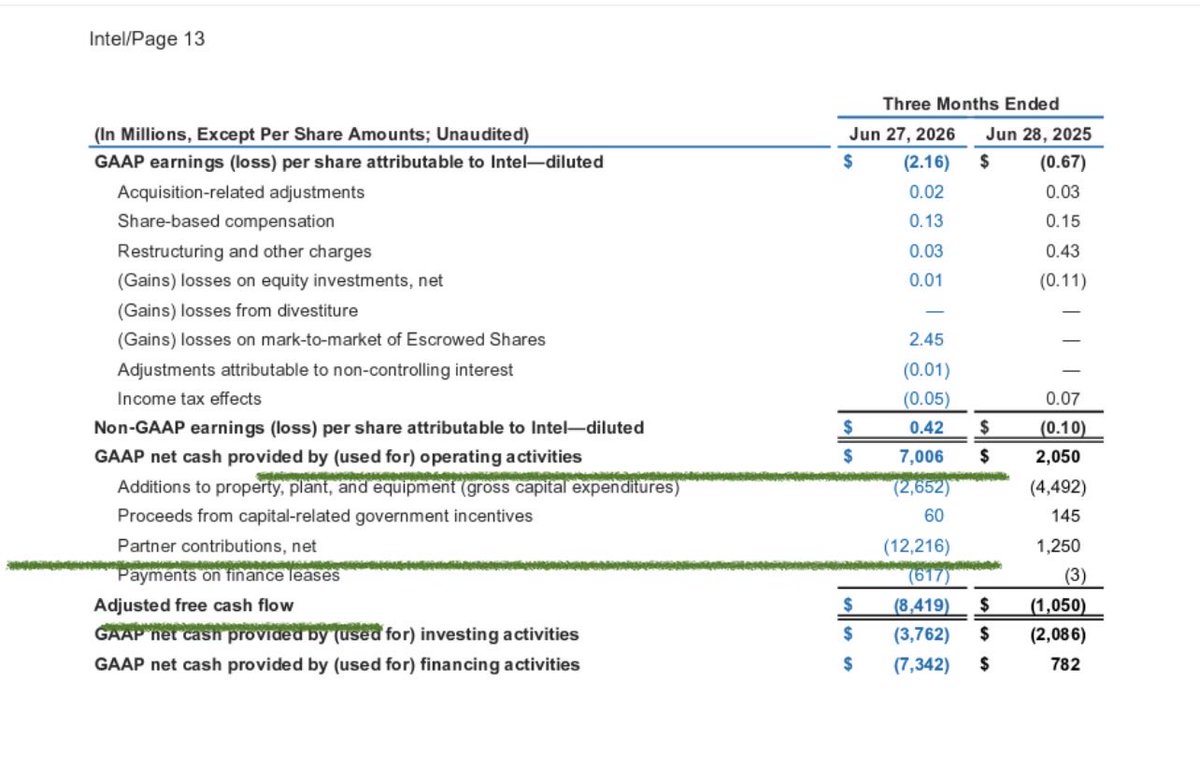
Let’s take a look at the adjusted cash flows of INTC.
Intel’s Q2 results looked strong on the surface, with revenue and EPS beating expectations, but the cash flow picture was much weaker.
Adjusted free cash flow fell to negative $8.4 billion because operating cash flow was overwhelmed by partner-related inflows and heavy capital spending and other investment cash demands.
The result suggests Intel is still in a capital-intensive, liquidity-consuming phase, where accounting strength is not yet translating into durable self-funded cash generation.
Ignore the noise do your own research.
$INTC
Canada the facts don’t add up.
Canada ports are a joke. Canada needs to start at 1st principles. Upgrade the Port infrastructure is the 1st step in diversifying trade.
Please stop the boondoggles and get to work.
https://t.co/m4wenbOn5o