if twitter suspends me one more fucking time im getting drunk and jerking off in front of Twitter headquarters in Austin @elonmusk fucking bastard youll never unfuck your dog
The blue-throated barbet (Psilopogon asiaticus) is a green Asian barbet native to the foothills of the Himalayas and Southeast Asia. Credit: Tanmoy Sarkar, India.
Some more interesting bits: In a 1929 interview, Činša said he had last seen his family when he was eight years old. During the Russo-Japanese War, his father took him to Mukden, where a Russian officer eventually took the boy with him to Russia.
During the First World War he repeatedly escaped captivity. Činša claimed that he once spent an entire month hiding in the forests near Vilnius, surviving on grass and roots, and travelled by clinging between, beneath and on top of railway carriages to avoid German checkpoints.
After fighting for Lithuania and being wounded, he settled in Kaunas as a disabled veteran. In 1926 he was baptised at the Resurrection Church, taking the name Petras, and married a Lithuanian woman, Teklė Kontrymaitė. Contemporary press reported that he worked in workshops for disabled veterans.
Three years later a journalist asked him to write something in Lithuanian.
Činša wrote:
„Aš dabar esu Lietuvos pilietis.“
“I am now a citizen of Lithuania.”
Underneath, he wrote his name in Chinese: 陳山
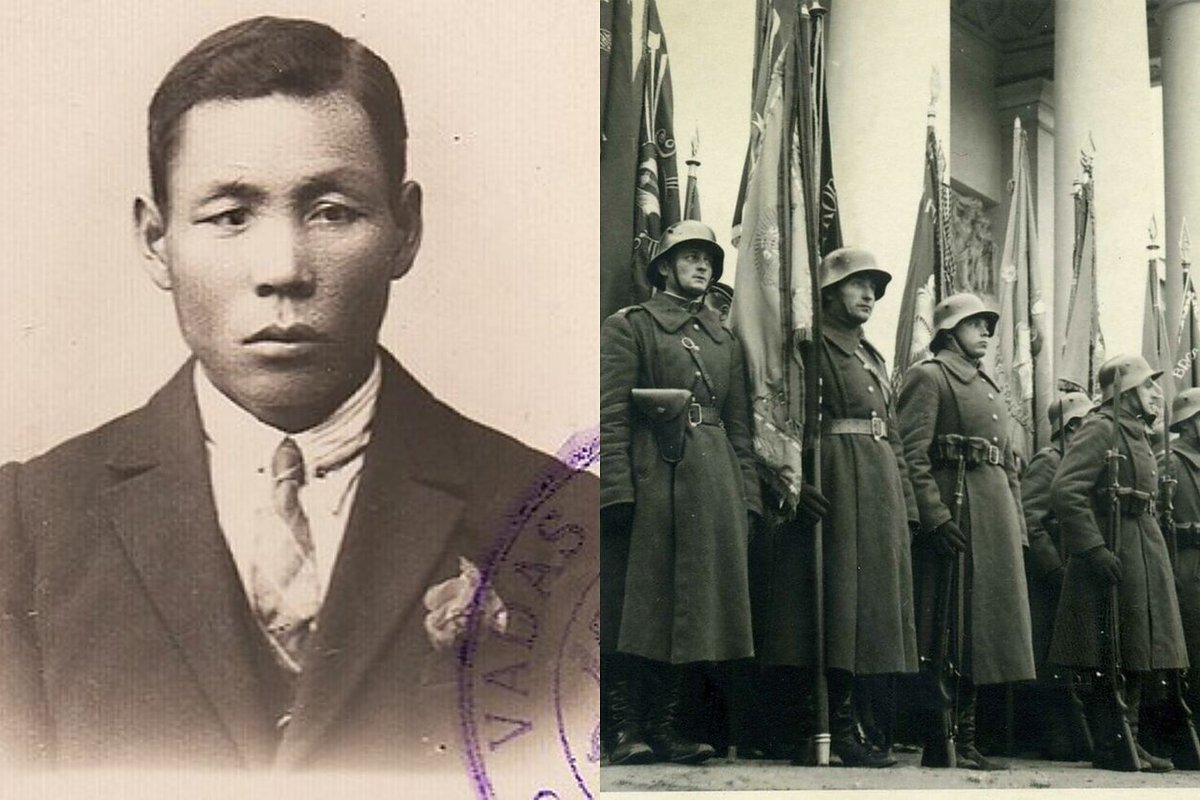
In 1920, Polish troops captured a Chinese man fighting in a Lithuanian uniform.
His name was Petras Činša. Born near Qingdao in 1896, he had ended up in Russia as a child and later volunteered to fight for newly independent Lithuania.
When the Poles demanded to know why a Chinese soldier was fighting for Lithuania, Činša convinced them that he was not alone: Lithuania supposedly had an entire Chinese corps.
Contemporary Lithuanian press claimed the story became serious enough for foreign military representatives to investigate. By the time they arrived to inspect their Chinese prisoner, Činša had escaped.
He was later wounded while fighting the Poles, captured again, and escaped a second time.
Činša eventually settled in Kaunas, where he worked as a trader. He died in 1930 and was buried there with military honours.
In 1920, Polish troops captured a Chinese man fighting in a Lithuanian uniform.
His name was Petras Činša. Born near Qingdao in 1896, he had ended up in Russia as a child and later volunteered to fight for newly independent Lithuania.
When the Poles demanded to know why a Chinese soldier was fighting for Lithuania, Činša convinced them that he was not alone: Lithuania supposedly had an entire Chinese corps.
Contemporary Lithuanian press claimed the story became serious enough for foreign military representatives to investigate. By the time they arrived to inspect their Chinese prisoner, Činša had escaped.
He was later wounded while fighting the Poles, captured again, and escaped a second time.
Činša eventually settled in Kaunas, where he worked as a trader. He died in 1930 and was buried there with military honours.