@WKCosmo Ok, I may not be following, but just for record, the three supernova analyses use a ton of the same data (particularly at low redshift), so they absolutely should not be combined. That would be super bad.
Understood. "This implicitly assumes that the systematic offsets between the different measurements are zero, which is an absurd assumption" - I agree with this sentence. Its so absurd, I don't even know who would say this, cause it's definitely not the supernova people whose data this assumption is about.
Who is assuming that? The SN datasets absolutely have systematics and also have a lot of covariance (not independent). I was pleased with the level of small differences of SN datasets when DESI first looked, and even more pleased after latest rounds of SN re-analyses (e.g. Dovekie). This signal with CMB+BAO is 2.5-3.5sigma. Hubble Tension is at 7sigma and still people are like "Lets wait and see." I don't see SNe people shouting from rooftops about evolving dark energy. There is clearly more work to be done.
Had a group goodbye dinner for @space_veggie before they go off and become fancy NASA Goddard scientist. Lauren is leading our supernova photometry pipeline for @NASARoman and will continue this work at Goddard.
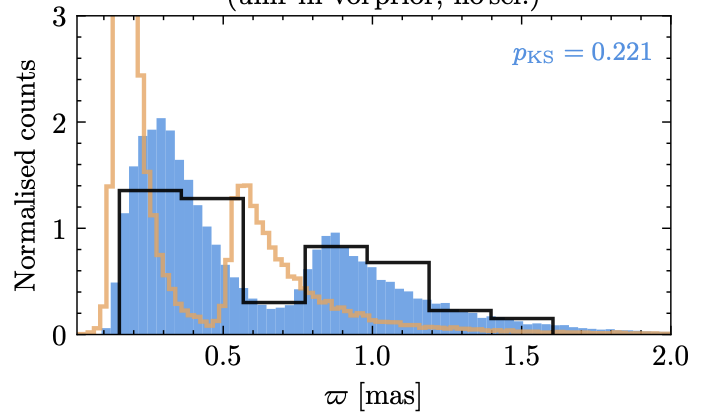
When the model includes the actual selection functions and a realistic MW disk prior, the forward model reproduces the observed distributions (heavy black) and yields the same calibration as SH0ES. Bonus insight shown in the paper: because the Cepheid PL relation is very tight, Bayesian and frequentist approaches agree as long as the prior isn’t in strong conflict with the data.
Really impressive H0-related paper by Richard Stiskalek et al. https://t.co/xMyCLL2VHA to make full Bayesian forward model of the Milky Way Gaia+HST Cepheid sample—periods, parallaxes, magnitudes, MW disk geometry, and survey selection all modeled together.
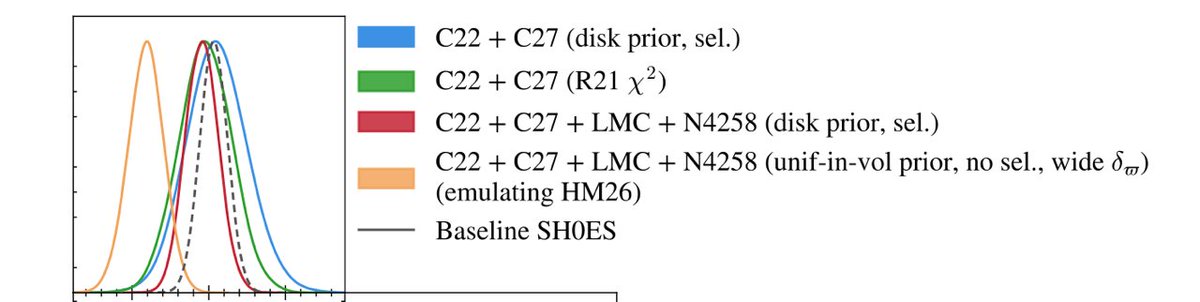
Key: Bayesian model must reproduce the data. A recent reanalysis (HM26) that lowered H₀ modeled the MW disk as a sphere and ignored selection, pushing Cepheids farther away. With a realistic disk + selection, the Cepheid calibration and the Hubble tension remain. Thread.
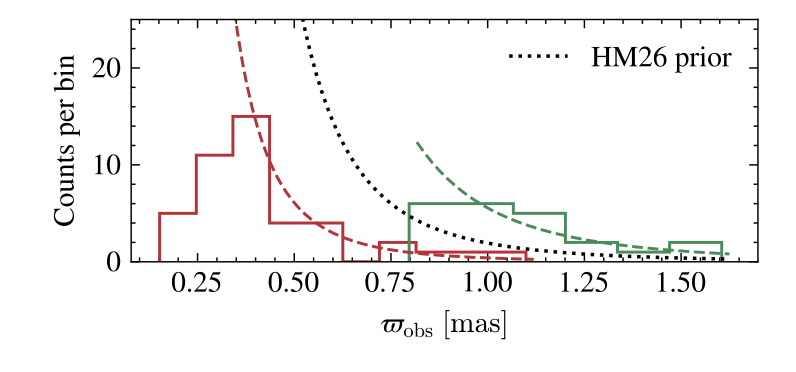
The issue is visible in Fig. 1.
The dashed curves show the parallax distribution expected if MW Cepheids followed a single uniform-in-volume (spherical) prior without selection.
But the observed Cepheids (two samples, red and green, with different selection functions) clearly don’t look like that, they live in the Galactic disk and are shaped by survey selection (closer, less extinction).
If the prior + selection don’t reproduce the observed distributions, the inference gets biased.
It was great to join @DukeU's SPACE Initiative to discuss the importance of bolstering STEM education and innovation.
As the Ranking Member of the Space & Aeronautics Subcommittee, I am grateful to see our local universities taking steps to support these educational initiatives in the face of Trump's funding cuts.
Duke’s @michaeltroxel received NASA’s Exceptional Public Achievement Medal for leading the OpenUniverse 2024 simulations--one of the most detailed synthetic views of the cosmos ever made. Congratulations!🔭✨
Read more: https://t.co/HQD1XQZy2B
I love Bayesian analyses — but they’re only as good as their priors. There’s no need to rush to “solve” the Hubble tension without modeling real selection functions.
Thought on new paper https://t.co/uyxoBdt9ky that claims “physical” distance priors shift SH0ES H0 downward by assuming all distance indicators are uniformly distributed in volume. But realistic Bayesian priors must include selection — and it’s clear from the data that selection dominates the effective prior. Neglecting that, not new data, drives the reduction in H0. 🧵
Similar issues arise on the 2nd and 3rd rungs: Cepheid distances are not volume-distributed due to selection (see Stiskalek+25), and SN calibrator brightness selection offsets a realistic host-distance prior. On the 3rd rung, the SN BBC correction already accounts for volume selection. In this new paper, they point to Desmond+25, but miss that they went the necessary step to model selection - see here:
Two important results today in supernova cosmology: a consistent set of host-galaxy stellar masses (Union3.1 led by @taylorjhoyt) and a new Bayesian model that solves for two SN Ia subclasses (UNITY1.8 by me). Both tackle one of our biggest challenges: astrophysical systematics.
We are now collaborating with the @b612foundation, who has studied similar questions, to understand this problem even better and figure out how well we can predict the orbit when we discover these objects. I think some numbers in our paper seem scary, but they are a big improvement of where things have been in the past!
Really proud of my grad student Qifeng Cheng for her first paper "Assessing the Vera Rubin Observatory's Ability to Discover Asteroid Impactors Before They Collide with Earth". https://t.co/mQS1PPb8Ap . A thread about @VRubinObs, discovery and warning times...
We spend a lot of time trying to understand why we miss ones we miss, and also look at the Argus Array as a complementary high-cadence, shallower depth unit. Basically, VRO will be great, but cannot carry the burden of planetary defense all by itself.