#QJE Aug 2026, #8, “The Effects of Mandatory Profit-Sharing on Workers and Firms: Evidence from France,” by Nimier-David (@ElioNimier), Sraer, and Thesmar (@dthesmar): https://t.co/TjKqiF3bIG
Last week I attended an inspiring workshop organized by @xgabaix and JP Bouchaud, on “Persistent Puzzles and Paradoxes in Economics: Are Radical Paradigm Changes on the Horizon?”
I wrote two summaries:
CHRONIQUE. Pour les économistes du MIT, @dthesmar, et d'HEC, @augustinlandier, la riposte à la vassalisation numérique américaine passe d'abord par la capacité des entreprises du Vieux Continent à soutenir une filière locale de l'IA. ➡️ https://t.co/nMdlXeHX3I
Sophisticated analysts' expected stock returns are strongly correlated with valuations, are contrarian, and predict future returns, in contrast with individual investors, from @dthesmar and @EmilVerner https://t.co/kq5UCDNO2O
Given the massive increase in profits in tech, profit sharing is in the news, for instance, with Samsung Electronics agreeing to pay a $400,000 bonus to its workers. But we are French people: Elio, David, and I study mandatory profit sharing. Now forthcoming in QJE:
Recently accepted by #QJE: “The Effects of Mandatory Profit-Sharing on Workers and Firms: Evidence from France,” by Nimier-David (@ElioNimier), Sraer, and Thesmar (@dthesmar): https://t.co/TjKqiF3bIG
I was invited to write a review of Al Roth's new book, "Moral Economics". I have a few disagreements, but this is a truly entertaining and thought-provoking piece, in the line of his reflections on repugnant markets. Highly recommend!
https://t.co/RqBWJMzwyO
Pour @augustinlandier d'HEC et @dthesmar du MIT, le concept de "démarchandisation" mis en avant par le PS aurait pu donner lieu à un débat intéressant. Mais selon eux, les socialistes ne font que revenir à un anticapitalisme primaire. ➡️ https://t.co/en32v3HI4z
✍️ Arnaud Bouillin et Thomas Mahler
J'aime bien la phrase: "Le TRI est particulièrement élevé pour les premières générations ayant connu des périodes de forte croissance économique et des niveaux de prélèvements plus faibles. " au-dessus de ce graphique:
@sc_cath La rupture d'égalité est patente
Mais ça ne doit pas faire oublier que même 2% est un rendement pathétiquement bas pour de l'épargne long terme
Se focaliser sur la lutte des classes d'âge c'est passer à côté du sujet
https://t.co/XaxqL0sEbj
📱 @dthesmar et @augustinlandier évoquent les conséquences des réseaux sociaux sur le bien-être. Même si les études sont fragiles, ce n'est, selon eux, pas une raison pour ne pas agir par rapport aux jeunes. ➡️ https://t.co/dnLwVLeEl5
✍️ Arnaud Bouillin et Thomas Mahler
Les deux économistes du MIT et d’HEC analysent les récentes annonces autour des progrès de l'IA, sans verser dans un catastrophisme moutonnier.
➡️ https://t.co/i2ZfpSvIXi https://t.co/i2ZfpSvIXi
seems to me a key point of the Citrini paper was that AI would increase competition (destroy firm margins). what seems missing in these discussion is that this predicts (1) an increase in productivity and (2) a reduction in profits --> this should be good for workers.
In all of the discussion of AI, r, and the Citrini post, I have not seen mention of Ricardo Caballero's recent paper on AI, r, and valuations. Some quick thoughts:
Ricardo's model captures the second force @ojblanchard1 mentions, namely lower r from wealth concentration. Higher wealth concentration among the wealthy who have a higher propensity to save (as in work by @ludwigstraub, @AtifRMian, @profsufi) leads to a lower required return. Here is the mechanism:
Optimism about AI => higher valuations (Tobin's q) => higher investment => higher capital => higher capitalist wealth => lower required return (nonhomothetic preferences over wealth) => high valuations (q) justified
A key assumption is that AI capital is "labor-like" and so does not have diminishing returns over some range of capital.
Another interesting feature: during the AI deployment, wages and worker consumption stagnate, and the labor share is lower (workers don't own claims to AI).
What about a recession? The model doesn't have sticky prices/demand-determined output. But it does highlight the simple point that a recession is more likely if the AI boom crashes (drop in q). If there is no crash and the optimistic AI boom is realized, then (*speculating here*) it depends on whether the rise in investment and consumption of capitalists offsets the stagnant worker wages. But investment demand would likely be strong given the high valuations, which will push against a shortfall of demand. Also, my sense is that a recession would be relative to the rising potential output (a "growth recession"), not the counterfactual without AI. Again, this latter part is speculation...
Here's a link to Ricardo's interesting paper: https://t.co/Y1aZe1jeJ9
🇪🇺 Pour @dthesmar du MIT et @augustinlandier de HEC, si l’Europe veut réellement devenir "souveraine" face aux Etats-Unis de Donald Trump, elle doit déjà rompre avec la démagogie et se tenir prête à en payer le prix. ➡️ https://t.co/xwCRCjlVCm
🇪🇺 Pour @dthesmar du MIT et @augustinlandier de HEC, si l’Europe veut réellement devenir "souveraine" face aux Etats-Unis de Donald Trump, elle doit déjà rompre avec la démagogie et se tenir prête à en payer le prix. ➡️ https://t.co/vBmRWNTMlK
David Thesmar (@dthesmar) and I are hiring a pre-doctoral research assistant to come work with us at MIT on research projects in the intersection of finance and macro starting July 2026.
Apply here: https://t.co/JcHtnJjLW0
@econ_ra
Running an experiment in which participants pose as investors finds that they price corporate intent, controlling for corporate actions. Participants value shares in companies that reduce pollution relative to peers, from @augustinlandier, @PARISASTRY, and @dthesmar https://t.co/bT7qJVD8mW
🥁Jour J pour le lancement du nouveau @LEXPRESS. Parmi nos nouvelles signatures, nous sommes heureux d’accueillir @augustinlandier et David Thesmar, économistes de HEC et du MIT. Ils dressent ici le bilan de la première année de Trump II.
https://t.co/SWQQYEcgrb
Very happy that our paper received the DFA Prize for Best Paper in the Journal of Finance.
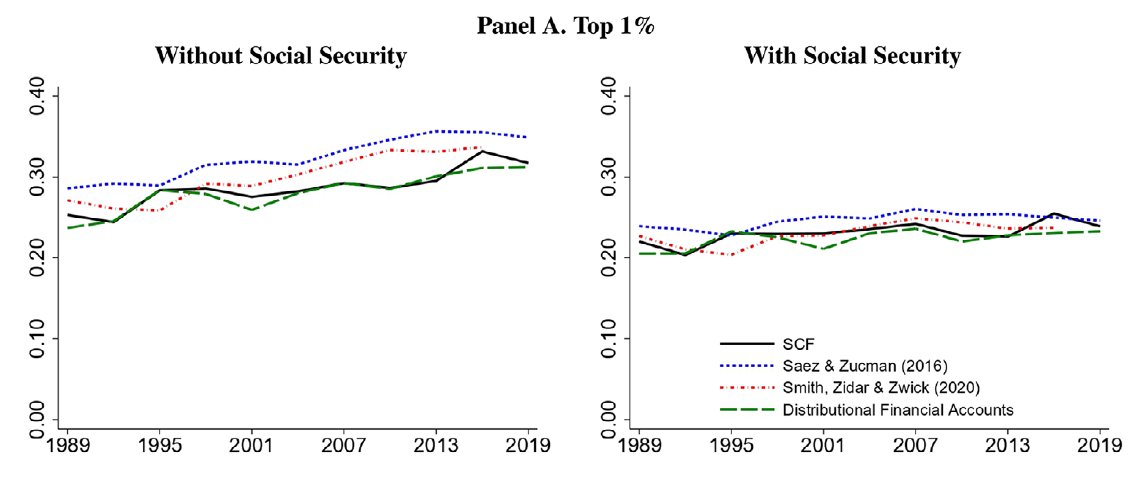
The literature on wealth inequality has been highly influential in public debates, yet it largely ignores a key way households save over the life cycle: Social Security.
We show that including the fair value of accrued benefits in wealth substantially mutes the rise in wealth inequality since 1989.
Its importance has grown dramatically over the past three decades. In 1989, Social Security represented only 26.0% of the wealth of the bottom 90%. In 2019, this percentage rose to 49.8%. We cannot understand household balance sheets without paying attention to Social Security.
I couldn't be more excited to share that submissions to 𝐉𝐅: 𝐈𝐧𝐬𝐢𝐠𝐡𝐭𝐬 & 𝐏𝐞𝐫𝐬𝐩𝐞𝐜𝐭𝐢𝐯𝐞𝐬 are finally open!
Insights are short (<7,000 words) high quality pieces. Perspectives outline promising future research directions.
https://t.co/CuAh3RpnF9