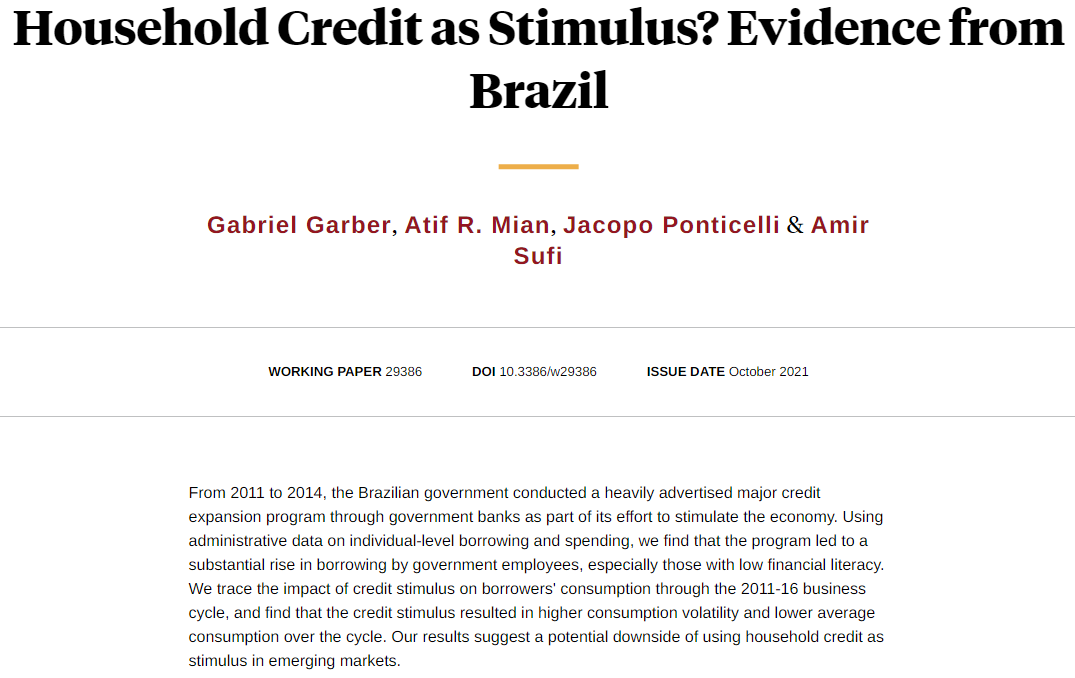
The results from Brazil also fit into the broader global picture that sharp rises in household debt predict an economic downturn. Brazil certainly fits the pattern. And now all eyes on China, which appears to be in a similar dynamic (N/N)
Starting in 2011, the Brazilian government tried to boost economic activity through aggressive household lending through government-owned banks. Is "household credit as stimulus" a good idea? A new paper with Gabriel Garber, @AtifRMian, and @jacopont (1/N)
https://t.co/k4DF8lNYmZ
There may be an important role for governments in developing household credit markets to help with risk-sharing, house purchases, and education financing. But the Brazilian example suggests that using household credit to juice economic activity can end badly (5/N)
A major government credit program in Brazil resulted in higher borrowing by public sector employees with low financial literacy at the expense of higher volatility and lower average consumption, from Gabriel Garber, @atifrmian, @jacopont, and @profsufi https://t.co/Wnt97Ws7fe
As a general point, the literature on market concentration could benefit from an injection of finance scholarship! I think finance is an important part of the overall explanation for trends in market concentration over the past 30 years (N/N)
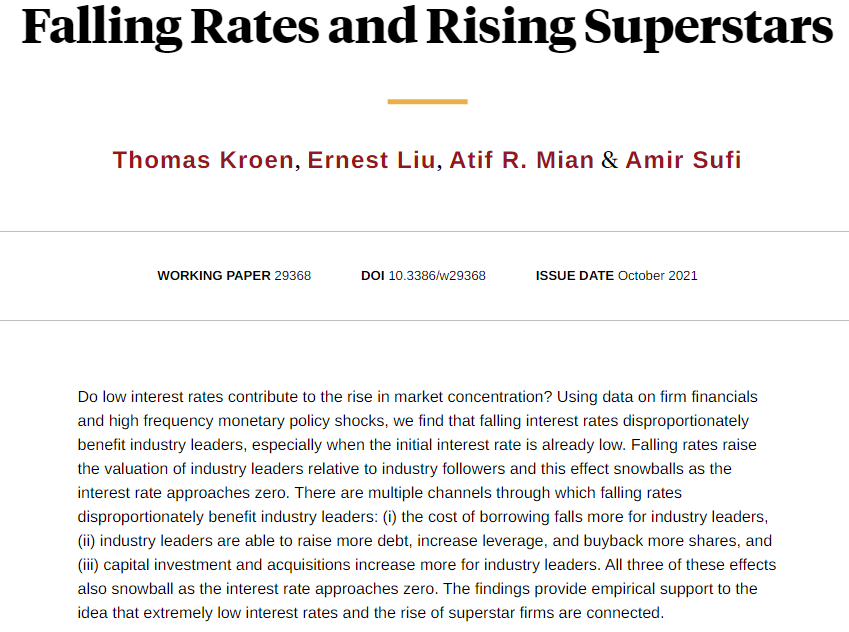
We live in an extremely low interest rate environment. What are the consequences for industry competition and market structure? This is the focus of the recent study we released (joint with Thomas Kroen @ErnestLiuEcon@AtifRMian). A thread (1/N)
https://t.co/3O0aswjny3
The stakes are high, because there is a growing body of research connecting market concentration to the decline in productivity growth. Our study suggests that low interest rates are an important link in the chain (6/N)
Falling interest rates disproportionately benefit industry leaders, especially when rates are already low, from Thomas Kroen, @ErnestLiuEcon, @atifrmian, and @profsufi https://t.co/OUqewx53QY
Are very low interest rates market neutral?
Or do low rates tend to tilt the scale in favor of market leaders, thus reducing competition?
We have a new empirical paper out that suggests falling rates help the rise of superstars
A short thread ...
https://t.co/isaOiZQhoT
New paper by @ErnestLiuEcon@AtifRMian@profsufi & Tom Kroen shows that lower rates benefit industry leaders; more so as r➡️0. Links low r and high concentration as in earlier theory paper: https://t.co/tEKyIPKBxu
Falling Rates and Rising Superstars https://t.co/3pjI4RSqKQ
Can’t even explain yet to my non-Econ friends just what a revolutionary force these three economists who just won the Nobel created. My book on causal inference has a blurb by Guido on the back and I sent one to Angrist with the inscription “thank you for inspiring a generation”
Uncorking the Champagne here!
This is a win for labor economics, modern empirical microeconomics, and three economists who were at the center of a revolution.
Congrats on a well-deserved Nobel Prize for @metrics52, a fantastic advisor, scholar, and teacher. Rock on, Josh!
(screenshots courtesy of his sneaky metrics TA in March 2020)