A lot of focus on agentic payments metrics recently.
Classic case of narrative / excitement overshooting adoption. But there’s progress happening if you know where to look.
There are 4 pieces to solve for adoption:
Users
Harness
Model
API
Users
“Who” is using the agent. Today, all agents tie back to a person, for now. So if agents are going to spend money, their person needs money. Most people using agents today have a bank account and debit / credit card. A smaller subset have a funded crypto wallet.
The main issue is that most people don’t have their money connected to their agents. Early adopters can do this today: give OpenClaw plaintext card info, install the MPP skill, etc. But it requires awareness and sophistication. It’s not the default, which limits adoption. Reasonable to assume this changes.
Harness
“How” you use the agent. Harness is sometimes separate from model, eg OpenClaw using Claude or Cursor using DeepSeek. But for most people, the harness is built by the model company.
If most consumers use the default option, a harness eventually built into an operating system, eg iOS, will have a significant impact on what payment method gets connected to an agent.
Model
“What” agent you are using. You can see where payments adoption is today by asking your favorite agent to “register me a domain name.” The default payment tool use from model companies, especially vertically integrated experiences, will have a huge influence on defaults.
APIs
“Where” the agent spends money. This is the supply side of the marketplace, and where most progress is happening.
It helps that Stripe supports nearly all agentic payments protocols, including different ones for e-commerce vs APIs, and has distribution to 5 million businesses, including virtually all leading AI companies.
But even if a business turns on agentic payments for their API, you still have to solve users / harness / model adoption.
Also, most services today are built around accounts and periodic billing. Migrating to usage-based billing will take time, both for incumbents and new AI-native services.
Here's a weekend project with a great name: a hibernaculum.
It's a buried pile of rubble and logs that gives frogs, toads, snakes, and salamanders a frost-free place to survive the winter, and it's one of the cooler habitat features you can add to a yard.
Cold is one of the major challenges for these animals. Because they can't make their own heat, many species spend winter in protected underground spaces where temperatures stay relatively stable and moisture levels remain high enough to prevent dehydration.
The build is simple. Pick a sunny, out-of-the-way corner. Dig at least a couple of feet deep, and deeper in colder climates where frost penetrates farther into the ground.
Fill it with logs, rocks, broken bricks, and rubble, leaving plenty of gaps and chambers inside. Slip a length of pipe or two in at ground level as entrance tunnels, then mound the dug-out soil over the top and plant it with native grasses and wildflowers.
Now it pulls double duty: providing a protected underground refuge where temperatures fluctuate far less than they do at the surface.
You can say you've buried a pile of junk in the yard and called it conservation, and you'd be exactly right.
The other models will certainly be better.
But the other models won’t be the built-in, *free* default with privileged access to personal data and what’s on the screen.
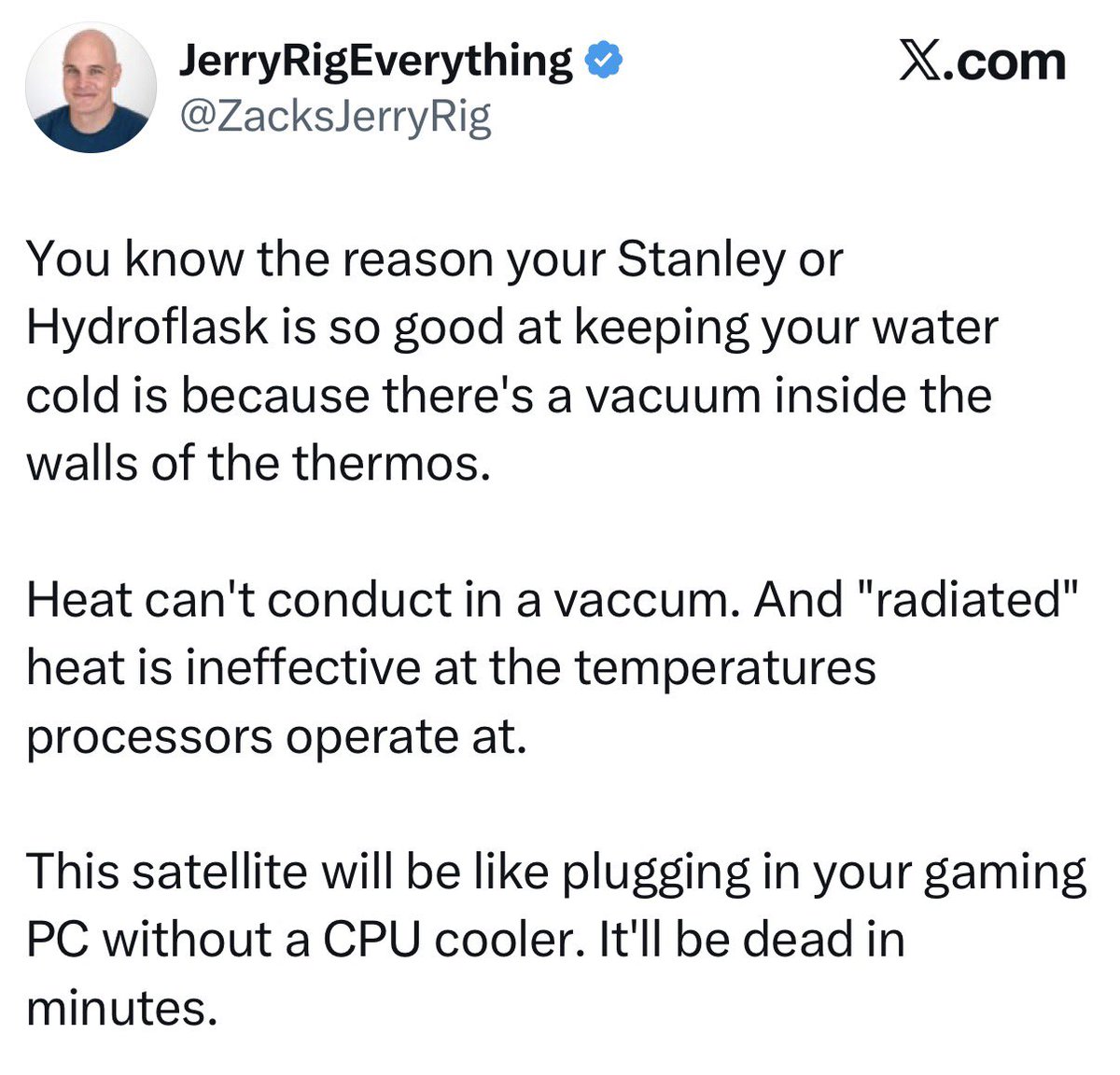
SpaceX has just officially unveiled its AI1 satellite, the first generation of its AI satellite.
Overall Specs:
• 150 kW peak compute payload
• 120 kW average compute payload
• 70 kW per ton
• Compute provider interchangeable
Dimensions:
• Wingspan: 70 meters
• Deployed height: 20 meters
Thermal System:
• 110 m² deployable liquid radiator
• Redundant pumping loops
• Integrated micrometeoroid shielding
• Deployable liquid radiators
Solar Power System:
• 150 kW solar array
• 250 W/m²
• SpaceX-manufactured solar technology from Bastrop, Texas
Architecture:
• Centralized compute module
• Large deployable solar arrays
• Deployable liquid-radiator thermal management system
• AI-focused compute satellite design ("AI1 satellite")
Elon: "The AI satellite is much simpler than a Starlink satellite. The AI satellite is essentially a lot of solar cells, you still need some laser links, but you don't have all of the super complex antennas that you have on a Starlink satellite. The easier one to design for is the AI satellite. It's bigger. A lot of this is technology we've already made with the Starlink V3 satellites."
Wonder if Cloudflare will detect / blocks these agents as bots by default.
If not, thin wedge for Apple devices to have a special agentic lane into many websites.
i don't quite believe everything apple has shown, but one agentic feature stood out for me. they have shown how passwords app can work with safari and go out and update all the weak or compromised passwords. it's a really good example of a thing you would only trust a local model with.
The stablecoin on/off-ramp must be understood as a dealer function situated at the boundary between two monetary hierarchies.
Stablecoins compress the transport of money: they reduce latency, intermediaries, reconciliation, and settlement frictions within the tokenized domain. However, they do not eliminate the scarcity of local convertibility. Instead, they displace it toward the edges.
Consequently, the ramp spread is the compressed price of an entire stack of constraints: fiat liquidity, banking access, inventory, compliance, fraud, regulation, FX scarcity, balance sheet capacity, and the cost of offloading positions into deeper layers of liquidity.
In the traditional system, these costs are distributed across correspondent banks, FX desks, domestic rails, payment intermediaries, and nostro/vostro structures. In the stablecoin model, many of these frictions condense into a single quote: the price at which local currency can be converted into tokenized dollars, or tokenized dollars into local currency, with size, speed, and certainty of execution.
This price is a form of jurisdictional basis. It does not merely measure the cost of moving money; it measures the difficulty of crossing a monetary border. In liquid, open jurisdictions, this basis will tend to compress due to competition. In jurisdictions with capital controls, dollar scarcity, inflation, banking fragility, or regulatory risk, the spread may persist because it essentially prices sovereignty, balance sheet capacity, and access.
Thus, stablecoins may commoditize global settlement, but they make local convertibility more valuable. They decentralize transport, yet they can recentralize economic rent at the points of entry and exit.
What this allows is that, provided the players operating these tolls are ultra-efficient, the aggregate cost of the overall structure could be driven down.
Therefore, the structural business is not simply moving stablecoins. It is market-making across incompatible monetary systems. The winner here will be whoever controls the scarce constraint within each respective corridor: licensing, banking access, local liquidity, distribution, compliance, or balance sheet capacity.
Stablecoins compress settlement. Ramps price convertibility. The spread is the market price of crossing monetary jurisdictions.
A lot of focus on agentic payments metrics recently.
Classic case of narrative / excitement overshooting adoption. But there’s progress happening if you know where to look.
There are 4 pieces to solve for adoption:
Users
Harness
Model
API
Users
“Who” is using the agent. Today, all agents tie back to a person, for now. So if agents are going to spend money, their person needs money. Most people using agents today have a bank account and debit / credit card. A smaller subset have a funded crypto wallet.
The main issue is that most people don’t have their money connected to their agents. Early adopters can do this today: give OpenClaw plaintext card info, install the MPP skill, etc. But it requires awareness and sophistication. It’s not the default, which limits adoption. Reasonable to assume this changes.
Harness
“How” you use the agent. Harness is sometimes separate from model, eg OpenClaw using Claude or Cursor using DeepSeek. But for most people, the harness is built by the model company.
If most consumers use the default option, a harness eventually built into an operating system, eg iOS, will have a significant impact on what payment method gets connected to an agent.
Model
“What” agent you are using. You can see where payments adoption is today by asking your favorite agent to “register me a domain name.” The default payment tool use from model companies, especially vertically integrated experiences, will have a huge influence on defaults.
APIs
“Where” the agent spends money. This is the supply side of the marketplace, and where most progress is happening.
It helps that Stripe supports nearly all agentic payments protocols, including different ones for e-commerce vs APIs, and has distribution to 5 million businesses, including virtually all leading AI companies.
But even if a business turns on agentic payments for their API, you still have to solve users / harness / model adoption.
Also, most services today are built around accounts and periodic billing. Migrating to usage-based billing will take time, both for incumbents and new AI-native services.
The industry doesn’t help itself since there are plenty of headline metrics bullposted that are uninteresting at best and intellectually dishonest at worst.
(No one outside of crypto cares about an agentic payment that launches a memecoin. So if your number includes that people will stop paying attention.)
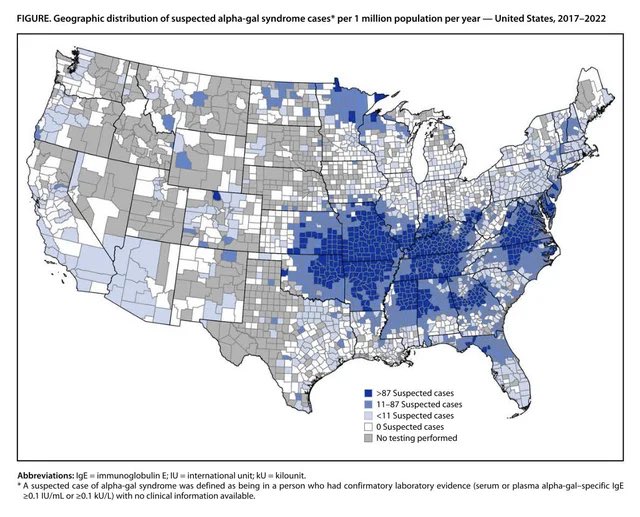
Using AI / data centers to help eliminate tick-borne diseases like Lyme and Alpha Gal feels like a great way to shift public opinion and win over a bipartisan group of senators.
SITUATION DETECTED: Antares Nuclear’s Mark-0 reactor has achieved initial criticality at Idaho National Laboratory, what the U.S. Department of Energy is calling one of the most significant technological achievements in nuclear energy in over 40 years.
When America sets bold goals, America delivers.
Last year, President Trump challenged our nation to bring multiple advanced reactors to criticality by America’s 250th Anniversary. Today, we reach an important milestone as the first non-light-water reactor goes critical in more than 40 years.
American workers, engineers, entrepreneurs, and local communities made this possible. Their achievement is proof that the United States still leads the world in innovation—and that America’s nuclear renaissance is well underway.