We're now accepting applications for research interns at @a16zfrontier, for summer '27 in NYC! Application deadline is Nov 20th. You'd be working with me @skominers@SuccinctJT@ittaia@PGarimidi@jneu_net@ErtemNusretTas, as well as other interns, visitors, and our advisors (such as @danboneh).
Our interests are broader than ever---ambitious undergrads with a keen grasp of emerging technologies, grad students looking to transition to building and entrepreneurship, as well as PhD students pursuing a more traditional academic career.
Research areas of interest include AI and machine learning, agentic commerce, cryptography, security, distributed computing, hardware design, economics (micro, macro, and empirical), energy, material science, biology, incentives, quantitative finance, market and mechanism design, foundations of computing, and pure mathematics.
For more details and to apply, see https://t.co/c8mT4h3dp9
I am hiring a social media lead for a16z Frontier!! “We’re lucky enough to be living through one of the most consequential curves in human history today” — THIS is the time, come work with us now! ⚡️🔑🔭💥🗺️
https://t.co/gl00pkqP1U
Marc Andreessen says the gap between what AI-native startups and incumbents think AI can do is the widest he’s ever seen:
"The AI-native early stage startups have just a completely different view on what they can do with AI than the typical incumbents in almost any industry, almost without exception."
"AI is just racing ahead in capability even week by week... There are going to be a lot of industries that are really up for grabs in a fundamentally more profound way than maybe has been the case in the past."
"The founders are gonna have a level of superpowers coming from the use of these tools and these technologies that they just simply haven't had in the past... Had I had Astra and Netscape in 1994, like, oh my God. Like, Ben, what would you and I have been able to do at Netscape?"
"Those entrepreneurs are gonna color way outside the lines. We already see this. They're not gonna think of themselves as like, 'I'm just a software company,' or, 'I'm just a hardware company,' or even, 'I'm just an AI company.'"
@pmarca@bhorowitz
Big personal news today: I have decided to leave @a16z, move to SF, and start a company.
It's time to build :)
It has been almost 10 years since I joined the firm. I met @cdixon, @bhorowitz, and @pmarca in 2017. At the time, I was an engineer at Google Brain working on robotics. I had a deep interest in open source. I knew nothing about investing. Chris meanwhile had already planted the @a16z flag at the frontier that was early crypto with investments in companies like Coinbase. But the crypto team at the firm consisted of only him, and he had the ambition to expand. His pitch to me was simple: "You should leave Google and come help me build the crypto vertical at the firm."
The work we've done together since then to build out our team and support our founders has been the most meaningful work of my life. I am grateful to have spent a decade working with everyone here, supporting our founders, learning from Chris, Ben, and Marc, and living the firm's culture. It is a culture that values integrity, life-long working relationships, and the belief that we humans have the power to build our own future.
Marc and Ben have built a16z into an incredible force for good in the world.
Before I joined the firm, I always thought that my inevitable path was to become a founder. The truth is that I wasn't ready for it then. Somehow, this year I've gotten the overwhelming feeling that this has changed.
As for what I want to build: It is early, but I care most about building infrastructure that enables open software ecosystems. I am starting with two core observations:
1. AI today is largely a single-player technology. Most uses involve one human talking with one agent in isolation from the rest of the world. That will soon change. Most uses of AI will soon be many-to-many: many humans and many agents working together. There will be at least one massive open network on top of which those uses will be built.
2. Software is now free. It can now be written just-in-time, on the spot for a single individual's hyper-targeted use case, and it can even be thrown out after a single use. This means that our entire software stack will have to change. In the limit, it will lead to a whole new kind of AI-mediated operating systems, which in turn will create an ecosystem of AI-native developers who build applications that actively rebuild themselves on the fly.
If you are working on related ideas, and especially if you are in the Bay Area, hit me up. Let's chat!
@bhorowitz , @pmarca, @cdixon, @eddylazzarin, @guywuolletjr, @jasonrosenthal , and our whole team — I want to thank you. Working with you has been the time of a lifetime. I am forever an a16z superfan and your ally.
Onward 🫡
AI is getting better at solving hard math problems, especially given recent drops. But what does that mean for the cryptography that protects everything from private messages to healthcare to banking and crypto wallets?
Stanford cryptographer Dan Boneh, with @eddylazzarin, @SuccinctJT, @liz_harkavy, and @smc90, makes sense of the warnings sounded recently. They cover:
- what’s fact vs. assumption
- what’s new and what risks cryptographers have long prepared for
- where quantum computing doesn't (and does) fit
- opportunities for builders
Highlights:
00:37 – What sparked the most recent debate about AI and cryptography
01:35 – Signal vs. noise: What the math does and doesn’t tell us
05:29 – Why cryptography depends on open problems
09:25 – Why the stakes go beyond blockchains
10:43 – How AI could strengthen confidence in cryptography
13:50 – Considerations for users and institutions
20:10 – Where AI and quantum threats overlap
22:32 – Building systems that can change cryptographic methods
23:59 – Hash-based versus lattice-based cryptography
33:07 – Opportunities for builders, and better security tools
38:14 – What comes next if there were a cryptographic break?
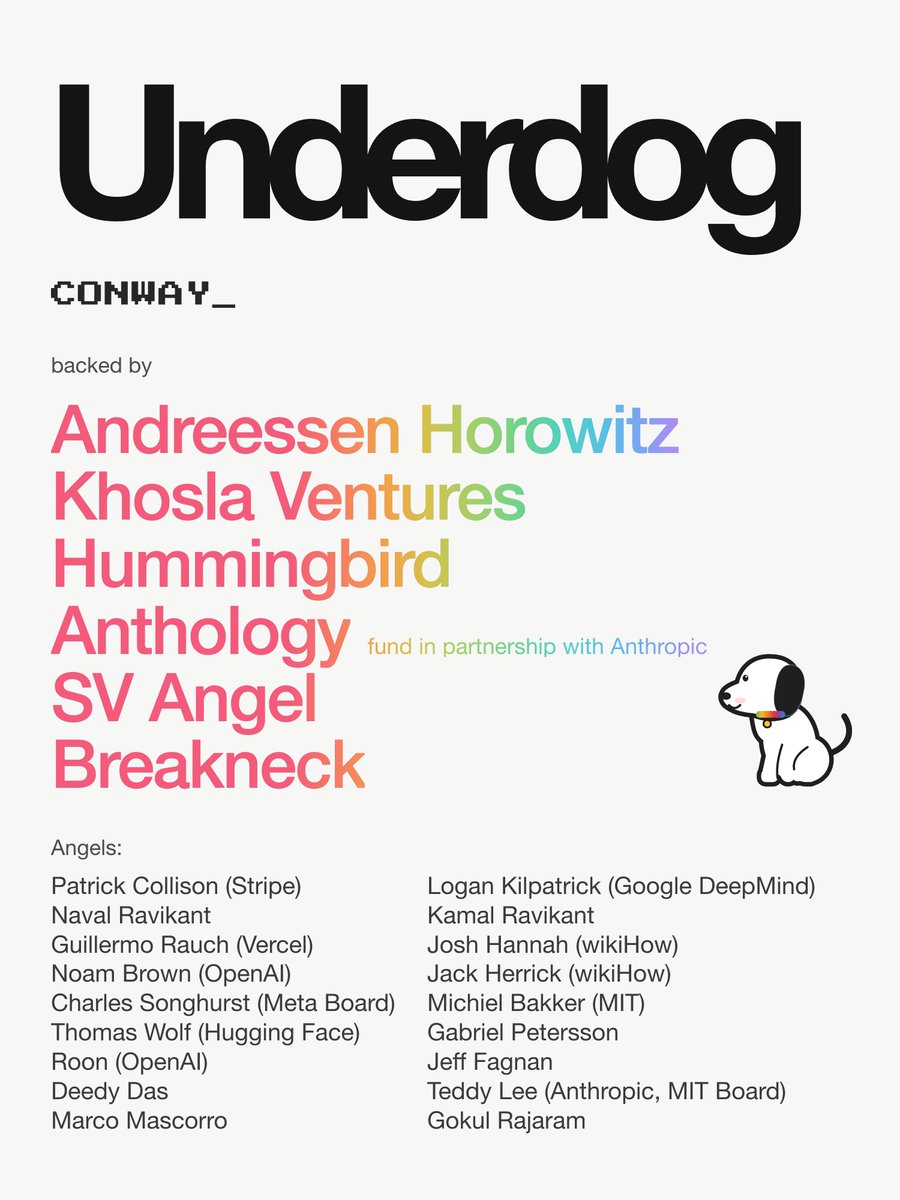
Introducing Underdog, your Private Personal AI on devices you already own
Today we're announcing our backing from @a16z@khoslaventures@HummingbirdVC Anthology (@AnthropicAI@MenloVentures) @patrickc@naval@rauchg@polynoamial@Thom_Wolf@Mascobot@tszzl@OfficialLoganK and other top AI leaders
Our mission is to provide free, capable, reliable and private AI to billions of people.
Underdog’s Law: today’s frontier intelligence reaches your devices in six months.
We’re starting with fast, capable AI that runs on consumer hardware. By co-designing models and inference engines, we’re pushing the frontier of capability, speed, power and data efficiency.
Our research also spans agentic commerce, confidential inference, and how AI will reshape the internet economy.
Privacy and capability no longer needs to be a tradeoff. If you believe in this future, join us. Time to build.
I don’t normally write these things. But this one hits a bit different. Nearly three years ago I told a16z I wanted to spend part time outside the firm helping @drfeifei start and build a frontier model company. And what followed were some of the most remarkable moments of my career. From being at the founding table. To watching the first git commits. Seeing the very early very rough results that hinted at something much greater. Contributing to the open source. Watching the creation of new model architectures that pushed the state of the art in multiple areas.
I saw the team spin magic from nothing again and again. And I was very privileged to be within the walls. I’m very proud of what was accomplished, and am so excited for what lies ahead.
So congratulations to AMD for entering into an agreement with the leading spatial intelligence frontier lab. And congratulations to the World Labs team on a partner that has the vision, ambition and leadership to be the top AI technology provider globally.
Also congratulations to Dr. Su and Dr. Li. Two world class CEOs with a common vision. The both of you working together is unimaginably legendary. Arguably the smartest leaders in tech with the shared goal of building the world's leading AI capabilities. I know you both share an optimistic view of AIs ability to aid humanity. We need far more of that.
As everyone knows. I’m World Lab’s biggest fan. And will remain so. Thanks to @drfeifei , @BenMildenhall , @jcjohnss and the entire team for letting me tag along. What a crazy fucking ride. You stood at the frontier, and moved it. And will continue to. Again, many congratulations to everyone involved. The future of AI will be so much brighter with this partnership. I can’t wait to see where it leads. Here’s to new worlds!
While I’m disappointed by today’s Senate vote, it doesn’t change the fact that crypto’s fundamentals are stronger than ever.
Billions of dollars are moving onchain, leading payments companies and financial institutions are adopting blockchain technology, and entrepreneurs around the world are building new financial products that bring money into the internet age.
Our work in DC is far from over. We’ll keep working for clear rules that protect consumers and let entrepreneurs build.
After a year of intense daily bipartisan negotiations, this bill is ready. Here is the final text. President Trump voluntarily agreed to new ethics provisions holding every federally elected official, judge, and their spouses to some of the toughest ethics restrictions in U.S. history. This new text includes more than 120 of Democrats' demands. A no vote on Tuesday means opposing real ethics reforms on politicians' personal investments, handing American leadership in digital assets to our foreign competitors, and leaving Americans with zero protections in the digital asset markets. Democrats got what they wanted; now they need to take yes for an answer. Here's the latest: https://t.co/pd9VjCk9MA
One step closer.
This draft reflects important additional bipartisan compromises and a lot of effort from congressional staffers.
This is the best version of market structure yet.
Thank you @POTUS for inviting crypto leaders to the White House yesterday and leading the push for CLARITY. I also appreciate @ChairmanSelig doing the same at the CFTC Innovation Advisory Committee meeting. It’s clear that there is a lot of support for crypto innovation from the top down.
The last two days in DC made one thing clear: the time for Congress to pass the CLARITY Act is now.