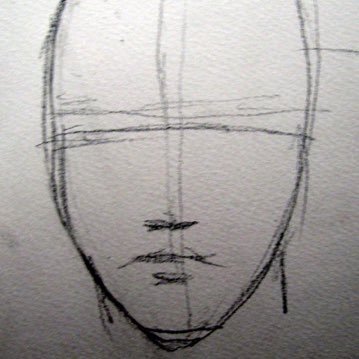
Tyler and I just published a list of the recipients of the New Aesthetics grants: https://t.co/aLhVgYXrbi.
Thank you very much to all who applied. There were far more applications than we expected. We funded 28 grantees and are excited to see what they create.
My reflections on the whole thing:
• Though there are clearly selection dynamics afoot, figuring out some route beyond the current aesthetic moment seems to be of wider interest in the art community than I would have guessed. Many applicants described their dissatisfaction with the status quo, some in strong terms. We had to close applications after a few weeks because there were so many.
• It's too early to call it, but it seems that both beauty as an unapologetic goal (contra much that is in modernist and contemporary approaches), and ways to channel pre-modern styles into something new for the present era, are of growing interest.
• The awards made me reflect on the perhaps obvious issue of how hard it must be for an artist to persistently do something new: schools, galleries, buyers, etc., all have structurally embedded preferences as well. These individual awards made me wonder what form supporting new clusters could take.
• Architecture seems to me like the discipline most ripe for new ideas. One correspondent observed: "American architects are somewhat constrained by the association with the academy, in addition to the well known regulation issues. There is a tendency to overthink things so that the designs are formally interesting to someone deep in the conversation, but lacking poetry and magic. There are more firms in Europe, South America and beyond that “just do things” (especially in places where it is easier to build)." This was evident in the submissions.
• AI seems to be making people rethink things in a quite fundamental way, just as urbanization/industrialization/popularization of photography did at the end of the 19th century. For some that will mean interesting new forms of AI-augmented art, but the effects of the rethinking will likely be wider.
• Arts funding is clearly as precarious and scarce as ever. That's unfortunate, but it probably also means that individual actors can have meaningful impact, and I encourage others to get involved if interested.
• There's a lot to know that is not written down, and I'm very grateful to those who have helped and advised me along the way.
🆕: @Meta and @stripe are partnering to make it easy for businesses to accept agentic payments using the @Muse Connector Platform.
Learn more:
• https://t.co/kGsKMULe3m
• https://t.co/Fn5U2QRaaz
• Email jweinstein@ / @jeff_weinstein
Opening access for developers to build Muse connectors. You bring the API -- Muse brings the agent, the browser, and the context of what the person actually wants. People reach your service just by asking for it, and their agent takes it from there.
New connectors are live today. Come build with us. https://t.co/o6oTf1Sj9y
it seems like agentic commerce is finally solved with stripe link. and we're excited to partner with stripe to enable all agents to transact online.
your agent can now natively make payments on the web using link cli + browserbase.
one shot prompt: https://t.co/KDHq9Ca6yT
📣 Announcing: @Meta and @stripe are partnering to make it easy for businesses to accept agentic payments using the @Muse Connector Platform. (This going to unlock many new money muse cases!)
Learn more:
- https://t.co/7DLG4WHlj9
- https://t.co/QcQyq0NQBj
- or email jweinstein@
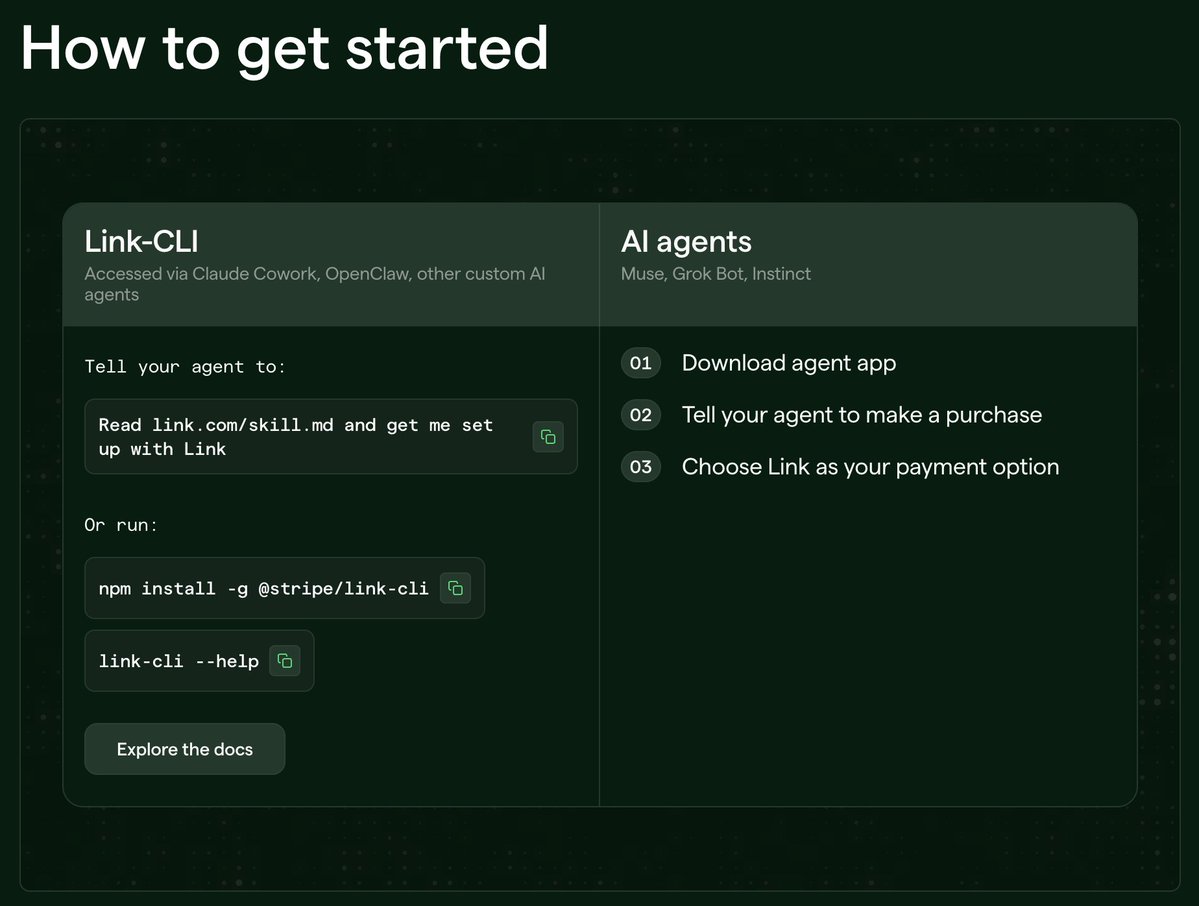
does your favorite agentic tool not (yet) work with @link for purchases?
no stress! you can use Link in _any_ agent by simply prompting something like:
> "read https://t.co/MOfgnayY9e and get me set up with Link"
Given how wary academia (understandably) is of the effects of AI on many disciplines, it is particularly ironic that consuming its publications is so easy for the models (the world's knowledge is neatly serried in their pretraining corpora) and so cumbersome for most humans (with trenches of CAPTCHAs, accounts, and paywalls ensuring that only the unusually dedicated reader will ever make contact).
I'm curious to read other stories from people who've scaled new businesses in Europe. (And if your experience has been positive, that's also useful to hear.) Feel free to email me: [email protected].
Met a German founder this week and asked him if all the stories one reads about the challenges of startups in Germany are exaggerated. "No, they're understated." Proceeded to describe spending a full day having a 90-page investment contract read to him (mandatory under German law; § 13 BeurkG) by a notary that then charged €30,000. That was for his first company. His second company, needless to say, was not incorporated in Germany.
“We don’t want to let the quality bar slip just because we’re shipping more and faster. It just became a question of designing a system to enable that at this newer scale.”
Excited to share our latest case study with the @Stripe design team!
They gave us a behind-the-scenes look at tools they’ve built across product, brand, and content that allow them to do Stripe-level work at an incredible velocity.
AI also clearly lets more people there participate in shipping great product, lets designers go way broader in their explorations, and even lets designers/engineers do work that simply wasn’t possible before AI (wait 'till you see how their brand team uses AI)
Thanks @lil_dill and team for showing us what embracing AI effectively can look like!
0:00 – How AI is changing design at Stripe
1:48 – Using ProtoDash for high-fidelity prototyping
4:52 – Maintaining Stripe’s voice at scale with Dante
8:03 – Designing Stripe Press book covers
9:45 – Why now is a creative renaissance
I launched a Substack: Breaking Change!
I’m going to write about what I’m learning as we build through the biggest breaking change to how we work, at @stripe and beyond.
First post: Can models build fully functioning t-shirt shops? Sort of.
https://t.co/XAJzYy8G8e