Excited to introduce @Cosign: the curated professional network for the startup community: https://t.co/zhjIYSCigC
Our goal is to create the following:
- A comprehensive startup directory of investors, companies, and operators, including what they worked on and who they worked on it with.
- Cosign graph: Who shaped your career? Who were you actually in the trenches with? Who would work with you again? Who thinks you’re someone to watch?
- Durable reputation: Great endorsements happen every day on X and disappear into the feed. Cosign attaches those signals permanently to people and companies.
- Discovery: Who are the best fintech angels? Which AI companies should I watch? Who are the best designers?
- Intent network: Privately signal “I’d invest in them,” “I’d hire them,” “I’d work with them,” or eventually even “I’d acquire this company.” Match people when interest exists on both sides.
Imagine if Wikipedia, LinkedIn, and OG AngelList had a baby. Though Cosign is a community, not a business.
In order to join, you need to be cosigned. Or you can apply directly.
David Booth and I started this idea 7 years ago but didn’t have the firepower to make it work. Now we do.
No one has really touched LinkedIn in 20 years. Excited to take a swing.
https://t.co/zhjIYSCigC
Amjad Masad on the delusional self-belief that kept him from selling Replit:
"We started getting acquisition offers literally the same year we started... It ramped up pretty quickly."
"But I was insane enough to say no, although it would've been not only life-changing money for me... It would change my entire lineage, my entire family, my entire country."
"It's just this delusional self-belief. And so far it's been working out."
@amasad on Second Time Founders Podcast, 2023
Brian Chesky used to ask Airbnb candidates if they'd take the job with a year left to live:
"I interviewed the first 300 employees at Airbnb, which people think I'm really neurotic, and that may also be true... I used to ask them, 'If you had a year left to live, would you take this job?' And actually the people who say yes to that you probably don't want because they should probably spend time with [their] family. So I amended it to 10 years."
"I really wanted people to think about that. That was enough time for you to do something you really cared about. And the answer doesn't have to be this company. And I say, 'Fine, if what you're meant to do is to travel... you should just do that. Don't come here. Go do that.'"
"Two men are laying bricks. Somebody comes up to the first man and says, 'What are you doing?' He says, 'I'm building a wall.' He asks the other guy, 'What are you doing?' He says, 'I'm building a cathedral.'"
"There is a job, and then there's a calling. And we want to hire people that aren't just looking for jobs. They're looking for a calling. And that's kind of the first value, and that's champion the mission."
@bchesky at Stanford, 2014
Katherine Boyle says SpaceX’s legacy will be the thousands of companies that spawn from the school of Elon Musk:
"What we've learned from the SpaceX story is that these kinds of companies can be built."
"It is one of the most important companies in America. It's beloved by Americans across the country for what it's been able to achieve."
"The legacy of SpaceX is going to be hundreds, if not thousands of companies—people who've gone to the school of Elon Musk, they've learned manufacturing and they've built companies, and built products in a way that they can take to new companies in manufacturing and defense, and drones and hypersonics—all of these other categories that SpaceX doesn't do."
"We're incredibly excited about SpaceX. We're incredibly excited for what it's achieved for the American people and what it's going to lead to over the next 25 years."
@KTmBoyle on @FoxBusiness
John Collison on why Stripe was willing to look ugly for a year to get one hire right:
"We've always been very willing to just simply not hire for a role and leave it unfilled rather than settle."
"We look at hiring like a tree. And so when you're hiring a person, you're not just hiring them, but you're hiring the next 10 people after them."
"I remember this when we were hiring our graphic designer. It took us a year to find the right person. And so for that intervening year, Stripe was just really ugly... We preferred to be ugly for that year, but have the right designer over the next many years, than settle immediately."
"Your ability to directly influence hires actually decreases as the group grows in size. And so you better really hope that you're doing a good job of those early hires."
@collision at Startup Victoria, 2014
Palmer Luckey on why Anduril is named after Aragorn's sword:
"It's named the Flame of the West in Elven. The idea being that it is the sword that allows the kingdom of man to stand against the oncoming thralls of Mordor."
"'I love the sword not for the brightness of the blade, nor the keenness of the edge, but for that which it protects.' And that was what we wanted to get across, and internally too."
"I wanted to reinforce this to my employees. We're not building weapons because it's cool... We are building it because of that which it protects, which is America and our allies around the world who believe in self-determination, democracy, freedom of speech."
"We're not an inanimate object. We are a conscious sword that fights for a specific side."
@PalmerLuckey at Abundance 360, 2023
Ben Horowitz says a16z copied CAA's model almost exactly:
"You had talent agents, and they would get you jobs, and they all operated independently of each other. And all the winnings went to the ones who had been around, because if you're a great actress, are you going to go to William Morris, who you've heard of, or some new agent?"
"That all changed when Michael Ovitz started a firm called CAA, and he introduced this new model of, 'You're not just getting an agent, you're getting a platform.' And we, because we knew Michael, we kind of copied the CAA design almost exactly and applied it to venture capital."
"So that as somebody coming up in the business, you can feel like a CEO. You can call anybody. You can get to anyone... So we're always grateful to Michael for that."
@bhorowitz at SALT 2019
Elon Musk on the maniacal sense of urgency behind his companies:
"I'm constantly addressing the limiting factor."
"I generally try to aim for a deadline that I at least think is at the 50th percentile. So it's not like an impossible deadline, but it's the most aggressive deadline I can think of that could be achieved with 50% probability. Which means that it'll be late half the time."
"A maniacal sense of urgency is a very big deal. You want to have an aggressive schedule. And then you want to figure out what the limiting factor is at any point in time and help the team address that limiting factor."
@elonmusk with @collision and @dwarkesh_sp
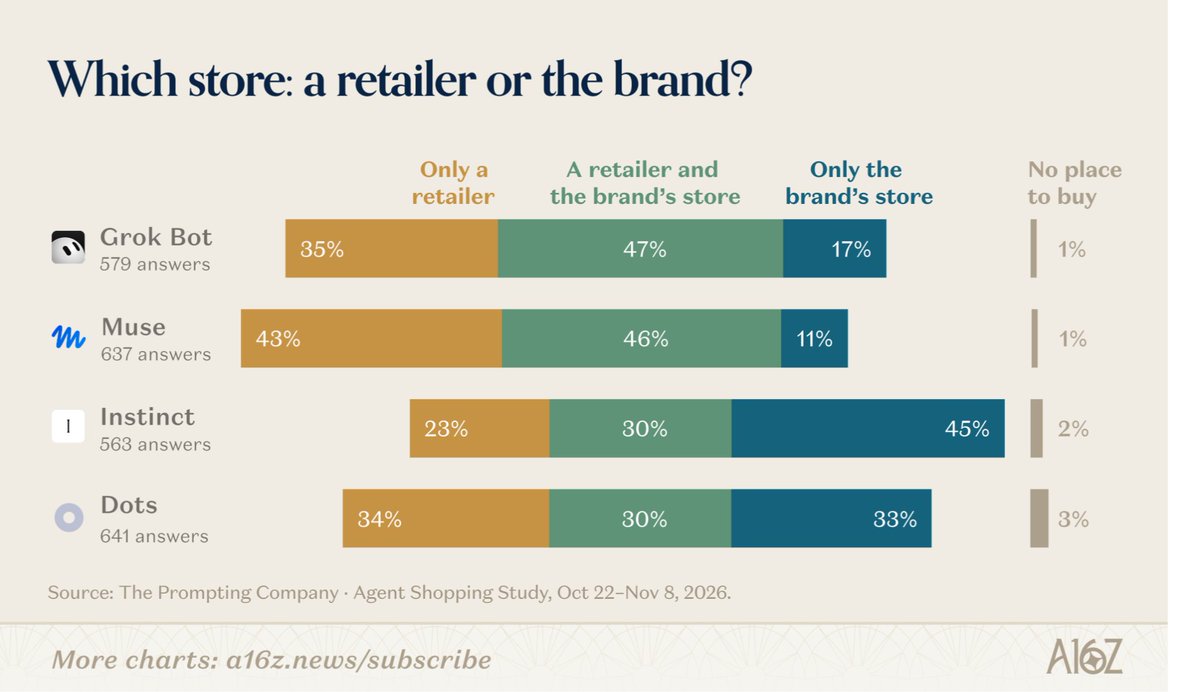
Different AI agents send shoppers to different stores.
In The Prompting Company's tests, Instinct linked only to the brand's own store in 45% of answers, compared with 11% for Muse.
Muse included a retailer in 89% of answers, either alone or alongside the brand's store.
Like people, each agent has its own taste - which can impact what products an agent even considers, as well as what it ultimately selects.
Full piece from a16z's Justine Moore and Olivia Moore: https://t.co/HD51wUbnwq
Agents are the next big distribution channel for products, services, and software.
But how do they decide what to recommend?
@omooretweets and I did a deep dive with @promptingco - and we're sharing takeaways after running 11k+ agent tests 👇 https://t.co/9tPBG9NJvj
What gets your product found, chosen, and bought by an AI agent?
a16z's Justine Moore and Olivia Moore partnered with The Prompting Company to test four consumer agents across 1,270 prompts and 11,307 completed runs.
Specific customer needs can overturn an agent's default recommendation. Shipping, returns, and seller credibility influence its choice. Requiring an account can stop it before checkout.
For businesses, winning an agent's business means making your product's value clear and giving the agent a path to actually buy or use it.
Full piece from a16z's Justine Moore and Olivia Moore: https://t.co/HD51wUbnwq
Agents are the next big distribution channel for products, services, and software.
But how do they decide what to recommend?
@omooretweets and I did a deep dive with @promptingco - and we're sharing takeaways after running 11k+ agent tests 👇 https://t.co/9tPBG9NJvj
OpenAI's Ashoka Rajendra, who cofounded Orchestra Bio, on the prospect of a one-person biotech company:
"Whether you are in manufacturing, at a pharma company, in clinical operations, in discovery and so on, how can these systems help you do the existing work you're doing faster and at higher quality, explore wider space?"
"I think that's a rising tide that will lift the entire industry. There are some substantial constraints, right? Human biology only moves so quickly. Regulation is a big lever that needs to be changed."
"But the industry has seen... what can small teams do in order to make breakthrough medicines. And I do think this is a great amplifier for the whole industry, with some fundamental limits, of course, in biology."
@JayRughani: "Do you think we'll see one-person biotechs anytime soon?"
@ashokaraj_: "Very much so, yes."
OpenAI is building tools to help scientists find insights in datasets too large for humans to fully explore. In one collaboration, 2,000 AI agents uncovered patterns in eight million cells that months of human analysis had missed.
OpenAI recently acquired Orchestra Bio, which Ashoka Rajendra cofounded to help scientists manage drug discovery and development. Together with OpenAI's Joy Jiao, he's working to bring a Codex-like experience to scientists.
Their view: AI could help researchers test more hypotheses, keep clinical trials on track, and even enable a single person to launch a biotech company with multiple drug programs.
Joy and Ashoka join a16z's Jay Rughani and Jorge Conde to discuss GPT-Rosalind, what makes biological data valuable, where startups can build alongside OpenAI, and more.
0:46 OpenAI's life sciences strategy
3:03 Why OpenAI bought Orchestra Bio
7:22 AI across the drug value chain
11:09 Infinite attention for biology data
14:28 2,000 agents vs 8 million cells
18:52 AI that pictures proteins in 3D
21:51 How agents keep trials from slipping
25:41 AI that fills clinical trials faster
29:46 Where pharma adopted AI fastest
35:37 Why manufacturing is ripe for AI
40:48 AI on both sides of insurance
43:34 The data OpenAI wishes existed
47:14 Advice for "data factory" founders
52:16 Where startups fit next to OpenAI
54:18 A 20-year diagnosis, solved by o3
59:00 Why prompts can't reveal bad intent
1:02:01 The rise of one-person biotechs
YouTube: https://t.co/FbE8PuSxsO
@joyjiao12@ashokaraj_@JayRughani@JorgeCondeBio
Agents may be the biggest distribution opportunity ever - working 24/7 on our behalf, with our wallets
How do you attract their attention?
We @a16z partnered with @promptingco on more than 10,000 runs across the four leading agents - our takeaways 👇
(cc @venturetwins)
OpenAI's Joy Jiao on building a Codex for scientists:
"One of the biggest things that we see with the models today is that there's what we call a capability overhang, and this means that there's a lot of things the models can do, but no one knows about it, and so no one has access to that."
"What we really wanna do is bring something that is as good as Codex for coders, for scientists and to biotechs and pharma."
"When we are training GPT-Rosalind, we have all these interesting capabilities in the model in both chemistry and structural biology. We see that the models are doing really well on the benchmarks."
"But one repeated theme we've seen is that people don't know how to use the models. They don't know even what prompts to use, what questions to ask. And I think this is really where you need an exceptionally good product or a good harness around the model to really make that capability accessible to people."
@joyjiao12
OpenAI is building tools to help scientists find insights in datasets too large for humans to fully explore. In one collaboration, 2,000 AI agents uncovered patterns in eight million cells that months of human analysis had missed.
OpenAI recently acquired Orchestra Bio, which Ashoka Rajendra cofounded to help scientists manage drug discovery and development. Together with OpenAI's Joy Jiao, he's working to bring a Codex-like experience to scientists.
Their view: AI could help researchers test more hypotheses, keep clinical trials on track, and even enable a single person to launch a biotech company with multiple drug programs.
Joy and Ashoka join a16z's Jay Rughani and Jorge Conde to discuss GPT-Rosalind, what makes biological data valuable, where startups can build alongside OpenAI, and more.
0:46 OpenAI's life sciences strategy
3:03 Why OpenAI bought Orchestra Bio
7:22 AI across the drug value chain
11:09 Infinite attention for biology data
14:28 2,000 agents vs 8 million cells
18:52 AI that pictures proteins in 3D
21:51 How agents keep trials from slipping
25:41 AI that fills clinical trials faster
29:46 Where pharma adopted AI fastest
35:37 Why manufacturing is ripe for AI
40:48 AI on both sides of insurance
43:34 The data OpenAI wishes existed
47:14 Advice for "data factory" founders
52:16 Where startups fit next to OpenAI
54:18 A 20-year diagnosis, solved by o3
59:00 Why prompts can't reveal bad intent
1:02:01 The rise of one-person biotechs
YouTube: https://t.co/FbE8PuSxsO
@joyjiao12@ashokaraj_@JayRughani@JorgeCondeBio
Full conversation with @ExaAILabs CRO Marcus Holm and a16z's @clu007:
00:00 Intro
01:17 Two Harvard roommates take on Google
02:45 Why 10¹⁸ is greater than 10¹⁰⁰
04:12 Do we really need another search engine?
06:01 How agents search
09:57 Why frontier models need a better knowledge layer
15:37 What hypergrowth does for a career
24:08 Where agentic search is taking off first
27:11 What perfect search could unlock
29:35 Marketing to humans and to agents
33:29 How the forward deployed engineers work
41:46 Why search could be winner-take-most again
Exa predicts that by 2030, AI agents will search the web 1,000x more than people do.
Harvard roommates Will Bryk and Jeff Wang started the company in 2021 to build a better search engine. Two weeks after Exa launched, ChatGPT came out.
Agents are a new kind of searcher, and Exa is built for them.
The company has grown 10x for three consecutive years, now handles 2 billion requests a month, and raised at a $2.2B valuation earlier this year.
Will and Jeff named it Exa after 10¹⁸, a smaller number than the googol (10¹⁰⁰) that inspired Google's name. Their explanation: "less is more."
Exa is hiring across all teams: https://t.co/Pqx7Yfiytt
@WilliamBryk@jeffzwang@ExaAILabs
We're thrilled to invest in Embo.
Robots can already do remarkable things in demos, but those skills are fragile. Move an object, change the lighting, or introduce something unfamiliar, and the robot can struggle.
@EmboAI is building the brain for the humanoid workforce. They start by training a world model on massive amounts of video and robot demonstrations so that robots learn general knowledge far beyond what could be collected on their hardware.
Then an agent practices skills inside that model, trying different actions across imagined scenarios and improving through reinforcement learning. The world model provides physical knowledge, and practice turns that knowledge into skills.
Danijar Hafner and Wilson Yan have spent years developing world models together, and their work includes pioneering research like Dreamer and VideoGPT.
Congrats @danijar, @wilson1yan, and the Embo team!
By @venturetwins, @RaghuRaghuram, and @BornsteinMatt
I'm excited to introduce Embo!
We are building the brain for intelligent robots to help people around the world.
We believe intelligent robots will unlock an era of abundance, making goods and services affordable for everybody. But to deploy them at scale, robots need to work out of the box in unfamiliar scenarios. At Embo, we are building frontier AI models with a deep understanding of physical reality and fine-grained motor skills.
Today's robot skills are fragile. Demonstrations can teach repetitive behaviors, but they cannot cover every object or situation a robot will encounter. We need general pretraining at internet scale to fill the gaps between individual tasks and practice to develop reliable motor skills.
The world models our team has pioneered unlock a path to general robots. Our robot brain pretrains on massive amounts of internet video to learn about objects, physical interactions, and how tasks unfold. It then practices motor skills in diverse imagined scenarios to become robust to unexpected situations.
Our team is behind seminal work in AI including Dreamer, VideoGPT, and Diffusion Forcing, with experience from DeepMind, Meta Superintelligence Labs, NVIDIA Cosmos, Berkeley, and MIT.
We have raised a $110M Seed led by @a16z. We are excited to partner with them, @khoslaventures, DST Global, NVentures (@nvidia), @strikervp, and other strategic investors to bring reliable intelligent robots out into the world.
@EmboAI
OpenAI is building tools to help scientists find insights in datasets too large for humans to fully explore. In one collaboration, 2,000 AI agents uncovered patterns in eight million cells that months of human analysis had missed.
OpenAI recently acquired Orchestra Bio, which Ashoka Rajendra cofounded to help scientists manage drug discovery and development. Together with OpenAI's Joy Jiao, he's working to bring a Codex-like experience to scientists.
Their view: AI could help researchers test more hypotheses, keep clinical trials on track, and even enable a single person to launch a biotech company with multiple drug programs.
Joy and Ashoka join a16z's Jay Rughani and Jorge Conde to discuss GPT-Rosalind, what makes biological data valuable, where startups can build alongside OpenAI, and more.
0:46 OpenAI's life sciences strategy
3:03 Why OpenAI bought Orchestra Bio
7:22 AI across the drug value chain
11:09 Infinite attention for biology data
14:28 2,000 agents vs 8 million cells
18:52 AI that pictures proteins in 3D
21:51 How agents keep trials from slipping
25:41 AI that fills clinical trials faster
29:46 Where pharma adopted AI fastest
35:37 Why manufacturing is ripe for AI
40:48 AI on both sides of insurance
43:34 The data OpenAI wishes existed
47:14 Advice for "data factory" founders
52:16 Where startups fit next to OpenAI
54:18 A 20-year diagnosis, solved by o3
59:00 Why prompts can't reveal bad intent
1:02:01 The rise of one-person biotechs
YouTube: https://t.co/FbE8PuSxsO
@joyjiao12@ashokaraj_@JayRughani@JorgeCondeBio
a16z's Moses Sternstein on why "there is no Gen Z":
"If you take Gen Z and you put them in a room of 99 other Gen Zs, 99 other millennials, 99 other Gen X, 99 other boomers, the odds of them finding a perfect match are almost the same. They actually have a slightly higher likelihood of matching with Gen X and boomers than they do with Gen Z."
"It's definitely heterogeneity, but it also just might be there are more Gen Z tribes... If you're trying to find some kind of uniform cohort, you're just not gonna find it."
"They are fragmented by their different online, by their internet consumption."
"And the implication, whether for politics, for marketing, for institutional trust is, everybody keeps asking, how do we reach the youngs? How do we reach these kids? But the issue is that of course, there is no Gen Z, so it's a hard problem to solve."
@MosesSternstein@alex_danco
Gen Z people are surprisingly unlike anyone, including other Gen Z people
In a room of 99 other Zoomers from the same country, 8.5% found someone with identical answers to 13 policy questions
That barely changed when the room was filled with Millennials, Gen X or Boomers
Charts of the Week: https://t.co/qIQ4CcNvd1
Planes stopped, bookings spiked
After the November 13 FAA ground stop, car and hotel bookings on Navan spiked to roughly twice their normal hourly volume as travelers searched for alternatives
Charts of the Week: https://t.co/LqguBQ2ukE
The super powers of AI is putting the spirited individual in the center. The Idea Guy suddenly has an avenue to push their dreams that doesn't rely on raising big money or being a master programmer. This is very exciting.
There's never been a better time to be delusionally ambitious than today. I talk about Omarchy, agents, 90s demo culture, and so much more with the gang from @a16z. https://t.co/hsIBvgyJBz