Today we're launching the new standard for how to sell with AI, built with 10 of the most-followed voices in enterprise sales.
For 30 years, we've perfected how sellers run a deal.
We have MEDDPICC, Challenger, Command of the Message. Sales leaders spend months turning them into sales process docs with exit criteria, qualification rules, and forecasting guidance, then ship them to the field.
But nobody shows reps what to put in front of the buyer to win. Aside from a generic pitch deck, everything else is left to interpretation. No templates. No examples. No standard.
So the top 1% of reps build their own: tailored first-call deck, champion enablement doc, mutual action plan. Everyone else guesses.
AI has turned this gap into a crisis by giving every seller the power to create content for buyers without knowing what good looks like.
The end result: buyers are drowning in polished but ineffective content, and they're tuning out.
So we built the missing half. We teamed up with 10 of the sharpest minds in enterprise sales to map what the top 1% do at the ten moments that matter most, and how AI is changing each one.
Introducing the 𝗕𝘂𝘆𝗲𝗿 𝗘𝘅𝗽𝗲𝗿𝗶𝗲𝗻𝗰𝗲 𝗚𝘂𝗶𝗱𝗲:
@KnuthJen23597 on building the account POV behind $50M+ closed with C-level buyers
@kylecnorton on building the best outbound and cold call strategy we've ever seen
@aprildunford on the first-call pitch she's built for 200+ companies
@Chris_Orlob on the demo lessons from thousands of recorded calls
@NNasrall on the business case that lets your champion close the deal without you
@samfjacobs on how to connect with execs and pitch the Economic Buyer
Rippling's Ricky Peca on the deal room that helped him hit 300% of quota
@JamesKaikis on scoping pilots that align teams and convert
@NickCeg on the seven-figure pricing proposal a CFO will actually read
@RomeenSheth and @travisjgood on the AI security playbook that answers 90% of buyer questions
Every moment comes with their playbook, where reps go wrong, how to avoid AI slop, and ready-to-use templates.
Who it's for: reps selling AI products, sales leaders chasing a higher win rate, and the enablement and product marketing teams who equip them.
Grab all ten templates, with the expert breakdown behind each:
https://t.co/FxXOqHAJM1
P.S. Mutiny's sales assistant is trained on these templates and sales frameworks. Join the early preview for free on our homepage.
Over 85% of oncologists at Memorial Sloan Kettering Cancer Center use OpenEvidence.
Together, @MSKCancerCenter and OpenEvidence have built OncoKB, MSK’s expert interpretation of a tumor’s genetics, directly into OpenEvidence, putting it in the hands of oncologists across the United States.
As Dr. Anaeze Offodile puts it: “Our mission is to end cancer for life.” As of today, we are widening OncoKB’s reach so that patients everywhere benefit from the same rigor as patients at MSK. Watch the story.
We're living in a new world! Two critical PHP vulnerabilities led to the shutdown of many websites, including government websites in Holland and Finland.
https://t.co/J85q1nU0Vl
I spoke to @dougleone about his first investment since returning back to an active investing role at Sequoia
I did not expect it to be a company that acquires customers through "Whopathons"
Fun read & my latest for @technology
https://t.co/S1Qx3lIKeu
LFG!! We @sequoia are so pumped to be partnering with Steven (@cultured) and @whop by leading this round with 🐐 @dougleone joining the board.
Whop is the best place for the exploding community of internet entrepreneurs to build their businesses. Every day they work towards their mission of delivering everyone a sustainable income.
It is a truly unique company in their pace of execution, breadth of platform and diversity of customers. We are SO bullish 🚀🚀🚀
I waited, learned and made my first investment since returning as an active investor at Sequoia.
Whop is a special company, and I’m excited to help them to create jobs and stimulate the economy.
@sequoia is leading our Series C at a $1B valuation.
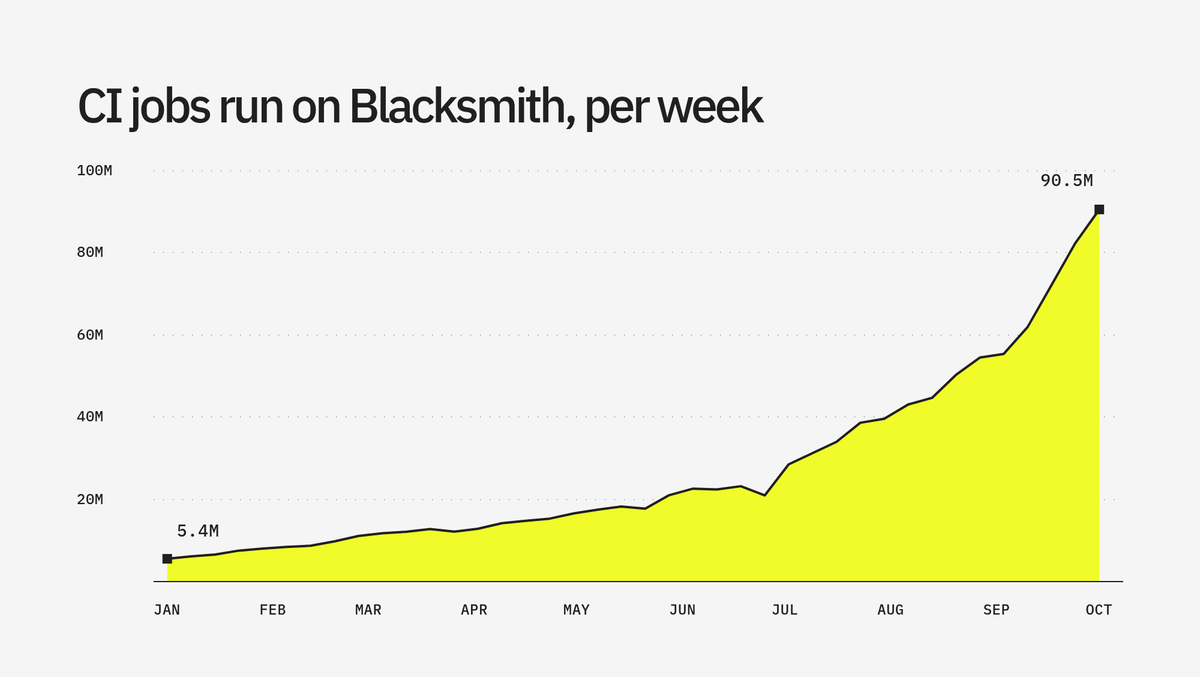
We started Blacksmith in 2024 to make CI faster and less painful. In January we ran 5 million CI jobs a week. Today it's over 90 million and growing, and we’re still early.
Biological intelligence to bootstrap robotic intelligence?
If robotics is about to enter its golden age, @MeckaAI is one of the companies feeding it, by sensorizing humans to train robots.
The biggest challenge robotics faces is the data flywheel cold start problem. LLMs got a free cold start from the internet: trillions of tokens, already written. Robotics gets nothing. Someone has to go create the training data to jumpstart the system.
@joshavata is the co-founder and CEO of Mecka, the data and deployment company for physical AI. Josh read every robotics paper he could find in late 2024, visited the labs, and made a bet: humans and humanoids look the same, so humans could act as the training fleet. Egocentric data, first-person video of people doing real work, could become vital fuel.
Two years ago, the biggest egocentric dataset was Ego4D at 4,000 hours. The field is now in the millions of hours, thanks in part to Mecka. We’re probably still orders of magnitude of training data away from robotics nirvana. But every rung on the physical intelligence ladder unlocks real commercial tasks. And eventually, Josh imagines a world with an order of magnitude more robots than people, of a plurality of shapes and sizes and use cases, as the Hitchhiker’s Guide to the Galaxy foretold :)
A few things we cover in this conversation.
- Why robotics has no cold start: pixels, actions and logic, and why pre-training data is a real market in robotics in a way it never was for LLMs
- What “teaching robots about carbon life” means: in sci-fi the final frontier is organic. The human brain runs on 20 watts and self-heals
- The egocentric bet: teleop couldn’t scale, humans and humanoids share a form, so Waymo-fy the humans. The first pilot was aunties and uncles recording themselves cooking on a mobile app
- Force data: video can’t tell a robot how hard to squeeze an egg. Wrist cameras are a hack. Mecka built the gloves instead
- Inside the data factory: a consumer app that streams your tasks, a B2B engine recruiting across “the taxonomy of all physical human work,” 100-gigabit upload lines, hundreds of petabytes
- Millions of hours vs. Tesla’s decade on two degrees of freedom, and why it’s a slow creep up, not a GPT-3 moment
- The home has the most data and is the hardest place to deploy. Laundry folding and assembly-line pick-and-place get solved in the next year or two
- Useful robots already exist: hotel delivery and cleaning bots in China and Southeast Asia, industrial cleaning in the US. Humanoids are the terminal state, not the first step
- Deployment diffusion: a modern systems integrator whose installed robot does something next week it couldn’t do last week. If Mecka ever helps deploy a robot that mines an asteroid, they’ve done their job
- The data pot of soup: a million hours of human data, tens of thousands of UMI, a few hours of in-domain teleop. Tactile and simulation haven’t entered the mix yet
- Move 37 for robotics: AlphaGo went behavior cloning, then self-play, then magic. The catch is the rules of the game are the entire physical world, and we don’t have the simulator yet
- Will the AGI labs steamroll robotics? “It takes a lot of courage to scale up data with imperfect information.”
- The Kawasaki Corleo, the robot panther-dog-horse on Mecka’s conference room wall, and why the future of robotics looks like Hitchhiker’s Guide to the Galaxy
Timestamps:
0:00 – Introduction
1:46 – What Mecka is: pixels, actions and logic
2:45 – Is robot data economically feasible without the internet?
4:15 – Teaching robots about carbon life
5:27 – Cloud kitchens, stablecoins and the path to robotics
7:03 – Entering robotics with a fresh lens
8:45 – What egocentric data is and why Mecka bet on it
10:09 – The first pilot: aunties and uncles with a mobile app
10:42 – Force data and tactile gloves
11:55 – Inside the operations of a data factory
14:41 – Heat-mapping the taxonomy of human work
15:42 – Quality gates, fraud and the McDonald’s POV videos
17:44 – Earning a margin as a data intermediary
19:33 – Millions of hours vs. Tesla’s decade
20:55 – Why it isn’t binary: unlocking commercial tasks along the way
22:02 – Home data is plentiful; home robots are the hardest
23:24 – Useful robots can be deployed today
24:35 – When robotics gets an FSD-style flywheel
26:42 – Deployment diffusion and the modern systems integrator
28:21 – Favorite vertical robot categories; mining an asteroid
30:08 – The hardware slate: Waymo-fying people
30:55 – EgoVerse
32:04 – The data pot of soup: the converged training mix
33:54 – Move 37 for robotics: AlphaGo and Federer
36:02 – World models and the training mix
36:58 – Will scaling the current mix get us to the promised land?
39:05 – Will the AGI labs steamroll robotics?
40:50 – Sci-fi roots and the Kawasaki Corleo
42:44 – How many robots in a decade?
How do you write a reward function for "science"?
You don't.
Evolution optimized fitness and got the complexity of life.
@IneffableLabs founder David Silver on simple objectives in complex worlds, and the chain from coordinating to communicating to trading to arithmetic to tools to science.
David Silver is one of the all-time greats. He was the creator of AlphaGo, which changed the course of history by showing that neural nets could achieve superhuman performance for the first time.
He also has a unique intuition and knack for forecasting when things will happen in AI. With computer Go, he predicted the Lee Sodol outcome 10 years before, right to the year. He got the year right for Starcraft and won a bet inside Deepmind. Same for AlphaProof. Same for the IMO.
David's prediction for superintelligence: 3 years. !!! He has a strong sense that now is the time to build a superleaner, and that superlearners are now possible, thanks to the enormous progress in compute, simulators, autoresearch, and the sophistication of technology in the stack since the AlphaGo days.
What is a “super learner”? A super learner discovers all knowledge from its own experience. Start from nothing (no internet pre-training), and go beyond human knowledge. Drop it into any stream of experience, simulated or physical, and the superlearner learns.
He expects the progress will be rapid. When you get the recipe for a superlearner just right and remove humans from the development loop altogether, a superlearner can learn extremely quickly. Just look at AlphaGo. AlphaGo took two years to develop with humans in the loop. When David and his team at @GoogleDeepMind got the formula for AlphaZero correctly, it surpassed the human-developed algorithms in just a few hours. Human data is a shortcut, but you have to let go of the human data to shoot beyond it.
In January, David left GDM to found @IneffableLabs, a research-led lab with one mission: build a "super learner" that discovers all knowledge from its own experience, and make first contact with superintelligence.
He joins us with co-founder Lasse Espeholt, who built IMPALA and SEED RL, the foundations of scaled-up RL, and now runs Ineffable's compute.
A few things we cover in this conversation.
— What a super learner is: depth (start from nothing, go beyond human knowledge) and breadth (drop it into any stream of experience, simulated or physical). The human brain is the only existence proof
— Why they're giving up human data: AlphaGo took two years with humans in the loop. AlphaZero outperformed it in a few hours. "You have to let go of the human data to shoot past the competition"
— Crucibles: simulated worlds with enough emergent complexity (physics engines, millions of interacting agents) for an agent to rediscover technology, science, maths and language on its own
— Simple rewards, emergent complexity: evolution optimized fitness and got all of life. Don't breadcrumb the objective, give the agent something simple to optimize in a world with a lot to learn about
— Go as the existence proof: one agent is the most boring game imaginable, two agents is "an infinite onion of layers of complexity"
— Why human language is probably not the endpoint for reasoning, and how training on it bakes in a flat earth and the four humors
— Can superintelligence be built in simulation? If the sim is Turing complete, computation, economics, language and maths are all expressible, and it happens 10-100x faster and safer
— Alignment: language-based monitoring is reaching its limits as agents learn to say one thing and do another. Shadow actions, superintelligences monitoring superintelligences, and building a real science of how they interact peacefully
— Accelerate in simulation, pace in the real world: Ineffable will gate real-world deployment on evidence that it goes well
— Timing as the determinant: Silver called Computer Go to the year, then StarCraft, then the IMO. He thinks this is the moment
— Predictions: True superintelligence within three years.
Timestamps:
0:00 – Introduction
1:09 – What held true from Go to today, and what the LLM era changed
3:35 – Why leave DeepMind to start a new lab
5:58 – Why "Ineffable" (and the secret second reason)
7:03 – Lasse's path: scaling RL at DeepMind and Google Brain
9:31 – Defining a super learner and first contact
12:35 – Super learners vs. LLMs that make discoveries
13:59 – Day to day: the RL stack, crucibles and human-journey milestones
16:13 – Don't breadcrumb the objective: simple rewards, emergent complexity
21:16 – What a crucible looks like
24:14 – Go: one agent is boring, two is infinite
25:41 – Will agents rediscover language?
27:22 – Removing human priors: AlphaGo to AlphaZero
32:05 – Keeping human bias out of the crucibles
33:35 – Confidence, timing and super forecasting
36:24 – Is compute the driver?
38:13 – The ceiling on simulation and Rich Sutton's objection
43:44 – Alignment and the science of superintelligence
47:45 – Monitoring agents that don't think in English
51:01 – Pacing the frontier
52:54 – The compute setup: Vera Rubin on GCP
55:18 – Training, inference, simulation and RL scaling laws
57:40 – IMPALA and SEED RL
1:00:58 – 20 people and the compute-per-person ratio
1:04:49 – A research-led culture
1:05:47 – Predictions
"What's the slowest thing to move in technology? The humans that work with it."
@Alfred_Lin on why the gap between model capability and real-world use is where the opportunity is at @stanfordaiclub
Is being technical still worth it when AI commoditizes math and coding?
We asked @Alfred_Lin of @Sequoia. We also talked about feature vs. real company, circular money in AI, and the rate of diffusion of technology.
Full talk 👇
https://t.co/0zRdz0zjEh
Beam is yours to build on. Open weights, Apache 2.0. Alongside Mirror CLI, the harness Reflection built and trained it on.
Proud of this team. Let’s build! 🇺🇸
“If a large company wants to kill you, they will kill you. But you know what? They’re distracted.”
@Alfred_Lin sat down with the @stanfordaiclub to share what he’s learned backing founders from idea to IPO, and why two people and an idea shouldn’t worry about defensibility yet.
Is being technical still worth it when AI commoditizes math and coding?
We asked @Alfred_Lin of @Sequoia. We also talked about feature vs. real company, circular money in AI, and the rate of diffusion of technology.
Full talk 👇
https://t.co/0zRdz0zjEh
Great to talk with the Stanford AI Club and the next generation of builders at Stanford. We've posted the full talk. Tune in if you want to hear me ramble about finding the right problems to solve, what's a feature vs a company, the future of math and humanities, and increasing our perspective on the size of the prize.
My main piece of advice to the audience was that they're in a privileged situation to take risk with their whole careers ahead of them, and have the tailwind of the biggest megatrend we've seen since the internet. Dream big and take the risk, before it becomes more expensive to do so.
Is being technical still worth it when AI commoditizes math and coding?
We asked @Alfred_Lin of @Sequoia. We also talked about feature vs. real company, circular money in AI, and the rate of diffusion of technology.
Full talk 👇
https://t.co/0zRdz0zjEh
As the world’s largest alternative asset manager, @Blackstone requires the highest standards of deployment flexibility and governance.
Factory made it possible to operate agentic software development within Blackstone’s own data centers without compromising model choice or workflows.
We invested in Abby Care because we need better home-based care options. All of us have felt the pain of how long it can take to get care at a medical facility. That pain is even worse for those who need ongoing home care.
@FortuneMagazine just wrote on their $82M Series C, and how they're building the infrastructure to support families caring for loved ones at home. In short, they're applying modern technology to drive higher quality health outcomes. Technology exists to improve our lives, and Abby Care has a real and tangible impact on those receiving, providing, and paying for home based care.
We’re excited to support Abby Care’s next phase of growth and the impact it will have on families across the country.
https://t.co/nw90e89n0Q
David Silver founded @IneffableLabs with a mission to build a "super learner" and make first contact with superintelligence.
He says a super learner has capacity in two dimensions.
Depth: it starts from knowing nothing at all and goes all the way to discovering things beyond what humans know.
Breadth: you can drop it into any stream of experience and it keeps learning.
His analogy is us. Humans started with gray mush and discovered languages, technology, science and mathematics for ourselves. Nobody handed us a blueprint or a dataset.
No AI system has done that yet.
David Silver is one of the all-time greats. He was the creator of AlphaGo, which changed the course of history by showing that neural nets could achieve superhuman performance for the first time.
He also has a unique intuition and knack for forecasting when things will happen in AI. With computer Go, he predicted the Lee Sodol outcome 10 years before, right to the year. He got the year right for Starcraft and won a bet inside Deepmind. Same for AlphaProof. Same for the IMO.
David's prediction for superintelligence: 3 years. !!! He has a strong sense that now is the time to build a superleaner, and that superlearners are now possible, thanks to the enormous progress in compute, simulators, autoresearch, and the sophistication of technology in the stack since the AlphaGo days.
What is a “super learner”? A super learner discovers all knowledge from its own experience. Start from nothing (no internet pre-training), and go beyond human knowledge. Drop it into any stream of experience, simulated or physical, and the superlearner learns.
He expects the progress will be rapid. When you get the recipe for a superlearner just right and remove humans from the development loop altogether, a superlearner can learn extremely quickly. Just look at AlphaGo. AlphaGo took two years to develop with humans in the loop. When David and his team at @GoogleDeepMind got the formula for AlphaZero correctly, it surpassed the human-developed algorithms in just a few hours. Human data is a shortcut, but you have to let go of the human data to shoot beyond it.
In January, David left GDM to found @IneffableLabs, a research-led lab with one mission: build a "super learner" that discovers all knowledge from its own experience, and make first contact with superintelligence.
He joins us with co-founder Lasse Espeholt, who built IMPALA and SEED RL, the foundations of scaled-up RL, and now runs Ineffable's compute.
A few things we cover in this conversation.
— What a super learner is: depth (start from nothing, go beyond human knowledge) and breadth (drop it into any stream of experience, simulated or physical). The human brain is the only existence proof
— Why they're giving up human data: AlphaGo took two years with humans in the loop. AlphaZero outperformed it in a few hours. "You have to let go of the human data to shoot past the competition"
— Crucibles: simulated worlds with enough emergent complexity (physics engines, millions of interacting agents) for an agent to rediscover technology, science, maths and language on its own
— Simple rewards, emergent complexity: evolution optimized fitness and got all of life. Don't breadcrumb the objective, give the agent something simple to optimize in a world with a lot to learn about
— Go as the existence proof: one agent is the most boring game imaginable, two agents is "an infinite onion of layers of complexity"
— Why human language is probably not the endpoint for reasoning, and how training on it bakes in a flat earth and the four humors
— Can superintelligence be built in simulation? If the sim is Turing complete, computation, economics, language and maths are all expressible, and it happens 10-100x faster and safer
— Alignment: language-based monitoring is reaching its limits as agents learn to say one thing and do another. Shadow actions, superintelligences monitoring superintelligences, and building a real science of how they interact peacefully
— Accelerate in simulation, pace in the real world: Ineffable will gate real-world deployment on evidence that it goes well
— Timing as the determinant: Silver called Computer Go to the year, then StarCraft, then the IMO. He thinks this is the moment
— Predictions: True superintelligence within three years.
Timestamps:
0:00 – Introduction
1:09 – What held true from Go to today, and what the LLM era changed
3:35 – Why leave DeepMind to start a new lab
5:58 – Why "Ineffable" (and the secret second reason)
7:03 – Lasse's path: scaling RL at DeepMind and Google Brain
9:31 – Defining a super learner and first contact
12:35 – Super learners vs. LLMs that make discoveries
13:59 – Day to day: the RL stack, crucibles and human-journey milestones
16:13 – Don't breadcrumb the objective: simple rewards, emergent complexity
21:16 – What a crucible looks like
24:14 – Go: one agent is boring, two is infinite
25:41 – Will agents rediscover language?
27:22 – Removing human priors: AlphaGo to AlphaZero
32:05 – Keeping human bias out of the crucibles
33:35 – Confidence, timing and super forecasting
36:24 – Is compute the driver?
38:13 – The ceiling on simulation and Rich Sutton's objection
43:44 – Alignment and the science of superintelligence
47:45 – Monitoring agents that don't think in English
51:01 – Pacing the frontier
52:54 – The compute setup: Vera Rubin on GCP
55:18 – Training, inference, simulation and RL scaling laws
57:40 – IMPALA and SEED RL
1:00:58 – 20 people and the compute-per-person ratio
1:04:49 – A research-led culture
1:05:47 – Predictions
It's been incredible partnering with David and team. Those outside the industry may not immediately recognize his name (yet), but he's one of the greats and we're excited for what's ahead. Tune in for more on how they're applying the lessons from AlphaGo, AlphaZero, and more to build a super learner and power the next phase of AI.