Partner @Sequoia. Investing in AI, from company formation. 1st partner to @linear @mach_industries @middeskhq @reflection_ai @ricursiveai @skildai @tavus
I’m starting a new early-stage AI fund, doing what I love: partnering with founders from company formation on bold bets, long before consensus.
The fund’s LPs will include Sequoia, Jeff Dean, Sachin Katti, Philip Wong (my Stanford professor and Chief Scientist adviser to TSMC), and others whose work has shaped our industry and how I think about AI’s future.
I’ll remain a partner at Sequoia and keep serving on my boards on Sequoia’s behalf.
Sequoia has been my home for the past 11 years. I joined as the youngest investor the firm had ever hired. I grew up here. Through years of intense debate and shared work, I found lifelong mentors and friends who took me under their wing and taught me this craft. They taught me to aim high and take big swings. I’ll carry that into what I build: outsized ambition, relentless truth-seeking and curiosity, and a refusal to become complacent.
Working alongside founders has made me want to build something of my own: a firm shaped from day one around the convictions I’ve developed over the past decade.
Life has taught me not to take time for granted. This is how I want to spend mine.
Why now
We’re seeing a new way of building companies in today’s AI era. Research and products often advance together. A breakthrough can open a market or accelerate a business far faster than expected. Some companies require extraordinary capital and compute early on. Others reach meaningful scale with remarkably small teams. The rules for how big these businesses can get, and how fast, are being rewritten.
But early on, the technology is unproven, the resources required enormous, and the vision seemingly implausible.
This is what I love most: seeing the potential right from the beginning, and helping founders realize their full scale of ambition.
More than ever, it starts with an extreme willingness to believe early, with bold, independent conviction in a founder’s technical insight before any product or market validation. Then, it means helping founders take the biggest swings, giving the rare, long-term patience to see those bets through uncertainty, ambiguity, and turbulence, and serving as a level head when the stakes are highest.
I learned this kind of partnership at Sequoia. It’s the foundation of the firm I’m building.
Believing before consensus
My fascination with AI’s potential took root at Stanford in the early-to-mid 2010s, studying computer science and working in Andrew Ng’s lab. The friendships I formed connected me to a community whose people and ideas would help shape modern AI and build some of our generation’s defining companies. What stayed with me was the gap between what those people saw was possible and what the wider world could imagine.
I’m drawn to founders pursuing ambitions that sound impossible today.
I start with a simple question: “What if everything goes right?”
Then we work backward together to make it happen.
In 2023, Deepak and Abhinav set out to build a general-purpose robot brain at @SkildAI, before physical AI was a consensus bet. Their sim-to-real breakthroughs gave me conviction where earlier robotics approaches had fallen short. But the data flywheel required deployment at scale. We made commercialization as urgent as research and brought in strategic partners like NVIDIA and SoftBank to support the ambition. Three years in, Skild is advancing the frontier of physical AI with nine figures in annualized revenue.
In 2024, Ioannis and Misha founded @reflection_ai with an insight into scaling reinforcement learning. As that grew into the ambition to build a Western frontier lab for open models, the hard question was how a startup competes with labs spending tens of billions. An introduction to NVIDIA and many compute calls and recruiting events later, the team has built Beam, now one of the leading US open models.
In 2025, Anna and Azalia, the co-creators of AlphaChip, founded @RicursiveAI to design models and hardware together. From day one, we made early customers and ecosystem partners a priority. Today, they are showing order-of-magnitude improvements on real workloads, working with some of the industry’s most consequential players, and reaching a defining inflection point.
The ambition keeps growing as these companies scale.
@linear has always had a kind of magic to it. Now it’s the system a new generation of AI companies builds on, for teams and agents alike.
@tavus saw early that we’d one day talk to AI the way we talk to each other. Today, it’s building the human computing interface for a world of AI colleagues.
@Mach_Industries began as hydrogen experiments in an MIT dorm room. It has since become one of the most exciting next-generation defense companies.
Making the ambition possible
Being a first believer is only the beginning. Compute falls through. A deep-pocketed incumbent makes your mission its top priority. A breakthrough changes the opportunity and the capital required overnight.
These are stomach-churning moments, and early belief carries a responsibility to help make the bet work.
This is the partnership I love: turning the full ambition into concrete steps. Raising capital, securing compute and strategic partners, recruiting exceptional people, and winning the first customers together. Thinking several moves ahead while solving what’s in front of us. And as breakthroughs open new possibilities, helping founders dream even bigger.
Thank you
To the founders I’ve worked with: thank you for trusting me and Sequoia to be your first partner and first believer. It’s been the joy of a lifetime, and I can’t wait to keep building together.
Thank you to Alfred and Pat for your leadership of Sequoia and your support of my next chapter. To Roelof, for bringing me into Sequoia and believing in me from the beginning. Alfred and Roelof, you have been mentors in investing and in life. So much of what I know, and the investor I’ve become, comes from your guidance and generosity over the years. To Bill, for the close partnership and wealth of knowledge, always wrapped in humility. To Shaun, for showing me how to think deeply and imaginatively. To Michael Moritz, for inspiring 22-year-old me to dream big. To Doug, for teaching me to keep things simple. To Bogie and Jess, for bringing joy to the everyday and perspective on what matters. And to all my Sequoia teammates, for the friendship, camaraderie, and lessons I’ll carry with me.
To my family, especially my husband and my brother, who have each started companies of their own: thank you for giving me the courage to take this leap.
Let’s get to work!
It was the worst of times, it is the best of times. It was the season of Darkness, it is the season of Light. It was the Winter of despair, it is the Spring of hope.
Today is, perhaps, the end of the beginning.
Summer is coming. Congrats to humanity. 💚💚💚
What would it take to learn general manipulation entirely in sim? Accuracy, scalability, and diversity.
Steel is our new physics solver, and it's (1) accurate. Each week we close the sim2real gap even more, this week on magnetic contacts and closed-loop joints.
It's (2) scalable. Heterogeneous environments are painful to run at scale. So we worked with @NVIDIARobotics to take full advantage of the GPU, reaching speeds >10x faster than PhysX.
Now, coding agents have unlocked environment creation at scale. We built Steel for them. Today we're releasing agent-first docs and examples to make it even easier. So (3) — it's diverse.
There's never been a better time for sim.
Very excited to see this! Congrats Jason, and congrats even more to Mercor for a massive leadership win! 🥇 I can attest to the fact that Jason has long been obsessed with this problem and I’m so excited to him make his dent on Mercor and the ecosystem 💥
After an amazing year at Meta’s TBD lab, I am very excited to join Mercor as Chief Scientist. Data will shape the next frontier as more companies train AI models than ever before. Mercor is incredible and I look forward to building the future with Brendan, Adarsh, and team!
Over the past week, I’ve been overwhelmed by the love and support of friends, industry colleagues, and people I've never met. Thank you to everyone who has shown kindness to my family and me. It means the world to me.
I came to the United States 53 years ago, and becoming an American citizen is one of the greatest gifts and proudest moments of my life. NVIDIA has been my life’s work. Building it into the company it is today alongside my colleagues has been a privilege and an honor. Nowhere but in America could a company like NVIDIA be possible. I love our country, and I love NVIDIA.
I did not live up to the standards expected of everyone at NVIDIA, and I have made serious mistakes in my personal life. I created problems for the Board that I deeply regret. I own my mistakes completely, and I am committed to cooperating with the Board’s independent investigation.
Since my departure, I’ve seen an outpouring of calls from NVIDIA’s employees, investors, business partners, and customers for me to return as CEO. Many continue to reach out to me directly as the company navigates complex technology, market, competitive, and geopolitical dynamics. NVIDIA is a once-in-a-generation company. If the Board of Directors decides that my return is in the best interest of our shareholders, our employees, the company, and America, I would be honored to answer these calls and return as CEO.
Thank you again to everyone who has shared their good wishes. I am profoundly humbled by your support. To my family: I love you, and I will spend the rest of my life being worthy of yours.
Jensen
The first @RicursiveAI hackathon, centered on Ripple-65B Preview, was so much fun! Participants built impressive computer use demos, a lightning-fast IDE built and operated by Ripple, kernel designs that outperformed Luna, and more.
We never directly optimized the model for some of these capabilities, like some cool visual demos.
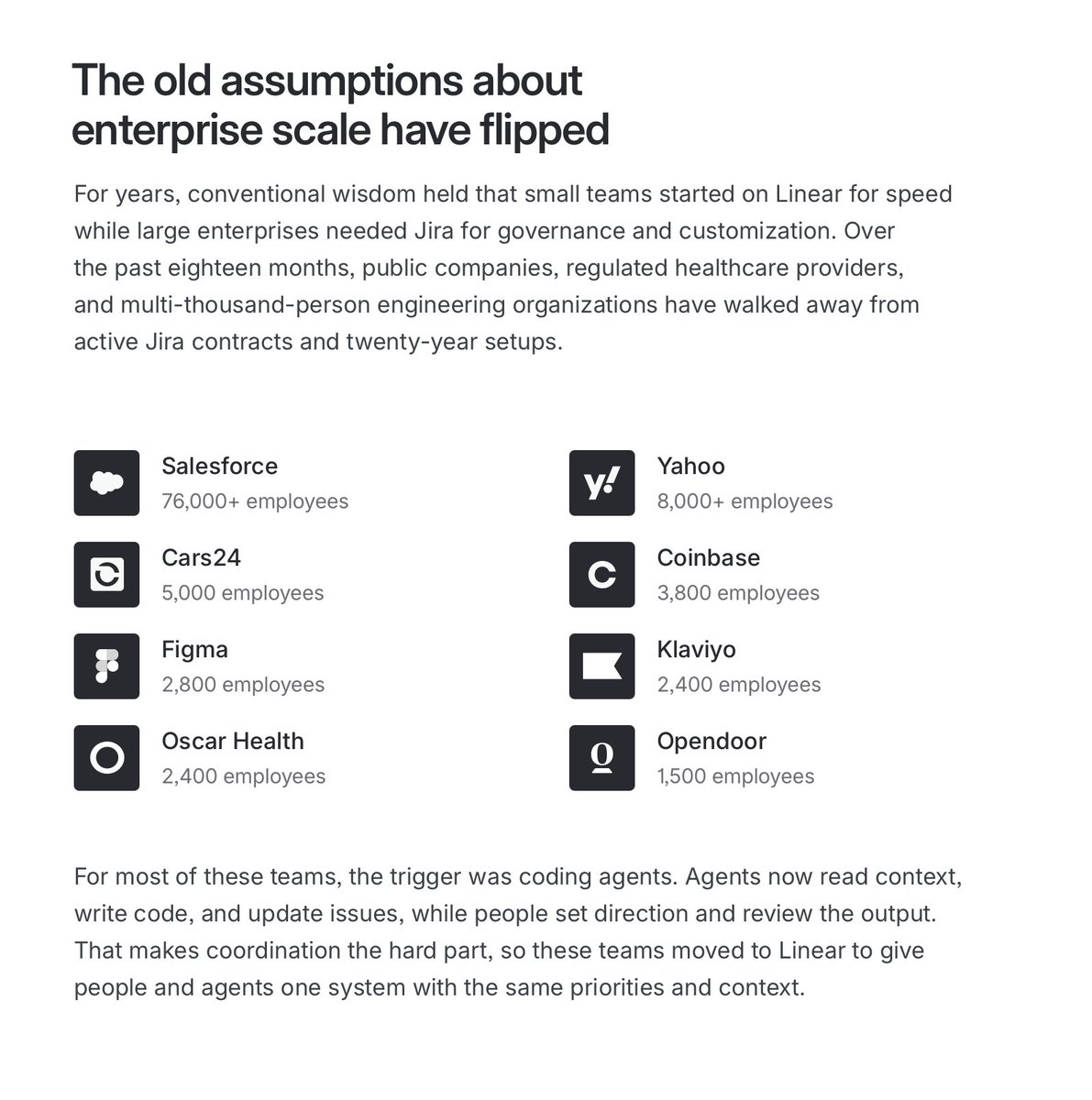
Just a few big names that have moved to @linear
Overly complicated setups feel increasingly unnecessary. What matters now is giving your team a clear path to make the most of the velocity the agents give us
Introducing Speculative Self-Distillation (SSD), which improves accuracy and effiecieny and reduces forgetting in self distillation.
It turns out only a few tokens in a rollout actually depend on the new knowledge. Letting the teacher generate just those tokens results in nearly matching on-policy self-distillation with 38–69% fewer training tokens, and the model forgets less.
Great work co-led by @talaei_shayan, @chewing_a_gum and @ckodser, with @jonashubotter and Amin Saberi (NeurIPS 2026). Check out Shayan’s thread for more.
Last week we released Ripple-65B Preview. This Friday, come build with it.
Ricursive After Dark Hackathon: Fri Nov 13, 3PM–10PM, at our Palo Alto office. Compute, dinner, and hardware prizes.
Applications close Thursday, November 12 at noon PT. Accepted participants will be notified by email Thursday night with the address and full details.
https://t.co/zkOcwkS8nD
Today we’re open-sourcing Steel, our internal physics solver built with @NVIDIA.
It runs simulations up to 13× faster than PhysX while using ~3× less GPU memory.
Steel unlocks scaleable simulation for manipulation, for everyone.
AI is using more and more of the world’s energy. But how much economic value are we getting from AI?
We’re introducing Joules-to-GDP (J2G), a framework that measures how well AI turns energy into economic value and shows which tasks, models, and hardware give the best return.
Across 44 occupations in finance, engineering, law, administrative work, and more in @OpenAI's GDPval, we arrive at three findings:
1) The tasks with the highest economic value are not the tasks with the highest economic value per joule. For example, CAD design earns ~10% more per task than building websites, but the latter earns ~27% more value per joule.
2) The most powerful model isn’t always the best use of energy. Gemma 4 31B delivers 56% of GLM 5.2’s net value with 23% of the energy, for 2.5x the value per joule.
3) More chips don’t guarantee proportionate returns. Moving the same model from 1 to 8 NVIDIA H100s uses 3.2x the energy but cuts completion time by only 22%, with about the same value.
With @SnorkelAI, we’re also releasing GDPWorks, a benchmark for economically valuable tasks across 36 additional occupations.
Joint work co-led by @amirzeinaalii and @Avanika15, with @Mersad_Abbasi, @Jon_Hartley_, John Hennessy, @HazyResearch, and @Azaliamirh.
More details below 🧵
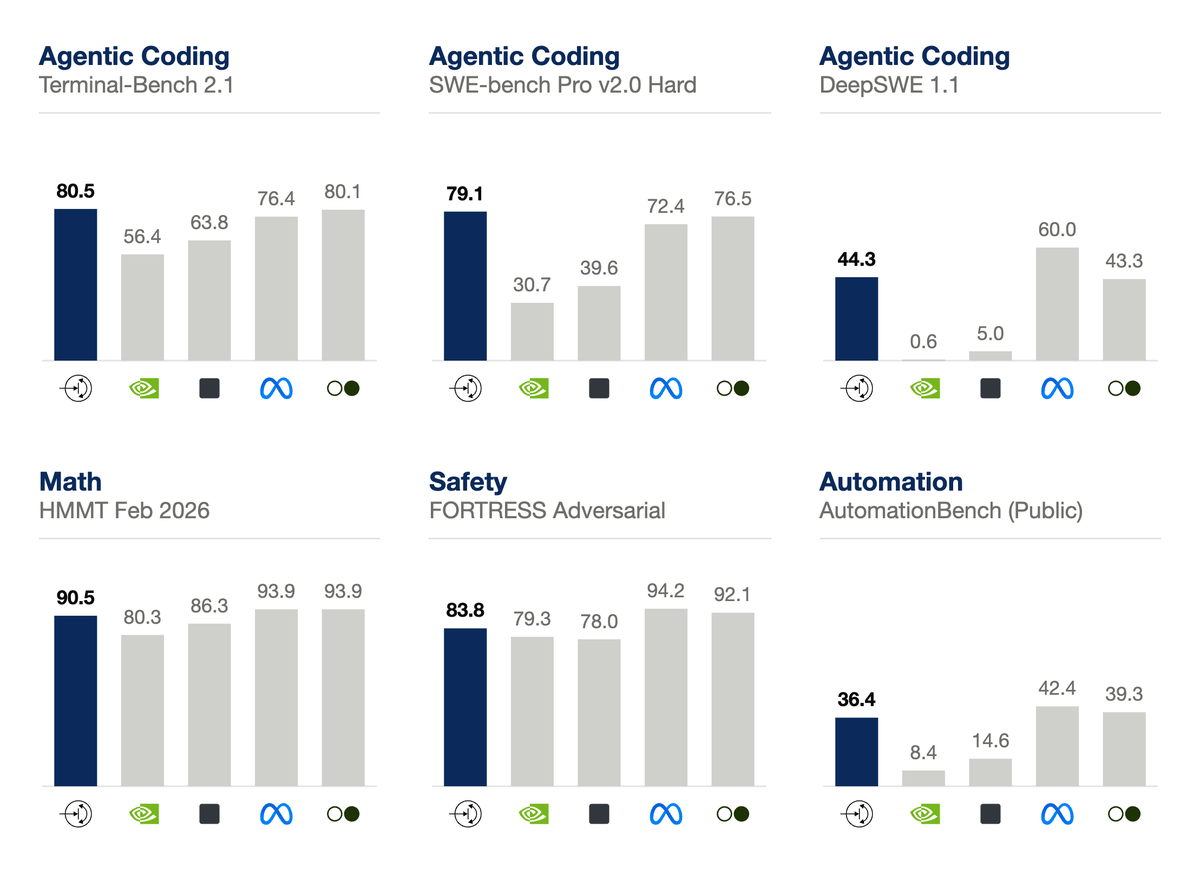
Very excited to launch Ripple-65B Preview, a new state of the art for U.S. open-weight model on agentic coding!
You can run Ripple-65B locally and efficiently on a MacBook Pro or DGX Spark!
Give it a try:
HuggingFace: https://t.co/o0MmMnpi6N
Together AI: https://t.co/ecz2drgKff
GMI Cloud: https://t.co/ajjgAKXRlD
OpenRouter: https://t.co/ltemSvuVg4