An amazing moment at Iso as we close our Series C funding round! We founded Iso on the conviction that AI can transform biology into a programmable science. We are clearly seeing this play out internally with our models’ capabilities translating into new potential medicines for patients. This funding will supercharge our efforts, so we can push even deeper into the hard problems of understanding disease biology, engineering the most exquisite molecules possible, and bringing new drugs to patients who need them. Lots more to come!
We’ve closed our $5 Billion funding round co-led by Greenoaks and Sequoia Capital to build the future of medicine and bioengineering with AI. https://t.co/iUiQQ0QHvY
Really proud of this one! We used teams of Gemini agents to make quantum algorithms for real scientific applications up to 10x cheaper.
These circuits can't be simulated or run yet, so we defined Lean theorems with holes in and the agents had to prove every result.
AI + Bio Data:
We are bringing together Iso’s next-gen AI approach and proprietary drug-design engine (IsoDDE), with @MSDInvents’ rich data sets and deep discovery, development and manufacturing expertise
Today, we enter a strategic research collaboration with @MSDInvents. The collaboration brings together Isomorphic Labs’ world-leading frontier AI capabilities with MSD’s deep discovery, development and manufacturing expertise.
Read more: https://t.co/C91AwXDZRl
Your heart, brain, and immune system share the same DNA sequence. So how can a single-letter change affect disease in some cells, while sparing the rest?
AlphaGenome 2 is our new AI model that zooms in on specific cells to help scientists understand what drives disease. 🧵
Our new paper, and my first since joining Google DeepMind, is on the arXiv today!
Super exciting to see how we can leverage human expertise, Lean and AI to design better quantum algorithms including for full-scale scientific applications.
https://t.co/GpPGPoLuEY
As we launch Gemini 4 Argon, we’re excited to share two standout results accelerating our quantum computing research at Google DeepMind, in collaboration with Google Quantum AI.
To unlock the full impact of AI on human health we need to build both the technology and the biological dataset it will run on. We’ve been developing our AI, our drug design engine (IsoDDE), for the last 5 years. Today, by joining the Virtual Biology Initiative as a founding member, we will be part of a large effort to generate the AI-ready data that will power predictive biology models.
Today, Isomorphic Labs joins the Virtual Biology Initiative (VBI) as a founding member.
We are helping build an open resource for the global research community to accelerate how we understand and treat disease.
Read more here: https://t.co/3FY3MS4HaR
The predictive capabilities from IsoDDE mean that not only can we create scientific hypotheses of new molecules, we can do a lot of predictive validation, so that when we do test in the real world, it has a much higher chance of success. More thoughts in the article here: https://t.co/fwdNoliemf (5/5)
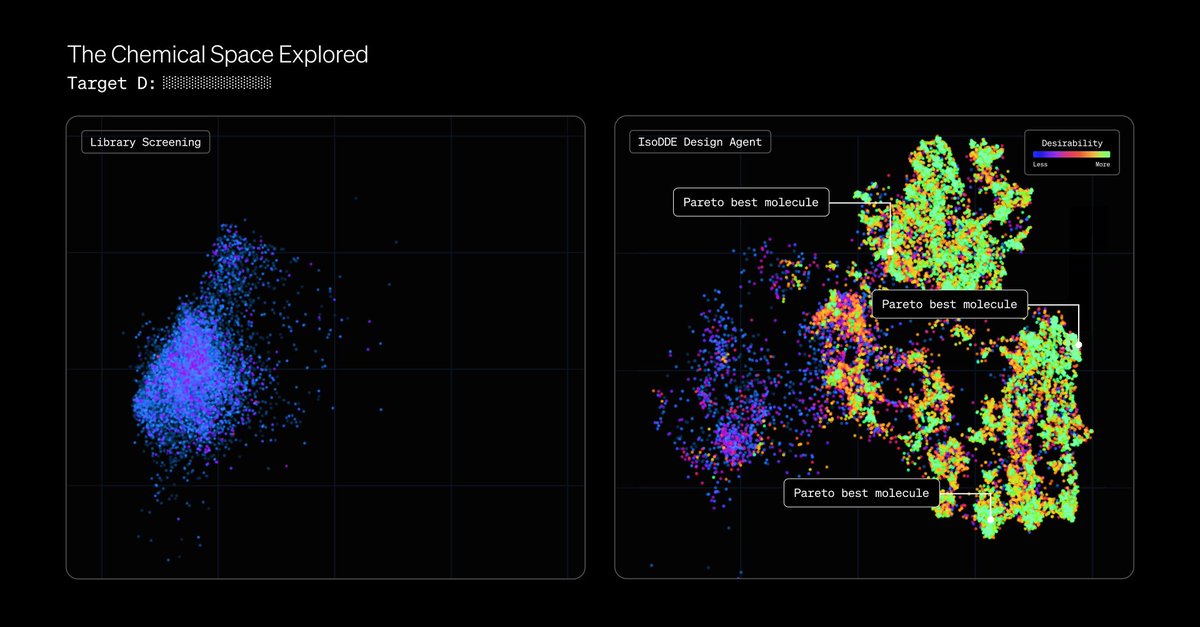
Here’s a visualisation I built of the generative design agent we use every day at Iso. IsoDDE takes the goals of our drug designers and works autonomously to produce a set of pareto best molecules. Throughout the core generative design and optimisation process you can see a visualisation of the agent’s attention (heatmap) as it balances exploration-exploitation across chemical space (here just umap visualised) to find the best molecules (greener = better)
I’ve pulled out only one pareto-best molecule to exemplify this process, but I’ll showcase in a later video how we do this at scale (1/5)
This is one example but we’ve seen this sort of success dozens of times at this point from our engine: unlocking exquisitely engineered molecule designs and proving out unique biological hypotheses in the lab. And pushing hard to show the translation into the clinic to benefit patients. (4/5)
Breakthroughs in frontier science rarely come from a sudden stroke of luck. Every major leap in AI drug design is the product of years of method development, rigorous engineering, and learning from what came before.
Witnessing the rapid advances in deep reinforcement learning and frontier AI capabilities led to a deep conviction: we could apply these same computational principles to other complex fields, like the engineering of new medicines.
That thinking led to the formation of Isomorphic Labs in 2021. Now, five years on, we have compelling evidence that our AI can unlock therapeutics to a wide range of disease classes. We are confident this technology will fundamentally impact how new medicines are created, from early discovery all the way through development.
In this article, I share the massive opportunity we have to transform human health with AI, and offer a look at the real, measurable progress we’re already making today.
https://t.co/fwdNolhGwH
Excited to release AlphaGenome Atlas 🧬 We used AlphaGenome to predict the regulatory impact of all 9B possible SNVs in the human genome. We collaborated with amazing scientists to analyze and apply it, and developed a portal to browse the genome using this new lens 🔬
🌐 Portal: https://t.co/Hq3ZLGXB7M
📖 Blog: https://t.co/cF4TsZkhwj
📄 Preprint: https://t.co/aIhrGELqr8
🧵 1/6
The prediction: 5 years for the industry to realise AI is essential in drug design and development – @maxjaderberg.
While this episode aired a year ago, we’ve been building for almost 5 years already, and have always held the conviction that our AI will redefine how new medicines are made.
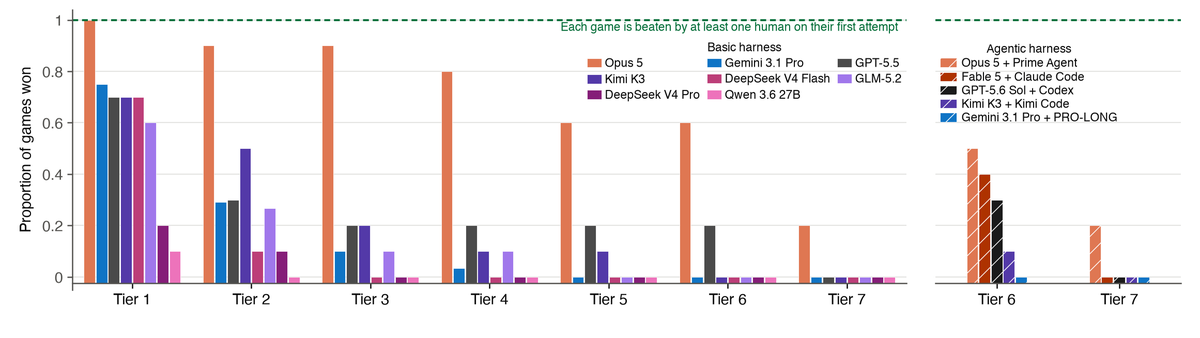
Interesting to see a benchmark for discovery that seems to have a meaningful axis of difficulty (at least wrt frontier models). And given that humans can solve first try.
We find that
1) Opus 5 & Fable marked a real increase in ability on these games, but they still struggle with the hardest tiers of games (Tiers 6 and 7)
2) Agentic harnesses like Prime don’t offer any benefit over a basic (non coding!) harness
3) There’s a large gap between closed-source (Opus 5) and open-source models (Kimi K3) and another big gap to smaller open-source models (Qwen 3.6 27B)
Finally, rule discovery really is the bottleneck in these games: when we give the ground-truth rules in plain language, even the previously weakest models score near perfect.
(4/5)
There's never been a better time to lean into using frontier AI towards the most important problems in the world, and at a place that is so singularly focused on achieving that impact like Isomorphic
I’ve been working towards AGI my whole life, and as we enter this pivotal moment, I’m stepping into a new role as Chair of Google DeepMind & Chief Scientist of Alphabet. This will allow me to focus on long-term strategy, and accelerating scientific breakthroughs, including leaning into my work at Isomorphic to help cure disease.
I’m excited that @koraykv will be stepping up to lead GDM as SVP, alongside @joshwoodward and our exec team. I could not be more excited and confident about our amazing next chapter! 🚀
https://t.co/2WtlIIlTUa