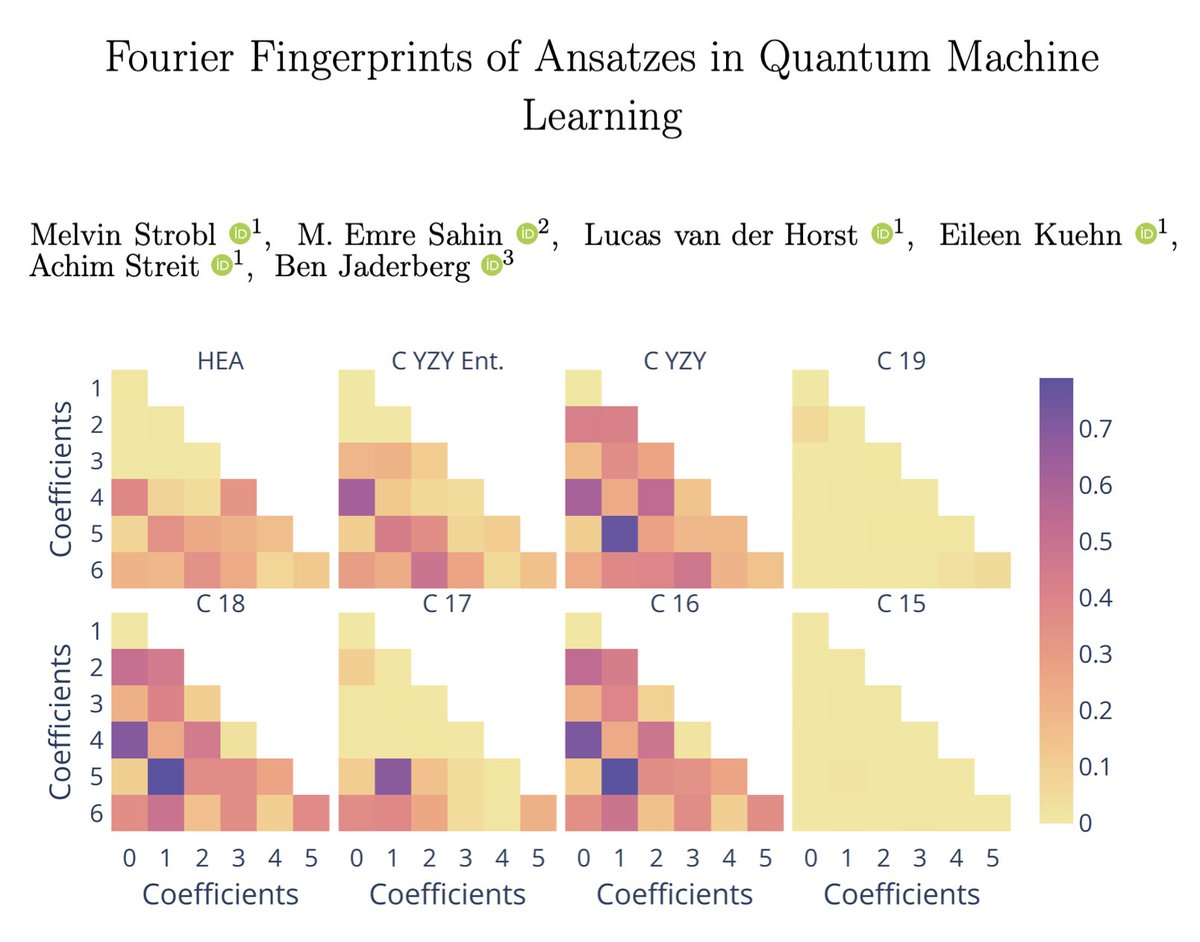
Today on the arXiv (https://t.co/HNiwTuFigS), we show how the Fourier modes of variational QML models are almost always correlated! And the amount of correlation (a) depends on your choice of ansatz (b) can be a strong predictor of how well your model will perform
Excited to share our latest paper and my first since joining IBM https://t.co/oKwVsS6KO9! Here we show how to practically prepare MPS with short-range correlations in shallow, high-fidelity circuits 🧵
Typically only quenches from the Neel state are done on quantum computers, since the ground state prep requires no CX gates. But with AQC-Tensor and ADAPT-AQC, we can study a quench, from near the phase boundary, for the first time on real hardware.
Exciting news! Our research, exploring the connection between trainable encoding gates and the spectral form of #QML models, is now published in PRA!
Key takeaway: for classical data, trainable encoding gates are often cheap and very effective!
https://t.co/MD0aSXPlkj
The UK IBM Quantum team are looking for summer interns! If you are a master's or PhD student and interested in a research placement this summer please see below:
https://t.co/rMg3JWbcQK
⚠️ Deadline is Monday 18th March ⚠️
The Hamiltonian Jungle is now alive! Inspired by the legacy of the Complexity Zoo, Quantum Algorithm Zoo, and Error Correction Zoo, this new website categorises the complexities of local Hamiltonian problems. Explore the jungle at https://t.co/oC7hOIM21y.
@chae_yeun_park Hi @chae_yeun_park - trying to understand your model, is it a coincidence in Fig.1 that it seems nearest-neighbours are most strongly interacting? Or is the normal distribution drawn from dependent on distance between sites or so?
@MvsCerezo Discrete-logarithm problems once again the exception, a similar outcome to those trying to prove > O(poly) speedups in QML for classical problems. Make's you consider whether Shor's is truly a one-off or will also fall one day
On the arXiv today: important new work work from @MvsCerezo and co. And proving once again the value of Twitter threads as a form of scientific communication!
Do you work on variational quantum algorithms or quantum machine learning?
If so, please check our latest article:
https://t.co/1RwVoZxh8e
Here, we ask: Are barren plateau-free models classically simulable? Should we rethink variational QC as a whole?
LONG 🧵 below
1/n
Could a TF model be interpreted as classical pre-proceessing?
Yes, as are many other FM techniques. But θ ultimately ends up as a physical quantum rotation angle. Plus only through the lens of being part of the quantum model lets us understand the impact on model frequencies.
A big thank you to @CERNquantum and the organising committee for an excellent #QTML2023! I learnt a lot, both from the talks and from those of you who gave feedback on our recent work (https://t.co/puZOThe20m). A Q&A 🧵of the questions I received:
Doesn’t the data-re uploading paper include the idea of trainable feature encodings?
Yes! Despite not being what it’s usually cited for, it does suggest to “incorporate data and processing angles in a single step”. See our Section II discussion about this vs our work.